
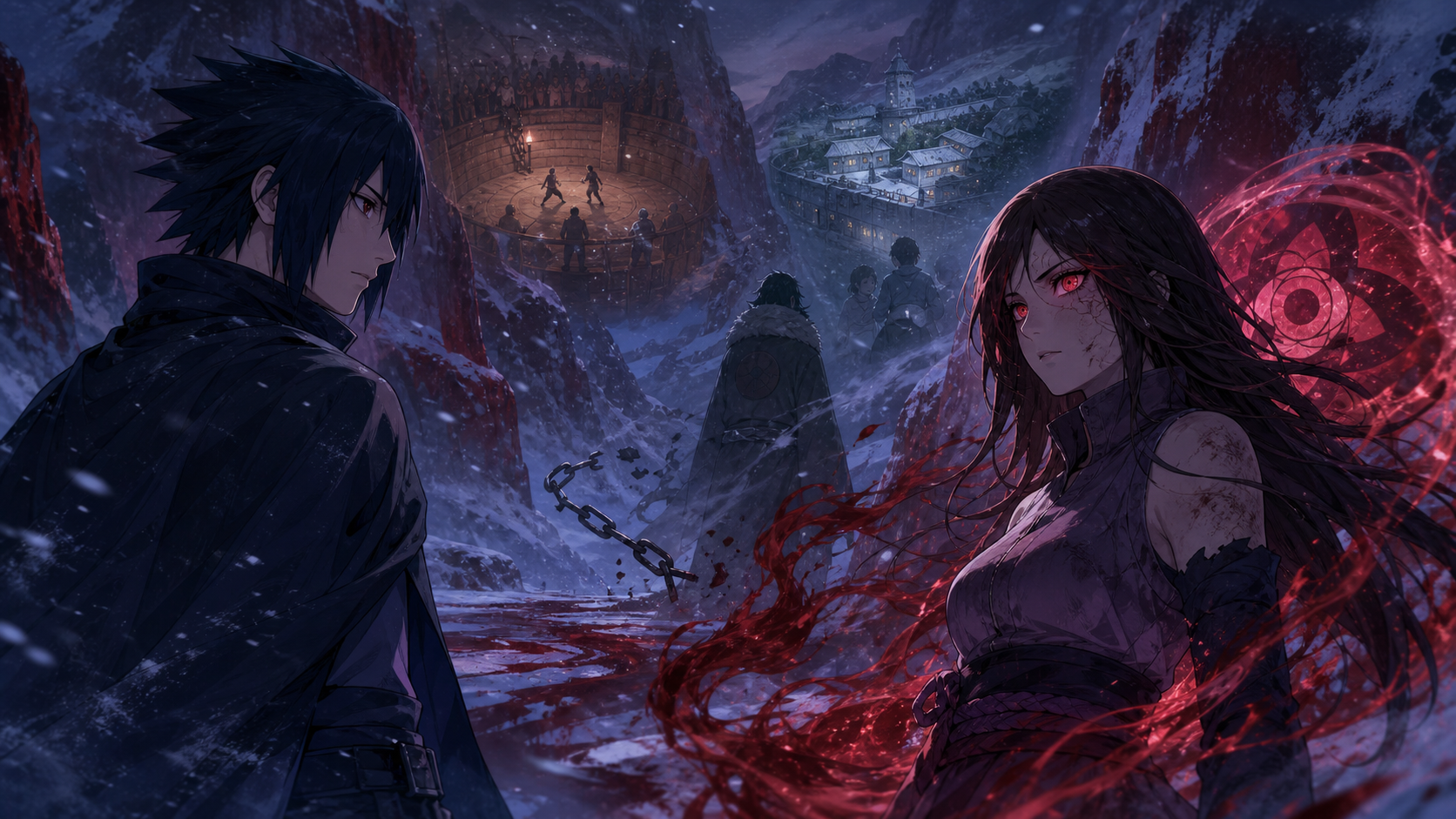
The Ketsuryugan
Chino reveals the bloodline institutions kept trying to own, and Sasuke must reject her collective punishment without pretending her grievance came from nowhere.
Bottom line
“The Ketsuryūgan” reveals that Chino's revenge began inside trafficking, clan exile, and the repeated discovery that every available institution valued her blood before her personhood. Sasuke defeats Fushin's Typhoon Release by reading the storm rather than overpowering wind indefinitely, but a red-eye genjutsu blocks his attempt to inspect Fushin's memories. At the Valley of Hell, Chino stops pretending to be a harmless traveler and shows Sasuke the childhood En Oyashiro controlled: forced training, Coliseum combat, discovery of the Ketsuryugan, friendship with another isolated captive, and escape through the Lightning Group. Their effort to protect the Bamboo Village briefly gave rare abilities a communal purpose. Betrayal by Kirigakure and rejection from the village they helped then transformed that work into revenge against major powers. Chino's grievance is grounded in real abandonment, including an Uchiha-enforced exile, but controlled civilians are not legitimate substitutes for institutions that harmed her. Sasuke understands the temptation because he once made collective punishment his own political language. Recognition gives him a duty to oppose her without denying the history that made opposition necessary.
Episode 487 continues the Sasuke Shinden adaptation
Episode 487 is titled “The Ketsuryugan.” The episode aired in Japan on December 22, 2016, and adapts Chino's history and Sasuke's pursuit from *Sasuke Shinden: Book of Sunrise*.
The anime places her revelation after a direct battle between Sasuke and Fushin.
Sasuke demands Fushin's account
Nowaki's disguise has ended, leaving the leader of the Lightning Group exposed. Sasuke wants the identity of the person controlling exploding humans.
Truth becomes the immediate battlefield objective.
Fushin refuses interrogation
He questions whether Sasuke can force an answer and responds through power. The challenge turns information into something supposedly earned through domination.
Combat protects the person behind him.
Typhoon Release fills the field
Fushin's kekkei genkai produces a sustained windstorm beyond ordinary Wind Release. The environment becomes his weapon rather than a backdrop.
Space itself resists Sasuke's approach.
Chakra blades move inside the gale
Explosive weapons ride unpredictable currents while Sasuke advances. The combination forces him to track both the storm and deliberate projectiles.
Layered danger punishes a simple charge.
Sasuke closes distance carefully
He does not answer every attack with maximum destructive force. Movement and observation let him test where Fushin's control is strongest.
Patience becomes tactical power.
Fushin increases the storm
Wind becomes a full typhoon as Sasuke gets nearer. Escalation reveals both Fushin's rare capacity and his dependence on keeping opponents outside a protected center.
Distance is part of the technique.
Complete Body Susanoo cuts through wind
Sasuke manifests overwhelming defense and uses the armored avatar to divide the storm. The image demonstrates how far his power exceeds ordinary shinobi scales.
Raw force creates access but not final understanding.
Fushin produces an even greater typhoon
The bloodline technique can answer Sasuke's giant form with broader environmental control. Fushin has survived exploitative arenas because his ability can challenge elite opponents.
Captivity cultivated dangerous mastery.
Sasuke dismisses Susanoo deliberately
Maintaining the largest form would continue an expensive contest against moving air. He recognizes that the storm's structure contains a quieter solution.
Adaptation matters more than pride.
The eye of the storm creates an opening
Every typhoon contains a central region of relative calm. Fushin's position inside protection also gives Sasuke a path once he reaches that center.
The defense creates its own vulnerability.
Chidori reaches Fushin
Sasuke crosses the final distance and strikes with precision. The attack ends active resistance without becoming an execution.
Victory preserves the possibility of testimony.
Sasuke tries to read his memories
The Sharingan offers a faster route to the controller than verbal refusal. Such intrusion raises its own consent problem, even when used against someone participating in mass attacks.
Urgency does not make mind access ethically neutral.
A massive red eye blocks him
Ketsuryugan genjutsu appears inside the memory space and overwhelms Sasuke's first attempt. Chino has protected Fushin through a hidden layer of visual power.
The absent partner controls the encounter.
Mangekyo Sharingan breaks the illusion
Sasuke answers the red-eye trap with his evolved dojutsu and regains consciousness. The clash places two persecuted bloodline traditions against each other.
Shared history does not guarantee alliance.
Fushin escapes while Sasuke is unconscious
Tracks in the snow show that the wounded man barely survived the retreat. Chino prioritizes removing him over attacking Sasuke immediately.
Their bond is visible through rescue.
Sasuke follows the Valley of Hell lead
En Oyashiro's directions now offer the strongest route toward the Chinoike survivor. The location carries both historical truth and present strategy.
Geography becomes testimony.
Red water fills the canyon
Iron-rich springs make the valley look blood-soaked even without violence. The canyon visually echoes the dojutsu associated with control over blood.
Natural color became part of the clan's legend.
Steam and isolation define the settlement
The valley offers little vegetation, few resources, and difficult visibility. Exile placed generations inside conditions hostile to ordinary community life.
Removal continued through environmental deprivation.
Sasuke questions whether anyone lived there
The abandoned canyon appears almost impossible as a permanent home. His disbelief measures the severity of the punishment enforced against the Chinoike.
An entire clan was sent beyond public concern.
Chino answers from the valley
She reveals herself as the red-eyed partner and confirms that her people survived there. The cheerful travel persona gives way to the person directing the attacks.
The investigator finally meets the author of the route.
Her small body concealed adult power
Others repeatedly treated Chino as a child because of her size and manner. She used that assumption to move near Sasuke without matching the expected image of a threat.
Underestimation became tactical shelter.
Chino was taken too young to remember family
En Oyashiro removed her from the valley before stable memories of parents or clan life could form. Her origin reached her later as information controlled by the captor.
Identity was separated from lived memory.
En forced her to become a shinobi
Training was not offered as education chosen for her future. Her body and bloodline were developed for use inside his private system.
Ability grew through coercion.
The Ketsuryugan emerged under pressure
Chino discovered a dojutsu capable of powerful genjutsu and manipulation of iron-rich liquid. The ability made her more valuable to the same person denying her freedom.
Talent increased captivity.
The Coliseum became her proving ground
She fought other owned shinobi before wealthy patrons who treated rare techniques as entertainment and investment. Survival required defeating people trapped by the same market.
Oppression converted peers into opponents.
Chino fought Fushin there
Their first meeting happened through forced competition rather than voluntary community. Each recognized formidable power inside another isolated captive.
Conflict became the doorway to solidarity.
Shared loneliness created trust
Both had been valued for bloodline ability and excluded from ordinary belonging. Recognition offered a relationship not defined entirely through ownership.
Connection began with a common wound.
Fushin became an older-brother figure
He protected Chino and followed her after escape. Their bond supplied a chosen family where clan and patron systems had failed.
Care grew inside captivity's aftermath.
Chino learned about the Chinoike clan
The recovered history included exile by the Uchiha and abandonment in the Valley of Hell. Knowledge gave her a people while revealing that the people were already gone.
Belonging arrived as grief.
She and Fushin escaped En
Leaving the collector reclaimed control over movement and ability. Escape did not provide legal identity, economic security, or protection from the networks seeking them.
Freedom began without infrastructure.
Other bloodline users joined them
The group gathered people marginalized or exploited for inherited techniques. Collective survival offered an alternative to patrons and hidden villages.
Shared exclusion became organization.
They formed the Lightning Group
The group stole from criminals and redistributed resources to people neglected by larger powers. Their early actions resembled resistance rather than indiscriminate revenge.
Rare abilities were redirected toward community need.
The Bamboo Village benefited
Chino and Fushin helped a small settlement outside the strongest village systems. Protection created local trust unavailable through formal authority.
Service briefly produced belonging.
The Dark Thunder Group changed the context
Karyu later transformed part of the movement into violent domination, and Sasuke intervened. The line between resistance and abuse fractured within the network.
Good origins do not guarantee good conduct.
Kirigakure betrayed the group
The Mist exploited or attacked them after treating bloodline users as dangerous resources. Historical persecution under the Bloody Mist gives their fear a credible foundation.
State reform had not reached every survivor.
The Bamboo Village refused shelter
Residents feared retaliation and turned away people who had helped them. Their choice is understandable under threat and devastating to those seeking refuge.
Fear can reproduce abandonment without malice.
The group collapsed under pressure
Members died, Karyu left, and Chino and Fushin were reduced to each other. A collective project narrowed into a bond organized around injury and revenge.
Isolation returned with sharper proof.
Chino came to the valley seeking origin
She hoped the place might unlock memory or offer evidence of family beyond En's account. Instead, the hostile canyon felt unfamiliar.
An ancestral home cannot restore stolen childhood.
Nothing triggers personal memory
Chino confronts the difference between inherited history and lived experience. She belongs to the clan without remembering life among them.
Identity does not require nostalgia.
Kirigakure shinobi attack there
Pursuers turn the valley into another battlefield before Chino can process loss. State force again reaches people who sought refuge beyond formal borders.
Violence interrupts mourning.
Chino makes one attacker explode
The Ketsuryugan manipulates blood after contact, converting a living shinobi into the technique later used across villages. The first detonation crosses a moral threshold.
Defense becomes a template for mass coercion.
She vows revenge against the hidden villages
Chino generalizes responsibility from the institutions and fighters who harmed her toward broad populations. Collective punishment repeats the logic used against the Chinoike.
Victimhood does not make repetition just.
Sasuke recognizes his former path
He once planned to destroy Konoha for the leadership's role in the Uchiha massacre and later sought rule through universal fear. Chino's reasoning echoes choices he understands from inside.
Recognition removes easy moral superiority.
Understanding still requires opposition
Sasuke can validate exile, trafficking, betrayal, and abandonment without allowing controlled civilians to absorb consequence. Empathy changes how he stops Chino, not whether he must.
Solidarity needs a boundary against new victims.
The Ketsuryugan is not inherently evil
The dojutsu can create genjutsu and manipulate iron-rich fluid, but technique does not choose purpose. Chino's history shaped its use toward coercive revenge.
Bloodline power should not define moral identity.
The Sharingan comparison remains incomplete
Both clans were feared for visual abilities and entangled in political violence. Their histories differ in agents, chronology, internal conflict, and institutional response.
Parallel suffering should preserve specificity.
Chino’s grievance has institutional addresses
The noble household that demanded collective punishment, the Uchiha who enforced exile, Yugakure officials who abandoned the valley, En Oyashiro’s trafficking network, Coliseum patrons, Kirigakure forces, and the Bamboo Village residents who withdrew refuge all occupy different places in her history. Naming those places matters because revenge becomes indiscriminate when responsibility is allowed to blur into everybody.
Chino does not need to pretend the system was kind in order to stop controlling civilians. She needs a form of justice precise enough to preserve the record, identify decision-makers, protect survivors, dismantle markets, and refuse biological guilt. The same specificity Sasuke needed around Konoha is what her pain now demands.
The Ketsuryugan was never the moral problem
Her eyes can control blood and perception, but ability does not arrive with an ethical program. The institutions surrounding Chino decide that rare power makes her collectible, useful, dangerous, or disposable before anyone asks what she wants. Every attempt to own the bloodline helps create the conditions under which she later uses it to own other bodies.
That history explains the repetition without excusing it. If Chino’s liberation depends on stealing agency, then the Ketsuryugan has become an instrument of the same worldview she hates. Freedom cannot mean becoming the person with the strongest claim on somebody else.
En Oyashiro stole childhood and controlled history
En did not simply train a talented child. He removed Chino from origin, developed her ability for a private market, placed her in forced combat, and became a primary source for information about the family she could not remember. Captivity gave him control over body, labor, and narrative at once.
Escaping the Coliseum reclaimed movement, but it did not return records, relatives, money, safety, or an uncontested identity. Chino had to build belonging from another captive’s recognition. Fushin’s loyalty therefore carries genuine care and the survival habits of a world that offered no trustworthy institution.
The Bamboo Village betrayal is complicated
Residents benefited from the Lightning Group and then refused shelter when association became dangerous. Chino experiences that choice as proof that care lasts only while marginalized people remain useful. The hurt is real. Villagers may also have feared collective retaliation from forces they could not survive.
Understanding their fear does not erase the abandonment. Naming the abandonment does not make every resident equivalent to a government ordering exile. Power, capacity, benefit, and risk all matter. Justice needs more detail than revenge allows.
Sasuke must oppose Chino without claiming innocence
He cannot stand in the Valley of Hell as though the Uchiha name has no connection to the place. He also did not personally expel her ancestors. The responsible position is neither inherited confession nor defensive denial. It is acknowledgment, listening, intervention against present harm, and a willingness to help uncover what official histories hid.
Sasuke’s past lets him recognize how collective punishment feels righteous from inside grief. That recognition gives him no superiority. It gives him a duty to demonstrate another route: stop the attack, keep Chino alive, protect the controlled people, and refuse to let either clan’s dead authorize new victims.
Fushin is family and still accountable
He protects Chino because their bond formed where ownership had replaced ordinary kinship. His rescue after the Coliseum and continued loyalty show real devotion. He also recruits decoys, guides Sasuke through deception, and helps sustain a campaign built on coerced bodies.
Love explains why he stays. It does not turn participation harmless. A future for either survivor requires the possibility that chosen family can challenge harm rather than proving loyalty by helping it continue.
Chino’s story also exposes the danger of asking marginalized people to prove goodness before receiving rights. The Chinoike were exiled as a group because power made others afraid. Chino was trafficked because the same power made her valuable. Later, the Lightning Group earned temporary belonging by protecting a village, only to discover that usefulness could not guarantee shelter when danger arrived. Rights that depend on service are not rights. A community should not have to save outsiders, win battles, or remain perfectly nonthreatening before safety becomes available. That principle does not remove accountability for Chino’s campaign. It clarifies what accountability should protect. She can answer for controlling bodies without surrendering the truth that her clan deserved home, due process, and freedom long before she chose revenge. Survivors of the exploding-human attacks deserve care without being turned into evidence that every Chinoike was dangerous. Fushin deserves judgment based on his conduct rather than his bloodline. Sasuke deserves the same precision around the Uchiha name. The episode becomes strongest when justice refuses every collective shortcut at once. No clan inherits criminal guilt. No victim inherits moral purity. No village earns innocence by hiding records. No wounded person gains ownership of another body. Those boundaries leave room for grief, anger, testimony, consequence, restitution, and changed conduct without requiring a clean hero or disposable villain. The Valley of Hell should become a documented crime scene and memorial, not a myth used to explain why violence was inevitable. History can warn the future only when people are allowed to know who made decisions, who benefited, who resisted, and who was forced to carry the cost. That public record would give Chino something revenge cannot: recognition that does not require new victims to make an old injury visible to the world again.
Final verdict
“The Ketsuryūgan” works because Chino's reveal does not reduce her to a surprise villain. Her route toward revenge begins with collective exile, environmental confinement, abduction, forced training, bloodline trafficking, Coliseum combat, state betrayal, and denial of refuge. Fushin becomes family because both were denied relationships outside ownership. Their Lightning Group even tried to use rare abilities for neglected communities before fear and violence broke that work apart. None of those facts licenses the exploding-human campaign. Chino turns civilians and former shinobi into unwilling bombs, repeating the collective punishment once imposed on her clan. Sasuke is the necessary opponent because he recognizes the logic rather than standing above the logic. He once tried to make Konoha pay as a whole for crimes committed through leadership and secrecy. Defeating Fushin's typhoon shows his tactical growth; confronting Chino without erasing her history will show whether atonement has changed his politics.
Sources and watch notes
- Naruto Official episode guide for the official series record.
- Crunchyroll for the licensed episode route where available.
What I am carrying forward
Episode 488 must decide what happens to the last Chinoike survivor after defeat. I am carrying forward En’s stolen childhood, Fushin’s loyal participation, the Bamboo Village’s fearful refusal, Uchiha enforcement, the Ketsuryugan’s coerced development, and Sasuke’s obligation to offer accountability without annihilation.