
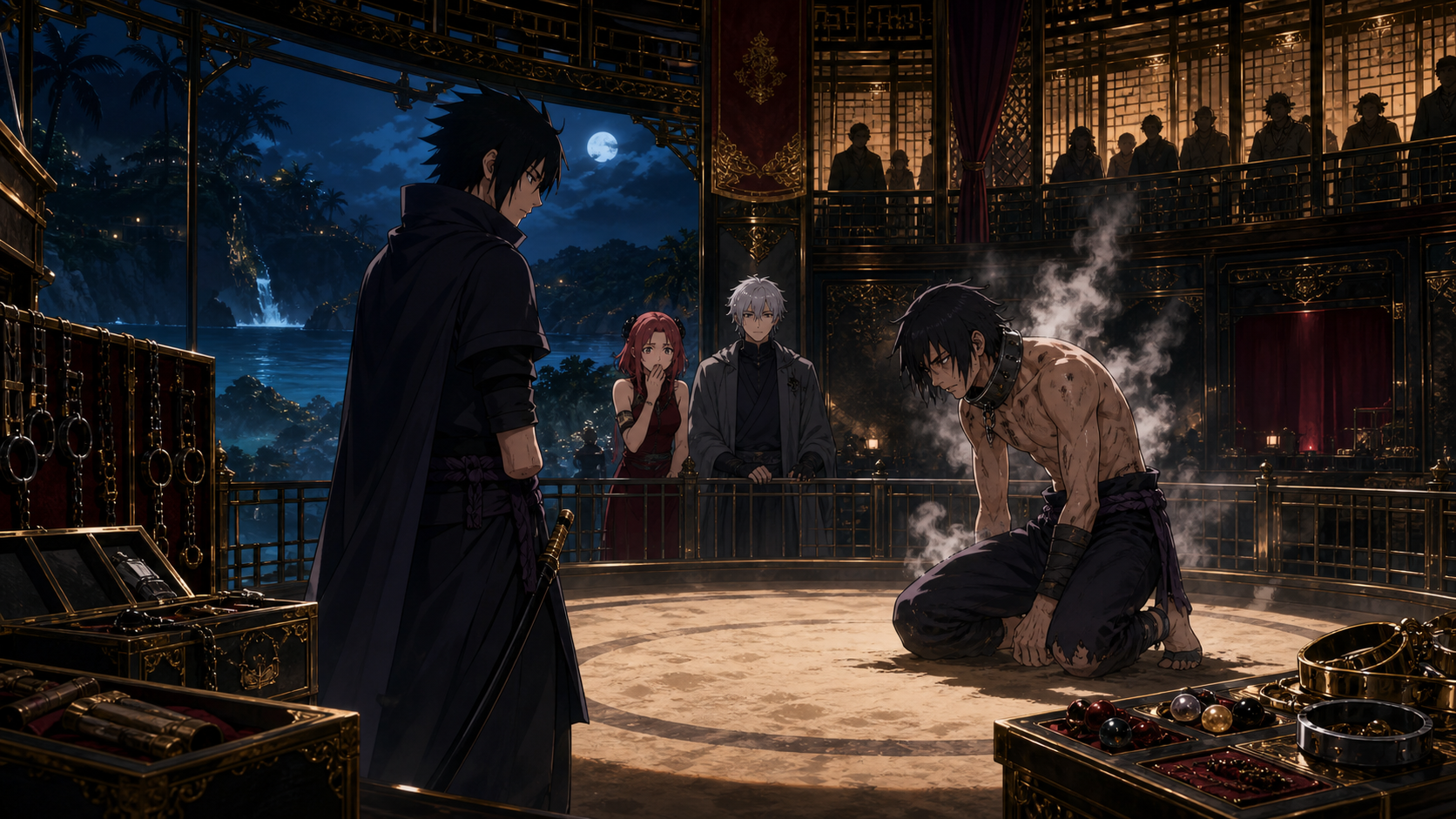
Coliseum
Wealthy patrons turn bloodline users into property and forced combat into entertainment, making neutral observation another form of participation.
Bottom line
“Coliseum” asks what shinobi peace means when wealthy patrons still buy bloodline users and gamble on forced combat. Sasuke reports the exploding-human threat to Kakashi but continues the investigation with Chino and Nowaki, following Fushin's name toward Orochimaru and the arms dealer En Oyashiro. Every guide on that route embodies unfinished accountability. Orochimaru remains under surveillance yet travels, trades information, and treats people as collections with alarming freedom. Yamato monitors him without receiving freedom from the assignment. The Coliseum converts kekkei genkai into private property and combat into entertainment for people insulated from consequence. Orochimaru enters Sasuke without consent to lure Oyashiro, placing him opposite the Boil Release user Futsu. The episode ends when another controlled person begins transforming among the patrons, proving that wealth cannot purchase distance from the violence sustaining wealth. Sasuke's challenge is larger than identifying Fushin. Atonement requires deciding whether gathering information through an abusive institution makes him another spectator, or whether his power obligates him to disrupt the market exploiting vulnerable shinobi.
Episode 485 continues the Sasuke Shinden adaptation
Episode 485 is titled “Coliseum.” The episode aired in Japan on December 8, 2016, and adapts material from Shin Towada's *Sasuke Shinden: Book of Sunrise*.
The anime changes portions of the novel's Coliseum sequence while preserving the exploitation behind the setting.
Sasuke reports to Kakashi
He sends information about the exploding humans rather than disappearing into a private investigation without accountability. Communication keeps Konoha prepared while he follows the external trail.
Independence no longer means total isolation.
He chooses not to return immediately
The Bamboo Village has evidence connected to the same technique, and Fushin's name offers a lead. Returning home would delay investigation at the source.
Distance can support responsibility.
Kakashi receives a reasoned decision
Sasuke does not ask permission through every step, but he provides enough context for the Hokage to understand his course. Their postwar relationship depends on judgment rather than obedience alone.
Trust includes transparent disagreement.
Funerals follow the first attack
People controlled as bombs cannot all be saved. Mourning interrupts the procedural momentum of the case.
Investigation begins beside irreversible loss.
The dead remain victims
Their forced attacks should not define their final public identity. Tadaichi and the others were made into weapons through stolen agency.
Memory must resist the controller's authorship.
Chino and Nowaki offer help
The wandering pair know the region and claim an interest in stopping the threat. Their assistance looks useful because Sasuke lacks local relationships.
Cooperation also gives hidden motives access.
Sasuke initially prefers solitude
His journey has been structured around personal reflection and reduced dependence. Traveling with new companions risks distraction and betrayal.
Atonement still carries habits of isolation.
He remembers Itachi
Thoughts of his brother complicate the refusal. Itachi's secrecy showed how solitary protection can harm both protector and protected.
Memory nudges Sasuke toward shared work.
Sasuke allows them to accompany him
Acceptance is restrained rather than warm, but the choice recognizes that local knowledge may matter as much as superior power. A team forms without formal village authority.
Cooperation begins through practical consent.
Chino asks about Konoha
Her questions test Sasuke's relationship to the village that sanctioned the Uchiha massacre and later pardoned him. Home cannot be described through uncomplicated loyalty.
The inquiry reaches an unresolved identity.
She asks whether he will restore the Uchiha clan
The question treats clan survival as a duty attached to the last known member. Sasuke has spent years carrying expectations created by dead relatives and political history.
Reproduction is not a public obligation.
Sasuke declines a complete answer
Silence protects private choices but also keeps companions from understanding his intentions. He is learning cooperation without suddenly becoming emotionally transparent.
Growth can remain gradual.
The group reaches Orochimaru's hideout
The location connects postwar investigation to one of the era's most notorious human experimenters. Knowledge remains concentrated in people who acquired information through abuse.
Useful intelligence carries a moral cost.
Yamato intercepts them
He monitors Orochimaru under Konoha's authority and verifies Sasuke's purpose. The assignment extends an old relationship in which Orochimaru experimented on Yamato as a child.
Surveillance places a survivor beside his abuser indefinitely.
Yamato deserves more than permanent duty
Keeping Orochimaru watched may protect the public, but assigning that burden to one former test subject raises serious questions about care and consent.
Security work can reproduce personal captivity.
Orochimaru receives Sasuke casually
Their old mentor-student relationship included grooming, bodily possession plans, coercive training, and murder. Postwar conversation cannot make that history ordinary.
Familiarity is not rehabilitation.
Chino recognizes the danger
Her surprise reflects Orochimaru's reputation beyond Konoha. Smaller communities know the consequences associated with his research and networks.
Peace has not erased public fear.
Karin reacts to Chino's closeness
Jealousy turns the meeting into comedy and recenters Sasuke as romantic territory. The exchange risks shrinking two capable women into rivalry around a man.
Possessiveness is not characterization enough.
Suigetsu provokes the argument
He enjoys escalating tension without bearing the emotional consequence. Team Taka's old dynamics return quickly inside the hideout.
Familiar banter can conceal unresolved harm.
Jugo remains comparatively quiet
His restraint contrasts with the surrounding noise and recalls how Sasuke once gave him a structure for managing violent transformations. That bond was practical and personal.
Team history survives separation.
Orochimaru identifies Fushin as a bloodline user
The name connects to a former guard under En Oyashiro, a dealer who collects shinobi with rare inherited abilities. Information turns the case toward a commercial network.
Bloodline persecution has become private inventory.
En Oyashiro trades in people and weapons
His business treats kekkei genkai as assets whose owners can be bought, sold, and deployed. The market reproduces village weaponization through private wealth.
Peace leaves profitable violence intact.
Orochimaru knows how to lure him
Oyashiro appears when a sufficiently rare or powerful fighter attracts interest. Sasuke's surviving Uchiha blood and paired dojutsu make him irresistible bait.
Identity becomes market value again.
Sasuke travels with Orochimaru
The arrangement is efficient because the former enemy knows illicit networks. Efficiency does not establish moral trust.
Temporary cooperation needs visible limits.
The boat conversation raises accountability
Sasuke asks why Orochimaru can move so freely after crimes against villages, children, prisoners, and test subjects. The question names a contradiction the postwar order has not resolved.
Peace has produced selective leniency.
Orochimaru compares himself with Sasuke and Kabuto
All three committed grave violence and later helped end the war. He argues that their unusual abilities make continued observation more useful than execution.
Utility should not decide justice alone.
The comparison has real similarities
Sasuke, Kabuto, and Orochimaru each pursued power through harm before changing course during the war. Institutions do need frameworks for reintegration after mass conflict.
Permanent exclusion can block repair.
The differences remain substantial
Orochimaru conducted systematic experiments, cultivated disposable subordinates, attacked Konoha, and repeatedly pursued immortality through stolen bodies. A shared label cannot flatten scale, motive, or response.
Accountability requires individual records.
Surveillance is not the same as justice
Yamato's presence may deter immediate crime, yet the arrangement offers little public truth, victim participation, restitution, or transparent legal reasoning.
Containment leaves moral questions open.
The Coliseum sits on a private island
Distance from ordinary law allows wealthy patrons to create their own rules. Luxury insulates spectators while fighters absorb bodily risk.
Geography protects exploitation.
Rich owners enter shinobi in combat
Participants with valuable techniques fight as property attached to patrons. Winning can transfer ownership of the defeated fighter.
The system treats people as wagers.
Kekkei genkai become collectibles
Abilities once triggered clan persecution now attract buyers seeking rarity and status. Admiration and dehumanization coexist easily when power is separated from personhood.
Collection is another form of captivity.
Spectators call violence entertainment
The audience enjoys danger because wealth keeps personal bodies outside the ring. Applause converts another person's coercion into leisure.
Distance makes cruelty socially elegant.
Chino challenges Sasuke to respond
She questions whether he can watch controlled fighters without helping. The challenge is pointed because he possesses enough power to alter the situation.
Capacity creates an ethical demand.
Sasuke is focused on Fushin
The exploding-human case threatens Konoha and other villages, giving him a legitimate urgent goal. Narrow focus can still turn surrounding abuse into background scenery.
Mission logic risks repeating old blindness.
Orochimaru secretly enters Sasuke
He registers Sasuke as his fighter without informed agreement. The maneuver uses Sasuke's body and reputation as bait, repeating Orochimaru's old disregard for consent in a smaller form.
Manipulation remains his default tool.
En Oyashiro takes the bait
The arms dealer presents Futsu once Sasuke's participation becomes known. Sasuke's rarity draws the hidden collector into view.
The trap succeeds by reproducing market desire.
The announcer turns history into promotion
Sasuke is introduced through the Uchiha name, the Five Kage Summit attack, and notoriety. Trauma and crime become selling points for a wealthy audience.
Reputation is packaged as spectacle.
Futsu uses Boil Release
His inherited technique creates dangerous heat and establishes him as more than an anonymous captive. The power belongs to a person the Coliseum describes through ownership.
Ability does not cancel exploitation.
Sasuke enters without enthusiasm
He accepts the immediate fight to reach Oyashiro but does not share the crowd's excitement. Restraint can prevent death while preserving the investigation.
Participation still risks legitimizing the arena.
His cloak is damaged
Futsu's opening attack reaches him enough to demonstrate credible danger. Sasuke can win, but effortless domination would not answer the institution around the match.
Power imbalance is not the only moral issue.
Another patron begins to transform
A person falls from the private seating with red eyes and a body approaching detonation. The exploding-human campaign has entered the space of those who purchase other people's risk.
Violence crosses the spectator boundary.
The attack exposes the arena's fragility
Guards and wealth cannot control a technique hidden inside human bodies. The same patrons who treated fighters as assets now face being used as delivery systems themselves.
Privilege does not guarantee immunity.
Controlled patrons remain victims too
Their participation in an abusive market does not make forced transformation acceptable. Accountability for exploitation and rescue from coercion can both be necessary.
Justice should not imitate revenge.
Sasuke must choose beyond the scheduled match
Continuing the contest would preserve the trap while civilians detonate nearby. Responding to the emergency tests whether information matters more than immediate life.
Atonement appears through priorities under pressure.
The episode links public and private militaries
Hidden villages trained bloodline users for national conflict, while Oyashiro purchases them for private competition. Both systems value bodies through deployable power.
Postwar reform must reach ownership itself.
The Coliseum is a market before it is an arena
The fights are the visible product. Ownership is the institution making them possible. Patrons buy people with rare bloodlines, wager their bodies, and treat transfer after defeat as an ordinary term of entertainment. The crowd can admire skill while refusing to recognize the skilled person as fully human. That combination is not contradiction. It is how exploitation becomes fashionable.
Calling the fighters competitors hides coercion. A meaningful contest requires the ability to refuse, leave, negotiate conditions, receive care, and keep the benefit of one’s labor. The Coliseum offers spectacle without those protections. It packages captivity as merit and lets wealth call possession patronage.
Spectatorship is participation
People in the seats may never strike a captive directly, but their money sustains the ring. Their excitement rewards owners. Their wagers convert injury into profit. Their social presence tells every fighter that cruelty is respectable when dressed in private-island luxury. Distance from the floor does not create neutrality.
The exploding human falling among them destroys that comfortable boundary. Patrons suddenly experience the terror of a body turned into somebody else’s weapon. They remain victims of coercion in that moment, even if they helped finance coercion before it. Rescue and accountability can occupy the same response.
Sasuke cannot investigate as though the arena is scenery
Fushin is connected to a campaign killing people across regions, so Sasuke has a legitimate reason to follow the lead quickly. Urgency still does not make the Coliseum morally invisible. His power changes the question. Someone with the capacity to interrupt trafficking cannot claim the role of detached observer while gathering information from the traffickers.
Atonement lives in those inconvenient collisions. Sasuke cannot repair every injustice he encounters, but he can refuse to become promotional bait, protect captive fighters, document owners, and share evidence with authorities capable of dismantling the network. The mission expands because real lives refuse to stay inside its original boundary.
Orochimaru’s usefulness remains dangerous
Orochimaru knows the market because exploitation has always been part of his world. That access makes him useful and makes every shortcut ethically unstable. Registering Sasuke without consent repeats the same assumption behind the Coliseum: another person’s body and reputation may be deployed if the plan seems productive.
Postwar surveillance has not taught him respect. It has limited some behavior while preserving habits of manipulation. Kakashi’s government needs more than Yamato watching from nearby. It needs transparent conditions, enforceable restrictions, survivor input, and a record that does not allow rare expertise to become immunity.
Yamato should not be assigned permanent proximity
Yamato survived Orochimaru’s experiments as a child. Making him the constant monitor ties public safety to the survivor’s ongoing exposure to the person who harmed him. He may accept the duty, but consent inside a military chain of command deserves scrutiny. A village with many capable shinobi can distribute surveillance without making one victim carry it indefinitely.
This is another place where utility threatens justice. Yamato’s Wood Release and personal knowledge make him effective. Effectiveness does not answer whether the assignment supports his recovery, limits his future, or substitutes one person’s endurance for institutional investment.
Bloodline ability belongs to the person
Kekkei genkai have been treated as clan property, village weapons, research material, and now luxury collectibles. Every system changes the owner while preserving the assumption that ability creates a claim on the body carrying it. The Coliseum makes that logic impossible to romanticize.
Peace requires a different starting point. Futsu’s Boil Release is his. Chino’s power is hers. Sasuke’s eyes do not make him bait available for Orochimaru’s plan. Talent can create responsibility when used, but it never turns a person into public or private inventory.
Chino’s challenge to Sasuke deserves attention too. She is not simply the cheerful companion asking the hero to notice suffering. She understands what bloodline persecution and private ownership do because her own history sits inside that economy. Her questions push against Sasuke’s tendency to narrow responsibility to the target directly in front of him. He knows what it means for a clan name and rare eyes to become public claims on a body, yet his power gives him choices most captive fighters do not have. Solidarity requires more than recognizing similarity. It requires using that freedom without speaking over the people still trapped. Sasuke can listen to fighters, learn what leaving would cost them, and avoid replacing one owner with a rescue plan designed entirely by outsiders. Liberation needs material support after the gates open: safe housing, medical care, identity protection, income, legal status, and protection from patrons seeking to recover valuable property. Otherwise freedom becomes another dramatic moment followed by abandonment. The great villages helped create demand for bloodline weapons through generations of military competition. They cannot treat the Coliseum as one criminal island detached from official history. Buyers learned that rare bodies are strategic assets because hidden villages modeled that logic first. Accountability therefore has to travel upward as well as outward, reaching patrons, brokers, governments, clans, and researchers who normalized ownership under different names. The episode does not resolve that structure yet. It makes neutrality impossible. Once Sasuke sees the ring, every next choice tells us whether atonement means following one criminal or confronting the world that keeps producing buyers. A peace that leaves those buyers connected and entertained is only a pause in public warfare. Private violence has inherited the same bodies, prejudices, and profit, waiting beyond the village gates for anyone able to purchase access.
Final verdict
“Coliseum” turns Sasuke's investigation into a confrontation with the economy surviving underneath shinobi warfare. He reports to Kakashi, accepts Chino and Nowaki as companions, and seeks information from Orochimaru without pretending the former mentor's freedom is ethically settled. Yamato's permanent surveillance assignment, Karin's unresolved attachment, and Orochimaru's casual access to illicit markets all show how much the war's ending left untouched. The private island makes that failure visible. Wealthy patrons own bloodline users, wager bodies, and applaud forced combat while calling the arrangement entertainment. Orochimaru manipulates Sasuke into the ring to attract En Oyashiro, proving that even a useful plan can repeat the consent violations surrounding the market. When an exploding human falls among the patrons, the boundary between spectator and weapon collapses. Sasuke can no longer gather information as though the institution around him were neutral. Atonement demands that he save lives, expose the controller, and recognize the fighters whose captivity the urgent mission almost made invisible.
Sources and watch notes
- Naruto Official episode guide for the official series record.
- Crunchyroll for the licensed episode route where available.
What I am carrying forward
Episode 486 moves toward Fushin. I am carrying forward the captive fighters, En Oyashiro’s ownership network, Orochimaru’s consent violation, Yamato’s coerced proximity, the controlled patron, and Sasuke’s responsibility to widen the mission when exploitation becomes visible. Information cannot be purchased with other people’s personhood.