
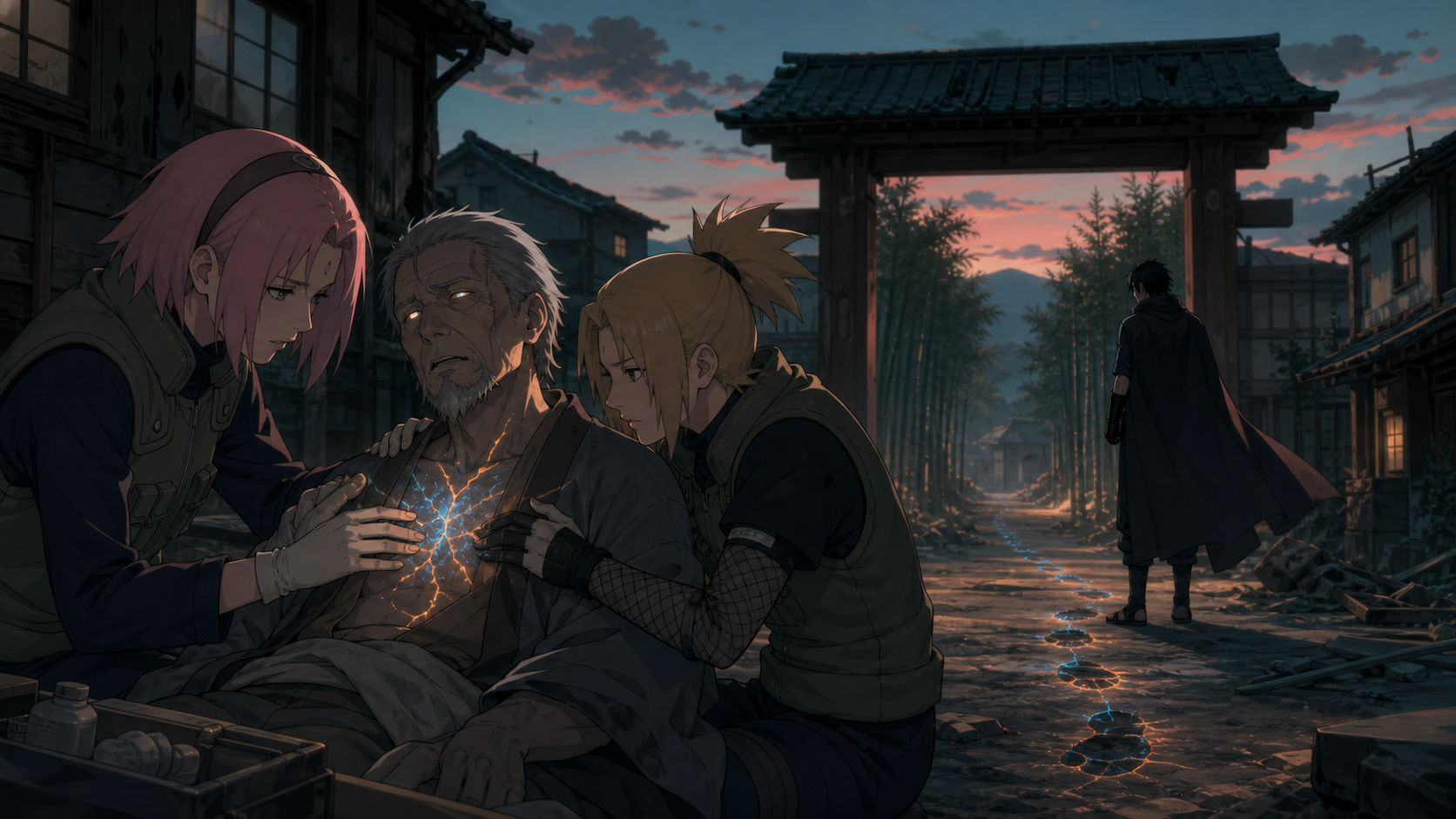
The Exploding Human
Postwar justice begins when medical judgment, personal memory and restraint stop a violent appearance from erasing the person trapped inside it.
Bottom line
“The Exploding Human” begins Sasuke's postwar investigation by turning bodies into evidence of a peace that has not reached everyone. Tadaichi, a retired ANBU member living as a merchant, is identified, controlled through an unknown visual jutsu, and sent back to Konoha as a weapon. Sakura immediately recognizes that the attackers are victims rather than willing enemies, while Ino's personal knowledge of Tadaichi prevents his violent behavior from replacing the life he lived before coercion. Sasuke receives Kakashi's message during his atonement journey but finds related violence in the Bamboo Village before returning home. His choice to investigate from outside Konoha makes sense because the threat crosses borders and because his visual power may identify the controller. The episode's real concern is not explosive spectacle. A hidden actor can convert former shinobi into disposable delivery systems, and postwar institutions are still prepared to read damaged people as security problems first. Sakura's medical judgment, Ino's memory, and Sasuke's restraint offer the necessary correction: stop the attack without erasing the person trapped inside the attack.
Episode 484 adapts Sasuke Shinden: Book of Sunrise
Episode 484 is titled “The Exploding Human.” The episode aired in Japan on December 1, 2016, and begins a five-episode adaptation of Shin Towada's novel *Sasuke Shinden: Book of Sunrise*.
The anime revises and compresses parts of the novel while preserving the postwar investigation.
The story moves into the Blank Period
Several years have passed since Naruto and Sasuke ended the war. Reconstruction has advanced, but peace remains uneven across villages and smaller countries.
Time has changed conditions without ending grievance.
Tadaichi leaves a hot spring
The opening follows an apparently ordinary traveler finishing a routine visit. His life after shinobi service includes commerce rather than active combat.
Retirement should provide distance from weaponization.
A stranger confirms his identity
The figure asks whether Tadaichi belongs to Konoha and knows enough to check his ANBU history. Surveillance has reached beyond his current occupation.
Past service makes him targetable.
Tadaichi identifies himself as a merchant
He denies being an active shinobi because his present life no longer centers missions. The distinction matters ethically even if old training remains part of his history.
A person is not permanently owned by military labor.
The attacker invokes his ANBU record
Secret service once made Tadaichi useful to Konoha and now makes him useful to an enemy. Hidden institutional histories create vulnerabilities long after missions end.
Secrecy does not contain consequence forever.
An unknown dojutsu takes control
The attack bypasses consent and redirects Tadaichi's body toward another purpose. Visual power becomes a mechanism of coercion rather than perception alone.
The victim remains present beneath forced conduct.
A second conspirator offers congratulations
The exchange confirms planning rather than spontaneous revenge. Someone is testing or advancing a campaign built through controlled human beings.
Organization hides behind individual bodies.
The promise to stain everything red establishes vengeance
Blood imagery announces a grievance connected to inherited violence. The speaker wants suffering to become visible through bodies rather than testimony.
Revenge seeks an audience through harm.
Naruto and Sakura visit Kakashi
The former Team 7 members enter the Hokage's office as trusted adults rather than students waiting for assignments. Their familiarity remains while institutional roles have changed.
Friendship now operates beside governance.
Sakura asks about missing shinobi
Her concern begins before the gate attack, showing awareness of a pattern rather than reaction to spectacle alone. Missing people deserve investigation before they return as threats.
Absence is already evidence.
Kakashi knows about the disappearances
The Sixth Hokage has reports but no confirmed mechanism or perpetrator. Administrative knowledge reaches a limit when attacks operate through concealed identity.
Office does not equal omniscience.
An explosion strikes near the village gate
Violence interrupts discussion and brings the missing-person problem directly into Konoha's defensive boundary. The gate can stop travelers more easily than controlled citizens.
Security faces an enemy wearing familiar bodies.
Five people attack the guards
Their coordinated arrival resembles an assault, but behavior alone cannot establish willing participation. Immediate defense remains necessary while intent stays uncertain.
Protection and investigation must happen together.
Naruto and Sakura respond first
Both move toward danger without waiting for a complete briefing. Naruto provides power, while Sakura brings medical perception essential to understanding the transformation.
Different expertise prevents a narrow response.
Ino, Shikamaru, and Choji join them
Team 10 arrives with sensory, strategic, and combat ability. The attack requires coordination more than overwhelming force.
Postwar defense depends on trusted teams.
Ino recognizes Tadaichi
He regularly visited Yamanaka Flowers and existed in her life as a customer rather than an ANBU record. Personal memory contradicts the image of a committed attacker.
Civilian relationships preserve identity.
She refuses the simplest explanation
Ino knows Tadaichi would not willingly attack Konoha. Her certainty does not prove every detail, but the relationship gives investigators a reason to pause before assigning guilt.
Knowledge of character can protect a coerced person.
Shikamaru suspects genjutsu
The coordinated behavior and mismatch between identity and action point toward external control. His analysis shifts the objective from defeating enemies to interrupting a technique.
Correct framing changes every tactical choice.
Sakura identifies all five as possible victims
Medical observation supports the control theory and warns that injury may trigger a worse outcome. Her role exceeds healing after damage.
Diagnosis shapes battlefield ethics.
Blood activates the transformation
Once wounded, the controlled people begin swelling with volatile chakra. A normal defensive strike can turn the victim into a bomb.
The technique punishes conventional force.
The attackers become explosive delivery systems
Their bodies carry violence toward allies and bystanders while denying them choice. The method transforms human vulnerability into tactical leverage.
Weaponization reaches inside the person.
Restraint becomes harder than destruction
Naruto and the others possess enough power to kill the attackers quickly. Saving them requires precision, observation, and tolerance for risk.
Strength is measured through control.
Blocking chakra can stop detonation
The defenders learn that interrupting chakra flow or rendering a victim unconscious may halt the process. The solution treats the condition rather than punishing the carrier.
Technique must answer mechanism.
Sakura coordinates medical response
Her knowledge allows teams to separate symptoms from intent and search for a reversible intervention. The hospital becomes part of village defense rather than an aftermath location.
Care functions as security infrastructure.
Hinata examines the chakra network
The Byakugan offers a detailed view of flow inside the victims. Her participation adds diagnostic visibility that ordinary observation cannot provide.
Inherited power is used to preserve life.
The control proves unusually sophisticated
Neither routine genjutsu release nor surface examination identifies the remote actor. The technique appears tied to a high-level visual ability.
The mystery points toward specialized history.
Kakashi considers Sasuke's eyes
Sasuke's Sharingan and Rinnegan make him the obvious investigator for a dojutsu-based attack. Calling him also tests whether pardon has become meaningful cooperation.
Expertise creates a route back toward community.
Sakura reacts to Sasuke's name
Her personal feelings remain, but the professional need is real regardless of romance. Sasuke possesses information and power Konoha currently lacks.
Emotion and mission can coexist without collapsing together.
Sai carries the message
Communication must reach a traveler whose exact location is not always known. Sai's mobility and ink creatures bridge village authority and Sasuke's independent route.
Networks matter when borders remain porous.
Sasuke continues his atonement journey
He travels without immediate comfort, studying regions affected by war and histories hidden from Konoha's center. Distance gives his accountability a wider field.
Atonement must encounter unfamiliar people.
Kakashi's request is not an arrest order
The village asks for Sasuke's help because trust has changed since imprisonment. Cooperation now depends on his choice rather than coercive return.
Pardon becomes practice through responsibility.
Sasuke receives word of Konoha's crisis
The message connects him to friends and institutions he left behind. He could interpret distance as release from obligation.
Instead, the information enters his active investigation.
Related violence appears near the Bamboo Village
Sasuke encounters signs that the exploding-human threat extends beyond Konoha. The coincidence reveals a distributed campaign rather than a single gate attack.
Smaller communities carry the same danger.
The Bamboo Village has its own wounds
Remote settlements often absorb conflict created by major powers without receiving equal protection or historical attention. The arc begins shifting focus away from the Five Great Nations.
Peace looks different from the margins.
Iō mistakes Sasuke for an enemy
Suspicion is reasonable in a village recently harmed by armed strangers. Sasuke's reputation and appearance do not automatically communicate safety.
Trust cannot be demanded on arrival.
Chino and Nowaki confront him
The two traveling shinobi respond alongside Iō, presenting themselves as defenders rather than sources of the larger plot. Their abilities complicate Sasuke's first reading of the scene.
Future suspects enter as apparent allies.
Chino uses Water Release
Her small stature and informal manner contrast with disciplined technique. The gap encourages others to underestimate both power and purpose.
Presentation becomes deliberate cover.
Nowaki uses Wind Release
His size and force make him the obvious threat, directing attention away from subtler control. The pair manage perception through contrast.
Visible strength can conceal actual command.
Sasuke avoids lethal retaliation
His ability could end the confrontation immediately, but restraint allows mistaken identity to be corrected. Postwar Sasuke no longer treats every obstacle as disposable.
Atonement appears through tactical choices.
The misunderstanding can be repaired
Once motives become clearer, the travelers and Sasuke stop fighting. The transition proves that conflict need not reach annihilation before conversation begins.
De-escalation is a learned skill.
Sasuke follows the external trail
Returning directly to Konoha would centralize the case around one village. Investigating where another attack occurred may identify the network behind both events.
Responsibility can require moving farther away first.
The attacker exploits postwar mobility
Former shinobi, merchants, travelers, and displaced fighters cross regions more freely after the alliance. The same openness that supports peace can be used for hidden violence.
Security cannot rely on closed gates alone.
Retired ANBU deserve more than secrecy
Tadaichi's fate raises questions about support, records, and protection after covert service. A village cannot use people in classified work and then treat later vulnerability as private misfortune.
Institutional duty continues after employment.
Tadaichi's death is not voluntary sacrifice
He does not choose to die defending or attacking anyone. The controller steals his body, reputation, and final actions.
Calling the event combat would erase the crime.
Ino restores part of his public identity
By naming him as a familiar customer, she makes witnesses remember a person beyond the attack. Flowers, purchases, and ordinary encounters become evidence against dehumanization.
Memory resists forced authorship.
Sasuke's history makes the case personal
The Uchiha name, visual jutsu, state violence, and revenge all intersect with his past. He knows how easily manipulated history can turn grief into a weapon.
Recognition creates responsibility without guaranteeing objectivity.
The arc begins with uncertainty about justice
Konoha must protect residents, save controlled attackers, investigate missing people, and confront grievances outside its own record. No single battlefield victory can answer all four tasks.
Peace demands patient institutions.
A violent body can still contain a victim
The gate attack is frightening because Konoha has seconds to respond and the people moving toward civilians look like willing aggressors. The episode refuses to let appearance become the final judgment. Ino knows Tadaichi as a customer. Sakura reads the medical evidence. Shikamaru recognizes a pattern. Each form of knowledge interrupts the easiest security answer.
That interruption does not mean the defenders ignore danger. They restrain, diagnose, and protect while accepting more risk than immediate execution would require. Mercy here is technical work. It needs sensory skill, medical authority, coordination, and people willing to remember that the attacker did not author the attack.
Ino’s memory restores civilian life
Tadaichi’s ANBU record explains why the controller targeted him, but Ino’s flower-shop memory tells us who he became afterward. He bought flowers. He moved through an ordinary business relationship. He had a life that did not belong to the village’s classified archive. That life deserves to define him alongside service, not disappear beneath his final coerced act.
This is why community knowledge matters during crisis. Databases can identify rank, mission history, and threat capacity. Neighbors remember habits, kindness, work, and contradiction. Neither source is complete alone. Together they make it harder for institutions to reduce a person to the moment when control was stolen.
Sakura turns care into public safety
Her medical judgment is not a secondary service provided after the real fighters finish. She changes the mission itself. Once Sakura identifies the explosive condition and the possibility of control, every strike has to be reconsidered. The goal becomes preserving bodies while interrupting a mechanism designed to punish ordinary force.
That is leadership. It does not require Sakura to stand in the Hokage’s office or deliver the loudest attack. Expertise creates authority when the team listens. A village serious about postwar peace would fund hospitals, forensic medicine, rehabilitation, and cross-team training as core security infrastructure rather than treating care as cleanup.
Sasuke’s restraint is part of atonement
Sasuke can end the Bamboo Village misunderstanding through overwhelming power. He chooses not to. That choice does not erase his past, and the episode does not need it to. Atonement becomes credible through repeated moments when the old route remains available and he takes another one.
He also refuses to make Konoha the only center of the case. The related violence outside the village deserves investigation on its own terms. Smaller communities should not become scenery while the great powers solve threats only after those threats cross prestigious gates.
Retired shinobi remain an institutional responsibility
Tadaichi left active service, but his covert history still made him vulnerable. Konoha benefited from missions he cannot discuss and records outsiders were apparently able to exploit. Retirement cannot mean the institution keeps the secrecy while the worker carries every later risk alone.
Former ANBU need medical support, mental-health care, identity protection, threat monitoring, and a way to report danger without reopening classified hierarchies. A peace settlement that celebrates soldiers and then abandons them when usefulness ends has not learned enough from war.
The controller is attacking authorship
The exploding-human technique steals more than movement. It tries to make the victim’s last public act look like chosen violence. Survivors and witnesses may remember the explosion instead of the person. That is why naming coercion is part of justice.
Stopping the body saves lives. Restoring the record protects identity. The episode needs both, and its strongest characters understand the difference.
The case also exposes how fragile postwar trust remains. Konoha has allied with former enemies, reopened travel, and begun reconstruction, but its first instinct still risks sorting every unfamiliar body into threat or asset. Sasuke enters the same landscape carrying a reputation that makes suspicion reasonable. He cannot demand belief because he helped save the world. He has to communicate, limit force, accept questions, and let present conduct accumulate slowly beside the record of what he did. That is why the Bamboo Village encounter belongs in an atonement story. It places him outside relationships where Naruto or Kakashi can certify his intentions. People who do not know him get to protect themselves. His responsibility is not to punish their caution. It is to behave in a way that gives caution room to change. The same standard should guide Konoha when controlled victims reach its gate. Fear may be justified by immediate danger, but fear cannot become permission to stop investigating personhood. Postwar justice lives in that narrow space: defend people now, preserve evidence, treat coercion as coercion, and remain answerable after urgency passes. The episode understands that peace is not a mood created by the war’s ending. It is a network of practices strong enough to distinguish a victim from a weapon, a stranger from an enemy, and necessary restraint from passive denial. That work will fail sometimes, and mistakes will carry real cost. Accountability means reviewing those failures openly, compensating harmed people, changing procedure, and refusing to hide institutional error behind the heroism of whoever prevented the worst outcome. A safer village learns after every crisis instead of merely surviving it once again.
Final verdict
“The Exploding Human” gives Sasuke's atonement a credible first test because the problem cannot be solved through punishment alone. Tadaichi attacks Konoha, but Ino remembers the merchant who visited her family's flower shop and Sakura recognizes a body under external control. Their knowledge stops violent appearance from becoming the whole verdict. Kakashi asks Sasuke for help because visual power and lived history make him uniquely useful, yet Sasuke encounters the same threat near the Bamboo Village before he can return. Investigating outside Konoha is not avoidance. The campaign crosses borders, and smaller communities may hold evidence the great village lacks. The episode's restraint matters most: Naruto's team tries to stop explosions without killing victims, while Sasuke corrects a mistaken confrontation without annihilating Chino, Nowaki, or Iō. Postwar strength begins to mean preserving the person an enemy tried to turn into a weapon.
Sources and watch notes
- Naruto Official episode guide for the official series record.
- Crunchyroll for the licensed episode route where available.
What I am carrying forward
Episode 485 takes Sasuke into the Coliseum. I am carrying forward Tadaichi’s stolen authorship, Ino’s civilian memory, Sakura’s medical authority, the controller’s unknown dojutsu, the Bamboo Village’s equal claim to safety, and Sasuke’s choice to investigate without demanding trust. Peace is being tested at its margins.