
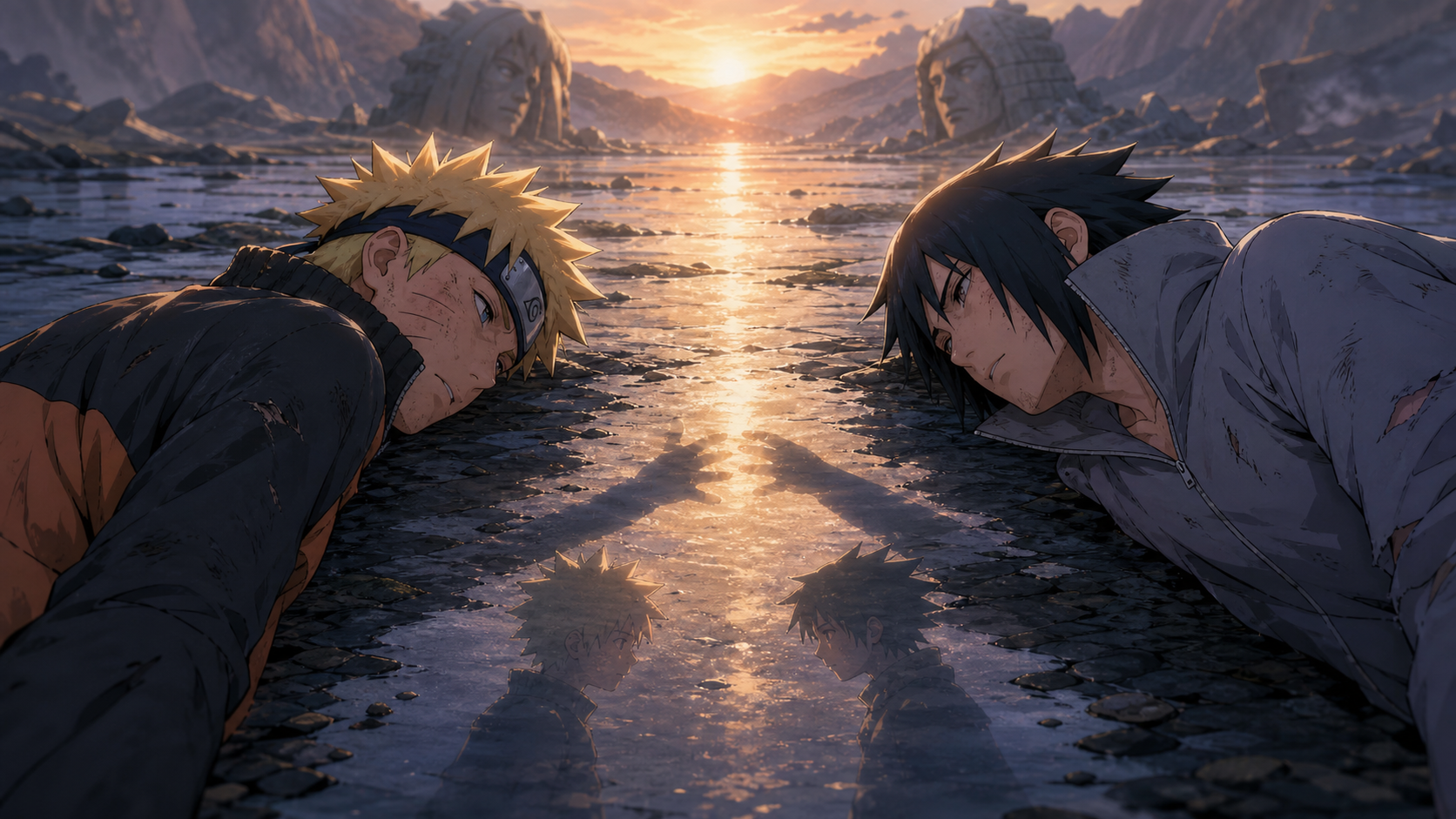
The Unison Sign
Sasuke’s surrender ends the right to rule through fear, while Naruto insists that living, cooperating and repairing are harder than martyrdom.
Bottom line
“The Unison Sign” ends the reincarnation cycle through surrender, not superior force. Naruto and Sasuke lie beside one another with their dominant arms destroyed, enough blood lost that movement could kill them, and no remaining technique capable of settling the argument. Sasuke finally asks the question he avoided for years: what does friendship mean to Naruto? The answer is not possession, nostalgia, or a demand that Sasuke pretend Konoha never harmed him. Naruto says Sasuke's pain hurts him. Shared feeling becomes the boundary Sasuke's revolution tried to eliminate. Sasuke admits defeat, then proposes death as the easiest way to end revenge and transfer the Rinnegan. Naruto refuses another martyrdom and tells him to live, cooperate, and help build the world he claimed needed change. That is the correct answer, with a condition the episode leaves mostly implicit: reconciliation cannot replace accountability. Sasuke must free the tailed beasts, release Infinite Tsukuyomi, answer for violence, and participate in repair. Their blood forms the Academy's reconciliation sign beneath shattered statues. The symbol works because neither hand can close into a fist anymore.
Episode 478 adapts manga chapters 698 and 699
Episode 478 is titled “The Unison Sign.” The Japanese title is “Wakai no In.” The episode aired in Japan on October 6, 2016.
The anime expands the canonical aftermath through shared memory, childhood imagery, and Sasuke's internal perspective.
The final attacks connect
Sasuke wants Naruto and their bond to disappear together as Blaze Release Chidori meets Rasengan. The explosion answers neither political argument.
Force removes their ability to keep attacking.
Academy sparring returns
Both remember childhood practice when students were expected to form a reconciliation seal after a match. Naruto and Sasuke repeatedly refused the gesture.
Pride blocked ritual before ideology existed.
The missing seal became a pattern
Every later clash ended through separation, interruption, or unresolved pursuit. They fought without completing the social action meant to close combat.
An unfinished school lesson follows them into war.
The Land of Iron warning returns
Naruto once said their next complete fight would kill both of them. Sasuke treated mutual death as a possible release from the cycle.
Their survival challenges the prediction.
Memory changes locations fluidly
Academy grounds, Konoha streets, the hospital roof, the first Valley battle, and later confrontations blend around them. The episode stops treating chronology as a straight line.
Relationship becomes the setting.
Both wonder whether they died
The shared inner space feels detached from wounded bodies. Death appears plausible after their final collision.
Conversation begins where combat identity has fallen away.
Sasuke recognizes parallel exclusion
Naruto was feared as Kurama's host, while Sasuke became the visible survivor of a murdered clan. Each boy lived among villagers who did not share his private absence.
Loneliness gave them an unspoken point of recognition.
Their isolation was not identical
Naruto lacked remembered parents and was actively shunned. Sasuke knew family love before state-enabled massacre took everyone away.
Shared pain should not flatten different histories.
Sasuke wonders whether they were brothers
The question names a bond stronger than ordinary rivalry and not dependent on blood. Naruto has pursued him with the persistence of family.
Chosen kinship becomes possible language.
Naruto denies the easy label
He does not accept “brother” as a complete explanation because their connection cannot be reduced to a category. Sasuke wants a definition capable of making Naruto's behavior rational.
Naruto answers through feeling later.
Naruto worries about dying before Hokage
He imagines apologizing to Tsunade for failing the promise attached to her necklace and mentorship. Even near death, office remains unfinished service rather than personal validation.
The dream points outward.
Infinite Tsukuyomi becomes his urgent concern
Humanity remains trapped and needs both surviving powers for release. Naruto's first post-battle thought is not whether Sasuke admitted defeat.
The living world still has a claim on them.
Sasuke initially dismisses that concern
He points toward Sakura and Kakashi as people who could find another answer. The response reflects his habit of treating individual replacement as possible for any bond.
Their actual power cannot release the genjutsu alone.
Sasuke imagines meeting Itachi
Death would bring him toward the brother whose life shaped every stage of his politics. The thought makes surrender through dying emotionally attractive.
Afterlife becomes another escape from repair.
Sasuke wakes first at night
Consciousness returns to the physical valley, where both lie unable to move safely. Darkness preserves the private tone of their exchange.
No audience can reward or punish the admission.
Their arms are gone
Naruto's right arm and Sasuke's left ended at the final clash. Each dominant side lies nearest the other.
The bodies carry the cost their avatars obscured.
Blood loss creates a hard deadline
Naruto warns that unnecessary movement could make both bleed out. Conversation must happen without posture, distance, or threat.
Vulnerability enforces equality.
Sasuke asks why Naruto persisted
He cut bonds, joined enemies, attacked allies, threatened Konoha, and declared a dictatorship. Ordinary reciprocity cannot explain Naruto's refusal to leave.
The question finally seeks Naruto's interior life.
“Because you are my friend” still sounds insufficient
Naruto repeats the answer he has given before, and Sasuke asks what friendship actually means. A label cannot explain years of risk by itself.
Definition must reach the body.
Naruto says Sasuke's pain hurts him
He cannot watch Sasuke carry everything alone without feeling distress himself. Empathy is not agreement with Sasuke's choices.
Connection makes another person's suffering personally consequential.
Pain does not create ownership
Naruto's hurt gives him reason to respond, not authority to dictate every part of Sasuke's future. Friendship must leave room for autonomy after stopping immediate harm.
Care needs boundaries.
Sasuke remembers the attention-seeking child
He watched Naruto make noise, provoke adults, and demand recognition. Those performances looked weak because they admitted need.
Sasuke protected himself by denying similar need.
Naruto reminded him of family
Attempts to connect awakened memories of parents and Itachi, making Naruto comforting and dangerous at once. Relationship threatened the emotional walls built after massacre.
Irritation concealed recognition.
Team 7 intensified the bond
Missions, training, meals, rivalry, and danger converted distant resemblance into shared experience. Sasuke began risking himself for Naruto and Sakura before revenge reclaimed priority.
Attachment formed through repeated action.
The Land of Waves remains foundational
Sasuke moved in front of Haku's needles without calculating personal survival. His body recognized connection before his ideology accepted the bond.
Protection preceded explanation.
Rivalry gave Sasuke a future-facing measure
Naruto's growth challenged him beyond clan memory and Itachi's shadow. Competition could have supported mutual development.
Trauma converted comparison into threat.
The hospital roof exposed fear
Sasuke saw Naruto's Rasengan damage and felt himself falling behind. The scene was not merely jealousy over strength.
Losing superiority threatened his only remaining route to vengeance.
Defection made severance a project
Leaving Konoha required Sasuke to treat bonds as obstacles to power. Naruto's pursuit kept proving that separation could not be completed through distance alone.
The bond survived every declaration of severance.
Itachi's return changed the political question
Learning the massacre's truth exposed Konoha's complicity and made simple return impossible. Naruto could not save Sasuke by demanding loyalty to the unchanged village.
Reconciliation must include institutional truth.
Sasuke remembers Naruto's growing network
Iruka, Team 7, the Konoha peers, Jiraiya, Gaara, Bee, the Kage, and the Allied Forces appear around Naruto. Connection expanded without erasing the original loneliness.
Belonging was built, not bestowed once.
He once read bonds as weakness
Depending on others seemed to invite another unbearable loss. Sasuke chose solitary power because control promised protection from grief.
Isolation created different vulnerability.
Naruto's network enabled survival
Every major victory relied on teachers, healers, rivals, summons, tailed beasts, and communities. Bonds did not eliminate pain.
They distributed the capacity to continue afterward.
Sasuke revisits Itachi's Hokage lesson
Itachi said recognition creates a Hokage rather than office creating recognition. The idea contradicts Sasuke's plan to appoint himself through fear.
Leadership cannot be self-certified.
Dawn follows the internal reckoning
The boys wake again as light reaches the ruined valley. Night contained confession; morning demands a decision about living.
Understanding must become conduct.
Naruto still wants to fight
He jokes about continuing once they recover because fair rivalry remains part of the bond. The line separates competition from attempted execution.
Conflict can survive without annihilation.
Sasuke laughs
The reaction breaks the solemn posture of revolutionary martyr. Shared absurdity returns where ideology demanded permanent distance.
Laughter becomes the first unforced surrender.
Sasuke admits defeat
He accepts that Naruto's refusal outlasted every attempt to sever connection. The loss is not simply lower remaining chakra.
His model of solitude failed to make him free.
Defeat does not settle every policy question
The Five Kage system still needs reform, the Uchiha massacre needs public truth, and tailed beasts need rights. Naruto winning cannot convert current institutions into justice.
Reconciliation begins political work.
Sasuke offers death as closure
He believes his death will end the revenge cycle and remove the threat of future relapse. The proposal repeats Itachi's pattern of one person absorbing consequence alone.
Martyrdom remains his default solution.
He proposes transferring the Rinnegan
Someone else could receive the eye and release Infinite Tsukuyomi with Naruto. Sasuke turns his body into a final instrument before disappearance.
Utility does not make suicide repair.
Naruto orders him to live
If Sasuke can imagine dying for change, Naruto wants that commitment redirected into years of cooperation. Life creates time for restitution and revised choices.
Survival becomes accountability.
Cooperation cannot mean obedience
Naruto asks Sasuke to help make shinobi work together, not simply submit to Konoha's old hierarchy. A credible future must preserve Sasuke's critique while rejecting dictatorship.
Peace needs dissent without terror.
Sasuke doubts anyone will accept him
He has attacked Kage, joined Akatsuki, assaulted allies, imprisoned the beasts, and attempted to kill Naruto. Suspicion from others would be reasonable.
Forgiveness is not a public entitlement.
Trust must be rebuilt through conduct
Naruto's confidence cannot obligate victims or institutions to skip accountability. Sasuke will need testimony, service, limits, and time.
One friend's faith opens a path, not a verdict.
Sasuke fears another reversal
He asks what happens if he turns against Naruto again. The question recognizes that insight after defeat may not guarantee permanent change.
Relapse planning is more responsible than certainty.
Naruto trusts the bond again
He cannot provide a logical guarantee and returns to friendship as evidence. Their history shows that Sasuke never fully succeeded in erasing care.
Hope remains informed but risky.
Sasuke cries and turns away
Tears arrive after years of treating vulnerability as a weakness enemies could exploit. He does not perform repentance for an audience.
The body admits connection before formal apology.
Blood forms the reconciliation sign
Their severed arms lie so joined blood traces the Academy gesture between them. Neither boy consciously performs the ritual.
The image completes what pride once refused.
The founders' hands remain beneath them
Hashirama and Madara's ruined statues have lost monumental authority, while their surviving hands frame Naruto and Sasuke. The old cycle becomes support for a different ending.
History is repurposed rather than erased.
Reconciliation is not restoration
Neither returns to the person he was before the fight, and the village cannot return to prewar innocence. Missing arms make change irreversible.
Peace begins with altered bodies and institutions.
The ending credits become shared childhood
The usual sequence gives way to a montage of Naruto and Sasuke growing alongside each other. The title appears only after the credits.
Their relationship becomes the episode's final authorship.
Surrender is not the same thing as repair
I love that Sasuke finally admits defeat, and I refuse to treat that admission as a magic eraser. The tailed beasts are still imprisoned. The world is still asleep. Sakura has been attacked, manipulated, and pushed outside decisions that directly concern her. The Uchiha massacre is still a state crime hidden behind respectable leadership. A private breakthrough between two boys cannot settle what institutions and victims are owed.
What the surrender changes is Sasuke’s claim to unilateral authority. He stops insisting that superior force gives him the right to decide everyone else’s future. That is necessary. It is not sufficient. The next ethical step is participation: release the people he restrained, tell the truth, accept limits, hear anger without demanding immediate forgiveness, and contribute to a world where criticism does not require terror.
Naruto does not own Sasuke’s redemption
Naruto’s belief keeps a path open, but he cannot grant forgiveness on behalf of everybody Sasuke harmed. Friendship gives Naruto standing to describe his own pain and set his own boundary. It does not make him the sole judge of consequence. Sakura, Karin, the Kage, the tailed beasts, and communities touched by Sasuke’s choices remain separate people with separate claims.
That distinction matters because fandom loves a clean redemption certificate. One emotional scene becomes permission to stop asking difficult questions. “The Unison Sign” is stronger if we read it as the beginning of accountable life. Sasuke chooses not to die. Now he has to keep choosing what living beside other people demands.
The reconciliation sign needs two participants
The Academy ritual was never meant to announce that both fighters agreed about everything. It marked the end of a match and the return to shared social space. Naruto and Sasuke repeatedly refused it as children because each wanted victory to protect a fragile identity. Their blood finally makes the sign when neither can physically perform it, turning an old classroom rule into an image of involuntary connection.
I do not read the blood as destiny doing the work for them. Their bodies create the shape, but dawn still requires choices. Sasuke must release his revolution. Naruto must resist turning rescue into possession. Both must allow the other to exist outside the role their rivalry assigned. A symbol can hold that promise. Conduct has to prove it.
Sasuke’s tears belong to him
There is no crowd applauding when he turns his face and cries. That privacy matters. He is not performing remorse to win leniency. His body is registering grief, relief, exhaustion, and connection after years spent converting every vulnerable feeling into a reason for more control. The tears do not absolve him. They make honesty possible.
Naruto does not demand a polished apology in the moment because both of them are bleeding out and the world needs their combined power. Urgency changes the order of work, not whether the work exists. First survive. Then free everyone. Then answer what happened. Care and accountability do not have to compete for the same sentence.
The missing arms make dependence visible
Neither man leaves the valley self-sufficient. They will need Sakura’s medical skill, Kakashi’s leadership, Kurama’s survival, and an entire network capable of moving them back into the world. That dependence is not punishment or sentimental symbolism. It is ordinary truth revealed through extreme injury: people live because other people carry what they cannot carry alone.
Sasuke’s revolution tried to make dependence shameful and hidden. Naruto’s answer makes it public. Accepting help does not cancel autonomy. It creates responsibility to respect the labor, consent, and perspective of the person helping. If the future learns that lesson, the valley can become more than another monument to men who hurt each other while everyone else waited.
The episode leaves me thinking about how shinobi institutions confuse silence with stability. Sasuke’s pain became dangerous partly because adults protected the village’s reputation instead of trusting children and citizens with the truth. Naruto can interrupt that pattern only if his leadership makes room for records, testimony, dissent, and consequences that do not disappear behind classified missions. Friendship may have reached Sasuke where policy could not, but public safety cannot depend on one exceptional friendship appearing at the right time. A just system needs routes for harmed people to be heard before grief becomes catastrophe. It needs leaders who can admit what their predecessors did, protect witnesses, share authority, and accept that unity is not agreement. If Naruto carries the valley forward, the lesson is not that love fixes everything. The lesson is that care must become structure before another lonely child is asked to save everyone through suffering.
Final verdict
“The Unison Sign” succeeds because Sasuke does not lose an argument to a speech while still holding every advantage. Both boys lose power, blood, and dominant arms before conversation becomes possible. Sasuke finally asks what friendship means and hears an answer grounded in involuntary empathy: Naruto hurts when Sasuke hurts. That recognition defeats the fantasy of clean isolation. The episode should not be mistaken for complete justice. Sasuke's tears do not free the tailed beasts, wake the world, repair Sakura's violated mind, or answer every victim. His surrender does something necessary first. He gives up the claimed right to rule through fear and accepts life as harder than martyrdom. Their blood completes the reconciliation sign because neither can close the missing hand into another weapon. Dawn finds them connected, accountable, and unfinished.
Sources and watch notes
- Naruto Official episode guide for the official series record.
- Crunchyroll for the licensed episode route where available.
What I am carrying forward
Episode 479 must return this private reconciliation to the public world. I am carrying forward the imprisoned tailed beasts, Infinite Tsukuyomi, Sakura and Kakashi waiting beyond the valley, Sasuke’s decision to live, and Naruto’s promise that cooperation must become more than a feeling between friends. Dawn is an opening, not proof that the repair is finished.