
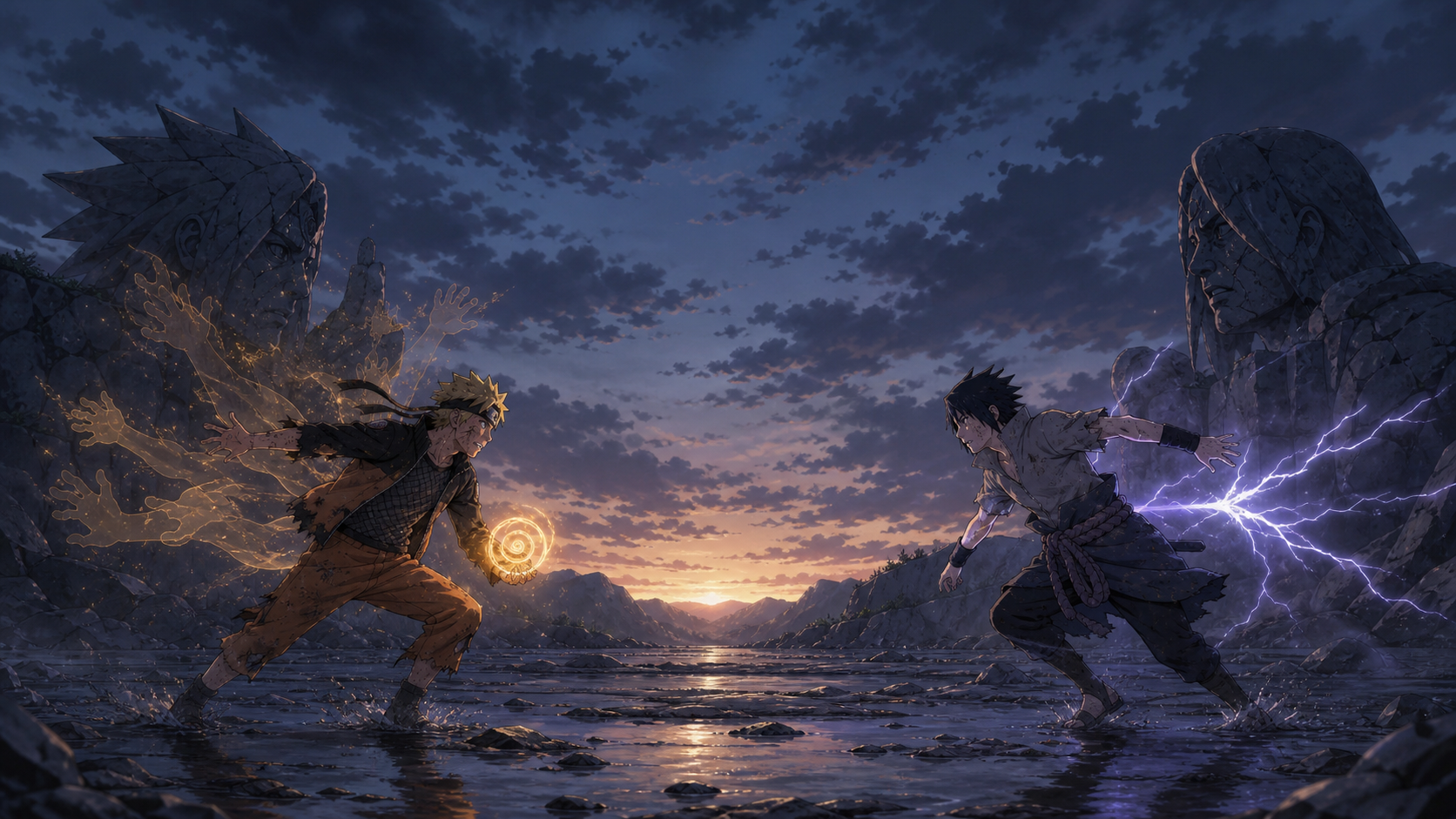
Naruto and Sasuke
After every divine avatar is spent, connection and chosen solitude reach one final collision through bodies that can barely stand.
Bottom line
“Naruto and Sasuke” spends godlike power until two exhausted boys are left hitting each other beside broken statues. Sasuke takes chakra from nine imprisoned beings and shapes Indra's Arrow, the strongest attack he can make. Naruto gathers nature energy through a hidden Kurama clone and answers with two Six Paths Rasenshuriken. Their collision tears the sky, drains both fighters, and destroys the monumental bodies of Hashirama and Madara. The fight then gets smaller and more honest. Amaterasu, clones, chakra absorption, Chidori, uppercuts, missed punches, and bodies too tired to stand replace divine avatars. Sasuke repeatedly demands that Naruto let him complete the revolution through murder. Naruto repeatedly refuses. Kurama gives his final reserve through a fist bump built across years of conflict and consent. Naruto's last Rasengan appears beneath the hands of people who shaped him; Sasuke's Blaze Release Chidori is carried alone. The final collision destroys their dominant arms. Neither technique proves a political theory. The loss of both arms makes the argument physical: no future can be built through one person gripping all power.
Episode 477 completes manga chapters 696 through 698
Episode 477 is titled “Naruto and Sasuke.” The Japanese title is “Naruto to Sasuke.” The episode aired with Episode 476 on September 29, 2016.
The canonical adaptation carries the final battle from its largest forms to total physical exhaustion.
Sasuke channels nine captives
The tailed beasts remain trapped in Chibaku Tensei and genjutsu while his Rinnegan draws their chakra. None consent to becoming revolutionary fuel.
His strongest form begins in renewed jinchuriki violence.
Susanoo becomes a chakra vessel
Sasuke concentrates gathered energy inside the complete armored avatar rather than the Demonic Statue. Kurama recognizes control approaching Hagoromo's level.
One body again claims authority over many lives.
Similar power carries different purpose
Hagoromo separated the Ten-Tails into beings with names and hoped they would connect people. Sasuke recombines their energy to enforce isolation.
Technique inherits ethics from relationship.
Kurama warns Naruto
The Nine-Tails understands the scale of what Sasuke has assembled and tells Naruto not to underestimate the threat. Their tactical conversation shows partnership under pressure.
Kurama is adviser, not ammunition.
Naruto creates multiple avatars
Shadow clones each manifest a Kurama body, trying to counter the enhanced Susanoo through numbers and angles. The battlefield fills with versions of shared power.
Sasuke reads multiplication as emotional disguise.
Sasuke names Naruto's loneliness
He argues that clones were always a substitute for people. The accusation reaches back to the neglected child who learned forbidden duplication before genuine friendship.
A survival skill can reveal the wound behind the technique.
Clones no longer mean solitude
Naruto now shares chakra with Kurama and carries relationships across every copy. The same jutsu has changed meaning through the life surrounding its user.
Origin does not fix permanent purpose.
Susanoo dominates the first exchange
Sasuke knocks avatars from the sky and severs their limbs. Captured beast chakra gives his form overwhelming concentration.
Numbers cannot immediately overcome compressed force.
Naruto briefly restrains the armor
Several Kurama bodies hold Susanoo long enough to create an opening. Their attacks fail to damage the reinforced shell significantly.
Control lasts without converting into victory.
The fight rises above the clouds
Both forms leave the valley floor and turn the sky into their arena. Distance from ordinary people matches the scale of their political abstraction.
The world below becomes almost invisible.
Lightning arrows meet beast bombs
Sasuke fires from Susanoo while Naruto's avatars launch Tailed Beast Balls. Each collision creates vast explosions across the atmosphere.
Power threatens land neither fighter asked to absorb the cost.
Sasuke prepares the strongest shot
He compresses lightning and stolen beast chakra into Indra's Arrow. The name ties his revolution to the ancestor who rejected Asura's succession.
Inherited conflict becomes a projectile.
The arrow is not solitary power
Sasuke calls himself the sole bearer of darkness, yet his greatest technique relies on energy taken from nine others. Isolation is materially supported by captives.
His self-sufficiency is a political fiction.
A fallen clone kept gathering energy
Naruto hid one Kurama avatar on the ground after the earlier exchange. While Sasuke focused above, the clone entered Sage Mode and drew from nature.
Patience creates the countermeasure.
Nature energy arrives without a captive
The reserve comes from balancing with the environment rather than invading another mind. Naruto still uses enormous external power, but the source is not a restrained person.
Consent distinguishes the methods.
Timing prevents immediate death
Kurama notes that the natural energy reaches Naruto just before Indra's Arrow would overwhelm him. Victory remains dependent on preparation performed outside Sasuke's attention.
Hidden labor saves the visible fighter.
Naruto combines the remaining avatars
The Kurama forms merge into a multi-faced, multi-armed body resembling Asura's ancient power. The visual makes reincarnation explicit without erasing Naruto's own choices.
An inherited image carries a chosen purpose.
Two different Rasenshuriken form
One attack combines a massive Rasenshuriken with Six Paths chakra, while another joins a Tailed Beast Ball with wind rotation. Naruto distributes the counter across paired hands.
His answer remains plural.
Sasuke believes Naruto has chosen lethal intent
Seeing the full response, he assumes Naruto finally accepts that only one can leave. Sasuke needs mutual killing intent to validate the fight as judgment.
Naruto rejects that frame again.
Naruto wants a fair victory
He admits wanting to fight and defeat Sasuke, but not the version consumed by the current plan. Competition and rescue coexist.
Winning means reaching someone, not removing him.
Indra's Arrow meets Six Paths power
The attacks collide at maximum force. Lightning, wind, beast chakra, and nature energy compress into a blast neither fighter can control after release.
Ideology becomes environmental destruction.
The explosion decapitates history
The valley and surrounding forest are devastated, while Hashirama and Madara's statues lose their heads. Monumental founders no longer tower intact over the descendants.
Inherited authority is physically broken.
A storm forms above the ruins
Clouds and rain replace the clear sky after the collision. The setting shifts from mythic light to mud, water, and damaged bodies.
The fight returns to human scale.
Both avatars disappear
Neither Susanoo nor Kurama's full form survives the chakra expenditure. The enormous symbols of isolation and relationship collapse together.
Political difference must persist without spectacle.
Sasuke cannot maintain Rinnegan control
He has spent too much chakra to continue drawing effectively from the imprisoned beasts or using every left-eye ability. Concentrated power has a resource limit.
His revolution was never infinitely self-sustaining.
Naruto's reserves are nearly empty
Nature energy preserved him through the largest collision but did not grant unlimited strength. Kurama also approaches total depletion.
Refusal must continue through weakness.
Amaterasu becomes a diversion
Sasuke uses black flames to obscure movement and pressure Naruto rather than expecting the fire alone to finish him. Smaller tactics reenter the battle.
Experience replaces raw scale.
Naruto anticipates the feint
Clones absorb or redirect the sequence while the original remains ready for Sasuke's approach. Familiarity lets him read intention beyond the visible attack.
Years of pursuit become combat intelligence.
Taijutsu turns visibly ugly
Punches lose form, kicks drag, and both fighters struggle to maintain balance. The animation refuses clean heroic posture.
Exhaustion strips away performance.
Sasuke keeps insisting on death
He tells Naruto to let the revolution proceed and stop rising. The demand reveals frustration that physical superiority cannot force emotional surrender.
Naruto's persistence denies narrative control.
Naruto keeps standing
His refusal no longer rests on a vast chakra cloak. Bruised muscle and habit carry the next movement.
Commitment survives after advantage disappears.
Kurama molds a final reserve
Inside Naruto, the Nine-Tails gathers the last available chakra for one more intervention. The process takes time while Naruto absorbs punishment.
Partnership continues behind conscious action.
Sasuke absorbs that chakra
The Rinnegan's Preta Path takes Kurama's carefully prepared reserve before Naruto can draw on that chakra. Sasuke again converts another being's labor into personal attack power.
The theft nearly decides the fight.
Chidori appears in Sasuke's hand
He uses the stolen chakra to produce the technique Kakashi taught him as a child. A gift from a bond becomes the weapon intended to sever the final bond.
Training carries no fixed morality.
Naruto lands an uppercut
At the last instant, he finds enough movement to strike Sasuke's jaw and spoil the clean execution. The blow has no divine title.
One exhausted body interrupts stolen power.
Both return to the ground
The fighters collapse, rise, miss, and strike again in rain. Every dramatic reserve is almost gone.
Their argument is now measured in willingness to continue hurting.
The choreography moves backward through the series
Cosmic avatars yield to signature techniques, basic ninjutsu, taijutsu, and finally clumsy fists. The battle sheds years of escalation toward their childhood origin.
Power history runs in reverse.
Sasuke prepares Blaze Release Chidori
He combines lightning with Kagutsuchi-controlled black flames for a final lethal thrust. The attack fuses his Uchiha inheritance and Kakashi's teaching.
Every part of his past enters the strike.
Kurama gives the last chakra willingly
The fist bump completes a relationship that began with confinement and hatred. Kurama chooses to support Naruto's attempt to save Sasuke.
Voluntary transfer answers repeated extraction.
Kurama remembers Naruto's promise
Naruto once vowed to address both Sasuke's hatred and the tailed beasts' resentment. The Nine-Tails invests in that unfinished commitment.
Trust is based on observed conduct.
Naruto's Rasengan contains remembered hands
The anime layers Jiraiya, Minato, Kushina, friends, teachers, Kage, Bee, Gaara, Obito, Kakashi, and Sakura into the forming sphere. Their hands are memory, not literal chakra transfers.
Relationship shapes technique symbolically.
Sasuke's final hand appears alone
His Chidori gathers without a comparable chain of supporters because he has defined severance as strength. The contrast is emotionally clear, though his dead family and Team 7 still shaped the person striking.
Isolation cannot erase influence.
The final collision echoes earlier battles
Rasengan and Chidori have met above the hospital and at the Valley before. This exchange carries every interrupted attempt to decide their relationship through force.
Repetition reaches physical limit.
Both dominant arms are destroyed
The blast takes Naruto's right arm and Sasuke's left. Each loses the limb used to form his signature attack and sealing mark.
Neither can grip victory alone afterward.
Blood creates the unison image later
Their wounds will flow together as they lie beside one another, visually forming the reconciliation sign beneath the shattered statues. Violence accidentally creates connection.
The body answers what ideology resisted.
The episode ends before surrender
Both fighters are alive, mutilated, and unable to continue normally. Sasuke has not yet admitted defeat, and Naruto has not released his demand for mutual survival.
The political answer waits inside conversation.
The spectacle is spending itself on purpose
This episode knows the franchise cannot make the final argument by introducing one more clean upgrade. We have already watched gods, reincarnations, sealed beasts, inherited eyes, and armies remake the landscape. The only honest direction left is downward. Susanoo and Kurama vanish. Named attacks become ragged tools. Ragged tools become fists that miss. By the time Naruto and Sasuke are dragging themselves through rain, power is no longer protecting either man from the meaning of what he chose.
That descent matters because Sasuke’s political plan depends on the fantasy that enough power can free him from dependence. Yet Indra’s Arrow is assembled from nine captives. His Rinnegan, Chidori, fire, training, and even the language of revolution all arrived through other people. He cannot become self-created by declaring himself alone. The episode exposes solitude as a story he tells about resources, grief, and teaching that remain visibly communal.
The tailed beasts are not a battery pack
I need to keep their personhood in the center because the fight makes it easy to stare at the sky and forget who paid for Sasuke’s biggest attack. These are beings who just fought to escape Madara and Kaguya. They have names, relationships, memories, and different opinions about humanity. Sasuke restrains them and withdraws chakra anyway. Whatever justice exists in his critique of the villages, this choice repeats the jinchuriki system’s foundational crime: powerful humans deciding another conscious life is a resource before it is a person.
Kurama’s last fist bump gives us the counterimage. He is exhausted and still chooses to help Naruto. Their relationship began in imprisonment too, which means consent now does not erase what came before. It shows how much work changed the relationship. Naruto listened, learned his name, confronted his hatred, shared risk, and accepted correction. Trust grew through conduct. The chakra matters because the choice behind it matters.
Naruto’s remembered hands are not a popularity contest
The Rasengan sequence could become sentimental accounting if we read every hand as proof that Naruto has more friends and therefore deserves to win. That would flatten Sasuke’s dead family into an absence he somehow caused. I read the sequence differently. Naruto accepts that he was formed by people. Some loved him well, some failed him, some challenged him, and some arrived only after years of neglect. He does not claim their influence makes him pure. He lets relationship remain part of his power.
Sasuke was formed by people too. Fugaku, Mikoto, Itachi, Team 7, Orochimaru, Taka, and countless enemies are inside the fighter even when the frame shows one hand. His tragedy is not that nobody ever touched his life. It is that he believes acknowledging those ties would weaken the absolute role he has assigned himself. The solitary Chidori is an argument he is trying to make, not an objective biography.
The ruined arms reject ownership
Naruto loses the hand that forms Rasengan. Sasuke loses the hand that forms Chidori. The image is brutal, especially after hundreds of episodes that trained us to recognize each technique before it fully appeared. Their bodies interrupt the repetition. Neither man can grip the other, seize the future, or perform his signature answer in the same way again.
I do not want to romanticize disability as a moral lesson delivered by violence. The injuries are not beautiful because they force growth. They are evidence of how thoroughly adults and institutions let two children carry political failure until those children tore each other apart. The coming medical response matters. So does the fact that care will be needed after the grand argument ends. Survival becomes collective labor again.
Naruto wins by refusing Sasuke’s terms
Sasuke repeatedly tries to define seriousness as willingness to kill. If Naruto will not aim for death, then Sasuke can call his conviction incomplete. Naruto never accepts that measure. He fights hard enough to stop the plan, absorbs terrible harm, and leaves room for both of them to remain after the answer. That is not a clean victory. It is a boundary maintained under pressure.
The distinction is the heart of RaeRae’s read for me. Compassion without a boundary abandons everyone Sasuke intends to hurt. A boundary without recognition turns punishment into disposal. Naruto attempts both: you cannot kill the Kage, own the tailed beasts, or rule the world through fear, and I will not pretend your life stopped mattering when you made those choices. The series does not always live up to that ethic, but this fight articulates it clearly.
After the collision, conversation becomes possible
The episode stops before Sasuke concedes because physical exhaustion is only the condition for the next truth, not the truth itself. Force can prevent immediate harm. It cannot manufacture consent, repair the massacre, restore the tailed beasts’ autonomy, or design accountable institutions. Naruto and Sasuke still have to speak when neither can dominate the other.
That pause is more valuable than a triumphant pose. The world is still asleep. Sakura and Kakashi are still waiting. The Kage remain trapped. Kurama is depleted. Every consequence outside the valley continues to exist while these two lie in the wreckage. Their private bond matters, but it cannot become another room where decisions about everyone else are made without everyone else.
The rain does not cleanse the valley or absolve either fighter. It makes the aftermath cold, heavy, and shared. Every breath now depends on someone else arriving, treating wounds, releasing captives, and refusing to confuse survival with completed repair.
Final verdict
“Naruto and Sasuke” makes its largest attacks impressive and its smallest punches decisive. Indra's Arrow carries power stolen from nine prisoners. Naruto's paired Rasenshuriken carry nature energy gathered through patience and cooperation with Kurama. Their collision destroys the founders' statues but cannot settle the argument. The real climax comes after avatars vanish, when Sasuke steals Kurama's final reserve, Naruto still lands an uppercut, and both boys continue with bodies that have almost nothing left. Naruto's last Rasengan is framed by the people who formed him. Sasuke's final Chidori is framed by the solitude he chose, even though every technique in his hand came through relationship. Their arms disappear in the collision. The story removes their ability to impose another answer and leaves them alive long enough to speak.
Sources and watch notes
- Naruto Official episode guide for the official series record.
- Crunchyroll for the licensed episode route where available.
What I am carrying forward
Episode 478 must move from impact to admission. I am carrying forward the tailed beasts’ stolen chakra, Kurama’s chosen gift, the founders’ broken statues, two destroyed arms, and the people waiting outside this private battlefield. Naruto has stopped the immediate revolution. Sasuke still has to decide whether connection can exist without becoming another form of control.