
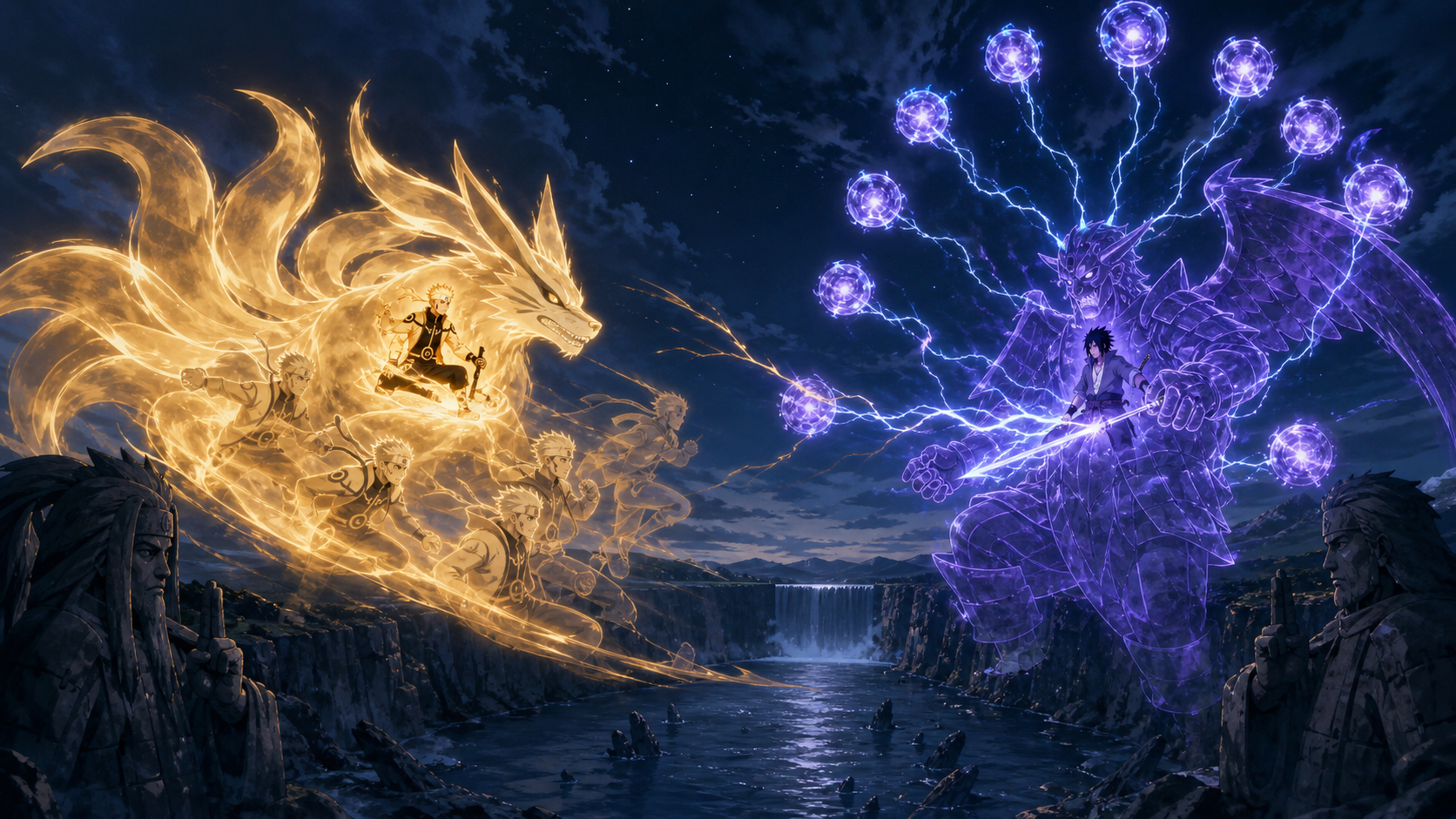
The Final Battle
Every upgrade expresses a political choice: shared and multiplying power confronts one unreachable ruler concentrating the world in himself.
Bottom line
“The Final Battle” begins with a question larger than who hits harder: can one traumatized survivor become the world's permanent enemy and call that peace? Sasuke reads Itachi's life as a governing model. One person should absorb every nation's hatred, kill anyone capable of sharing power, and rule from the shadows without bonds that could compromise judgment. Naruto recognizes the sacrifice inside Itachi's history and rejects the system that demanded such sacrifice. He refuses to kill Sasuke because murder would validate the same shinobi logic both men claim to oppose. Their argument moves through fists, fire, Chidori, Rasengan, Susanoo, and Kurama's avatar, yet Naruto keeps stalling for an answer that leaves both alive. Sasuke calls that refusal weakness. The episode shows the opposite. Killing is the clean line. Remaining connected to someone who has hurt you, while preventing him from hurting anyone else, requires sustained force and a future plan. Naruto is not defending the old Kage system. He is defending the right of other people to participate in whatever replaces that system.
Episode 476 adapts manga chapters 694 through 696
Episode 476 is titled “The Final Battle.” The Japanese title is “Saigo no Tatakai.” The episode aired in Japan on September 29, 2016.
The canonical battle was presented with Episode 477 as a one-hour television special.
Neji's warning returns
At the Valley of the End, Naruto remembers Neji recognizing darkness around Sasuke during the retrieval mission. The memory carries the people lost while Naruto kept pursuing one friend.
Connection has never been cost-free.
Sasuke defines Hokage through Itachi
He believes a true leader accepts every stain, operates unseen, and becomes hated so others can live without carrying the burden. Itachi's secret service becomes the prototype.
The definition begins in coerced martyrdom.
Itachi carried a village's crime
Konoha's leadership ordered a teenager to choose between clan massacre and civil war, then preserved peace by hiding the truth. Sasuke correctly sees an institution surviving through one person's isolation.
Secrecy protected authority, not justice.
Sasuke mistakes exploitation for governance
Itachi's willingness to bear pain does not prove that leaders should reproduce the conditions that destroyed him. A victim's endurance is not a constitutional design.
Martyrdom cannot become public policy.
He wants all hatred concentrated on himself
Sasuke will create enough fear that villages remain united against one target. His existence becomes a permanent emergency holding the coalition together.
Peace depends on continuous terror.
Naruto asks who consented
Other nations, civilians, Kage, and tailed beasts did not choose Sasuke's arrangement. He dismisses their disagreement because power gives him the ability to proceed.
Revolution without public agency becomes conquest.
Sasuke treats capacity as authority
The Rinnegan, genjutsu, and captured beast chakra convince him that implementation makes legitimacy irrelevant. He can enforce the plan, so he believes nobody else must approve.
Ability replaces accountability.
Naruto cites the Kaguya fight
No single fighter sealed her. Obito opened dimensions, Sakura supplied chakra and position, Kakashi coordinated, and Naruto and Sasuke carried complementary seals.
Recent survival contradicts solitary supremacy.
Sasuke reads cooperation as temporary
The villages united only because Akatsuki, Madara, and Kaguya threatened everyone. Once common danger disappears, old interests may return.
His skepticism is supported by shinobi history.
Temporary unity still creates evidence
Ninja from rival nations shared command, chakra, medical care, intelligence, and grief. Emergency cooperation does not guarantee peace, but proves coordination can be learned.
Possibility deserves institutions, not dismissal.
Sasuke plans to erase the past
Killing the Kage and tailed beasts would remove symbols and power centers linked to previous wars. He imagines a clean foundation beneath his rule.
Bodies cannot be deleted into historical innocence.
Naruto refuses historical erasure
Pain, isolation, Iruka's recognition, Jiraiya's teaching, and every bond shaped who he became. Remembering harm allows people to challenge repetition.
The past needs truth and repair, not execution of witnesses.
The tailed beasts are witnesses too
They remember centuries of captivity and negotiation with different humans. Sasuke wants to kill them partly because their power complicates control.
Removing victims removes testimony.
Hagoromo begins fading
The Sage has given his power and cannot dictate another outcome. His attempt to treat both reincarnates equally has still produced conflict.
Ancient authority leaves before resolution.
He tells Kakashi to keep faith
Kakashi cannot enter the Valley or overpower Sasuke. His remaining role is belief in students making decisions beyond his command.
Teaching ends in relinquished control.
Hagoromo's failure remains instructive
He once selected Asura through hidden criteria and asked Indra to accept support status. Equal power in a later generation did not repair the old family pattern automatically.
Process matters beside intention.
The first exchange uses taijutsu
Naruto and Sasuke begin close enough to read shoulders, feet, breath, and familiar habits. Cosmic power temporarily gives way to bodies trained together and against one another.
History lives in muscle memory.
Their movements include childhood selves
The animation layers younger versions across adult strikes, showing every age carried into the present. They are not reenacting one fight from memory.
Every unfinished encounter arrives at once.
Naruto blocks without seeking a kill
His early defense absorbs Sasuke's pressure while preserving openings for speech. Sasuke interprets restraint as refusal to take the ideology seriously.
Naruto is fighting the plan, not erasing the person.
Sasuke attacks with fire
Great Fireball Technique returns the battle to an Uchiha skill taught through family expectation. Naruto evades rather than matching spectacle immediately.
An old language opens the escalation.
Amenotejikara breaks distance
Sasuke swaps position and appears behind Naruto after the fire attack. Space itself becomes part of his close-combat rhythm.
Naruto must defend against intention arriving from anywhere.
A Truth-Seeking Ball disappears in the anime
The television choreography suggests Sasuke exchanged with one of Naruto's orbs, though the manga does not show that loss. The detail makes the transition readable while creating a continuity question.
Adaptation adds tactical shorthand.
Sasuke accuses Naruto of stalling
He recognizes that Naruto is not applying every lethal option. For Sasuke, a fight without willingness to kill cannot settle competing revolutions.
Death is his preferred proof of conviction.
Naruto refuses another solitary departure
He will not let Sasuke walk into darkness believing isolation protects everyone else. The statement echoes their first Valley battle with a changed capacity to enforce the promise.
Persistence now carries equal power.
Refusal to kill has public consequences
Sasuke holds the only Rinnegan needed to release Infinite Tsukuyomi. Killing him could leave humanity trapped permanently.
Mercy and practical survival align.
Sasuke claims alternate methods
He believes his Rinnegan grants enough knowledge to free the world after Naruto dies. The plan still makes every sleeping person's future dependent on his honesty.
No external check remains.
Susanoo raises the scale
Sasuke surrounds himself with the complete armored avatar above Madara's statue. His revolutionary ruler appears literally enclosed within an enormous solitary body.
Power creates distance from everyone below.
Kurama's avatar answers
Naruto manifests the Nine-Tails' chakra with a willing partner rather than a captured weapon. The form embodies cooperation Sasuke treats as weakness.
Two beings occupy one defense without erased identity.
Chidori meets a Tailed Beast Ball
Sasuke channels lightning through Susanoo while Naruto forms compressed beast chakra. Their clash sends force across a valley already carved by ideological violence.
Inherited monuments absorb another generation.
The mental space opens again
Contact lets their thoughts cross without ordinary speech. Neither can hide the emotional argument beneath technique.
Combat becomes forced intimacy.
Sasuke says they have changed
The boys who fought here before wanted escape and retrieval. The men returning now carry global power and competing political programs.
The relationship remains recognizable while stakes transform.
Naruto questions the new world's durability
Even if Sasuke unites everyone through fear, darkness can form inside the order he creates. A single ruler cannot predict every future grievance or succession crisis.
Control postpones rather than abolishes conflict.
Mortality breaks the permanent-enemy plan
Naruto asks what happens when Sasuke dies. A system centered on one immortal-seeming threat has no legitimate transition.
Succession exposes the design's emptiness.
Sasuke trusts Rinnegan possibilities
He hints at methods for extending influence or ruling from shadows beyond a normal lifespan. The answer avoids naming a public structure.
Mystical capacity substitutes for governance again.
His revolution needs secrecy
Operating unseen prevents assassination and keeps hatred focused on a symbol rather than a negotiable leader. Nobody can debate a ruler who refuses relationship.
Opacity becomes security.
The Five Kage alliance is fragile, not meaningless
Gaara, the Raikage, Tsunade, Mei, and Onoki learned cooperation under crisis. Their villages may relapse, yet shared command has altered what leaders know is possible.
Peace needs sustained work after emergency.
Naruto argues for unfinished reform
He does not present current villages as pure. His answer rests on people changing through contact, accountability, and repeated effort.
Uncertainty is not the same as surrender.
Sasuke calls the hope naive
His life contains abundant evidence that institutions protect themselves and bonds can be weaponized. Skepticism guards him against another betrayal.
Cynicism also makes coercion feel inevitable.
The imprisoned beasts enter the battlefield
Sasuke draws their Chibaku Tensei satellites toward the valley. Captives become fuel for the man claiming to end their role in conflict.
His first step into darkness repeats extraction.
Chakra is taken without consent
The tailed beasts remain under genjutsu while Sasuke pulls power through the Rinnegan. Their personhood disappears inside his revolutionary calculation.
Liberation cannot begin with renewed ownership.
Susanoo becomes the vessel
Instead of the Demonic Statue, Sasuke channels gathered beast chakra through his armored avatar. Kurama recognizes a technique resembling Hagoromo's level of control.
Sasuke turns himself into a living weapon system.
The visual mirrors Kaguya and Madara
One body accumulates many beings' chakra and claims unique authority to reshape the world. Sasuke condemns their methods while reconstructing the same concentration.
Intent does not erase structural resemblance.
Naruto multiplies Kurama
Shadow clones create several chakra avatars to meet the transformed Susanoo. Sasuke reads cloning as compensation for loneliness.
The insult identifies Naruto's oldest wound.
Clones began as survival
Naruto learned mass duplication when exclusion left him without peers. The technique gave him numbers before genuine relationships formed.
A coping method later became collaborative strategy.
Sasuke also hides inside power
Every larger Susanoo places more armored distance between his body and another person. Solitude is not absent because the form looks singular and strong.
His defense externalizes isolation.
Naruto's avatars are overpowered
The tailed-beast-enhanced Susanoo destroys copies and controls the air. Naruto cannot win the upper exchange through numbers alone.
Captured collective power temporarily dominates voluntary partnership.
A hidden clone gathers nature energy
While visible avatars fight, another Kurama form remains below collecting sage chakra. Naruto prepares an answer through patience rather than immediate escalation.
The land becomes an uncoerced source.
Nature energy differs from stolen chakra
Naruto borrows from the environment through Sage Mode's balance, while Sasuke extracts from restrained sentient beings. Both accumulate external power under different ethics.
Source and consent matter.
The episode ends before the largest collision
Sasuke has formed his enhanced Susanoo, Naruto's visible clones are failing, and the hidden reserve is nearly ready. Episode 477 will carry Indra's Arrow and the physical collapse.
Ideology has reached its largest body.
This fight is not a personality test
I keep coming back to the fact that Naruto and Sasuke are not simply optimism and pessimism wearing expensive chakra. That reading is too neat for what this episode has earned. Sasuke has receipts. Konoha used Itachi, buried the truth, benefited from the Uchiha massacre, and then expected the surviving child to accept the village as a trustworthy moral authority. The Five Great Nations built prosperity through smaller countries’ suffering and only found unity when extinction stood in front of them. Sasuke is not inventing institutional rot because he enjoys being difficult. He is naming the rot with devastating accuracy.
What fails is the remedy. Sasuke takes every lesson about concentrated power, secrecy, disposable lives, and unaccountable leadership, then proposes a stronger version with himself at the center. He wants to end the cycle by becoming its final administrator. That is why the tailed beasts matter so much here. The minute his plan needs their bodies but not their consent, the revolution has already reproduced the world it claims to replace. You cannot liberate people by deciding their freedom is less important than your blueprint.
Naruto’s restraint is active work
The episode understands how easy it is to mistake refusal for passivity. Naruto is blocking, calculating, buying time, and trying to keep a catastrophic situation from narrowing into murder. He is not standing in the valley asking Sasuke to feel better. He is physically preventing Sasuke from killing the Kage and the tailed beasts while refusing the false choice that says the only serious response is execution. That takes discipline. It also takes faith that accountability can exist without annihilation, a faith the shinobi world has almost never deserved.
I do not read that faith as a blank check for friendship. Naruto is not saying bonds erase harm. He is saying relationship creates an obligation to confront harm without pretending the person committing it became disposable. The distinction matters on a fandom site because we are often encouraged to sort characters into approved and condemned piles, then call the sorting analysis. This story is messier. Sasuke is responsible for the choice he is making. The institutions that shaped that choice are responsible too. Holding both truths at once does not weaken either one.
The animation makes political structure visible
Perfect Susanoo is gorgeous, but its beauty is doing narrative work. Sasuke sits inside a sealed monument powered by beings he has restrained. Every layer of armor places him farther from the people whose future he intends to control. Naruto’s chakra form works differently because Kurama is not equipment anymore. They argue, cooperate, lend power, and remain recognizable as separate selves. The forms turn an abstract question about government into bodies we can read at a glance: power hoarded under one will against power negotiated through relationship.
Even the multiplication matters. Sasuke mocks the shadow clones as proof that Naruto cannot endure loneliness, and he is not completely wrong about where the technique began. Naruto built crowds because solitude hurt. What changed is that he learned a copy is not a substitute for community. His real strength now comes from Kurama, the other tailed beasts, teachers, rivals, medics, parents, and strangers who chose to meet him. The clones are no longer a fake audience. They are a method carried forward by someone who finally knows the difference between numbers and belonging.
The episode refuses an easy defense of the villages
Naruto’s side would be much less convincing if the story asked us to believe the existing Kage system only needs kinder people. It needs records, public truth, reparations, limits on covert authority, and room for the people most harmed by the villages to shape whatever comes next. The anime does not hand us that policy program, but Sasuke’s accusation makes it impossible to accept a ceremonial restoration as victory. If everyone wakes from Infinite Tsukuyomi and returns to business as usual, he will have been wrong about his method and right about their cowardice.
That is the challenge beneath Naruto’s promise. Saving Sasuke is only meaningful if Naruto helps build a world that would not demand another Itachi. Friendship cannot carry that labor by itself. Sakura, Kakashi, Gaara, the other Kage, the tailed beasts, and ordinary citizens all have stakes that cannot be folded into a private reconciliation between two powerful men. The future has to be shared or Sasuke’s central critique survives the fight untouched.
The valley remembers what adults failed to repair
Hashirama and Madara tower over this argument because their generation also mistook personal settlement for durable structure. Their bond mattered, their rupture mattered, and the institutions they created carried both men’s unresolved choices into children who never consented to inherit them. Naruto and Sasuke are standing inside that inheritance. Winning cannot mean producing another monument while leaving the machinery of grief intact.
Children remain visible inside these giants.
Final verdict
“The Final Battle” earns its spectacle by making every upgrade express a political choice. Sasuke seals himself inside a Susanoo fed by nine imprisoned beings because his revolution concentrates authority in one unreachable ruler. Naruto shares space with Kurama, multiplies, stalls, and gathers nature energy because his answer depends on relationships and time. Neither visual makes the politics automatically correct, but their methods reveal the difference. Sasuke's critique of the Five Kage and crisis-based alliance remains sharp. His answer still requires executions, coerced chakra, secrecy, and a permanent enemy who cannot be challenged. Naruto refuses to kill him because the world needs more than another Uchiha sacrificed to institutional failure. The harder task is stopping Sasuke, preserving his life, freeing everyone, and then proving reform can survive after the common enemy disappears.
Sources and watch notes
- Naruto Official episode guide for the official series record.
- Crunchyroll for the licensed episode route where available.
What I am carrying forward
Episode 477 has to answer the question this hour leaves suspended above the valley: when borrowed and stolen power are exhausted, what remains between Naruto and Sasuke? I am carrying forward the tailed beasts’ lack of consent, Kurama’s willing partnership, Naruto’s hidden reserve of nature energy, and Sasuke’s unanswered succession problem. The final collision can settle who falls first. It cannot, by itself, prove which future deserves everyone else.