
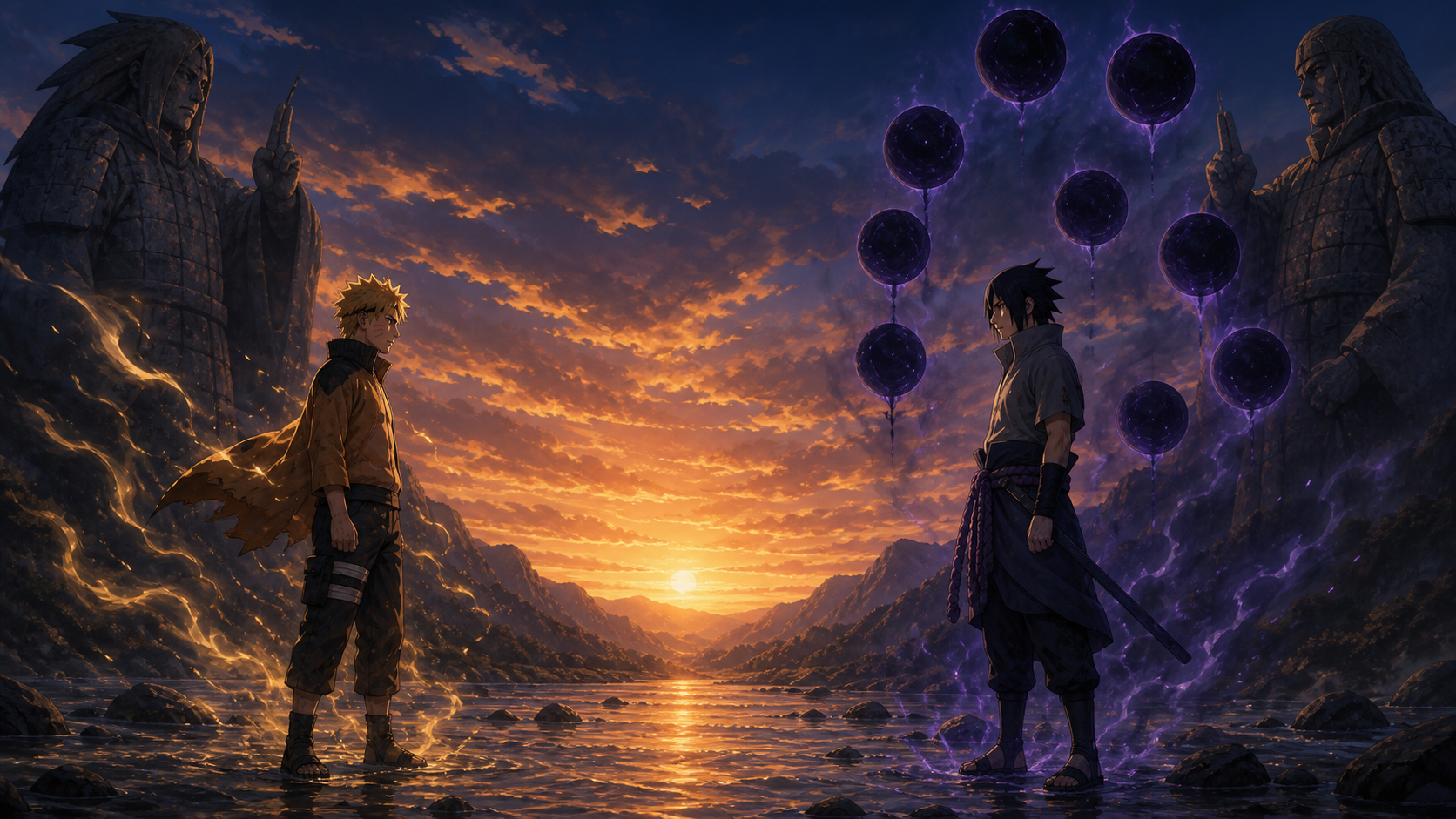
The Final Valley
Sasuke correctly names the shinobi world’s structural violence, then proposes an immortal dictatorship sustained by universal fear.
Bottom line
“The Valley of the End” lets Sasuke make the strongest version of his political diagnosis before exposing the authoritarian core of his cure. The Five Kage inherited systems built through clan violence, secret police, child soldiers, jinchuriki confinement, and wars over resources. Temporary unity formed only when Madara and Kaguya threatened everyone at once. Sasuke concludes that lasting peace requires one permanent enemy: himself. He will execute the Kage, kill the tailed beasts, sever every personal bond, and rule from the shadows as the object of universal hatred. That plan names structural failure and answers with endless dictatorship. The tailed beasts receive freedom for minutes before Sasuke invades their minds and hangs them inside Chibaku Tensei prisons. Sakura offers love as a reason to stop; Sasuke answers by forcing a violent genjutsu into her mind. Naruto goes to the Valley of the End because debate without resistance would leave everybody else's freedom dependent on Sasuke's private certainty. This is not a fight over whether the shinobi world needs revolution. This is a fight over whether revolution can belong to one armed man.
Episode 475 adapts manga chapters 692 and 693
Episode 475 is titled “The Valley of the End.” The Japanese title is “Shumatsu no Tani.” The episode aired in Japan on September 8, 2016.
The canonical chapter moves directly from Kaguya's defeat into Sasuke's declared revolution.
The dead Kage depart
Hagoromo releases the reanimated Hokage and summoned spirits after their work is complete. The battlefield belongs to the living again.
No previous generation remains available to make the next decision.
The tailed beasts discuss home
Freed from Kaguya and the Demonic Statue, nine beings consider where they want to live. Their plans assert personhood after another cycle of capture.
Victory should mean self-determination.
Gyuki intends to return to Bee
Their partnership has grown through mutual respect rather than ownership. Returning is Gyuki's choice, not reassignment by a Kage.
Relationship survives release.
Kurama is asked to remain with Naruto
Hagoromo proposes reunion because Naruto and Kurama already chose cooperation. The request still deserves Kurama's consent.
A jinchuriki bond should not default back into imprisonment.
Naruto becomes a meeting place
Fragments of all nine beasts' chakra remain within him, allowing them to communicate through his inner world. Hagoromo imagines Naruto as a voluntary gathering point.
Connection replaces the Demonic Statue's forced vessel.
The distinction between host and prison matters
Naruto can carry shared access without claiming ownership of nine lives. The future depends on keeping communication separate from command.
Sasuke will violate that distinction almost immediately.
Hagoromo repeats his earlier question
He asks Naruto and Sasuke whether their answers about power, bonds, and the future changed after confronting Kaguya. The inquiry returns philosophy to the center.
Divine power did not settle political judgment.
Naruto's answer remains relational
He still believes strength comes through protecting bonds and sharing burdens. The Kaguya fight confirmed that no single fighter could succeed alone.
Experience reinforced rather than replaced his view.
Kushina becomes his measure of motherhood
After hearing Kaguya's story, Naruto says he is glad Kushina was his mother. Kaguya treated children and chakra as possessions; Kushina gave love under fatal conditions.
Family is defined through care, not origin.
Naruto and Sasuke can release Infinite Tsukuyomi
The tailed beast chakra within Naruto and the Rinnegan held by Sasuke provide the necessary combination. Humanity remains asleep until both cooperate.
Shared power creates a constitutional check neither can bypass easily.
Sasuke reveals his first execution list
Before freeing anyone, he announces that the Five Kage must die. The statement shocks allies who expected Kaguya's seal to end hostilities.
Revolution begins with decapitation.
His indictment of the Kage has evidence
Hidden villages normalized child combat, covert assassination, clan surveillance, and interstate war. Current leaders inherit institutions that repeatedly failed vulnerable people.
Peace cannot rely on gratitude alone.
Individual leaders are not one interchangeable class
Gaara changed Sunagakure, Tsunade resisted Danzo's politics, and the Kage joined against Madara. Their records contain failure and reform.
Collective execution erases distinction and due process.
Killing officeholders does not abolish institutions
Villages, councils, economies, borders, and military ranks survive the deaths of five people. Sasuke treats symbolic heads as the entire system.
Rebuilding requires more than vacancy.
The tailed beasts become his second target
Sasuke plans to destroy them after using their chakra to release Infinite Tsukuyomi. He defines living beings as recurring sources of conflict.
Victims are blamed for wars fought to possess them.
Conflict followed captivity, not existence
Villages captured, traded, sealed, and deployed tailed beasts as weapons. Their power attracted coercion because human institutions chose ownership.
Killing the captives rewards the captors' framing.
Sasuke attacks before consent can form
His Rinnegan places all nine beasts under genjutsu at once. They receive no negotiation, warning, or opportunity to challenge the plan.
Revolution opens through mental domination.
The speed exposes premeditation
Sasuke did not invent this response during Hagoromo's question. He waited until Kaguya was sealed and the dead leaders were leaving.
Teamwork against a common enemy concealed a private agenda.
Chibaku Tensei builds nine prisons
Each beast is enclosed in a separate satellite and suspended above the battlefield. The technique mirrors the seal just used against Kaguya.
Liberation becomes captivity through the same visual language.
Sasuke calls the project revolution
He wants to destroy the shinobi world's current arrangement and build another order. The term correctly acknowledges that reform at the margins will not address every inherited violence.
His method makes one person the new structure.
He intends to become permanent hatred
Sasuke will act as the universal enemy whose presence keeps villages allied. Peace would depend on everyone fearing and opposing him.
Shared hatred substitutes for shared governance.
The plan repeats the war's temporary coalition
The Allied Shinobi Forces united because Obito and Madara threatened all villages. Sasuke treats that emergency unity as a sustainable social model.
Permanent crisis becomes policy.
One immortal ruler would need endless violence
Maintaining universal hatred requires periodic terror, surveillance, and punishment. Any genuine reconciliation would weaken the political design.
Peace would be forbidden from maturing.
Sasuke calls isolation responsibility
He believes severing bonds will let him judge without favoritism. Emotional detachment appears to guarantee clean decisions.
Isolation removes accountability along with affection.
No community can correct him
The revolution contains no electorate, council, successor, court, or public mechanism for challenging error. Sasuke's Rinnegan becomes the constitution.
Private certainty replaces law.
Naruto apologizes to Hagoromo
He feels the ancient brothers' conflict has repeated despite receiving equal power. The apology accepts responsibility for ending the cycle without pretending he caused Sasuke's plan.
Inheritance becomes a task, not destiny.
Hagoromo sees his family pattern again
Giving power to both reincarnates did not automatically create cooperation. Equal distribution cannot repair mistrust by itself.
The Sage must leave the outcome to relationship.
Naruto refuses fatalism
He rejects the idea that Asura and Indra's descendants must repeat the same ending forever. A cycle persists through choices and can end through choices.
Reincarnation does not erase agency.
Sasuke identifies Naruto as the last bond
To become completely solitary, he must kill the only person who refuses to stop recognizing him. Naruto is both political obstacle and emotional witness.
Murder would complete self-isolation.
Naruto also carries tailed beast chakra
Sasuke needs that power for the eventual release of Infinite Tsukuyomi and then intends to remove the remaining gathering place. Killing Naruto serves several parts of his plan.
Relationship and logistics converge.
Kakashi challenges the revolution
The teacher asks why Sasuke would answer one catastrophe with another. Without Obito's chakra, Kakashi cannot physically stop him.
Moral authority remains after borrowed power leaves.
Sasuke indicts the shinobi world
He connects his clan's massacre, Itachi's coerced life, Konoha's secrecy, and repeated wars to leadership structures that preserve themselves through sacrifice. The diagnosis deserves attention.
His victims do not make dictatorship democratic.
Itachi's life becomes contested evidence
Sasuke reads his brother's hidden service as proof that one person must carry hatred alone. Naruto reads Itachi's failure to rely on others as a warning.
Love does not settle which lesson is correct.
Sakura makes one final appeal
She admits she cannot physically defeat or intellectually redirect Sasuke, then asks him to stop because she still loves him. Vulnerability is her remaining tool.
The scene repeats their departure years earlier.
Her love is not a policy answer
Sakura does not address the Kage system, tailed beast rights, or Sasuke's theory of permanent hostility. Emotional appeal alone cannot resolve structural grievance.
That limitation does not justify violating her.
Sasuke calls her annoying again
The repeated phrase deliberately echoes the night he left Konoha. Memory has returned without growth in how he handles her care.
Dismissal becomes cruelty through repetition.
He puts Sakura under genjutsu
Sasuke forces an image of being stabbed through her body and renders her unconscious. He could have refused and departed.
Mental violence is a choice, not strategic necessity.
Preventing interference does not excuse torture imagery
Sakura is depleted and cannot match his power. A nonviolent restraint or direct warning would have sufficed.
The illusion punishes her for speaking.
Kakashi names her suffering
He tells Sasuke that Sakura's love has already caused her pain and that she asks for no reward. The defense recognizes emotional cost.
Kakashi still frames her primarily through devotion to Sasuke.
Sakura deserves identity beyond persistence
Her medical leadership, strength, village service, and war contributions should matter independently of whom she loves. The scene narrows her again at the climax.
Romance eclipses achievement.
Sasuke remembers his family
Kakashi's words trigger images of Fugaku, Mikoto, and Itachi. Sasuke understands love as the source of unbearable loss.
Cutting bonds appears safer than risking another massacre.
Trauma does not make coercion inevitable
His family was destroyed through state violence, clan conflict, and Itachi's impossible assignment. That history explains why attachment frightens him.
Sasuke still chooses how fear becomes policy.
Naruto promises to bring him back
He reassures Kakashi that the old promise remains active. “Back” cannot mean restoring Sasuke to the exact village system he condemns.
Reconciliation must include political change.
Hagoromo places trust in Naruto
He tells Kakashi about Asura and Indra and believes this reincarnation can choose differently. The Sage cannot intervene further.
Hope shifts from power to persistence.
Sasuke selects the Valley of the End
He moves the battle away from Sakura, Kakashi, and the imprisoned beasts. The site carries Hashirama and Madara's conflict and Naruto and Sasuke's first decisive rupture.
Geography becomes inherited argument.
The statues make history unavoidable
Hashirama and Madara tower over the river where their ideologies once collided. Naruto and Sasuke stand on successors' monuments while refusing to remain simple replicas.
Stone frames living choice.
Naruto carries Itachi's definition
He reminds Sasuke that becoming Hokage does not make people recognize someone. Recognition from others is what allows someone to become Hokage.
Leadership grows from relationship rather than self-appointment.
Sasuke's plan reverses that principle
He will declare himself Hokage through unmatched force and make recognition irrelevant. Fear will organize compliance.
The title becomes dictatorship wearing village language.
Naruto will not let him act alone
Opposition is not merely an attempt to preserve Konoha unchanged. Naruto refuses a future built through murdered leaders, imprisoned beasts, and a friend converting himself into permanent terror.
Resistance protects political possibility.
The fight must answer more than friendship
Naruto wants Sasuke alive, but the battle also decides whether sleeping humanity wakes under shared uncertainty or one man's control. Personal rescue and public freedom align.
The stakes exceed Team 7.
Sasuke’s indictment should survive rejection of his cure
Konoha concealed the Uchiha massacre, converted Itachi into an expendable instrument, normalized child combat, and protected leadership through secrecy. Other villages built their own coercive systems around jinchūriki, bloodlines, and war.
Naruto cannot answer that history by insisting friendship makes existing institutions acceptable. Defeating dictatorship must leave the demand for structural change alive.
The revolution makes emergency permanent
Sasuke sees that villages united when a shared enemy threatened them. He proposes maintaining that unity by becoming an immortal source of fear.
The model requires recurring terror. If communities reconcile, challenge his judgment, or no longer need the enemy, he must create enough violence to restore dependence. Peace becomes a condition his system cannot permit.
One man cannot become a constitutional check on himself
Sasuke offers no council, court, public record, successor, appeal, election, or community capable of correcting him. Severed bonds are supposed to guarantee impartiality.
Isolation removes the people who might reveal when judgment has become obsession. The Rinnegan becomes law, enforcement, evidence, and final appeal inside the same body.
The tailed beasts expose the revolution immediately
They have just emerged from Kaguya’s forced unity and begun discussing where they want to live. Sasuke invades their minds, suspends them inside nine prisons, and plans their deaths because humans fought over possessing them.
Victims become guilty for the violence captors organized around their bodies. Liberation lasts only until the next powerful man names ownership necessary.
Killing leaders does not dismantle leadership systems
The Five Kage inherit serious failures and deserve scrutiny. Their deaths would not erase councils, borders, military economies, clan hierarchies, secrets, or incentives that reproduce conflict.
Execution confuses visible officeholders with the whole structure. Durable change requires records, participation, redistribution, rights, and institutions capable of admitting what they did.
Sakura’s appeal is politically incomplete and still deserves consent
Love does not answer Sasuke’s indictment of the villages or provide a governance plan. Her emotional request cannot carry every argument the moment needs.
That limitation does not permit Sasuke to force a stabbing illusion into her mind. He can refuse, restrain, leave, or speak. Torture imagery punishes her for remaining emotionally present.
Naruto’s promise needs a destination larger than Konoha
Bringing Sasuke back cannot mean restoring him to the unchanged institution that ordered his clan’s destruction and consumed Itachi’s life. The old promise survives only if “back” includes reform, truth, and a political place where grievance can be heard without becoming dictatorship.
Relationship is not the alternative to structural change. It is the condition that keeps change answerable to other people.
The final fight is about who owns the future
Sasuke believes clear diagnosis and superior power authorize him to decide for sleeping humanity, imprisoned beasts, living Kage, and every village. Naruto refuses that ownership before presenting a complete replacement system.
Resistance matters because it preserves political possibility. Nobody can build a shared future after one person has murdered every competing voice.
The Valley holds inheritance without dictating outcome
Hashirama and Madara’s statues frame the same river where Naruto and Sasuke fought as children. Reincarnation, grief, and institutional history press on both boys.
Stone can preserve the old argument. It cannot move their hands. Repetition becomes meaningful because another choice remains possible.
Shared power can function as a safeguard
Infinite Tsukuyomi requires Naruto’s tailed-beast chakra and Sasuke’s Rinnegan to release. Neither person can wake humanity alone. That arrangement places the world’s return behind cooperation between two people who profoundly disagree.
Sasuke reads dependence as a temporary obstacle to eliminate. A healthier political reading treats divided capacity as protection against unilateral rule. Shared authority can slow decisions and produce conflict, but the delay forces explanation, negotiation, and recognition of another person’s standing. The answer is not to pretend every partnership is safe. It is to build checks that prevent one injured, brilliant, powerful individual from becoming the only mind permitted to define necessity for everyone else.
Power needs witnesses.
RaeRae’s verdict
“The Final Valley” gives Sasuke the diagnosis his revolution deserves and then exposes the cure as concentrated domination. He is right that gratitude after Kaguya cannot absolve the shinobi system. He is wrong that clarity gives him ownership of everyone else’s future.
The tailed beasts become the proof. Newly free people are imprisoned because Sasuke classifies them as sources of conflict. Naruto must stop the dictator while carrying the institutional indictment forward. Otherwise friendship wins the fight and loses the argument.
Final verdict
“The Valley of the End” works because Sasuke is not wrong about the world and is catastrophically wrong about what gives him the right to replace that world alone. Hidden villages created child soldiers, persecuted clans, weaponized jinchuriki, and protected authority through secrecy. The Five Kage cannot congratulate themselves into innocence. Sasuke's answer repeats every abuse at a larger scale. He invades nine minds, imprisons nine newly freed people, plans executions without trial, assaults Sakura through genjutsu, and proposes an immortal dictatorship sustained by universal fear. Naruto must do more than bring a lonely friend back to Konoha. He must prove that bonds can support structural change without becoming another excuse for preserving the old order. Their return to the Valley of the End makes history visible. Whether history repeats remains a choice.
RaeRae’s call
Sasuke is right that the shinobi system cannot congratulate itself into innocence. He is wrong that one immortal enemy should replace every institution, court, relationship, and public voice. His revolution begins by invading nine minds, imprisoning newly freed beings, planning executions, and assaulting Sakura through genjutsu. Naruto must defeat that ownership without defending the old order unchanged. The future needs reform that remains answerable to the people living inside it.
Episode details and viewing routes
- Official episode reference: Naruto Official episode guide
- Licensed episode route: Crunchyroll licensed episode page
What I am carrying forward
Kaguya was sealed, but Infinite Tsukuyomi still required Naruto and Sasuke to cooperate. Sasuke instead placed all nine tailed beasts under genjutsu, imprisoned them with Chibaku Tensei, and declared his revolution.
He plans to execute the Five Kage, kill the beasts, sever every bond, and become the permanent enemy organizing the world through fear. After attacking Sakura with genjutsu, he meets Naruto at the Valley of the End. Episode 476 begins their final battle over who gets to decide the future.