
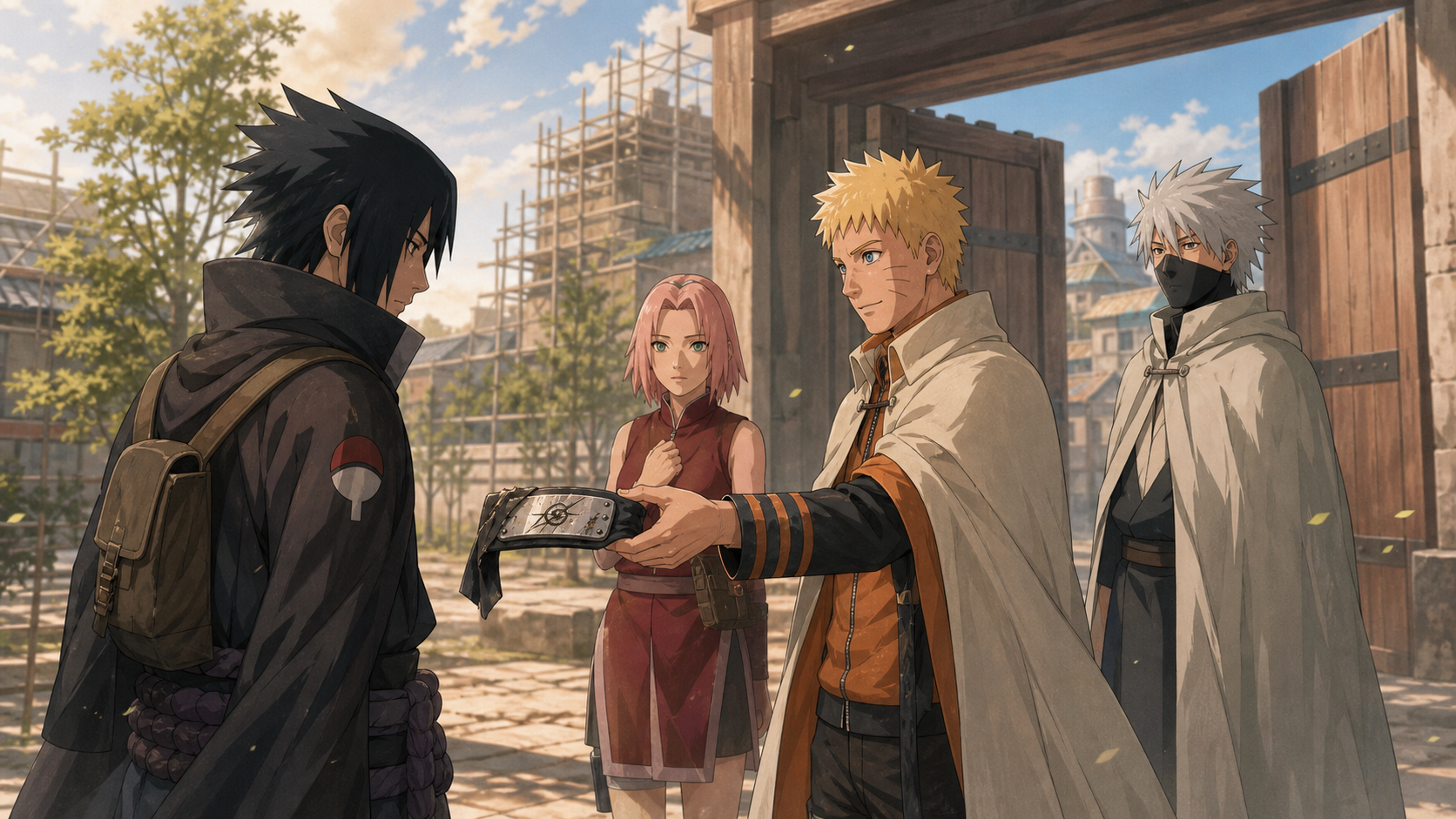
Naruto Uzumaki!!
The war ends through cooperation, but mercy remains conditional and Sasuke must carry accountability into years of conduct nobody can perform for him.
Bottom line
“Naruto Uzumaki!!” closes the Fourth Shinobi World War by making survival answerable to the future. Sakura and Kakashi find Naruto and Sasuke bleeding beside each other, and Sakura heals both without pretending Sasuke never harmed her. His apology matters because he names wrongdoing without asking her to erase the record. Naruto and Sasuke then release Infinite Tsukuyomi together, Sasuke frees the tailed beasts, and funerals place victory beside permanent loss. Kakashi becomes the Sixth Hokage while Sasuke receives a conditional pardon shaped by war service, Naruto's advocacy, and Kakashi's authority. That outcome is mercy, not proof that justice has finished. Sasuke chooses an atonement journey rather than immediate comfort, refuses Sakura's request to accompany him, and answers her through the same forehead touch Itachi once gave him. Naruto returns the scratched forehead protector saved since their first Valley battle. The exchange completes an old promise without restoring their childhood. Naruto has changed the shinobi world by refusing to discard one person, yet Sasuke must now change through years of conduct nobody can perform for him.
Episode 479 adapts the postwar ending of manga chapter 699
Episode 479 is titled “Naruto Uzumaki!!” The Japanese title is “Uzumaki Naruto!!” The episode aired in Japan on October 13, 2016.
The episode expands the manga's immediate postwar transition with reconstruction, mourning, Academy scenes, and a broader view of Naruto's new public standing.
Sakura and Kakashi reach the valley
They find the final battlefield carved open and Team 7's two boys lying at the edge of death. Neither reunion resembles the triumphant return once imagined.
The team comes together among consequences.
Sakura begins healing both survivors
Her medical work keeps Naruto and Sasuke alive after their severed arms and blood loss. Care remains an action before forgiveness becomes a discussion.
Sakura protects life without surrendering judgment.
Naruto thanks her
The small acknowledgment restores ordinary teamwork after battles fought at mythic scale. Naruto recognizes labor directed toward his survival.
Gratitude brings the story back to human size.
Sasuke tells Sakura not to bother
His first response still carries the belief that his body can be discarded. Death has repeatedly looked easier than living beside damage he caused.
Self-rejection cannot substitute for accountability.
Sakura orders him to let her concentrate
She rejects his attempt to decide whether her care has value. Her irritation also refuses a sentimental scene built entirely around his feelings.
The medic controls the treatment.
Sasuke apologizes
He says he is sorry for everything he has done. The wording reaches beyond one attack toward years of abandonment, manipulation, threats, and attempted murder.
An apology opens a door but does not settle the debt.
Sakura cries through anger
Relief, exhaustion, grief, and fury arrive together. Her tears do not convert abuse into romance or make pain disappear.
Emotional release remains different from absolution.
Team 7 briefly laughs together
The laughter sounds awkward because reunion comes after catastrophe rather than a completed mission. Kakashi sees fragments of the children he first trained.
Familiarity survives without innocence.
Kakashi remembers their first introduction
Naruto wanted recognition, Sakura centered Sasuke, and Sasuke centered revenge. Those early declarations contained the conflicts that shaped their team.
The memory measures growth and unfinished work.
Kakashi believes Sasuke has returned
Return cannot mean resuming life exactly where departure interrupted the team. Sasuke has rejected revolutionary terror, but belonging still requires consent from people he harmed.
Homecoming must be earned in practice.
Sasuke reflects on Naruto's persistence
Naruto never accepted the claim that isolation made Sasuke unreachable. That refusal helped break the reincarnation conflict and stopped another solitary ruler.
Persistence succeeded because connection survived underneath resistance.
The God Tree begins to wither
Roots that held the world's bodies lose their power. The physical collapse mirrors the rejection of peace imposed through unconscious captivity.
Freedom returns through imperfect waking life.
Naruto and Sasuke form the release seal
Each has one remaining hand, so cooperation becomes physically necessary. The powers received from Hagoromo cannot complete the task through either survivor alone.
Interdependence becomes the first postwar fact.
Infinite Tsukuyomi ends
People across nations wake from private dreams designed around unmet desire. Release means returning them to grief, conflict, responsibility, and choice.
Reality is painful because reality belongs to everyone.
Sasuke releases the tailed beasts
The beings he imprisoned as fuel for revolution regain freedom. Their liberation is a required action, not a favor proving his kindness.
Renouncing control begins with ending captivity.
The beasts leave on their own terms
Their destinations do not need to serve a village's military strategy. Kurama's bond with Naruto also differs from compulsory confinement imposed on earlier jinchuriki.
Peace must include nonhuman autonomy.
Tenten helps free Samui and Atsui
The Benihisago still contains the Cloud siblings swallowed during the war. Darui receives the tool so their rescue can finally happen.
Smaller recoveries remain part of victory.
The war dead receive funerals
Konoha mourns people who will not wake with everyone else. Shikaku, Inoichi, Neji, and countless shinobi leave absences no celebration can repair.
The ending refuses a victory without graves.
Neji's absence changes every reunion
His death cannot become a motivational ornament for surviving characters. Hinata, Naruto, the Hyuga family, and their peers carry a relationship that ended during battle.
Peace arrives too late for him.
The intelligence leaders leave unfinished families
Shikaku and Inoichi died transmitting the final strategy to the alliance. Their children inherit grief alongside the public language of sacrifice.
National survival does not reduce private loss.
Reconstruction begins across Konoha
Buildings, roads, institutions, and households require repair after mobilization. Postwar life depends on workers whose names never appear in battlefield rankings.
Rebuilding is collective labor.
Kakashi becomes the Sixth Hokage
Tsunade's successor enters office with direct knowledge of ANBU secrecy, war, Team 7's failures, and the cost of inherited conflict. Authority now carries an obligation to confront those systems.
A new face on the monument is only a beginning.
Naruto does not become Hokage immediately
Saving the world does not automatically provide administrative training, legal knowledge, or institutional experience. Recognition has arrived before readiness for office.
The delay protects the meaning of his dream.
Naruto returns to Academy study
Iruka assigns the education Naruto skipped while developing extraordinary combat power. The hero must still learn ordinary material required for leadership.
Achievement does not cancel preparation.
Iruka remains his grounding teacher
Their relationship began when one adult saw a child instead of only a jinchuriki. Now Iruka can challenge Naruto without worshiping his public status.
Belonging includes someone willing to assign homework.
Naruto becomes a village celebrity
People who once avoided him now seek his attention and celebrate his name. Public love repairs part of an old wound while creating a new risk of shallow admiration.
Recognition cannot rewrite earlier abandonment.
Young admirers follow him
Fans respond to the savior described by public memory rather than the lonely boy known by a few teachers and friends. Naruto receives the visibility he demanded as a child.
Fame is not the same relationship as care.
Konohamaru watches the changed village
Naruto's younger rival has seen ridicule turn into reverence. The transformation confirms that a village can revise its judgment, although delayed acceptance still deserves examination.
Community growth does not erase communal failure.
Sasuke faces imprisonment
His actions against the Five Kage, Killer B, Team 7, the alliance, and the tailed beasts create legitimate grounds for detention. The cell prevents reunion from bypassing legal consequence.
Private forgiveness cannot decide a public case alone.
Kakashi grants a pardon
The Sixth Hokage weighs Sasuke's decisive role in ending Infinite Tsukuyomi and the war. Naruto's advocacy also influences the decision.
Mercy comes through political authority and therefore remains open to scrutiny.
War service does not erase earlier violence
Saving lives can matter during sentencing without turning prior victims into accounting entries. A pardon closes formal punishment faster than moral repair.
Legal freedom and restored trust are separate outcomes.
Konoha also owes Sasuke truth
The village leadership enabled the Uchiha massacre, concealed responsibility, and used Itachi's loyalty until his death. Any judgment that ignores state violence would be incomplete.
Accountability must run in both directions.
Sasuke chooses to travel
He leaves to understand the world from outside the perspective of revenge, Konoha, and inherited clan conflict. The journey also gives him distance from immediate rewards for changing sides.
Reflection becomes work rather than exile alone.
He names the journey as atonement
Atonement requires more than feeling guilty. Future choices must protect people, reveal hidden threats, accept limits, and remain accountable when nobody offers praise.
Repentance gains meaning through duration.
Sakura asks to accompany him
Her request carries affection and a desire for a relationship beyond repeated departure. She also deserves a future not organized entirely around waiting for Sasuke.
The question exposes unequal emotional history.
Sasuke refuses her request
He says his path has nothing to do with her sins, correcting any suggestion that she shares responsibility for his crimes. Traveling alone may help him resist using closeness as escape.
The refusal is kinder than accepting care he cannot yet return responsibly.
The forehead touch recalls Itachi
Sasuke taps Sakura's forehead before promising another time. The gesture carries affection, delay, distance, and the shadow of a brother who repeatedly postponed honesty.
Inheritance can comfort while repeating an old wound.
Sakura receives a real acknowledgment
Sasuke thanks her rather than dismissing her presence. The scene gives emotional recognition without presenting a fully repaired partnership.
One gentle gesture cannot complete years of relational work.
Naruto waits at the village boundary
Their farewell belongs to the two boys whose conflict structured the series. Naruto does not block Sasuke's movement now that departure is chosen without a plan for destruction.
Care finally makes room for distance.
Naruto returns the scratched forehead protector
He kept Sasuke's headband from their first Valley of the End fight, when Sasuke proved he could scratch the Leaf symbol during combat. The object survived pursuit, war, and ideological rupture.
Naruto carried evidence of both conflict and promised reunion.
Sasuke accepts the old symbol
Taking the protector does not mean blind loyalty to Konoha or denial of the massacre. He accepts a bond to Naruto and a shinobi identity no longer defined only through severance.
Belonging can include criticism of home.
The scratch remains visible
The damaged metal is not replaced with a clean emblem. Their bond keeps the mark of violence rather than staging recovery as a return to untouched childhood.
Repair preserves evidence.
Naruto has kept his promise to Sakura
He brought Sasuke back from the path toward destruction, but the result differs from the simple Team 7 restoration once imagined. Sakura's own labor, Kakashi's guidance, and Sasuke's decision also shaped the outcome.
No single hero owns the reunion.
The title finally fits Naruto differently
The name once shouted for attention now identifies someone recognized across the shinobi world. His greatest success came from refusing Madara, Kaguya, and Sasuke's versions of peace without consent.
Recognition follows responsibility rather than spectacle alone.
The main manga conflict reaches closure
Episode 479 ends the central war and Naruto-Sasuke struggle adapted from the original manga's concluding chapter before the later epilogue. Remaining episodes explore postwar lives and novel-based stories.
Closure becomes a bridge instead of a full stop.
The postwar world remains unfinished
The villages still rely on militarized child training, clan power, secrecy, and leadership structures capable of burying crimes. One alliance formed during crisis does not guarantee durable reform.
Naruto inherits a peace that needs maintenance.
Sakura’s care does not erase her anger
I need this episode read with Sakura’s agency intact. She arrives as the medic whose skill keeps both men alive, not as a prize waiting at the end of their fight. She can treat Sasuke and remain furious with him. She can accept an apology and still carry the memory of genjutsu, threats, abandonment, and years spent watching people excuse his harm because his pain was real. Care is an action she chooses. It is not evidence that consequence disappeared.
Sasuke’s apology works because he does not add an excuse or demand that Sakura comfort him. It is brief because the valley is an emergency room before it is a reconciliation chamber. More words will have to come later. So will listening. The scene opens that work without pretending one sentence performs it.
A pardon is a political decision
Kakashi’s mercy cannot be separated from his new office, Naruto’s influence, Sasuke’s war service, or Konoha’s own hidden crimes. That complexity is why I resist both easy answers. Saying Sasuke saved the world does not erase the people he attacked. Saying he deserves punishment without naming the Uchiha massacre lets the village judge a survivor while protecting the system that helped create the crisis.
A responsible pardon would need conditions, transparency, supervision, testimony, and meaningful restitution. The episode gives us the emotional logic more clearly than the public process. That gap matters. Justice cannot depend on whether the Hokage personally trained you or whether the village hero calls you a friend. Institutions need standards that still function for people without extraordinary advocates.
The tailed beasts leaving is part of the ending
Releasing Infinite Tsukuyomi wakes humanity, but freeing the tailed beasts confirms that Sasuke has surrendered the right to use other lives as political equipment. They do not owe the villages another military alliance because they helped save everyone. They get to leave, choose relationships, and decide what contact with humans looks like next.
Kurama’s continued bond with Naruto should be understood through that same autonomy. Their partnership became meaningful because coercion changed into conversation and choice. A peaceful future cannot simply rename captivity as friendship while leaving the seal and state claim untouched. The beasts’ freedom belongs beside every human funeral and reconstruction scene.
Fame is not retroactive care
Watching Konoha celebrate Naruto is satisfying and uncomfortable. The village that once treated him as a threat now wants proximity to its savior. Communities can change, and he deserves joy in that recognition. But applause after heroism does not become childhood protection. The adults who looked away do not get rewritten as supporters because the child they abandoned became useful.
Iruka remains essential because he cared before consensus made it safe. He can assign Naruto homework now because their bond was never built on celebrity. That ordinary accountability is a better foundation for leadership than the crowd’s sudden devotion. Naruto needs people who remember the lonely boy without trapping him there or worshiping the famous man who replaced him.
The scratched forehead protector preserves the record
I love that Naruto returns the damaged headband instead of a polished replacement. The scratch is evidence. It remembers rivalry, departure, violence, and a promise that survived without restoring innocence. Sasuke can accept connection to Naruto and Konoha while continuing to name what the village did. Belonging does not require historical amnesia.
The object also marks a healthier separation. Naruto does not chase Sasuke this time because travel is not the same as severance. Sasuke leaves without planning conquest, and Naruto trusts distance that includes a route back. Their bond finally stops treating physical proximity as proof of loyalty.
Reconstruction needs the people whose labor rarely receives a monument. Medics, builders, cooks, messengers, archivists, teachers, and families are the ones turning a battlefield victory into a livable morning. Naruto’s name may headline the peace, but his politics will be measured by whether those people have safety, resources, and a voice after the famous fighters leave the frame. That includes civilians from smaller nations whose homes became routes for wars planned elsewhere. It includes surviving shinobi asked to return to ordinary life with injuries and memories nobody can see. It includes children entering an Academy that still trains them for state violence. If the alliance learned anything, it should be that shared survival creates shared responsibility. The villages cannot celebrate cooperation during crisis and then rebuild the same hierarchies in private. Peace deserves budgets, records, care, and participation, not merely statues of the people who won it.
Final verdict
“Naruto Uzumaki!!” gives the war an ending without pretending every consequence can fit inside celebration. Sakura saves both teammates and receives Sasuke's apology, yet her care does not erase what happened. Naruto and Sasuke free the world through cooperation neither could replace with solitary power. Funerals interrupt victory, reconstruction distributes responsibility beyond famous fighters, and Kakashi's new office turns moral claims into institutional decisions. Sasuke's pardon remains ethically uneasy because mercy, state guilt, war service, and victim accountability all share the frame. His departure works because the story denies him immediate domestic comfort as a reward for surrender. Sakura's requested future remains postponed, Naruto's friendship leaves room for distance, and the scratched forehead protector keeps damage visible. The episode honors Naruto by showing what his name now means: not flawless leadership, universal forgiveness, or a world already fixed, but a person who made continued life possible and insists that connection carry responsibility into whatever comes next.
Sources and watch notes
- Naruto Official episode guide for the official series record.
- Crunchyroll for the licensed episode route where available.
What I am carrying forward
Episode 480 begins the postwar character stories. I am carrying forward Sakura’s lifesaving labor and unresolved hurt, Sasuke’s conditional freedom, the tailed beasts’ autonomy, Konoha’s debt to the Uchiha truth, Naruto’s unfinished education, and the scratched forehead protector. Peace now has to become ordinary conduct instead of one extraordinary battlefield decision.