
Orochimaru vs. Jinchuriki
The spectacle looks symmetrical until you ask who chose the experiment.
The battle looks symmetrical until you ask who chose it
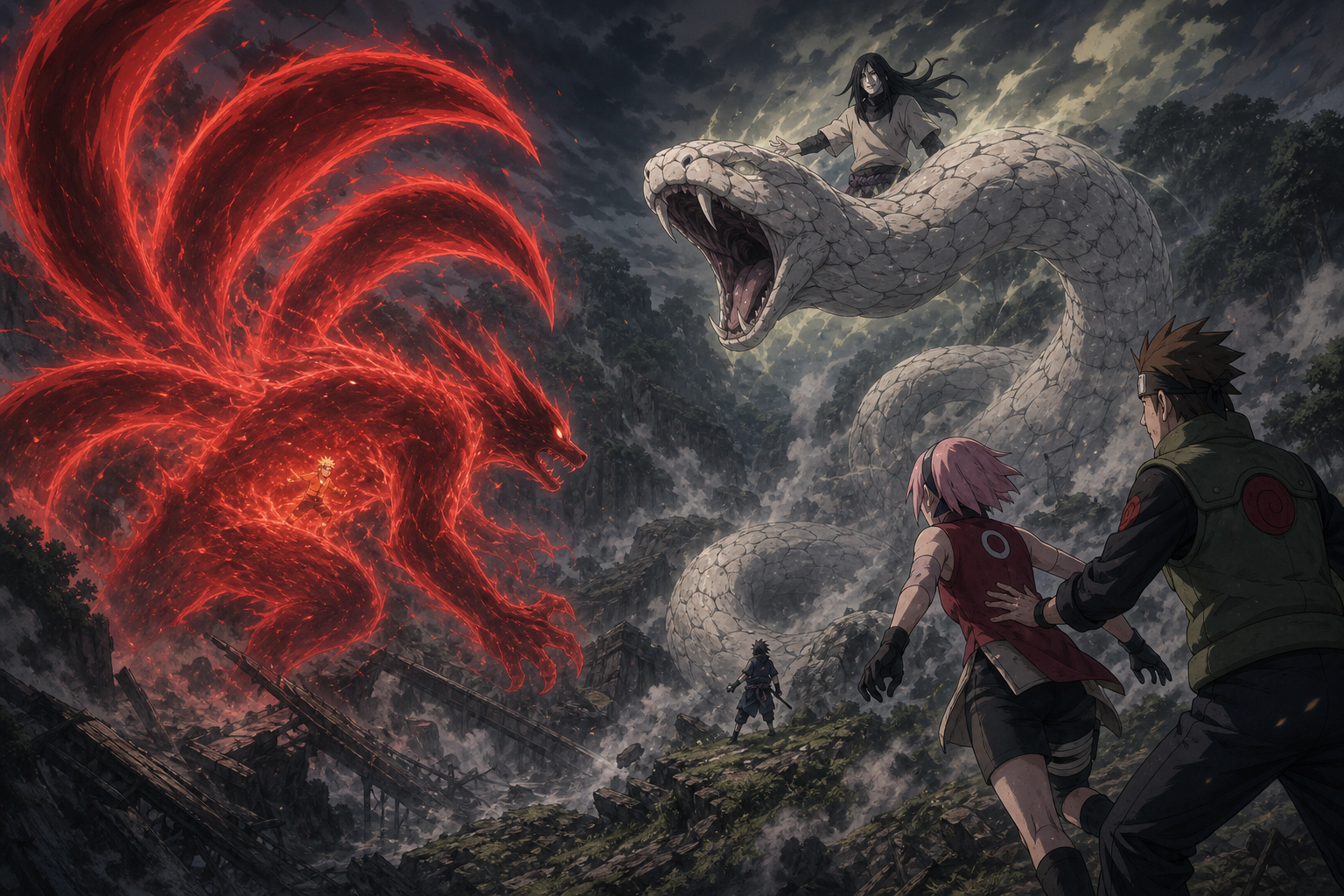
Episode 42 delivers the confrontation promised by the previous transformation. Naruto reaches the four-tailed state and loses conscious awareness. Orochimaru answers with giant snake techniques, bodily replacement, and the Kusanagi blade.
At a distance, the scene can look like two monsters testing one another. Both reshape the battlefield. Both survive damage that should end an ordinary fight. Both use bodies in ways that exceed normal human limits.
The symmetry is visual, not ethical. Orochimaru chose experimentation and treats bodies as disposable shells. Naruto is trapped inside power that consumes his body while overriding his will.
One participant is fascinated by the destruction. The other is no longer capable of consenting to it.
Four tails erase the distinction Naruto needs most
Naruto’s bond with Sasuke triggered the escalation, but the four-tailed form no longer protects the meaning of that bond. The transformed Naruto attacks according to destructive impulse. Ally and enemy cease to function as moral categories.
This is the cruel contradiction of the scene. Naruto wanted enough power to overcome Orochimaru and reach Sasuke. The chakra gives him power while removing the judgment required to save anyone.
At this stage, calling the transformation “Naruto fighting” becomes misleading. His body remains at the center, but Naruto’s ordinary awareness has receded. The Nine-Tails’ chakra turns his pain into an autonomous weapon.
The more visually dominant he becomes, the less agency he possesses. Spectacle grows while personhood shrinks.
Orochimaru treats replacement as immortality practice
Orochimaru survives Naruto’s attacks through repeated bodily replacement. Damage that would carry consequence for another person becomes a reason to discard one shell and emerge from another.
The technique reflects his entire philosophy. Bodies are containers with expiration dates. Identity belongs to the consciousness and knowledge he intends to preserve, not to the flesh carrying them at a given moment.
That belief allows him to treat injury as data. He can test the four-tailed jinchūriki without respecting his own body because another shell can absorb the cost.
Naruto has no equivalent protection. The corrosive chakra tears at the body he must continue living in. Orochimaru externalizes consequence through replacement. Naruto internalizes consequence through injury.
The battle therefore dramatizes two relationships to embodiment. Orochimaru refuses the limits of any single body. Naruto is imprisoned by a body carrying power larger than his current control.
Kusanagi measures force without restoring control
Orochimaru’s Kusanagi blade extends the experiment. He uses it to test the transformed Naruto’s durability and push the chakra body across the devastated landscape.
The weapon’s failure to produce an ordinary wound emphasizes the scale of the transformation, but durability should not be confused with safety. Naruto can resist penetration while the chakra continues damaging him from within.
This is another way the fight deceives the eye. An attack fails to break the outer form, so Naruto appears protected. The protection itself is corrosive.
Orochimaru does not care about that cost. He wants to learn what the form can withstand. Yamato and Sakura care because survival includes the condition Naruto will be in after the power is gone.
Sakura runs toward the person, not the weapon
Sakura sees Naruto inside the threat even when Naruto cannot see her. She moves toward him despite Yamato’s warning because emotional recognition pulls harder than tactical distance.
The impulse is compassionate and dangerous. The four-tailed form does not reward loyalty with restraint. Naruto’s conscious bond with Sakura cannot guide power he is not consciously directing.
Her approach exposes the limit of believing love automatically reaches the person underneath. Sometimes the person is inaccessible until the immediate danger is contained.
Sakura’s medical training tells her Naruto is being harmed. Her history tells her he would never choose to hurt her. Both truths push her forward. Yamato understands the third truth: intention cannot protect Sakura while Naruto has no control.
The scene is not about Sakura being foolish for caring. It is about care needing a safe method. Running into the chakra may turn one person’s crisis into two.
Yamato has to protect Sakura from Naruto and Naruto from himself
Yamato’s responsibility has expanded beyond mission command. He must prevent Sakura from reaching a lethal distance, suppress the Nine-Tails’ chakra, and keep Orochimaru from exploiting the transition.
The task requires him to hold two versions of Naruto in mind. The visible form is an immediate battlefield threat. The person inside is a teammate who needs rescue.
Treating only the threat would justify lethal force. Treating only the teammate would underestimate the danger. Yamato’s Wood Release offers a path between those failures.
This is why his appointment matters. He possesses an ability suited to containment and a leadership philosophy that still recognizes the contained person as human.
Danzō might call Naruto an asset that has become unstable. Yamato acts as though Naruto must return, not merely stop.
Sai makes contact while the team breaks apart
Sai’s hidden mission advances during the battle. He approaches Orochimaru while Naruto, Sakura, and Yamato are separated by the chakra emergency.
The decision repeats the simulation on a larger scale. Sai leaves a teammate in danger to complete the objective he has been assigned privately. Root defines success through the order, not through the team’s survival as a unit.
The battlefield gives him cover, but it also creates a moral test. Naruto’s crisis is visible. Sakura and Yamato need help. Sai continues toward Orochimaru because Danzō’s purpose remains more authoritative to him than the people he has traveled beside.
This does not mean Sai enjoys their danger. Root training makes enjoyment irrelevant. He has been taught that emotion should not alter mission priority.
The question is whether contact with the team has created enough friction inside that training to matter later.
The landscape records what the characters cannot say
The destroyed gorge makes the cost visible. Bridge sections splinter. Earth is carved away. Trees and stone become debris around power too large for the original mission.
The damage reflects Naruto’s emotional state. He came seeking a connection and has destroyed the bridge beneath him. He wanted a route toward Sasuke and now leaves a landscape nobody can cross safely.
Orochimaru’s serpent forms move through the ruin comfortably because destruction suits his method. He does not need the bridge to remain useful. He only needs the encounter to yield information and opportunity.
Yamato and Sakura, by contrast, must think about what remains after the fight. Their goal includes recovery, information, teammates, and a path forward. Orochimaru’s goal can survive the scene becoming uninhabitable.
RaeRae’s reaction
This fight is visually incredible and emotionally awful. The four-tailed form looks powerful enough to make every earlier threat feel small, but Naruto is not winning in any meaningful sense. He is absent from the decision-making while his body pays the bill.
Orochimaru’s replacement technique is disgusting because it removes consequence for the person choosing the experiment. He can keep shedding bodies while Naruto has one body being burned by chakra from the inside.
That is why I reject the easy “two monsters” framing. Orochimaru built his relationship to bodies deliberately. Naruto is a teenager losing control of something sealed inside him before he could choose what that relationship would be.
Sakura running forward makes emotional sense and tactical sense only up to a point. She sees her friend suffering. Of course she wants to reach him. But Naruto cannot recognize the rescue while the chakra controls him. Yamato’s warning is not coldness. It is the protection care requires in that moment.
Sai slipping toward Orochimaru while all of this happens makes the secret mission feel even uglier. Root depends on emergencies consuming everybody else’s attention. The team’s pain becomes operational cover.
Yamato remains the moral center because his containment goal is restoration. He wants the threat stopped so Naruto can return. That difference separates restraint from control for control’s sake.
Power without agency is another form of captivity
Episode 42 ends with the battlefield transformed and Naruto more powerful than anyone expected. Yet power has not made him freer.
Orochimaru chooses when to replace a body, when to test a technique, and when to withdraw. Sai chooses to advance his hidden assignment. Yamato chooses how to protect the team. Sakura chooses to move toward Naruto despite the warning.
Naruto, the strongest visible force in the scene, has the least access to choice.
That imbalance is the episode’s real horror. The four-tailed form can resist Kusanagi and devastate a gorge, but it cannot carry Naruto toward Sasuke according to Naruto’s values. Until his agency returns, every increase in power is another layer of captivity.
Official episode reference: Naruto Official episode guide
Licensed episode route: Crunchyroll licensed episode page
The title removes Naruto before the fight even starts
“Orochimaru vs. Jinchuriki” names one combatant as a person and the other as a category. Orochimaru keeps his name, history, intention, and agency. Naruto becomes the military condition imposed on him at birth.
The wording fits the horror onscreen because the fourth tail has made Naruto inaccessible. Still, the category should make us uncomfortable. A jinchuriki is not a species of weapon. It is a person forced to house a tailed beast because a village decided one child’s body could carry communal security.
When spectators call this a monster fight, they repeat the disappearance. Orochimaru wants to become less human through chosen experimentation. Naruto needs other people to remember his humanity while the chakra makes remembering difficult.
Orochimaru can leave every body except the consequences
His replacement technique turns mortality into stagecraft. A damaged shell collapses, another Orochimaru emerges, and the fight continues as though injury were no more binding than a costume change.
That freedom is purchased through other bodies. Orochimaru’s research depends on subjects, vessels, stolen cells, and lives he considers exchangeable. His apparent independence from flesh exists because he has made everyone else’s flesh available to him.
Naruto’s condition exposes the opposite arrangement. He cannot step out of the body absorbing the corrosive chakra. Healing will return the same skin to him only after the transformation has torn it apart. One man exports physical cost. One boy has nowhere to send it.
Durability is not the same as being unharmed
The Kusanagi blade cannot pierce the chakra shell in the ordinary way, so the transformed Naruto appears invulnerable. That appearance rewards the audience for looking only at the outside.
Inside, the chakra is burning tissue and forcing regeneration at a speed the body was never designed to sustain. Resistance to an enemy’s weapon does not mean safety from one’s own power.
Shinobi culture regularly praises the body that keeps functioning. Episode 42 asks whether continued function can hide an injury everyone has decided to call strength.
The Tailed Beast Bomb turns breath into siege machinery
The concentrated chakra attack takes a living function and converts it into artillery. Naruto’s mouth, lungs, and posture no longer communicate. They become parts of a weapons system.
The scale is spectacular, but the spectacle depends on the removal of ordinary human expression. Naruto cannot explain fear, ask for help, or choose a smaller response. The body can only accumulate force and release it.
That is what captivity through power looks like. The prison is not weakness. The prison is having enormous capacity with no control over what the capacity does in your name.
Orochimaru survives because he never promises to protect anything
He can let the bridge collapse, the gorge split, and his own bodies be discarded because none of those losses violate his purpose. He came for access, observation, and advantage.
Team Kakashi has obligations that make the same destruction costly. They need Naruto alive, Sakura safe, Sai accounted for, information preserved, and some path toward Sasuke left open.
Villains often look freer in battle because they have abandoned responsibility. That freedom is not evidence of greater strength. It is the advantage of making everyone else pay for the aftermath.
Sakura’s movement is love without enough information
Sakura knows Naruto would never consciously choose to hurt her. She does not yet have the full technical understanding of how completely the fourth tail has displaced conscious choice. Her emotional knowledge is true but insufficient for the state in front of her.
This is why the adults’ secrecy matters. Jiraiya and Yamato understand the threshold. Tsunade knows why Yamato was assigned. Sakura is expected to operate beside Naruto without the same map of danger.
Running forward is not proof that she cares more than Yamato. Holding her back is not proof that Yamato cares less. They are responding with different knowledge, and leadership has failed if critical safety knowledge reaches teammates only after the crisis begins.
Yamato’s Wood Style carries a history the fight cannot show
Onscreen, Wood Style looks like the perfect technical counter to Nine-Tails chakra. The fit risks becoming too neat. Yamato has the right power, Naruto has the dangerous power, and the captain can restore order.
Nothing about their histories is neat. Yamato’s cells were altered through Orochimaru’s infant experiments. Naruto’s body became a container through a village decision made on the night he was born. The rescue works because two violations happen to be compatible.
We can value Yamato’s choice to protect Naruto without calling the route that produced his ability acceptable. A good use does not retroactively bless the abuse.
Containment has to end in return, not compliance
Yamato’s goal separates his intervention from the control Orochimaru and Danzō pursue. He does not need Naruto to become obedient to him. He needs Naruto’s consciousness restored and his body protected from further damage.
The moral test comes after the battlefield quiets. Will Naruto receive the truth about what happened? Will Sakura be allowed to understand the danger? Will the team build a plan together, or will the adults simply congratulate themselves because the asset was stabilized?
Restraint is care only when it preserves the person’s future agency. Otherwise the village is repeating the logic that created the jinchuriki.
Sai’s meeting turns his teammates into a distraction
Every moment Naruto holds Orochimaru’s attention also improves Sai’s access. Sakura’s panic and Yamato’s containment work keep them from following. The team’s emergency becomes the mechanism of Root’s progress.
Sai does not create the transformation, but he accepts its usefulness. That choice matters. People are responsible not only for disasters they cause, but for what they decide to extract from somebody else’s disaster.
Root has trained him to call the extraction discipline. The audience can see the cost because we remain with the people he leaves behind.
Hidden orders make informed loyalty impossible
Yamato cannot decide whether Sai’s assignment deserves support, refusal, or modification because he does not know the assignment exists. Sakura and Naruto cannot decide what degree of trust Sai has earned. Danzō has preempted everyone’s judgment by withholding the facts.
That is not operational efficiency. It is domination through information. The hidden mission remains protected from ethics because the people carrying its risks are denied the chance to object.
A team cannot consent to serve as cover when only one member knows cover is the job.
Kabuto’s healing ability makes his indifference sharper
Kabuto understands anatomy, injury, and recovery. He knows that a body continuing to move may still be sustaining terrible damage. Watching him assist Orochimaru therefore carries a different moral weight from ignorance.
Medical knowledge gives him the language to recognize Naruto’s condition. Allegiance teaches him to translate that condition into useful observation.
Expertise does not produce care on its own. Care begins when knowledge changes what harm a person is willing to permit.
The fight previews what Naruto must learn before saving Sasuke
Naruto believes determination and greater strength will close the distance to Sasuke. Episode 42 demonstrates why strength without self-command cannot complete that promise.
Reaching Sasuke will require Naruto to hear an answer he may hate, distinguish coercion from choice, and remain present when grief becomes anger. The fourth-tailed form can do none of that. It can only destroy the space where a conversation might occur.
If Orochimaru can produce the transformation by saying Sasuke’s name, then Naruto’s bond has become an enemy-controlled switch. Love deserves a form that does not surrender authorship to the person exploiting it.
The battlefield cannot tell us who the monster is
Visually, the giant pale serpent and the crimson chakra body occupy the same category. Both are distorted, destructive, and far beyond ordinary human scale. Ethics requires information the image alone cannot provide.
We have to ask who chose, who was altered, who can stop, who benefits, and whose body will carry the damage afterward. Those questions break the false symmetry.
Orochimaru remains a person while choosing monstrous methods. Naruto remains a person while a monstrous condition takes control away from him.
RaeRae’s full take
I understand why this fight is remembered as a spectacle. Orochimaru sheds bodies, Kusanagi stretches across the gorge, and four-tailed Naruto turns the landscape into something that looks bombed. None of that is the part I can stop thinking about.
Naruto is the most powerful figure on the screen and the only major participant who cannot choose. Orochimaru chooses every experiment. Sai chooses the hidden mission. Yamato chooses containment. Sakura chooses to run toward her friend. Naruto’s body produces the biggest decisions while Naruto is absent from all of them.
Calling that power feels obscene. The cloak is burning him, his bond with Sasuke has been converted into a trigger, and the enemy is collecting data from every second of the collapse.
Yamato’s response matters because he does not look at Naruto and see a failed weapon. He sees somebody who has to come back. Sakura sees the same person, but love alone cannot safely cross the chakra. Care needs truth, planning, and sometimes restraint.
Then Sai uses the moment to reach Orochimaru, because Danzō built a mission that profits when everyone else is too busy surviving to ask questions. Root calls emotional absence professionalism. I call it a system teaching a young man that other people’s emergencies are convenient.
There are not two monsters in this gorge. There is one adult who chose to make bodies disposable and one teenager whose body was chosen for him. If we cannot keep that difference clear when the animation gets loud, the spectacle has swallowed the story.
RaeRae checkpoint: Naruto can resist Kusanagi and still be profoundly unsafe. Invulnerability on the outside means nothing when the power protecting the body has evicted the person who lives there.
Receipts and official routes
- Episode placement, the four-tailed battle, Orochimaru’s replacement techniques, Kusanagi, and Sakura and Yamato’s response: Naruto Official Site episode guide.
- Licensed episode route: Crunchyroll.