
The Top-Secret Mission Begins
The loudest emergency creates cover for the quietest betrayal.
The loudest emergency hides the quietest betrayal
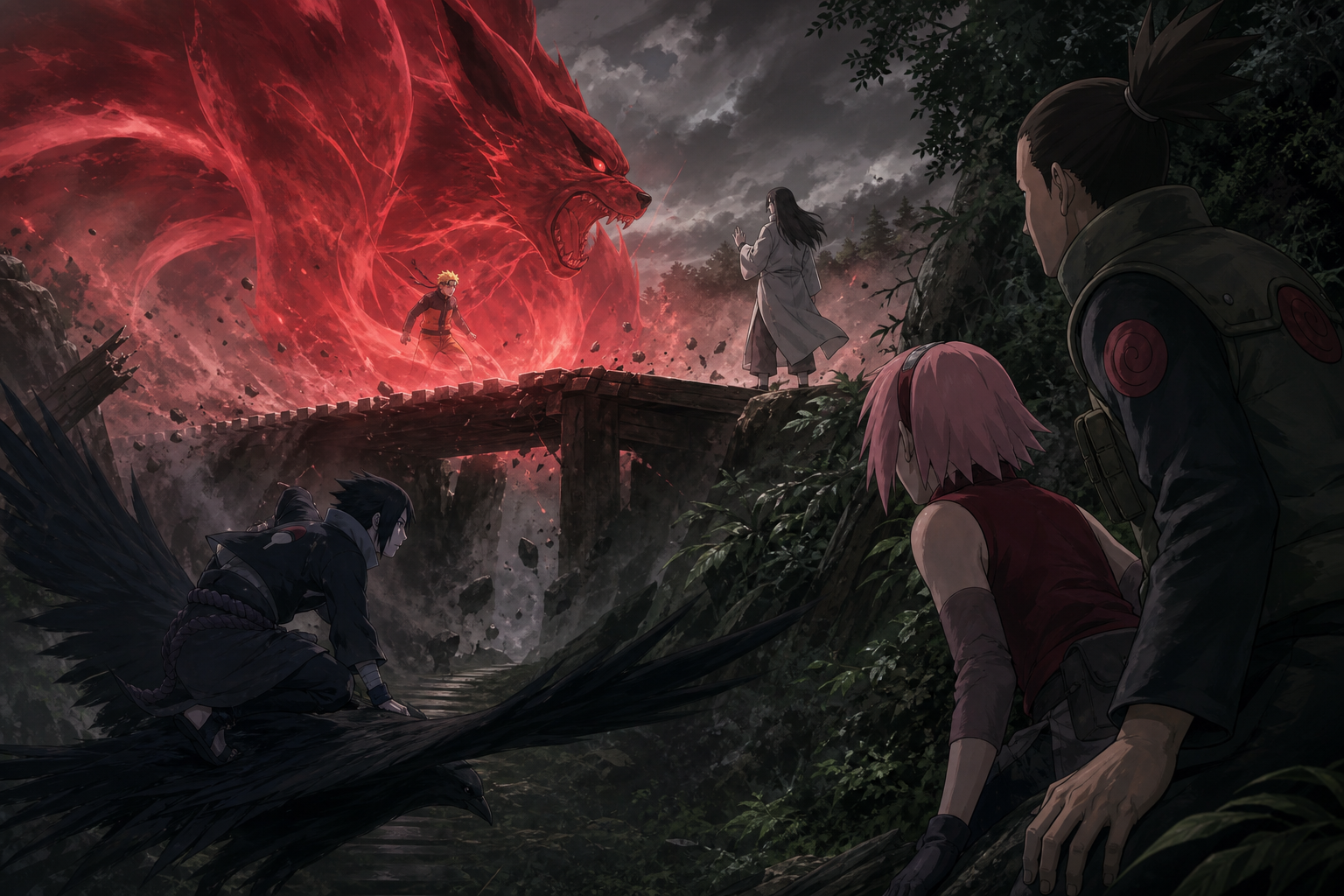
Episode 41 splits the Tenchi Bridge crisis into two missions. The visible mission is survival. Naruto’s Nine-Tails chakra continues escalating until his awareness narrows to Orochimaru alone. Yamato and Sakura have to contain a teammate who can no longer recognize them as allies.
The hidden mission belongs to Sai. While everybody watches the chakra battle, he moves toward Orochimaru under Danzō’s separate orders. The chaos does not interrupt his assignment. It creates the cover he needs to begin it.
That contrast gives the title its sharpest meaning. The top-secret mission begins not in silence, but behind something louder. Institutions hide agendas by placing them where nobody has attention left to spare.
Naruto loses sight before he loses power
As the third tail appears, Naruto’s perception collapses around a single target. Orochimaru becomes the only figure he can see. Teammates, surroundings, and the original intelligence objective stop carrying meaning.
This is the danger Episode 40 prepared us to understand. The Nine-Tails’ chakra does not simply increase Naruto’s strength. It reduces his capacity to choose how that strength serves him.
Naruto entered the mission to find Sasuke. Now he cannot recognize Sakura or Yamato, the people helping him pursue that goal. The bond that triggered the transformation no longer guides the action. Rage has preserved the target and erased the purpose.
Orochimaru welcomes that narrowing. An opponent who sees only him can be led away from everything else. Naruto’s destructive attention becomes predictable even as his power becomes harder to contain.
The fourth tail changes the category of the threat
Yamato carries Jiraiya’s warning about the fourth tail because that threshold marks more than another increase. Naruto’s recognizable human form gives way to a chakra body driven by destructive impulse.
Jiraiya nearly died during a previous transformation. That history tells Yamato what ordinary battlefield instinct cannot. Approaching Naruto through familiarity may not work. The person inside is no longer responding normally to voices, faces, or concern.
The danger is also self-directed. The chakra damages Naruto while giving him power. His body is being used as fuel for an attack he cannot consciously regulate.
Yamato has to suppress the transformation before Naruto kills an ally, destroys himself, or gives Orochimaru an even clearer demonstration of the jinchūriki’s limits. The mission against an external enemy becomes an emergency rescue of its own member.
Orochimaru treats the jinchūriki as an experiment
Orochimaru answers the transformation with curiosity. Snake techniques and the Kusanagi blade are not only weapons. They are tests. He wants to learn what the chakra body resists, how it moves, and how far Naruto’s loss of control can be pushed.
That attitude makes the fight especially ugly. Naruto’s grief is a crisis to Sakura and Yamato. To Orochimaru, it is useful data.
He does not respect the distinction between a person and the power housed inside that person. Bodies are vessels, experiments, and potential replacements throughout his worldview. Naruto’s transformation fits neatly into that framework.
The battle therefore stages two opposite responses to dangerous power. Orochimaru probes it because he wants knowledge and control. Yamato prepares to suppress it because Naruto’s life and agency matter.
Sai recognizes the moment Danzō prepared him for
Sai’s movement toward Orochimaru confirms that his official membership in Team Kakashi was never the whole mission. Danzō placed him where access to Orochimaru might become possible, and the bridge chaos opens that route.
From Sai’s perspective, leaving the team may resemble the simulation. The visible group is occupied. The covert objective remains available. He can prioritize the assignment without allowing attachment to interfere.
The difference is that the real mission carries consequences nobody rehearsed. Naruto is not a simulation obstacle. Sakura and Yamato need every available teammate. Sai’s departure makes a private institutional goal more important than the emergency affecting the people beside him.
Root trained him to interpret that choice as discipline. The episode presents it as betrayal, even before the others have time to notice.
Danzō and Tsunade sent different teams to the same place
Officially, Tsunade sent Yamato, Naruto, Sakura, and Sai to contact Sasori’s spy and locate Orochimaru. That team shares one destination and a public chain of command.
Danzō effectively sent another team inside it: Sai alone, carrying orders that answer to Root. The other three serve as access, cover, and potentially expendable context for that assignment.
This arrangement reveals how factional power works inside the Hidden Leaf. Danzō does not need to overrule the Hokage openly. He inserts an operative into her mission and allows the official structure to transport his private objective.
The method depends on information imbalance. Yamato cannot lead around a purpose he has not been told. Sakura and Naruto cannot evaluate Sai’s choices against orders they do not know exist.
Teamwork requires a shared definition of success. Episode 41 proves the team has been carrying two definitions from the beginning.
Sakura cannot reach Naruto through the promise alone
Sakura has spent the mission trying to keep Naruto’s loyalty to Sasuke from becoming self-destruction. At the bridge, words and shared history are no longer enough.
The transformed Naruto cannot recognize her normally. That is a devastating reversal. Naruto’s commitment to his friends is the reason the chakra surfaced, yet the chakra now makes those friends invisible to him.
Sakura’s medical skill cannot solve the problem while the chakra continues burning through his body. She needs Yamato’s suppression ability to restore a state in which healing and communication can matter.
The scene demonstrates why support is not secondary to strength. Naruto’s power dominates the battlefield, but he cannot bring himself back. Sakura and Yamato must preserve the person whose body is producing the threat.
Yamato has to lead without the whole team
Yamato’s job is now almost impossible. He has to monitor Orochimaru, protect Sakura, contain Naruto, and account for Sai. The crisis consumes the attention that might have revealed Sai’s departure sooner.
This is exactly how hidden agendas exploit emergency. A captain allocates attention toward the largest immediate danger. The covert actor moves through the unattended space.
Yamato’s preparation helps with Naruto. His Wood Release and knowledge of the transformation give him a containment path. No amount of battlefield preparation can compensate fully for a teammate acting on undisclosed orders.
Leadership depends on reliable information. Danzō has denied Yamato that resource while still making him responsible for the outcome.
A bigger disaster makes the secret easier to carry
The battle’s scale creates moral camouflage. Against a crimson chakra monster and Orochimaru’s techniques, Sai’s quiet movement can look insignificant. That is the point.
People expect secrecy to involve empty rooms and whispered instructions. Episode 41 shows another kind. A secret can travel openly when every witness is occupied by something more urgent.
Danzō’s assignment benefits from Naruto’s loss of control. The team’s worst vulnerability becomes Root’s best opportunity. That connection does not require Danzō to have planned the transformation. It only requires Sai to use the condition once it exists.
The top-secret mission begins because the public mission is breaking apart.
RaeRae’s reaction
This episode is horrifying in two different volumes. Naruto’s transformation is enormous, loud, and impossible to ignore. Sai slipping away is quiet enough to miss. Both threaten the team, but only one announces itself with a shattered bridge.
Orochimaru’s curiosity makes me furious. He looks at Naruto losing his body to rage and sees a test opportunity. Yamato looks at the same power and sees someone who has to be brought back. That difference tells you everything about them.
Sakura’s situation hurts because Naruto’s loyalty is supposed to include her, yet he cannot see her anymore. The chakra was triggered by love and grief, then discarded every relationship except the target of anger. That is not devotion becoming stronger. It is devotion being hollowed out.
Sai’s choice confirms the fear everyone carried from his introduction. He was not added because Danzō believed in Team Kakashi. He was added because the team could deliver a Root operative to an otherwise inaccessible enemy.
I also keep thinking about the simulation. Sai already demonstrated that he would leave Naruto behind to complete an objective. Yamato treated it as a teamwork failure. Danzō likely considers it proof that Sai is ready.
The same behavior receives opposite judgments because the institutions want different kinds of shinobi. Tsunade needs a team that returns with its people. Danzō needs an operative who will continue when people become inconvenient.
Two missions cannot share one team forever
By the end of Episode 41, Naruto is crossing the fourth-tail threshold, Yamato is preparing the suppression he was chosen to perform, and Sai is beginning the assignment nobody else received.
The immediate battle threatens bodies. The hidden mission threatens the meaning of the team itself. If Sai’s objective conflicts with the search for Sasuke or the safety of his teammates, the administrative fiction of New Team Kakashi will no longer hold.
The episode makes the fracture visible to the audience before every character can respond to it. One team arrived at Tenchi Bridge. Two missions leave the rendezvous. They cannot remain aligned much longer.
Official episode reference: Naruto Official episode guide
Licensed episode route: Crunchyroll licensed episode page
The four-tailed body is not Naruto with fewer manners
Once the fourth tail forms, the episode stops presenting an angry boy who might calm down if someone finds the right words. The chakra has built a body over Naruto’s body. It moves according to an animal fury that has access to his grief but not to his judgment, relationships, or original plan.
That distinction matters because people love to romanticize loss of control when the result looks powerful. Naruto is not finally expressing an honest self that manners kept hidden. His skin is being destroyed, his awareness is submerged, and the reason he came to the bridge has been replaced by a single urge to attack Orochimaru.
Sakura runs toward the friend inside the danger
Sakura does not see a military asset that has exceeded safe operating limits. She sees Naruto. That recognition is morally right and physically dangerous at the same time. Friendship keeps her from abandoning him, but friendship cannot make the chakra recognize her.
Her instinct exposes the cruelty of this transformation. Naruto would never knowingly strike Sakura for trying to help him. The force using his body can do exactly that because it has severed power from the commitments that normally direct it.
Care is not proven by pretending danger is harmless. Sakura needs to preserve her own life while refusing the village habit of reducing Naruto to the fox. Both truths have to remain present.
Yamato’s restraint is an act of recognition
Containment can sound cold, especially in a story where villages have imprisoned tailed beasts inside children. Yamato’s task is different in purpose. He is not suppressing Naruto to make him obedient or useful. He is trying to return Naruto to himself before the cloak destroys more of his body and reaches the people he loves.
The Wood Style response treats agency as the goal. A successful intervention is not merely a quiet battlefield. It is Naruto able to see, choose, speak, and understand again.
The seal responds to inherited power, not personal trust
Yamato can suppress the Nine-Tails because Orochimaru placed First Hokage cells in his infant body. The ability comes from abuse, yet it becomes the available tool for protecting another person altered by adults before he could consent.
The symmetry is painful. Neither Naruto nor Yamato chose the bodily condition that defines his usefulness to Konoha. Now the institution assigns one survivor to regulate the other. Their compatibility may save a life, but usefulness cannot substitute for care, truth, or respect.
Sai uses a medical emergency as operational cover
Naruto is experiencing a catastrophic loss of control. Sakura is exposed. Yamato is managing a threat that once nearly killed Jiraiya. Sai sees the same emergency and recognizes an opening for Danzō’s order.
Root training has taught him to separate the objective from the people sharing the field. He does not have to hate Naruto to leave him. He only has to believe that Naruto’s crisis ranks below the concealed mission.
That is why emotional absence can serve institutional violence so efficiently. Cruelty does not always arrive as pleasure in another person’s pain. Sometimes it arrives as disciplined refusal to let that pain alter the schedule.
Danzō spends a team he does not command
Tsunade authorized a reconnaissance mission. Danzō inserted a second purpose and never gave Yamato the knowledge required to plan around it. Root benefits from the transport, intelligence, distraction, and risk carried by Team Kakashi while accepting none of the captain’s authority.
This is not merely one operative keeping a secret. It is an unelected power center using the Hokage’s people as resources for an agenda she did not approve. The secrecy prevents debate because debate might produce refusal.
Danzō’s method lets him claim success if Sai reaches Orochimaru and deny responsibility if the team is destroyed. Hidden orders protect the person who gave them more reliably than the people expected to obey them.
Sai’s ink bird makes departure look weightless
The ink technique is visually elegant. Sai draws movement and rises above the broken ground while everyone else remains trapped in the consequences below. The beauty of the image should not soften the choice.
He is not simply scouting ahead. He is leaving the shared emergency to begin an undisclosed assignment with the enemy. The clean flight expresses exactly what Root promised him: distance from attachment, accountability, and the mess made by competing loyalties.
The simulation was a warning nobody could fully interpret
During training, Sai abandoned Naruto to pursue the objective. Yamato read the decision as proof that Sai did not understand teamwork. The bridge reveals that Sai may have understood his real job perfectly.
Root did not send him to become a better member of Team Kakashi. It sent him to preserve access and obey Danzō when the team’s needs diverged from the hidden order. What looked like a social failure was operational consistency.
Yamato could correct the visible behavior, but he could not remove the command structure rewarding it. A team exercise cannot repair divided authority that leadership refuses to disclose.
Orochimaru turns Naruto’s pain into a demonstration
The battle gives Orochimaru a close view of the Nine-Tails cloak, its defenses, its destructive range, and Yamato’s likely countermeasure. He keeps testing because every exchange teaches him something about Konoha’s weapons and survivors.
Naruto believes the fight concerns Sasuke. Orochimaru has widened it into research. The more Naruto loses himself, the more information the enemy receives.
This is another reason provocation matters. Orochimaru does not need to defeat Naruto cleanly to profit. If anger exposes the seal, the jinchuriki, and Team Kakashi’s containment plan, he has already collected value.
Kabuto understands the injury and continues serving the cause
Kabuto’s medical knowledge should make Naruto’s condition impossible to dismiss. He can recognize bodily damage that other observers may only experience as spectacle. Yet expertise does not automatically produce ethics.
He remains beside the person provoking the transformation. Knowledge becomes another instrument of observation instead of a reason to stop the harm.
The episode refuses the comforting belief that technical competence makes someone responsible. Skill can document suffering while loyalty chooses the system creating it.
Sasuke is absent and still controls the entire battlefield
Sasuke never appears at the bridge, but every faction acts through a different claim on him. Naruto wants to recover his friend. Orochimaru presents Sasuke as a willing possession. Danzō’s hidden objective uses access to Orochimaru, whose plans center on Sasuke’s body.
The absent teenager becomes a destination, bargaining point, weapon, and justification. Very little space remains for what Sasuke wants, why he left, or how coercion and agency coexist in his decision.
A rescue that never makes room for the rescued person’s mind risks becoming another form of possession. Naruto’s love is real, but rage cannot answer the political and emotional questions waiting when he finally reaches Sasuke.
The title belongs to more than Sai
Sai’s assignment is the obvious top-secret mission, yet the episode is full of hidden programs beginning or continuing inside public ones. Yamato carries an origin produced by a concealed experiment. Naruto carries a weaponized history adults explain around him. Orochimaru conducts research inside a fight. Danzō conducts policy inside Tsunade’s team.
Secrecy is not background atmosphere here. It shapes who has enough information to choose. Naruto, Sakura, and Yamato are held responsible for outcomes while other men control the facts.
A mission cannot be shared when success means different things
For Sakura and Naruto, success means finding Sasuke and bringing their teammate home. For Yamato, it includes completing reconnaissance and returning his team alive. For Sai, the concealed order can outrank every public objective.
The group therefore has matching uniforms but no common finish line. Teamwork language cannot solve that contradiction. Before trust can grow, the competing mission has to become visible and answerable.
RaeRae’s full take
Naruto is disappearing inside a crisis, Sakura is running toward him, and Yamato is preparing to use the product of his own stolen childhood to bring Naruto back. That alone is enough for one episode. Then Sai looks at the emergency and sees his opening.
I do not need Sai to perform friendship he does not yet understand. I do need the story to name what Root trained into him. He has been taught that another person’s worst moment can become useful cover, and that following the hidden order is cleaner than allowing human need to change the plan.
Danzō is the betrayal before Sai ever makes a move. He placed one mission inside another and left Yamato responsible for people whose orders he could not know. Sai is carrying the choice, but Danzō designed the conditions and protected himself with secrecy.
Meanwhile Orochimaru studies Naruto like pain becomes respectable once somebody takes notes. It does not. Naruto is not a field test, Yamato is not a successful specimen, and Sai is not an empty instrument just because Root worked hard to make him one.
The real emergency is not only the fourth tail. It is every institution in this episode deciding that young people’s bodies, loyalties, and grief are usable materials. Yamato and Sakura resist that logic by trying to return Naruto to himself. Sai has not learned how to resist it yet.
RaeRae checkpoint: The loud battle does not interrupt the secret mission. It hides it. Danzō’s plan works because Naruto’s crisis consumes every ounce of attention that accountability would require.
Receipts and official routes
- Episode placement, Naruto’s four-tailed transformation, Yamato’s containment response, and Sai beginning his hidden assignment: Naruto Official Site episode guide.
- Licensed episode route: Crunchyroll.