
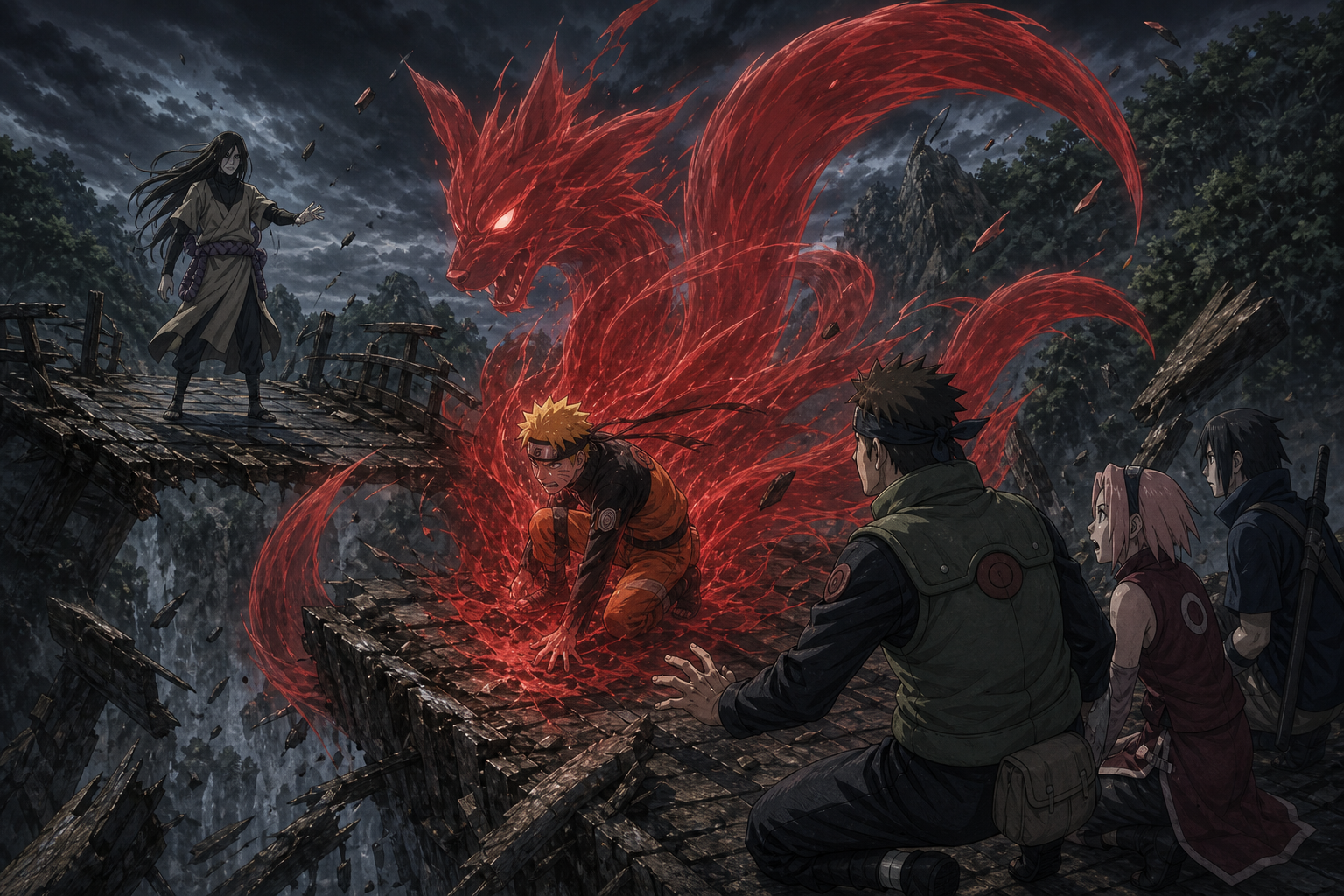
Nine-Tails Unleashed
The power Naruto releases begins removing him from the rescue he wants.
Orochimaru turns Sasuke’s name into a trigger
Episode 40 begins after the Tenchi Bridge operation has collapsed into confrontation. Yamato’s disguise is exposed. Kabuto stands with Orochimaru. The careful intelligence mission no longer protects Naruto from direct contact with the person he blames for Sasuke’s absence.
Orochimaru understands the emotional terrain immediately. He speaks about Sasuke with the confidence of ownership, and Naruto’s anger rises faster than his judgment can contain it. The Nine-Tails’ chakra answers that anger.
This is not power arriving cleanly when Naruto needs it. It is grief finding a target and using Naruto’s body as the route toward destruction. The more Orochimaru provokes him, the farther Naruto moves from the rescue he wants.
The episode title says the Nine-Tails is unleashed, but the frightening part is how little freedom Naruto has inside that unleashing.
Anger feels like action until it removes the person acting
Naruto has spent years turning emotion into forward motion. Anger at injustice makes him intervene. Loyalty makes him endure. Grief makes him refuse to abandon people. Those qualities are central to his strength.
The Nine-Tails’ chakra exploits the same pathway. Naruto feels powerless in front of Orochimaru, so more power appears to offer an answer. Each increase promises that he can force the enemy to return Sasuke or reveal where he is.
Instead, the chakra begins replacing intention with instinct. Naruto’s goal becomes less specific. He is no longer gathering information or protecting the team. He is attacking the object associated with his pain.
That shift is why the transformation is tragic rather than triumphant. Naruto wants to save Sasuke because bonds make people human. The power he reaches for begins stripping away his own ability to recognize the people standing beside him.
Orochimaru understands emotional leverage
Orochimaru rarely needs to invent a weakness. He identifies what another person already wants and offers a distorted route toward it. He gave Sasuke power framed as freedom from helplessness. At Tenchi Bridge, he gives Naruto provocation framed as information.
Every reference to Sasuke invites Naruto to prove his loyalty through rage. Orochimaru does not care whether Naruto’s response is strategically useful. He wants to see the jinchūriki lose control, measure the power, and enjoy the damage.
This makes the encounter an experiment from Orochimaru’s perspective. Naruto is both enemy and specimen. The Nine-Tails’ chakra is valuable because it reveals what the body can do under emotional pressure.
Naruto cannot defeat that manipulation simply by caring more. Orochimaru is already using care as the lever. He needs discipline strong enough to preserve the bond without surrendering control of the body carrying it.
Yamato’s appointment stops looking temporary
The early episodes framed Yamato as Kakashi’s replacement while Kakashi recovered. Episode 40 reveals the deeper reason Tsunade selected him. His Wood Release is capable of suppressing the Nine-Tails’ chakra in ways ordinary strength cannot.
Yamato watches Naruto’s transformation with Jiraiya’s warning in mind. The fourth tail is not an abstract threshold. Jiraiya nearly died when Naruto reached that state during training. A teammate standing too close can be harmed regardless of Naruto’s intentions.
That knowledge changes Yamato’s role. He is not merely directing the operation against Orochimaru. He is responsible for preventing Naruto from becoming a second uncontrolled threat on the battlefield.
The burden is severe because containment must happen without treating Naruto as only a weapon. Yamato needs to stop the chakra while protecting the person inside it. Danzō’s philosophy would value the asset and accept collateral damage. Yamato’s leadership has to value Naruto.
Jiraiya’s scar becomes a warning the team can finally understand
Jiraiya’s account of the four-tailed transformation gives the episode history beyond the current fight. Naruto’s loss of control has already nearly killed someone who loves him. The danger is not hypothetical, and it does not distinguish between enemy and mentor.
That truth complicates the training journey Naruto completed with Jiraiya. He returned stronger, but strength included contact with a power neither of them fully controlled. Jiraiya carried the physical evidence of how close that experiment came to catastrophe.
Yamato receives the warning because the new mission may reproduce the same emotional conditions. Orochimaru and Sasuke are exactly the subjects most likely to push Naruto past restraint.
Episode 40 proves the planning correct. The team does not encounter an unpredictable accident. It encounters the risk Tsunade and Jiraiya anticipated.
Preparation does not prevent the transformation, but it gives the others a chance to respond before the cost becomes irreversible.
Sakura watches the rescue become another wound
Sakura’s position is especially painful. She wants Sasuke back and understands Naruto’s anger. She also has to watch Naruto damage himself in pursuit of that promise.
The chakra is visibly dangerous, but the emotional pattern matters just as much. Naruto has tied his commitment to Sasuke so tightly to his identity that any suggestion of failure threatens to break him open. Sakura cannot heal that with medical ninjutsu.
She also cannot approach the transformed Naruto as though her presence guarantees recognition. The chakra is reducing his ability to distinguish ally from obstacle. The person most determined to protect his friends is becoming dangerous to them.
This is the hidden cost of the promise Sakura once placed in Naruto’s hands. She has grown strong enough to pursue Sasuke herself, yet Naruto still carries the promise as a personal measure of worth. Episode 40 shows how easily Orochimaru can turn that burden against him.
Sai sees attachment produce power and danger
Sai has spent the arc treating emotional bonds as inefficient or incomprehensible. Naruto’s transformation gives him a brutal demonstration of why Root fears them. Attachment produces extraordinary power, but it can also overwhelm mission discipline.
The lesson Sai takes from the scene is not guaranteed to be compassionate. He may see proof that Danzō’s emotional suppression is practical. Naruto’s grief is tearing apart the bridge and forcing the team to reorganize around him.
Yet the scene also reveals what Sai’s training cannot explain. Naruto’s rage exists because Sasuke matters. The same bond that creates danger is the reason Naruto has crossed nations, survived Akatsuki, and refused to stop.
Sai is watching the destructive extreme of a human connection he barely understands. Whether he learns to distinguish attachment from loss of control will shape his place in the team.
The battlefield exceeds normal mission parameters
Yamato planned signals, positions, and contingencies for an intelligence exchange. The Nine-Tails’ chakra turns the environment into something those procedures cannot fully contain.
The bridge breaks. Distance becomes difficult to judge. Orochimaru welcomes the escalation rather than retreating from it. Kabuto observes while Sakura and Sai struggle to remain relevant beside power on a different scale.
This is where a mission can stop being recognizable. The original objective was to capture a spy and locate Orochimaru’s base. Now the immediate objective is survival and containment.
A good team has to know when the plan has changed. Yamato must prioritize Naruto without losing track of Orochimaru and Kabuto. Sakura must be ready to treat injuries while keeping herself outside the chakra’s path. Sai must decide whether his hidden orders supersede the emergency in front of him.
The transformation exposes every fault line at once.
RaeRae’s reaction
Orochimaru knows exactly what he is doing when he talks about Sasuke like property. Naruto hears the one thing he cannot tolerate, and the reaction gives Orochimaru the spectacle he wanted.
I hate how effective the manipulation is because Naruto’s feeling is not wrong. Sasuke is not an object Orochimaru gets to claim. The problem is that rage does not return agency to Sasuke or Naruto. It gives Orochimaru control of the pace.
The red chakra looks like power, but emotionally it is absence. The more of it Naruto releases, the less Naruto remains available to make decisions. That is the opposite of the rescue he imagines.
Yamato’s appointment finally clicks into place here. Tsunade did not send a random substitute captain. She sent the one person whose abilities might interrupt this exact disaster. That does not make his task easy. Suppressing a tailed beast is one challenge. Reaching the teenager inside the rage is another.
Sakura’s fear hurts because she understands both sides. She wants Sasuke back too. She knows why Orochimaru’s words cut. She also sees Naruto turning the promise into physical self-destruction.
Sai is the wild card for me. Root taught him that emotion is weakness, and Naruto is giving him spectacular evidence. But the episode also shows why simply erasing emotion is not an answer. Naruto needs regulation and support, not the disappearance of everything that makes him care.
The fox is not the same thing as freedom
Episode 40 leaves Naruto with enormous power and diminishing control. That contradiction defines the Nine-Tails relationship at this stage. The chakra can overwhelm enemies, but it does not serve Naruto’s chosen purpose once rage opens the gate too far.
Orochimaru provokes the transformation because he understands that uncontrolled power can be directed without being commanded. Yamato prepares to suppress it because he understands that Naruto’s survival depends on returning choice to the person inside.
The mission came to Tenchi Bridge seeking a route toward Sasuke. Naruto’s grief turns that route into a battlefield. If he cannot remain himself while pursuing the bond, the Nine-Tails will transform devotion into the very force that prevents reunion.
Official episode reference: Naruto Official episode guide
Licensed episode route: Crunchyroll licensed episode page
Orochimaru says Sasuke because he wants Naruto to disappear
The provocation is deliberate. Orochimaru knows Naruto’s fear, guilt, and promise are concentrated around Sasuke. Repeating the name turns a relationship into a trigger and invites the Nine-Tails to take over the response.
He does not need Naruto to believe a lie. He needs a true feeling to become ungovernable. Manipulation often works by choosing the direction of justified anger.
Each tail marks less access to Naruto’s own choice
The chakra cloak looks like an increase in combat power, but the progression is also a countdown. Naruto can remain conscious through the earlier stages. Approaching the fourth tail means the person directing the body is being displaced.
Calling the transformation an upgrade misses the emergency. Strength is rising while agency is collapsing.
The cloak harms Naruto before it harms the enemy
Nine-Tails chakra burns his skin away and later forces rapid healing. The body becomes the battlefield through which power exits. Every dramatic recovery hides another cycle of damage.
This is not a free reserve Naruto can responsibly borrow whenever rage feels righteous. The mechanism shortens his life while making the destruction look spectacular.
Orochimaru admires the weapon and ignores the child
He watches the tails emerge with curiosity because Naruto becomes another experiment to measure. The pain, lost control, and threatened lifespan register only as interesting properties.
That gaze connects Naruto to Yamato and Sasuke. Orochimaru repeatedly treats young bodies as containers for power he wants to study, possess, or provoke.
Yamato learns his own survival was an experiment’s leftover
Orochimaru identifies Wood Style and explains the First Hokage cell experiments conducted on infants. Yamato survived a program that apparently killed the other subjects.
The revelation does not turn survival into consent or make the power a gift. His ability exists through violence done to him before he could choose anything.
Konoha benefits from the result of a crime it failed to prevent
Yamato’s Wood Style gives the village its best available method for suppressing Nine-Tails chakra. That usefulness cannot clean the origin. Orochimaru’s experiment harmed children, and Konoha now deploys the survivor around another child made into a military container.
Protection becomes ethically unstable when an institution uses damaged people without facing how the damage was produced.
Yamato’s assignment reduces two survivors to compatible functions
One survivor can control tailed beasts. One jinchuriki may lose control. The village places them together because the abilities fit.
The arrangement may save Naruto’s life, but neither man should be reduced to Wood Style and Nine-Tails chakra. Care requires information, consent where possible, and recognition of the people beyond the functions.
Sakura sees the power and the person separating
She has known Naruto’s expressions, promises, jokes, and pain. Watching the chakra consume those recognizable signals makes the transformation personal rather than theoretical.
Her fear is not simply fear of a monster. It is fear that Naruto is being removed from the body in front of her while everyone else discusses his strength.
Sai receives proof that Naruto is a jinchuriki
Root briefed Sai as an operative, but witnessing the chakra cloak changes the information from file knowledge into physical danger. He sees why Yamato was selected and why the mission carries containment planning.
The question is whether he interprets Naruto as a person in crisis or another capability Danzō may want measured.
Kabuto turns observation into clinical distance
He comments on Naruto’s growth as though the transformation were a successful trial result. Medical knowledge becomes dangerous when it records damage without recognizing an obligation to reduce it.
Kabuto can identify what the body is doing and remain aligned with the person provoking that harm.
Sasuke’s choice does not belong to Orochimaru’s version of the story
Orochimaru insists that Sasuke came willingly. The statement contains truth and manipulation. Sasuke did leave Konoha by choice. He made that choice inside trauma, revenge, the curse mark, and repeated grooming from Orochimaru’s agents.
Recognizing agency does not require pretending coercive conditions vanished. Naruto needs a response more complex than possession from either side.
Naruto’s demand to return Sasuke risks repeating ownership
Naruto wants his friend free from Orochimaru. Saying “give him back” can also make Sasuke sound like property transferred between men.
The rescue must eventually confront Sasuke as someone making harmful choices, not only an object stolen from Team 7. Relationship requires agency even when that agency hurts.
Anger supplies Orochimaru with the fight he wanted
The enemy invites escalation because the transformation produces information about Naruto, Yamato, and Konoha’s containment methods. Every new tail shows another secret.
Naruto feels like he is forcing an answer about Sasuke. Orochimaru is using the reaction to conduct his own reconnaissance.
Jiraiya’s warning makes the fourth tail a known failure of protection
Jiraiya nearly died during Naruto’s earlier transformation and understood the physical cost afterward. The adults know this threshold exists.
That knowledge creates responsibility. They cannot act surprised when a predictable trigger produces a documented crisis. Training, seals, staffing, and honest communication should have prepared Naruto too, not only the people assigned to stop him.
The seal weakening is not a moral failure by Naruto
The mechanism changes over time. Anger matters, but Naruto did not design the seal, choose the Nine-Tails, or control how the containment ages.
Holding him responsible for choices during escalation must not become blame for the infrastructure failing inside his body.
Power without agency cannot complete Naruto’s promise
The Nine-Tails may let him strike Orochimaru harder, but it cannot decide what rescuing Sasuke should mean. Once Naruto loses consciousness, the promise becomes fuel without judgment.
A bond cannot be protected by power that removes the person holding it.
The adults prepared a restraint plan without giving Naruto the full map
Jiraiya, Kakashi, Tsunade, and Yamato discuss the tail thresholds, physical damage, weakening seal, and Wood Style response. Their preparation may save Naruto. It also reveals how much critical information circulates around him instead of through him.
Naruto cannot make informed choices about anger, retreat, or asking for help if the adults keep the mechanism as classified knowledge. Security explains why every detail cannot become public. It does not explain why the person whose skin burns away should remain the least informed participant in his own containment plan.
Honest preparation would not guarantee control. Orochimaru could still provoke him, and trauma does not become manageable merely because someone explains it. Knowledge would give Naruto another tool before the crisis and make Yamato’s intervention part of an agreed safety structure rather than a surprise imposed on his body.
Yamato has to reject Orochimaru’s claim on his usefulness
Orochimaru treats Yamato’s survival as evidence that the experiment produced something valuable. That framing attempts to turn abuse into authorship: the criminal caused the condition, therefore he owns the achievement.
Yamato’s life, training, judgment, and choices do not belong to the man who endangered him as an infant. Surviving an experiment is not consent to become its success story. Using Wood Style to protect Naruto can become an act against Orochimaru’s logic, but only if Yamato remains more than the surviving result Konoha finds convenient.
Containment should preserve the person it restrains
Yamato’s power matters because it can stop escalation before Naruto loses more of himself. The standard cannot be quiet at any price. Successful containment returns choice, reduces damage, and leaves room for explanation afterward. If Naruto wakes only to discover that everyone studied the crisis while withholding the truth, the team will have prevented one emergency while preparing another.
RaeRae’s full take
Orochimaru keeps saying Sasuke’s name because he is not debating Naruto. He is operating a trigger. Every tail gives him more information while Naruto gets less access to his own body. That is not Naruto finally showing his “true power.” It is a young person being pushed out of himself in public.
Then Orochimaru casually explains that Yamato exists because he experimented on babies and left the failures behind. Konoha now uses the survivor to contain another child altered by adult policy. Nobody should be comfortable with how useful that arrangement is.
Naruto’s anger is real. Sasuke’s choices are real. Orochimaru’s grooming is real. The answer cannot be a chakra cloak that burns Naruto alive and lets the enemy steer the reaction. If the rescue costs Naruto his agency, Orochimaru has already chosen too much of the outcome.
RaeRae checkpoint: The Nine-Tails gives Naruto more force while taking away the person who knows why he is fighting. Power that erases the promise-holder cannot keep the promise.
Receipts and official routes
- Episode placement, Naruto’s advancing chakra cloak, Yamato’s origin, and Orochimaru’s provocation: Naruto Official Site episode guide.
- Licensed episode route: Crunchyroll.