
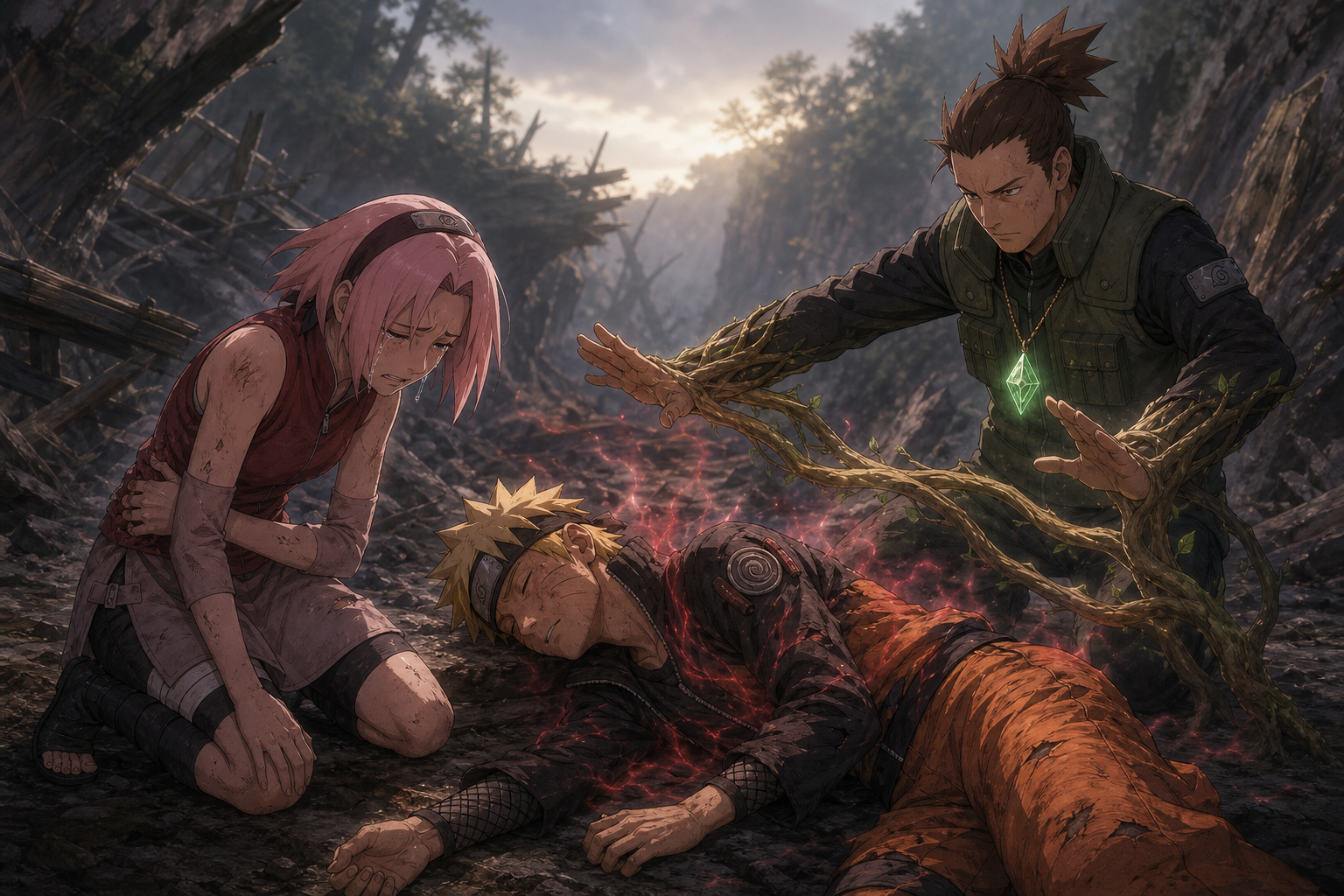
Sakura’s Tears
The tears mark the cost of a promise that has lost its brakes.
Sakura reaches Naruto and finds the promise has no brakes
Episode 43 turns the Tenchi Bridge spectacle into consequence. Naruto remains trapped in the four-tailed state, unable to recognize the teammates who came with him. Sakura moves toward him because she sees her friend suffering beneath the chakra.
Naruto’s chakra arm strikes her.
The injury is not a betrayal Naruto chooses. That fact does not make it less real. His body has become dangerous to the person he would consciously protect, and Sakura’s tears carry the weight of that contradiction.
She is watching Naruto destroy himself for a promise connected to her grief over Sasuke. Then the power produced by that promise wounds her without knowing who she is.
Love explains why she approached. It cannot make proximity safe when Naruto has lost control.
The tears belong to guilt, fear, and recognition
The title can be flattened into romantic concern, but Sakura’s tears hold more than one feeling. She is afraid for Naruto’s life. She is in physical pain. She is confronting the cost of a promise Naruto has carried since the original series.
Sakura once asked Naruto to bring Sasuke back because she felt powerless to do it herself. Naruto made the promise part of his identity. By Shippuden, Sakura is stronger and actively participating in the search, but Naruto still treats failure as a personal debt.
The four-tailed transformation makes that debt visible on his body. His skin and awareness are being consumed by power summoned through grief.
Sakura’s tears are therefore not helpless decoration. They are recognition that Naruto’s devotion has become self-harm, and that her own longing for Sasuke is tangled inside the burden he refuses to release.
Naruto’s intention cannot protect Sakura while Naruto is absent
Nobody doubts that Naruto would protect Sakura consciously. The injury happens because conscious intention no longer governs the chakra body.
This distinction matters beyond the fight. People often treat good intention as though it guarantees safety. Episode 43 refuses that comfort. A person can love someone and still become dangerous when control is gone.
Sakura approaches the Naruto she knows. The transformed body responds to movement and threat without access to that relationship.
The tragedy is not that Naruto secretly wants to harm her. The tragedy is that the part of him capable of choosing has been displaced.
Yamato has to respond to the condition that exists, not the intention everyone remembers. He cannot let Sakura remain close because Naruto’s values are not currently available to restrain the power.
Yamato’s containment restores the possibility of care
Yamato uses Wood Release and the First Hokage’s necklace to suppress the Nine-Tails’ chakra. The technique does not punish Naruto. It creates the conditions in which Naruto can return.
That difference is central to ethical containment. Yamato recognizes the transformed state as dangerous without reducing Naruto to the danger. His goal is restoration.
The necklace serves as a connection between Naruto and the First Hokage’s power, but Yamato’s judgment activates the response. He has to read the threshold, position the suppression, and act before another injury occurs.
Once the chakra recedes, ordinary care becomes possible again. Sakura’s wounds can be assessed. Naruto’s body can begin recovering. Words may eventually reach him.
Containment comes before healing because nobody can treat a person safely while the uncontrolled force remains active.
The body remembers what Naruto cannot
When Naruto returns to human form, he does not carry a clear memory of everything the four-tailed state did. His body carries the evidence anyway.
This separation between memory and consequence deepens the horror. Naruto may not remember striking Sakura, but Sakura was still struck. He may not remember the chakra burning through him, but his exhaustion and damage remain.
Lack of memory does not erase responsibility in a simple sense, yet assigning blame is equally complicated when agency was absent. The team has to hold consequence without pretending Naruto chose it.
That requires honesty. Protecting Naruto from the truth may preserve his feelings temporarily while leaving him unable to understand the danger. Telling him carelessly may turn the injury into another reason for self-hatred.
The episode leaves that emotional repair ahead. First, everyone has to survive the physical aftermath.
Sakura’s medical role does not cancel her need for care
Sakura is the team’s medic, which often makes her the person expected to treat everyone else. Episode 43 reverses that role. She is wounded and needs protection.
The reversal matters because competence can make a character’s vulnerability easy to overlook. Sakura has precise chakra control, medical expertise, and extraordinary strength. None of those make her immune to Naruto’s chakra arm.
She also cannot clinically detach from this patient. Naruto is her teammate and the person carrying their shared promise. The injury arrives with emotional information medicine cannot neutralize.
Yamato must address immediate damage while Sakura processes what happened. Her tears are compatible with strength. They are the body and mind responding to a cost she cannot punch or heal away.
Sai’s absence becomes louder after the battle
While Yamato and Sakura deal with Naruto’s transformation, Sai continues his contact with Orochimaru. His absence leaves the team with fewer hands during the emergency.
This is where Root’s mission-first philosophy becomes concrete. Sai does not merely choose another objective on paper. He leaves actual people to manage injury and containment without him.
The team does not yet know every detail of his assignment, but the gap is visible. A member who should be present is elsewhere because Danzō defines success differently.
Naruto’s uncontrolled power caused direct harm. Sai’s controlled obedience causes another kind of harm through absence. One crisis is explosive. The other is administrative.
Both reveal why shared purpose matters.
The promise to save Sasuke needs a healthier form
Naruto’s determination remains admirable, but Episode 43 shows that determination alone cannot guide the rescue. If Sasuke’s name can trigger a transformation that injures Sakura and nearly destroys Naruto, the promise is being carried in a form Orochimaru can exploit.
Saving Sasuke cannot require Naruto to erase himself. It cannot require Sakura to accept injury as proof of Naruto’s devotion. A bond that demands self-destruction has stopped functioning as care.
This does not mean Naruto should abandon Sasuke. It means the method has to change. He needs strength that remains under his values, support he does not interpret as failure, and a definition of loyalty that includes his own survival.
Yamato’s suppression is the first hard boundary around that lesson. The team will not reach Sasuke by letting the Nine-Tails make every decision.
RaeRae’s reaction
Sakura’s tears wreck me because she is not crying over a simple injury. She is looking at the cost of Naruto’s promise written across both their bodies.
Naruto would never choose to hit her. That is precisely why the scene is so frightening. His intention is gone from the mechanism causing harm.
I appreciate Yamato’s response because he does not waste time arguing with the transformed Naruto as though friendship should magically fix the chakra. He contains the danger first. That is care with a boundary.
The First Hokage’s necklace and Wood Release could be framed as tools for controlling a jinchūriki asset. Yamato makes them tools for returning a teammate to himself.
Sakura also deserves to be seen as someone needing care, not only the medic who will stand up and treat everybody. Her strength is not measured by how quickly she hides the pain.
I keep returning to the promise of a lifetime. Naruto made it because he loved his friends and wanted to give Sakura hope. Orochimaru has turned that hope into a trigger. The answer cannot be caring less. It has to be carrying the care differently.
Sai’s absence makes the team fracture even clearer. Yamato and Sakura are dealing with the human aftermath while Sai advances an order built around access and leverage. Danzō’s mission has no room for tears because it has no room for the relationships producing them.
Restoration is the real victory
Episode 43 does not resolve the mission against Orochimaru. It accomplishes something more immediate: Yamato brings Naruto back from the four-tailed state before the destruction continues.
The battlefield remains ruined. Sakura is injured. Naruto’s body is exhausted. Sai is gone. The intelligence operation has splintered.
Still, Naruto returns to a condition in which choice, healing, and accountability can exist. That restoration is more meaningful than any additional burst of power.
The tears mark the cost, but they also mark the presence of someone still willing to see Naruto as a person inside the danger. The next step is ensuring Naruto learns to see that person too.
Official episode reference: Naruto Official episode guide
Licensed episode route: Crunchyroll licensed episode page
Sakura’s wound is not a lesson that she cared too much
The easiest reading punishes Sakura for approaching danger emotionally. Yamato warned her. She ran forward. The chakra struck her. That sequence can be described as a tactical mistake without turning compassion into the flaw.
Sakura is responding to a friend whose body is being destroyed in front of her. The failure belongs partly to a mission structure that placed her beside a known four-tail risk without enough preparation for what the threshold meant. Adults kept the most important information inside command conversations and expected teammates to improvise around the result.
Her care needs a safer method. Care itself does not require correction.
Yamato protects Sakura without humiliating her grief
He restrains her because another step could be fatal. He does not use the moment to call her weak, irrational, or unfit. The boundary is about the active danger, not a judgment on the legitimacy of her feelings.
That difference matters in a military culture that often treats emotion as interference. Sakura’s grief contains accurate information: Naruto is suffering, the promise has become destructive, and the team is losing the person they came to support.
Yamato acts on the physical emergency while allowing that emotional truth to remain true.
The chakra arm makes intention irrelevant for one terrible second
Naruto’s conscious self would protect Sakura. The four-tailed body does not consult that self. When the arm lashes out, love cannot intercept force already separated from choice.
The injury refuses a comforting fandom habit of using intention to erase impact. Naruto did not choose the blow, so blame must be handled carefully. Sakura was still injured, so the consequence cannot be talked away.
The team will eventually need language spacious enough for both truths. Naruto is not secretly cruel. Sakura does not owe silence merely because he lacked agency.
The promise of a lifetime was never meant to become a debt collector
Naruto offered to bring Sasuke back because Sakura’s grief mattered to him and because Sasuke mattered to him too. Over time, the promise accumulated guilt. Every delay started feeling like personal failure, and every reminder of Sasuke became another demand Naruto placed on himself.
Orochimaru exploits that pressure by naming Sasuke until grief converts into chakra. The promise stops guiding action and begins collecting payment from Naruto’s body.
A loving commitment should help people endure responsibility together. It should not become a private creditor that accepts skin, consciousness, and friendship as installments.
Sakura has already changed since she made the request
The girl who asked Naruto to retrieve Sasuke felt unable to participate directly. The Sakura at Tenchi Bridge trained under Tsunade, defeated Sasori with Chiyo, and entered the search as a capable shinobi and medic.
Her guilt cannot be understood as though she still expects Naruto to do everything alone. She is here precisely because she refuses that earlier helplessness. Yet Naruto still carries the old promise as if the distribution of responsibility never changed.
Their friendship needs an updated agreement. Sakura can share the work. Naruto can admit limits. Neither person has to reenact the roles they held at thirteen.
Healing the wound does not heal what Sakura learned
Medical ninjutsu can close tissue and manage immediate damage. It cannot remove the knowledge that Naruto’s transformed body failed to recognize her.
Sakura now understands the Nine-Tails crisis through her own skin. That knowledge may sharpen future judgment, but trauma should not be romanticized as the best teacher. She deserved preparation before injury supplied the lesson.
Physical recovery and emotional recovery operate on different schedules. Competence may let Sakura treat the wound quickly. The meaning can remain long after the skin closes.
Naruto wakes inside consequences he cannot remember creating
Memory loss protects him from the direct experience of the strike while making accountability harder. He has to rely on other people’s testimony about what his body did.
That position is frightening. Learning the truth could deepen shame and trigger another cycle of self-punishment. Hiding the truth could leave him unable to understand why future boundaries exist.
Honesty must come with context: the fourth-tailed state displaced his agency, the danger was real, Sakura was hurt, and preventing another transformation is a shared safety need rather than proof that Naruto is a monster.
Yamato’s necklace response returns a name to the body
During the fight, Naruto is repeatedly described through the jinchuriki category and the number of tails. Yamato’s suppression reverses that reduction. The crimson shell recedes, human features return, and Naruto becomes visibly recognizable again.
The technique works on chakra, but the moral outcome is the return of a person. A containment system should always be judged by that outcome. Does it preserve somebody for future choice, or merely restore institutional control over a useful body?
Yamato’s behavior points toward the first purpose, even if Konoha’s history with jinchuriki often points toward the second.
The First Hokage’s power does not make the village innocent
The necklace and Wood Style connect the rescue to Konoha’s founding legacy. It would be easy to frame that legacy as benevolent power correcting Orochimaru’s corruption.
But the village also sealed the Nine-Tails inside Naruto and concealed the truth from him for years. Orochimaru’s experiments created Yamato outside legitimate authority, yet Konoha now depends on their surviving result.
Institutions do not become ethical merely because their symbols participate in rescue. They become ethical by telling the truth, caring for survivors, and refusing to repeat the conditions that made rescue necessary.
Sai’s absence shows what Root removes from a mission
Sai is not present to help contain Naruto, protect Sakura, or account for the team’s injuries. Root has extracted him from reciprocal obligation while leaving him physically embedded in the group.
That absence is the hidden mission’s cost. Yamato must cover another role during crisis. Sakura and Naruto take risks without knowing one teammate has a competing priority. Danzō gains access to Orochimaru while Team Kakashi absorbs the shortage.
Root’s ideal operative does not become a burden by needing others. He becomes a burden by refusing to be available when others need him.
Orochimaru withdraws with information while the team keeps the damage
He has seen the four-tail threshold, tested its defenses, measured its destructive capacity, and observed Yamato’s relationship to the First Hokage’s power. The ruined landscape and injured people do not follow him as obligations.
Team Kakashi remains with bodies to heal, trust to repair, a missing teammate to locate, and a mission to salvage. This is how exploitative actors win without winning the formal battle. They collect knowledge and leave consequence behind.
The cost ledger is radically unequal because Orochimaru never intended to preserve the space or the people inside it.
Tears communicate what mission language keeps hiding
A report could say the target transformed, an ally sustained injury, the captain suppressed the chakra, and the team resumed pursuit. Every clause would be accurate and emotionally dishonest.
Sakura’s tears reject that compression. They show fear, pain, guilt, love, and the shock of recognizing how close Naruto came to disappearing. The mission vocabulary cannot carry all of that because mission vocabulary is designed to make people operationally legible.
A fandom editorial should not repeat the report’s emotional erasure. The tears are not excess around the plot. They are evidence of what the plot costs.
Naruto needs a promise that includes staying present
Bringing Sasuke home cannot remain the only measure of loyalty. Naruto also has to remain conscious enough to recognize Sakura, accept Yamato’s help, and decide what he will do when he reaches his friend.
The Nine-Tails offers force without presence. Every tail increases his capacity to move bodies and decreases his ability to honor relationships. That exchange cannot fulfill a promise founded on relationship.
The healthier commitment is harder because it includes limits: pursue Sasuke, refuse Orochimaru’s trigger, trust teammates, and survive the rescue as a person rather than a weapon.
Accountability should not become shame
Naruto needs to know Sakura was injured. He does not need the information delivered as proof that he is inherently dangerous or undeserving of closeness.
Shame says the problem is Naruto’s existence. Accountability identifies the conditions, harm, and changes required to protect everyone next time. One isolates him. The other invites him into a shared plan.
Konoha has already taught Naruto to fear that the fox makes him unacceptable. His team must not reproduce that lesson while addressing a real risk.
RaeRae’s full take
Sakura’s tears are not here so the story can call her soft. She just watched a promise built from love consume Naruto’s body and then reach out with his arm to hurt her. There is no tidy emotion for that.
I refuse to blame her for seeing Naruto before she saw the threat. I also refuse to pretend Yamato should have let her keep running. Care without a boundary would have produced another victim. Yamato protects both of them by acting on the danger and still believing Naruto can return.
The wound matters even though Naruto did not choose it. His lack of agency matters even though Sakura was truly hurt. If our language can hold only one side, our language is too small for the scene.
I am angry that the adults knew what four tails meant and allowed the team to learn the practical truth during catastrophe. Secrecy did not protect Sakura. It protected the people who controlled the information from having to explain their decisions.
And Sai being gone is not a neutral subplot. Danzō has taken one set of hands out of an emergency because Root’s access matters more to him than Team Kakashi’s survival. Naruto loses control loudly. Root abandons people quietly. Both create damage somebody else has to carry.
Naruto’s promise has to change form. Saving Sasuke cannot mean disappearing from everyone who loves him. Sakura is not asking for that payment, and Sasuke cannot be reached by a power that destroys the person trying to speak to him.
RaeRae checkpoint: Sakura’s tears do not prove she is weak, and Naruto’s missing memory does not make the wound imaginary. Care begins by holding impact and lost agency together without turning either person into a villain.
Receipts and official routes
- Episode placement, Sakura’s injury, Yamato’s Wood Style suppression, and Naruto’s return from the four-tailed state: Naruto Official Site episode guide.
- Licensed episode route: Crunchyroll.