
Demon Desert Survival
Neji’s avoidance plan is sound until another team faces preventable death, forcing strategy to prove whether compassion belongs inside leadership.
Bottom line
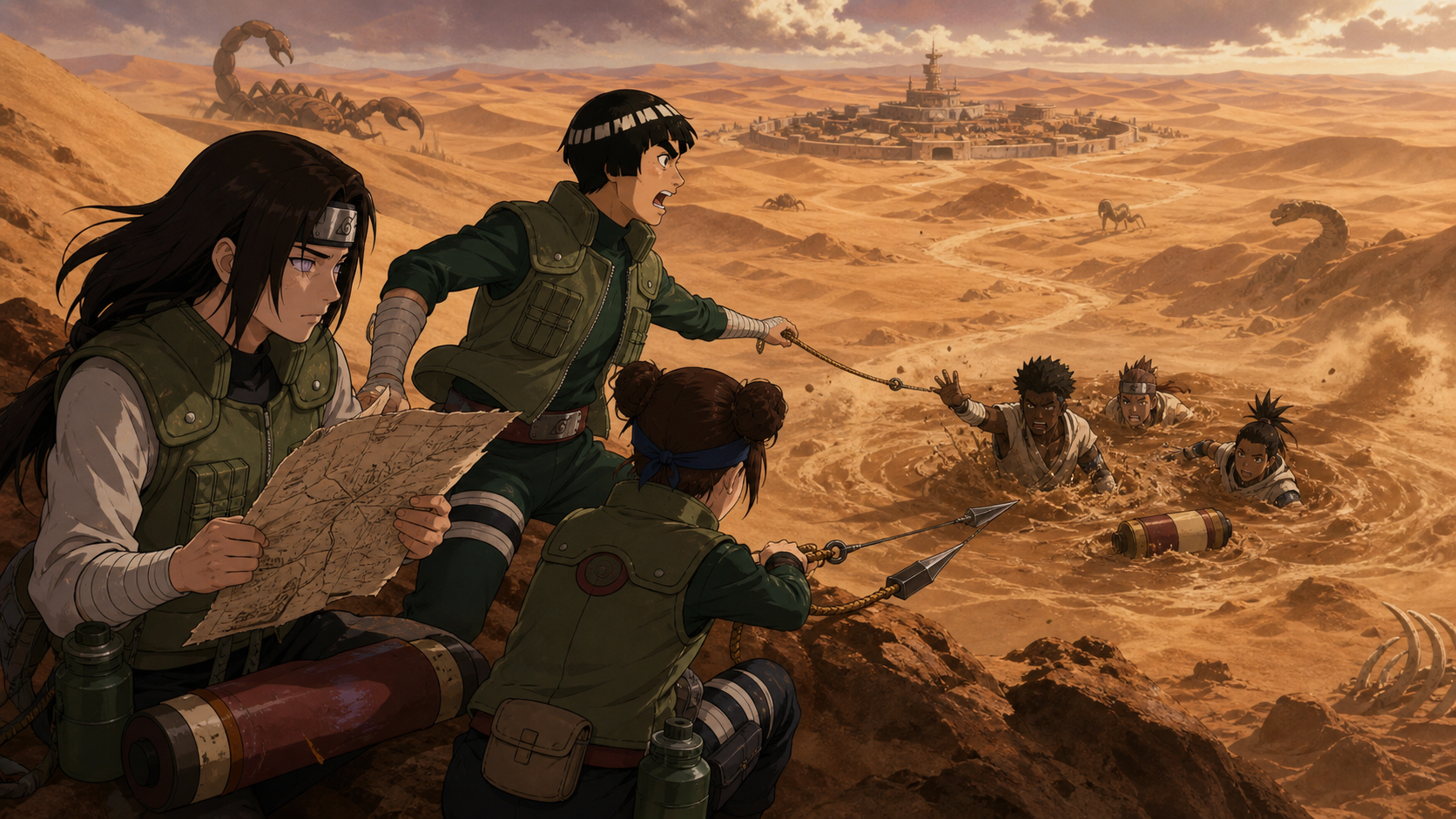
“Demon Desert Survival” gives Team Guy a clean strategic disagreement. Neji studies the field, identifies Fū’s team and Shira’s team as dangerous, and recommends avoiding both. Lee hears that Shira stopped one of his kicks and immediately wants the fight. Tenten stands between tactical sense and a teammate whose entire personality just heard “rare taijutsu user nearby.” The scroll rules reward selective engagement: collect Heaven and Earth, reach the central base within seventy-two hours, and do not waste water or strength on ego. Then Team Shira is betrayed and trapped in quicksand. Team Guy turns back to help instead of exploiting vulnerable competitors for an easy scroll. That choice proves more about chūnin readiness than any safe route Neji could calculate. The episode works because strategy and compassion are not enemies. Neji is right to avoid unnecessary battles. He is also right to revise the plan when another team faces preventable death. Lee’s excitement needs discipline, but his identification with Shira helps the team recognize a person before a target.
The rescue also tests whether exam design rewards the values administrators claim to want. If helping a trapped team makes success less likely, the scoring system quietly teaches candidates that promotion belongs to people willing to watch rivals die.
Round Two begins in the Demon Desert
Teams enter a vast, hot environment with limited cover and lethal wildlife. The test changes every tactical assumption carried from the Forest of Death.
Terrain is an active opponent before another team appears.
Each team receives one scroll
Half carry Heaven and half carry Earth. Passing requires acquiring the counterpart from another team.
The rules manufacture conflict because nobody can finish through navigation alone.
The destination sits at the center
Teams must reach the designated base with both scrolls. A successful theft far from the center still leaves travel, heat, and defense ahead.
Acquisition is one phase of a longer logistics problem.
The time limit is seventy-two hours
Three days allow scouting, ambush, rest, recovery, and route changes. The duration also increases dehydration and exposure risks.
Endurance planning matters as much as one fast victory.
Teams begin from separate positions
Distributed starts reduce immediate crowd fighting and force candidates to gather their own information. No group receives a complete map of opponents.
Uncertainty makes reconnaissance valuable.
Neji uses the Byakugan for early intelligence
His vision can identify distant movement, formations, and threats across exposed terrain. The technique gives Team Guy a major scouting advantage.
Information becomes useful only when the team agrees how to act on the information.
He studied opponents the night before
Neji watched how candidates moved, reacted, and handled conflict. He enters the desert with a threat assessment rather than improvising every encounter.
Preparation protects chakra and time.
Fū’s team sits on the avoid list
Her power and unpredictable openness make the group difficult to classify. The Seven-Tails remains concealed, but visible ability already warns Neji away.
Avoidance is respect for risk, not an insult.
Shira’s team also raises concern
Shira stopped Lee’s kick, demonstrating unusual taijutsu control. Neji recognizes that direct combat could become expensive.
A brief observation can justify caution without proving the full ceiling.
Lee hears a challenge
Another dedicated taijutsu fighter triggers curiosity and competitive excitement. Lee wants to understand Shira through movement.
His enthusiasm is sincere and strategically inconvenient.
Not every strong opponent requires a duel
The exam rewards scroll acquisition and arrival, not a ranking of every fighter. Chasing personal comparison could waste hours and injure the whole team.
Mission purpose should govern engagement.
Lee’s curiosity has emotional roots
He grew up dismissed because he could not use ninjutsu or genjutsu effectively. Finding another taijutsu specialist may feel like meeting someone who understands the same institutional judgment.
Recognition can override tactical patience.
Tenten has to balance the team
She understands Neji’s planning and Lee’s intensity while managing her own weapons, supplies, and ambitions. Her role should not be limited to reacting between two boys.
Practical team stability is leadership work.
The desert punishes loud movement
Running hard across open ground creates visible trails, increases heat strain, and consumes water. Lee’s preferred pace may become a liability without route discipline.
Athletic capacity does not cancel environmental physics.
Genjutsu distorts Team Guy’s search
When Neji cannot detect expected teams, he realizes their perception has been manipulated. The Byakugan offers strong vision without making him immune to every deception.
Specialized power still needs skeptical interpretation.
Cactus-based deception fits the terrain
An opponent uses environmental familiarity to disguise the attack. Local knowledge can offset a famous clan ability.
Home terrain becomes a form of training advantage.
Neji corrects the assessment
He does not cling to the first explanation when sensory evidence fails. Recognizing a false premise allows the team to respond.
Leadership requires revising the map in public.
Team Guy seeks a manageable opponent
Avoiding the strongest observed teams is not cowardice. The exam is a resource mission under time and exposure constraints.
Choosing a fight is part of winning a fight.
“Weak team” language carries danger
Candidates can underestimate unfamiliar techniques, desert experience, or coordinated traps. Rankings based on one night of observation remain provisional.
People look weakest when the observer lacks the right information.
Shira carries a special assignment
Gaara wants capable Sand genin to advance and has entrusted Shira with helping other village teams. The mission mixes candidate status with unofficial responsibility.
Hidden objectives complicate the fairness of the exam.
Helping every Sand team would distort competition
Village solidarity makes political sense, but coordinated assistance can give local candidates an advantage foreign teams do not receive. Hosts already know the terrain.
An international exam needs clear limits on official intervention.
Shira accepts service because Gaara recognized him
The Kazekage saw value in a taijutsu user dismissed by Suna’s training culture. Loyalty grows from receiving an opportunity long denied.
Recognition can inspire service without creating permanent debt.
Other Sand candidates exploit that loyalty
Teams willing to accept help may still see Shira as inferior or disposable. Shared village identity does not erase hierarchy.
Prejudice survives inside cooperation when nobody confronts the belief beneath the arrangement.
Betrayal turns alliance into a trap
Goji’s group attacks Team Shira and leaves them endangered by quicksand. The act converts an exam rivalry into a potentially lethal abandonment.
Winning a scroll does not require ensuring another team dies slowly.
Quicksand makes movement worse
Panicked force can deepen entrapment, and desert conditions reduce rescue options. A strong fighter cannot punch every environmental problem.
Survival requires control, leverage, and outside help.
Team Guy sees an easy competitive opening
Shira’s team is vulnerable, and their scroll could be available with little resistance. The exam rules create incentive to exploit the moment.
Legal opportunity and ethical action are not identical.
Neji chooses rescue
He revises avoidance and helps competitors facing death. The choice protects people without pretending Team Guy no longer wants to pass.
Leadership keeps mission goals beneath a floor of human responsibility.
Lee sees himself in Shira
Both trained taijutsu under systems that treated missing ninjutsu talent as disqualification. Lee recognizes the humiliation and persistence behind Shira’s skill.
Shared experience turns an opponent into a person quickly.
Identification can sharpen justice
Lee’s anger at Shira’s mistreatment grows because he knows the wound. Personal recognition motivates intervention when abstract fairness might feel distant.
Empathy becomes stronger when discipline directs the response.
Anger can still derail the rescue
Chasing the betraying team before Shira is safe would prioritize punishment over immediate harm. Lee must distinguish protecting someone from satisfying outrage.
Justice needs sequence.
Tenten’s tools matter in environmental rescue
Ropes, anchors, weapons, and stored equipment can create leverage that pure hand-to-hand skill lacks. Her broad arsenal fits a survival test exceptionally well.
The anime should let utility become visible rather than treating support as background.
Neji’s sight supports extraction
He can evaluate body position, ground movement, and safe approach while avoiding another trapped teammate. Reconnaissance becomes care.
The same power used to find targets can find rescue routes.
Team Shira’s scroll should remain secondary
Helping them does not entitle Team Guy to payment. A coerced exchange after rescue would turn compassion into leverage.
Voluntary gratitude differs from a rescue tax.
The exam’s design encourages moral shortcuts
Every team needs an opposing scroll, time is limited, and the environment can kill. Candidates are rewarded for allowing natural hazards to remove rivals.
Proctors should evaluate how teams use that freedom.
Water management should govern every chase
Three days in extreme heat make canteens, shade, rest cycles, and route length part of combat planning. A team that wins a scroll after an unnecessary pursuit may still fail because the chase consumed water needed for the trip inward.
Lee’s physical endurance is exceptional. His teammates should still stop him from treating exceptional endurance as a shared supply plan.
Local candidates hold an unspoken terrain advantage
Sand teams know weather patterns, common hazards, landmarks, and movement techniques suited to loose ground. Foreign teams arrive with different equipment and habits.
The hosts can reduce unfairness through maps and safety briefings, but no briefing replaces lived familiarity. Evaluators should separate desert expertise from general leadership when deciding promotion.
Surveillance and intervention need clear boundaries
Adults must allow candidates to solve dangerous problems while preventing avoidable deaths. The first Chūnin Exam often let harm escalate too far.
Testing judgment does not absolve organizers of care.
Neji’s plan and Lee’s instinct both matter
Without Neji, the team may waste resources on a vanity fight. Without Lee’s recognition, they may treat Shira as only another threat profile.
Good teams let different strengths correct each other.
The episode sets up a real taijutsu conversation
Shira is not merely an opponent with a similar move set. His place in Suna reveals another village’s assumptions about which techniques count as legitimate shinobi ability.
Lee’s next confrontation can examine training culture through combat.
Japanese performance analysis needs direct evidence
The final publication should verify Japanese cast and staff credits. Claims about Neji’s caution, Lee’s excitement, Tenten’s response, or Shira’s restraint require lawful scene-level listening.
Specific observation must come before judgment.
The desert is an opponent the organizers selected
Heat, distance, sand, scarce water, wildlife, and deceptive landmarks create pressure before candidates meet another team. Those hazards may test preparation and can kill people without revealing leadership.
Officials therefore own responsibility for mapping intervention thresholds, medical routes, accessible checkpoints, weather changes, and how much environmental danger the exam is allowed to manufacture.
Local knowledge creates a predictable advantage
Sand candidates understand movement, hydration, shelter, and terrain signs that visiting teams may never have encountered. Home knowledge is a legitimate skill and not a neutral baseline.
A fair joint exam should brief universal survival essentials while allowing deeper expertise to matter. Otherwise evaluation confuses birthplace with leadership merit.
Water management should outrank exciting pursuit
Every chase spends hydration and energy the team will need for rescue, combat, navigation, and the return route. Lee’s appetite for a worthy opponent cannot override that arithmetic.
Neji’s restraint is not fear. He is protecting the mission from a fight that may be emotionally satisfying and strategically expensive.
Avoidance is an active tactical choice
Using Byakugan intelligence to route around dangerous teams preserves capacity and reduces unnecessary conflict. Leadership includes deciding which battles do not serve the objective.
The plan remains accountable to new information. Avoidance becomes cowardice only if it abandons a duty the team can reasonably fulfill, not because spectators wanted a dramatic duel.
Tenten carries the team’s material reality
Weapons, wire, stored equipment, range judgment, and practical planning give Team Guy options beyond fists and eyesight. Her role is crucial in terrain where reaching someone safely matters more than striking harder.
The story should not treat her as referee between two talented boys. She is a shinobi whose tools can turn concern into an actual extraction method.
Shira’s assignment converts gratitude into unpaid obligation
Gaara recognized someone excluded by Sand custom, and Shira responds by helping village teams through the exam. Service may be freely chosen and still become exploitable when others expect unlimited assistance.
Leaders must ensure gratitude does not become a debt without boundaries. Recognition should expand Shira’s choices, not make refusal look like betrayal.
Helping every Sand team damages exam legitimacy
Shared village identity may motivate support, but systematic assistance gives local candidates an advantage unavailable to visitors. Shira’s special role blurs security, mentorship, and competition.
Gaara should define what aid protects life, what aid preserves fairness, and who reviews disputes. Quietly relying on Shira leaves him carrying institutional ambiguity alone.
The betrayal is not proof that trust was foolish
Other Sand candidates exploit Shira’s loyalty and place his team in lethal danger. Their conduct shows accountability failure, not a universal law that cooperation creates weakness.
The correct lesson is to build consent, verify requests, preserve exit routes, and sanction exploitation. Cynicism would punish people who tried to help while rewarding those who weaponized that help.
Quicksand turns panic into a mechanical threat
Struggling increases entrapment, so rescue begins with clear instructions and controlled movement. Emotional steadiness becomes bodily protection rather than a personality preference.
Neji can assess position, Tenten can establish reach, and Lee can apply force at the correct moment. Different specialties matter because raw effort alone may worsen the hazard.
Team Guy sees a scroll and chooses people first
The exam’s rules make an exposed rival scroll strategically valuable. Taking it while Shira’s team sinks might be efficient inside a narrow competition frame and indefensible inside any serious leadership frame.
Neji’s choice reveals whether promotion is meant to produce officers or opportunists trained to exploit preventable death.
Rescue should not create a new debt
Saving Shira’s team does not entitle Team Guy to their scroll, loyalty, information, or future support. Assistance given under mortal danger cannot become an involuntary exchange contract afterward.
The exam should credit rescue conduct separately so candidates do not need to collect repayment from the people they protected.
Lee’s identification needs discipline
He recognizes another fighter excluded from ninjutsu-centered standards and feels the injustice personally. That empathy helps him see Shira as more than a competitor.
It can also make anger or eagerness override what Shira’s team needs. Solidarity asks first, follows the rescue plan, and avoids converting another person’s story into a stage for one’s own wound.
Neji proves leadership by revising his plan
His original avoidance strategy was sound under the information available. The quicksand and betrayal create a moral and tactical condition the earlier plan did not cover.
Changing course is not inconsistency. Leaders should be judged by how well they incorporate new evidence, especially when rigid adherence would preserve efficiency by abandoning reachable people.
Proctors need visibility without voyeurism
Surveillance can detect lethal danger, cheating, outside attackers, and candidates who need extraction. It can also turn children’s suffering into observed data while officials wait for a dramatic threshold.
Rules should state when intervention occurs, who can authorize it, how privacy is protected, and why a preventable death would never be an acceptable test result.
Survival means returning with everyone possible
Scrolls, time, and tower arrival remain objectives. Water, injury, mental state, teammate consent, and the lives of nearby candidates remain part of the field.
A worthy Chūnin does not treat compassion as an obstacle to strategy. They build strategy wide enough to include the people the mission exists to protect.
The organizers owe Shira’s team a response after rescue. Betrayal by candidates should trigger medical care, protected testimony, evidence review, and consequences that do not depend on Shira proving gratitude to Gaara. If the exam quietly resumes, the institution teaches everyone that attempted murder is merely competitive initiative. Safety requires a record able to distinguish deception from conduct that should end participation and invite investigation.
RaeRae’s verdict
“Demon Desert Survival” understands that the best strategic plan still needs a moral floor. Neji correctly identifies the teams most likely to consume time and chakra. Lee correctly senses that Shira’s taijutsu means something beyond an inconvenient opponent. Tenten helps keep both instincts inside one functioning unit.
When Team Shira is betrayed and trapped, Team Guy could exploit the rules and take the easy route. They turn back. That rescue does not contradict Neji’s caution. The emergency changes the problem. A future chūnin should avoid pointless combat, preserve resources, read terrain, and refuse to let a competitor die when help is possible. Strategy without compassion produces efficient cruelty. Compassion without strategy can create another casualty. Team Guy succeeds when both stay in the room.
RaeRae’s call
Neji’s first plan was good. Avoid strong teams, protect water, and reach the objective without turning Lee’s curiosity into an unnecessary fight. Then Shira’s team began sinking, and Neji changed the plan. That revision is leadership. Tenten’s tools, Lee’s force, Neji’s sight, and clear instructions make rescue possible. The scroll stays secondary. The exam created incentives to exploit exposed rivals; Team Guy refuses them. Strategy is not compassionate when it ignores cost. Strategy becomes credible when it can protect the objective and still turn back for a reachable person.
Episode details and viewing routes
- Official episode reference: Naruto Official episode guide
- Licensed episode route: Crunchyroll licensed episode page
What I am carrying forward
Round Two began with teams carrying either a Heaven or Earth scroll into the Demon Desert. They have seventy-two hours to obtain the counterpart and reach the central base.
Neji advised avoiding Fū’s team and Shira’s team after assessing their strength, while Lee wanted to meet Shira in combat. When another Sand team betrayed Shira and trapped his group in quicksand, Team Guy chose rescue over an easy competitive advantage. Episode 400 follows Lee’s anger over Shira’s treatment and the bond between two taijutsu specialists.