
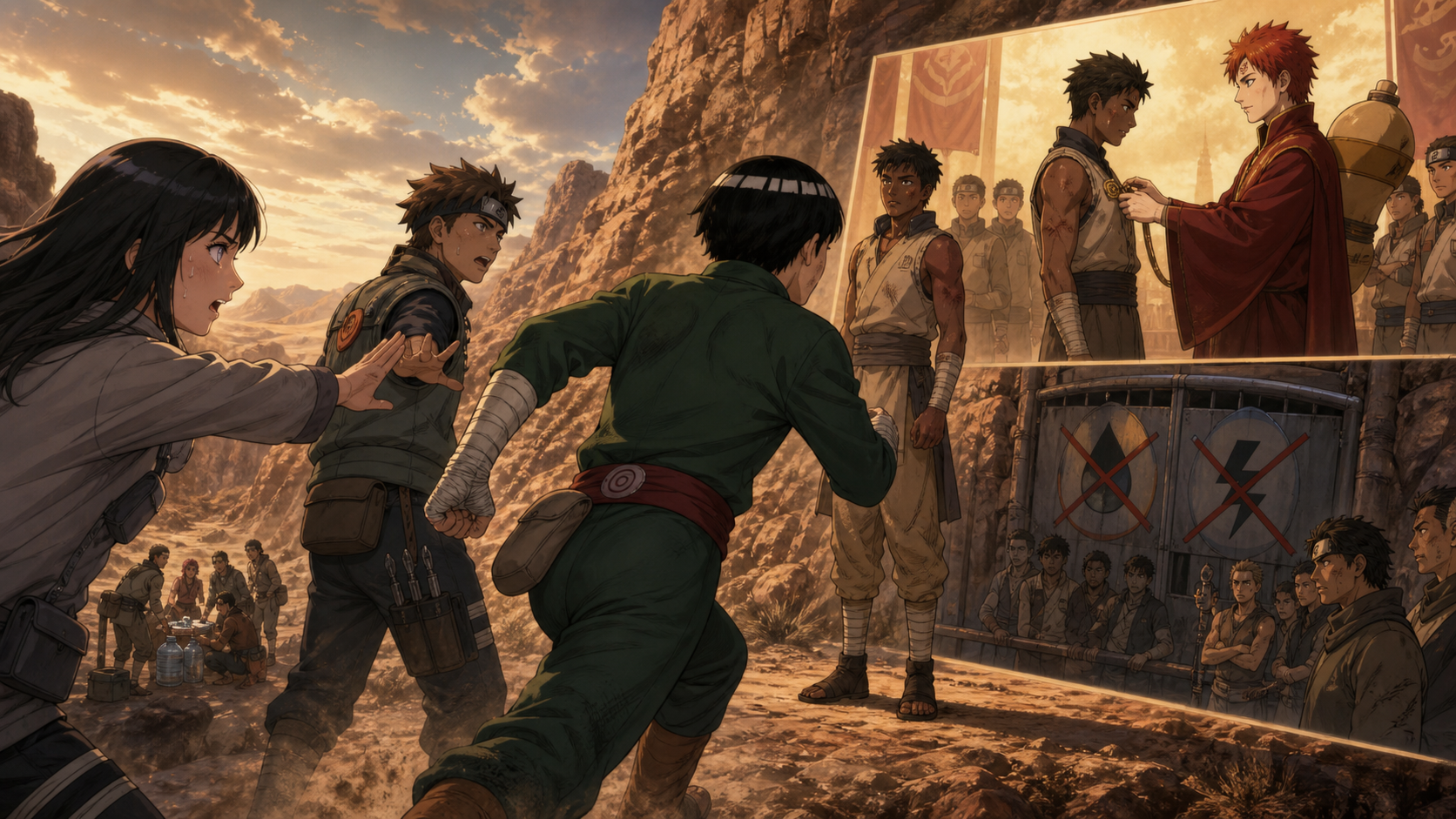
As a Taijutsu User
Lee recognizes the exclusion Shira survived, but solidarity has to protect the harmed person and challenge policy without abandoning every other responsibility.
Bottom line
“As a Taijutsu User” gives Lee the mirror he has deserved for years. Shira cannot use ninjutsu, and Sunagakure once refused to recognize him as a shinobi at all. Gaara sees his taijutsu skill, overturns the exclusion, and appoints him as an instructor. That promotion does not erase the insult. Other Sand shinobi resent Shira’s rise, attack him, and mock the effort that made their own system look foolish. Lee recognizes the wound immediately because Konoha also treated his missing ninjutsu and genjutsu as proof that he had no future. His anger is earned. Chasing the attackers alone is still reckless. Lee leaves teammates, rescue work, water planning, and the exam objective behind because punishment feels urgent. Solidarity becomes useful when Lee protects Shira and challenges the policy that excluded him. Solidarity becomes self-indulgent when Lee decides his outrage authorizes another avoidable crisis. The episode understands institutional gatekeeping better than Lee understands sequence.
The strongest response would combine protection with a record. Shira’s attackers should face immediate restraint, but the village also needs testimony, disciplinary review, and proof that Gaara’s policy change survives resistance after the exam ends.
Shira’s history explains the betrayal
The attack from other Sand candidates is not one random scroll dispute. Resentment follows his elevation under Gaara.
Their violence protects an old hierarchy threatened by visible competence.
Sunagakure excluded shinobi without ninjutsu
The village treated one missing skill category as total disqualification. That policy confused a standard training route with the definition of a ninja.
Institutions often call narrow design objective merit.
Shira kept training anyway
He developed taijutsu without formal recognition or the resources granted to accepted candidates. Persistence proves commitment while exposing unfair access.
He should not have needed extraordinary endurance to receive basic evaluation.
Gaara recognizes his ability
The new Kazekage sees what previous authorities dismissed. Recognition matters because Gaara can change policy rather than merely offer encouragement.
Leadership becomes real when judgment alters access.
Shira becomes a recognized shinobi
Formal status allows him to serve, train, and participate under the village name. The change repairs an immediate barrier.
Belonging granted late does not refund the years spent outside.
He is appointed as a taijutsu instructor
Gaara moves beyond admission and treats Shira’s specialization as knowledge worth teaching. The village must now learn from the person its rules excluded.
That reversal can change future students if the institution supports him.
Appointment does not guarantee cultural change
One leader can revise status while peers preserve contempt. Shira’s attackers show that resentment survived the official decision.
Policy needs enforcement, education, and accountability after announcement.
Other shinobi call the rise favoritism
They see Gaara’s recognition as an unfair shortcut rather than correction of an unfair exclusion. Privileged access becomes invisible to people who received the standard route.
Equality feels like theft when advantage was mistaken for normality.
Jealousy targets the person with less power
The attackers could question Gaara or the evaluation process. They assault Shira because he is easier to isolate.
Cowardice often wears the language of protecting standards.
They insult effort while depending on institutional approval
Shira built ability without official validation. His critics use existing rank to claim superiority.
The person who overcame the larger barrier is accused of not earning the result.
Lee recognizes the same wound
Konoha peers mocked his inability to use ninjutsu and genjutsu. He once feared that no amount of work could make him a splendid ninja.
Shira’s story reaches him before formal introductions do.
Might Guy changed Lee’s available future
Guy recognized taijutsu potential, provided specialized training, and treated effort as a foundation rather than a consolation prize. Mentorship turned access into development.
Talent grows differently when an adult stops measuring only the missing category.
Gaara plays a comparable institutional role
He uses political authority to recognize Shira and create a teaching position. The decision reaches beyond private mentorship.
One intervention changes a life. Policy change can change the next generation.
The parallel is strong without being identical
Lee trains in Konoha under Guy while belonging to a formal team. Shira faces a village rule that denied shinobi status entirely.
Shared exclusion should not flatten different histories.
Lee’s anger is morally understandable
He sees people reproduce the contempt that nearly destroyed his own dream. The attack is physical, organized, and aimed at humiliating Shira.
Refusing indifference is the right instinct.
He runs after the attackers alone
The decision abandons Team Guy’s coordinated plan and turns one rescue into another emergency. Lee assumes his body can carry the entire response.
Personal courage does not create operational permission.
He wants an apology
Demanding acknowledgment matters because the attackers harmed Shira and demeaned his labor. An apology should name conduct and responsibility.
Forced words during combat may produce surrender without understanding.
Punishment is not the same as accountability
Beating the attackers can stop immediate harm. Accountability also requires consequences within Suna, protection for Shira, and rejection of the exclusion policy.
Lee can fight people without repairing the institution that trained their contempt.
He is surrounded by multiple enemies
The attackers use numbers against a person who charged ahead without support. Lee’s strength makes the choice look survivable until coordinated opposition closes around him.
Confidence becomes risk transferred to teammates who must follow.
Team Guy now has to rescue Lee
Neji and Tenten cannot continue the scroll mission while one member is isolated. His anger consumes their time, chakra, and water.
Solidarity includes not creating preventable burdens for the people beside you.
Shira may feel responsible for Lee’s danger
Being defended can become another weight when the defender acts recklessly. Shira did not ask Lee to chase anyone alone.
Support should respect the person receiving support.
Lee centers his own recognition too quickly
Seeing himself in Shira creates empathy, but Lee’s experience does not grant full knowledge of what Shira wants next. He should ask before turning shared pain into a personal crusade.
Identification needs listening.
Shira’s restraint is not weakness
He may prioritize his team, the exam, Gaara’s trust, or long-term reform over immediate revenge. Refusing escalation can reflect strategic control.
The injured person does not owe spectators a satisfying retaliation.
Neji understands strategic sequence
His earlier caution about Shira’s team and the desert remains relevant. He can value rescue while recognizing that chasing every offender undermines the mission.
Justice and timing belong in the same plan.
Tenten’s judgment deserves equal weight
She manages tools, range, supplies, and the practical consequences of Lee’s impulse. The story should let her challenge him as a full teammate.
Emotional men do not automatically own the moral center.
The attackers reveal promotion failure
Candidates willing to ambush a peer from jealousy have already demonstrated poor leadership. Scroll possession cannot repair that evidence.
Proctors should track conduct throughout the desert.
Gaara’s reform creates backlash he must manage
Appointing Shira was correct. Leadership also requires protecting him from retaliation and making the new standard durable.
Symbolic inclusion without enforcement leaves the target exposed.
Suna should examine its curriculum
If taijutsu expertise can produce an instructor, entry rules should allow specialized candidates to qualify through relevant competencies. One exception preserves the rule’s power.
Reform should remove the barrier rather than celebrate a rare waiver.
Konoha is not innocent by comparison
Lee found Guy, but early peers and standard expectations still treated missing ninjutsu as a joke. A success story can hide everyone who never found the right mentor.
Exceptional rescue does not prove a system is accessible.
“Work hard” needs structural honesty
Lee and Shira train relentlessly, yet effort alone did not grant recognition. Each needed a powerful sponsor willing to challenge existing judgment.
Motivation without access can become blame directed at excluded people.
Specialized mastery is legitimate mastery
A shinobi does not need equal excellence in ninjutsu, genjutsu, taijutsu, medicine, tracking, sealing, and strategy. Teams exist because people contribute differently.
The institution should evaluate capability and mission fit.
Taijutsu still has limits
Close-range combat can face barriers, long-range attacks, terrain problems, and opponents who exploit bodily strain. Specialization needs tactics and teammates.
Respect does not require pretending one discipline solves everything.
Lee’s body already carries the cost
His training and earlier surgery show how hard he pushes physical limits. Anger can make him ignore injury signals and recovery needs.
Self-destruction should not become proof of dedication.
Shira’s body may carry another cost
Training without institutional support can mean unsafe methods, limited care, and no protected recovery time. His success should prompt questions about what he endured unseen.
Celebrating results can hide preventable harm.
The episode makes representation practical
Shira is not included merely to say another taijutsu user exists. His recognition changes village policy, teaching, peer resentment, and Lee’s decisions.
Representation gains weight through consequences.
Instructor status creates a new responsibility
Shira now teaches students who may arrive with different bodies, techniques, and access needs. He can reproduce the harshness used against him or build training around adaptation and safe progression.
Surviving exclusion does not automatically make someone an inclusive teacher. Reflection has to turn experience into better practice.
Gaara should not make Shira prove the reform alone
Appointing one excluded specialist can become a public test where every mistake is blamed on the entire policy change. The Kazekage needs to provide authority, resources, and protection while evaluating Shira by the same fair standards applied to other instructors.
Institutional reform fails when the first person admitted must be flawless.
The exam becomes secondary to dignity
Scrolls and deadlines remain active, but Lee reacts as though Shira’s treatment matters more than promotion. The priority is morally defensible.
The solo chase is the problem, not the decision to care.
A better response would combine protection and evidence
Team Guy could secure Shira, identify attackers, preserve testimony, and report the conduct to proctors while defending against renewed assault. That approach supports accountability without surrendering the mission.
Strategy makes solidarity harder to dismiss as impulse.
Japanese performance analysis remains bounded
The final publication should verify Japanese cast and staff credits. Claims about Lee’s anger, Shira’s restraint, Neji’s concern, Tenten’s response, or the attackers’ contempt require lawful scene-level listening.
No invented vocal detail belongs in the React.
Recognition should not depend on finding one exceptional leader
Gaara sees Shira clearly, but a fair system cannot rely on every excluded child eventually meeting a powerful person with unusually good judgment. Rights that arrive through personal favor remain fragile even when the favor is deserved.
Suna needs written standards, multiple evaluators, an appeal route, and training options that recognize specialized mastery. Otherwise Shira becomes evidence that the system works while everyone without access to Gaara remains invisible.
One success story can hide everyone still outside
Shira’s appointment is meaningful, but institutions love a single triumphant exception because his achievement can be used to excuse the barrier he survived. His persistence does not prove that exclusion was harmless.
A credible reform asks who quit, who was never tested, and who still believes they do not belong. Celebration should open that investigation rather than close it.
Teaching turns lived experience into public knowledge
Shira brings more than impressive kicks to his instructor role. He understands what training feels like when official pathways were not designed for your body, skills, or starting point.
That experience can help students recognize alternate routes to mastery, but the village must compensate and protect him. Marginalized teachers are often expected to repair a culture while also surviving it.
Lee should ask what Shira wants before acting for him
Recognition creates immediate kinship for Lee, yet shared pain does not erase Shira’s agency. Shira may want distance, documentation, restraint, or a response shaped around consequences inside his own village.
Solidarity begins by listening. Charging after the attackers gives Lee emotional release, but it makes his interpretation more important than the harmed person’s chosen response.
An apology without changed conditions is theater
Lee wants the attackers to admit wrongdoing, and that desire is human. Words extracted while fists are raised cannot guarantee safety when everyone returns to Suna.
A real apology names the exclusion, accepts consequences, repairs harm, and stops retaliation. The village must make those commitments enforceable so Shira is not asked to judge sincerity alone.
Evidence protects the case from becoming rumor
Neji’s sight, Tenten’s observations, Shira’s testimony, injuries, and the attackers’ conduct can establish what happened. Recording evidence is not colder than confrontation. It can keep powerful peers from rewriting the encounter later.
Accountability needs a chain that survives the desert. Witness statements, medical documentation, and proctor review give Gaara something stronger than competing stories.
Tenten understands that rescue has a sequence
She does not need to share Lee’s exact history to recognize the injustice. Her judgment keeps empathy connected to water, teammates, distance, injuries, and the original mission.
That is not emotional detachment. It is care expressed through coordination. Tenten refuses the fantasy that the loudest response is automatically the most loyal one.
Neji knows talent can be trapped by inherited rules
The Hyūga branch system taught Neji how institutions label hierarchy as destiny. Shira’s treatment should resonate even when the details differ.
His measured response does not mean the issue matters less to him. Neji understands that confronting a structure requires more than defeating whichever individuals express its values most openly.
Specialization is not an inspirational consolation prize
Taijutsu is a complete field of study with timing, distance, balance, conditioning, observation, recovery, and tactical application. Shira and Lee do not deserve respect because they tried sweetly despite a deficiency.
They deserve evaluation based on what their discipline can do. The village can acknowledge limits without treating ninjutsu as the only language in which competence counts.
Lee’s body cannot remain the receipt for every belief
Whenever someone doubts effort, Lee answers by spending his own joints, muscles, stamina, and safety. That habit makes conviction visible while teaching everyone around him to accept bodily sacrifice as proof.
His friends interrupt because they value him beyond the argument he wants to win. Support sometimes means refusing to let a person injure himself for a truth already established.
Gaara’s policy needs enforcement after the announcement
Promoting Shira sends a signal, but backlash proves that a decision from the top has not changed daily culture. Supervisors must investigate harassment, protect reporting, and establish consequences for retaliation.
Reform is measured by what happens when the leader is absent. Shira should be able to teach, compete, disagree, and rest without personally defending Gaara’s judgment every day.
The exam should evaluate how candidates respond to discrimination
Leadership is visible when candidates see abuse inside their own ranks. Ignoring it to protect village reputation should count against promotion, while safe intervention and honest reporting should count in a candidate’s favor.
The rubric matters because silence is also conduct. If officials score only scrolls and combat, they teach future officers that dignity disappears whenever the mission becomes inconvenient.
RaeRae’s verdict
“As a Taijutsu User” gives Lee a reason to be furious. Sunagakure once told Shira that a person without ninjutsu could not become a ninja. Gaara recognized the obvious flaw, admitted him, and made him a taijutsu instructor. The peers who attack Shira are not protecting standards. They are protecting the comfort of a system that told them their route was the only legitimate one.
Lee understands that injury in his bones. He also makes the mess bigger by chasing several attackers alone. Solidarity should center Shira’s safety and choices, then target the rule that enabled exclusion. Lee’s anger is not wrong. His sequence is. A splendid ninja does not merely hit harder on behalf of somebody else. A splendid ninja listens, coordinates, protects the injured person, and makes sure the institution cannot repeat the same harm with the next child.
RaeRae’s call
Lee is right that Shira’s treatment demands an answer. He is wrong to decide that the answer must be his solo chase. Shira needs protection, choice, witnesses, and a village process strong enough to outlast Gaara’s personal attention. Tenten and Neji keep outrage from becoming another burden Shira must carry. The episode lands because taijutsu is not framed as a touching substitute for real ability. It is real ability. The failure belongs to institutions that recognize only one route, then resent the person who proves their definition was too small.
Episode details and viewing routes
- Official episode reference: Naruto Official episode guide
- Licensed episode route: Crunchyroll licensed episode page
The most revealing choice is that Team Guy refuses to confuse urgency with ownership. Lee can recognize Shira’s pain without becoming the author of Shira’s response. Neji can demand a plan without minimizing the harm. Tenten can protect the mission without treating dignity as a distraction. Those positions belong together. A village serious about reform would preserve that balance after everyone leaves the desert. Shira would control his testimony, receive protection from retaliation, and participate in decisions about discipline. The attackers would answer for violence and for using old standards to police belonging. Gaara would accept that opening one door also creates a duty to keep others from slamming it shut. Lee’s best act of solidarity is not winning Shira’s battle for him. It is standing beside him, keeping him safe, and helping make sure the next taijutsu user never needs a Kazekage’s personal exception to be seen.
What I am carrying forward
Shira revealed that Sunagakure once refused to recognize him because he could not use ninjutsu. Gaara acknowledged his taijutsu skill, granted him shinobi status, and appointed him as an instructor.
Other Sand shinobi resented Shira’s rise, attacked him, and mocked his effort. Lee identified strongly with that exclusion and pursued the attackers alone, leaving himself surrounded. Episode 401 turns from the ambush toward a direct taijutsu contest between Lee and Shira.