
The Night Before the Second Exam
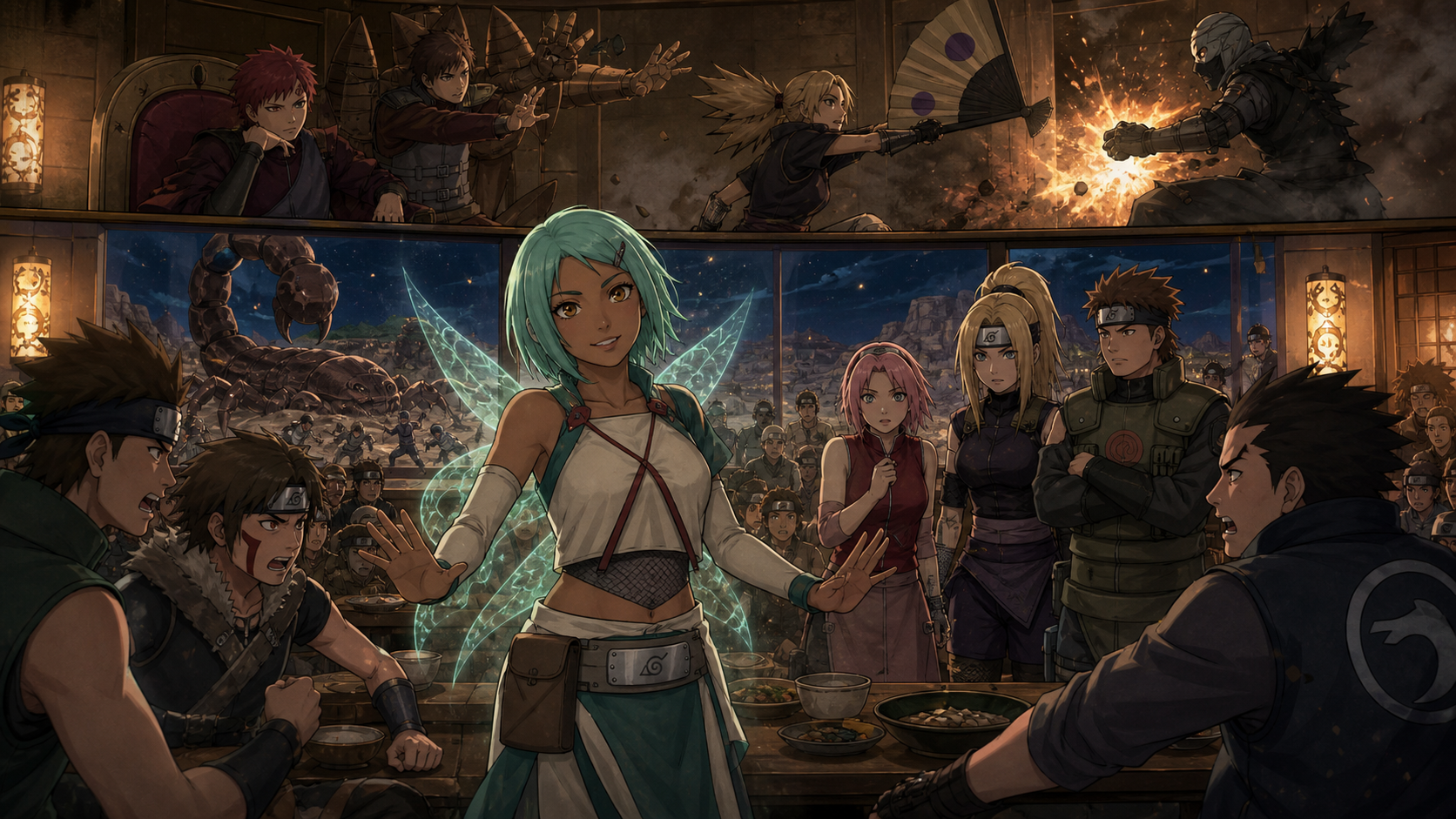
Fuu refuses the hostility everyone expects while the adults conceal an assassination campaign from candidates about to enter the desert.
Bottom line
“The Night Before the Second Exam” introduces Fū as the person in the room most determined to treat rivals like possible friends. That openness is funny, brave, and painfully vulnerable because her own village has told her to hide the Seven-Tails while sending her into an international exam. The cafeteria brawl shows candidates carrying village suspicion into an ordinary meal. Konoha cannot settle the conflict. Fū enters with direct friendliness, then watches people leave because nobody knows what to do with someone who refuses the expected hostility. Later she rescues Sakura, Ino, and Chōji from a giant scorpion without demanding loyalty first. Gaara recognizes Naruto’s social effect in her immediately. The parallel works, but Fū deserves more than becoming “girl Naruto” for one arc. Her cheerfulness belongs beside the isolation imposed on another jinchūriki. Meanwhile, Kankurō and Temari stop an extremist attacking Gaara, proving that the exam’s greatest danger has nothing to do with scroll rules. The children are about to enter a desert while adults conceal an assassination campaign.
The contrast also exposes the institution’s priorities. Candidates receive detailed rules about meals, scrolls, and disqualification while the adults conceal a coordinated attempt on the host leader’s life. Safety information flows downward only when administrators decide young people can carry the truth.
Gaara remains under active threat
An intruder enters the Kazekage office complex at night. The attack confirms that opposition inside the Land of Wind has moved beyond criticism.
Political hostility has become direct violence.
Kankurō intercepts the masked attacker
He confronts the intruder and demands an identity. Protecting Gaara now means protecting a head of state as well as a younger brother.
Family care and official duty reinforce each other.
The attacker claims reformist purpose
He presents himself as part of an extremist movement seeking change in the Land of Wind. That label does not establish the group’s full goals or public support.
Political language can hide assassination behind a cleaner noun.
Escape turns into a suicide attack
When cornered, the intruder attempts to kill himself and take Kankurō with him. The tactic values symbolic damage over survival.
Movements that spend their own members easily rarely protect ordinary people later.
Temari saves Kankurō
Her intervention prevents the attacker from controlling the final outcome. The siblings’ coordination shows why Gaara’s leadership survives internal threats.
Protection is a network, not one Kazekage’s personal strength.
Kankurō urges Gaara to reconsider exposure
Serving as an exam administrator creates predictable locations and divides security attention. His warning is not cowardice.
Risk assessment belongs inside loyalty.
Gaara refuses to abandon the event
The Chūnin Exams carry personal meaning because his first exam led to Naruto, defeat, and the beginning of change. Hosting also matters to his political legitimacy.
He will not let attackers dictate his public responsibilities.
Personal meaning can distort security judgment
Gaara’s connection to the exam gives him resolve, but symbolism should not override the safety of candidates and residents. Leaders must separate emotional importance from operational necessity.
Kankurō’s caution keeps that distinction visible.
Cancelling could reward intimidation
An automatic retreat would teach extremists that threats control Suna’s public schedule. Proceeding can demonstrate institutional stability.
The responsible answer requires stronger protection, not macho denial of danger.
Candidates reach the Demon Desert checkpoint
Teams that arrive on time preserve eligibility. Late arrivals are eliminated and directed home.
Travel and punctuality become the first unannounced survival filters.
Distance is part of the exam
Foreign genin navigate unfamiliar routes, climate, and logistics before Round Two begins. Candidates with stronger village support may arrive better rested and supplied.
Opportunity is never perfectly equal before the starting signal.
The cafeteria gathers rival villages
Competitors eat in one shared space while carrying old political assumptions and immediate tournament anxiety. An ordinary meal becomes a pressure chamber.
Proximity does not create trust automatically.
Konoha shinobi ruin the food
The accident becomes a trigger for anger across teams. Hunger, travel fatigue, and competition magnify a practical mistake.
Conflict often starts smaller than the grievances people pour into the conflict.
A brawl breaks out
Candidates who just passed a leadership test begin fighting in a cafeteria. The contradiction exposes how little one written answer can certify.
Behavior after evaluation may reveal the truth the evaluation missed.
Konoha cannot calm the room
Familiar authority and peer intervention fail because foreign teams do not recognize Leaf candidates as neutral. The village connected to the accident has limited moral leverage.
Leadership depends on legitimacy among the people being led.
Fū enters looking for friends
She approaches the room with direct enthusiasm rather than guarded rivalry. Her goal sounds socially simple and emotionally enormous.
A jinchūriki sent away from home may want connection more urgently than rank.
Her friendliness disrupts the script
Other candidates expect posturing, suspicion, or tactical assessment. Fū offers openness that does not fit those categories.
People sometimes retreat when kindness creates an obligation to respond honestly.
The cafeteria empties around her
Instead of rewarding the attempt, participants leave, and Fū is disappointed. The comic beat carries a familiar jinchūriki wound.
Wanting friends publicly does not guarantee anyone feels safe enough to stay.
Fū’s village told her to hide Chōmei
Takigakure sends her into competition while concealing the Seven-Tails. The instruction may protect her from enemies, but secrecy also isolates her from honest relationship.
She is expected to make connections without revealing a central fact about her life.
Concealment responds to a real threat
Akatsuki targets jinchūriki, and public knowledge could endanger Fū and her teammates. Security concerns are not imaginary.
The village still owes her support beyond an order to stay quiet.
Secrecy protects institutions too
Takigakure may fear losing a military asset or appearing vulnerable if other villages identify its host. Fū’s safety and village power overlap without becoming identical.
Leaders should say whose interest each restriction serves.
Chōji goes searching for more food
Hunger pulls him toward the jōnin area after the cafeteria disaster. The choice is comic and reckless because candidates are in an unfamiliar desert checkpoint.
Ordinary appetite creates an encounter no exam planner intended.
Sakura and Ino follow him
Their temporary team stays together rather than allowing one member to wander alone. The decision shows practical responsibility outside the scored phase.
Team formation becomes real through small follow-through.
A giant scorpion attacks
The desert environment introduces lethal wildlife before the official survival round starts. Administrative boundaries do not stop local danger.
Candidates need environmental awareness even during rest.
Fū rescues them
She intervenes without demanding friendship, village loyalty, or strategic payment. Her ability and quick response protect three competitors.
Action gives her social openness credibility.
Rescue creates a better introduction
The cafeteria offered a broad request for friendship that nobody knew how to answer. Shared danger gives Sakura, Ino, Chōji, and Fū a concrete experience.
Relationship often grows more easily from specific conduct than declared intention.
Gaara sees Naruto in her
He recognizes the charisma that crosses expected boundaries and the jinchūriki loneliness beneath overt energy. Naruto once reached him through similar refusal to stay distant.
Recognition gives Gaara a reason to watch Fū carefully and kindly.
The comparison should not erase Fū
She comes from Takigakure, carries Chōmei, travels with different teammates, and uses her own social strategy. Naruto offers one useful parallel.
Supporting women should not exist as reflections of the male lead.
Gaara could offer informed protection
As a jinchūriki and Kazekage, he understands both personal danger and village secrecy. He may recognize risks around Fū that ordinary proctors miss.
Shared experience can improve policy when power listens.
Kakashi reports failure in Amegakure
He could not penetrate the village’s secrecy or meet Hanzō directly. The absence of normal access increases suspicion rather than resolving the invitation mission.
Failed intelligence collection is still intelligence about control.
Amegakure’s closed system should alarm Tsunade
Konoha has invited Rain candidates into a joint event without understanding their leadership. Proceeding requires surveillance that does not punish genin for adult secrecy.
Security should distinguish participants from the regime behind them.
The second round uses Heaven and Earth scrolls
Half the teams receive one type and must obtain the counterpart. The structure forces direct competition, concealment, tracking, and resource judgment.
Passing requires both scrolls and arrival at the central destination.
The desert replaces the forest
Heat, scarce water, exposed movement, sandstorms, wildlife, and limited cover change the survival problem from the original Forest of Death.
Teams cannot copy old tactics into a new environment without adjustment.
Food and water should count as tactical preparation
The ruined meal and Chōji’s search play as comedy, but entering a seventy-two-hour desert test underfed can affect concentration, temperature regulation, and decision-making. Proctors who test survival still owe candidates a safe baseline before the clock begins.
Resource scarcity created by the exam may be legitimate. Scarcity caused by poor event management is negligence.
The waiting night is part of psychological pressure
Candidates have time to study rivals, imagine attacks, question their teams, and lose sleep before entering the desert. Fū uses that time to seek connection, while Neji uses observation to identify teams worth avoiding.
Rest becomes a strategic choice when anxiety encourages constant vigilance.
The assassination threat is hidden from candidates
Gaara, Kankurō, and Temari know extremists are active. Most genin prepare for scroll conflict rather than an attack on the administrator.
Incomplete disclosure makes informed risk impossible.
The exam may provide cover for attackers
Many foreign teams, scheduled movement, desert isolation, and divided guards create plausible concealment. An extremist can exploit normal competition as noise.
Event security should assume the timetable is public to the enemy.
Fū already passes the human test
She stops conflict through disarming openness and later protects people who did not welcome her. Neither action earns formal points.
The best evidence of leadership keeps appearing outside the official rubric.
Japanese performance requires direct observation
The final publication should verify Japanese cast and staff credits. Claims about Fū’s energy, Gaara’s resolve, Kankurō’s alarm, Temari’s intervention, or the cafeteria conflict require lawful scene-level listening.
No generic vocal description should stand in for evidence.
Fū’s friendliness is a choice under surveillance
She enters wanting connection while knowing her village has reasons to hide Chōmei and limit what outsiders learn. Openness therefore carries personal and political risk.
Calling her naturally cheerful would flatten the courage involved. She keeps approaching people after institutions taught everyone that closeness can expose the body carrying a tailed beast.
She is not a substitute Naruto
Gaara recognizes familiar loneliness, directness, and determination to make friends. The comparison helps him notice danger and possibility, but Fū has a different village, beast, team, gendered experience, and relationship to secrecy.
Her choices deserve explanation through her own history. Similarity can open empathy without turning one character into another character’s echo.
Takigakure’s secrecy protects and confines
Hiding Fū’s status may reduce Akatsuki exposure and prevent rivals from targeting Chōmei. It may also isolate her from informed allies and let village leaders control decisions about her body without public scrutiny.
Protection becomes legitimate when Fū understands the plan, can challenge restrictions, and receives truthful alternatives rather than orders justified by danger she cannot discuss.
Chōmei belongs inside the security conversation
The tailed beast is not classified equipment stored in Fū. Any decision about concealment, travel, combat, or extraction risk affects two sentient participants sharing one body arrangement.
Leaders should seek both perspectives. A policy that protects village assets while denying Chōmei’s voice repeats the logic Akatsuki exploits.
The cafeteria conflict is not harmless rivalry
Food scarcity, travel fatigue, village tension, and competition turn a common room into a brawl. Candidates about to enter a survival test are already showing how quickly frustration becomes collective punishment.
Proctors should intervene, document escalation, and examine whether event logistics created predictable conflict. Hungry adolescents do not become safer because adults label the chaos team building.
Fū changes the room by refusing expected hostility
She treats competitors as possible friends before they prove usefulness or lower their guard. The reaction exposes how thoroughly the exam has trained candidates to read warmth as suspicious.
Her approach is not foolish by definition. It does need boundaries, situational awareness, and allies who will warn her without punishing the desire for connection.
Rescuing Team Sakura creates evidence
When the scorpion attacks, Fū acts before friendship has been guaranteed. Sakura, Ino, and Chōji receive a concrete reason to revise whatever assumptions the dining hall produced.
Rescue should not become a fee Fū pays for acceptance. Her worth existed before she saved anyone, and the others owe more than temporary gratitude.
Sakura’s team can reciprocate through information
Medical awareness, sensory ability, clan knowledge, and Konoha’s Akatsuki experience may help protect Fū if risk becomes visible. Reciprocity begins by asking what she wants rather than deciding rescue on her behalf.
A friendship between jinchūriki and non-jinchūriki allies should expand choice, not create a new group entitled to manage her movements.
Gaara’s continued hosting requires a threshold
Cancelling immediately could reward attackers and damage diplomacy. Continuing without conditions could expose candidates to a threat they did not agree to face.
Responsible leadership defines triggers: when intelligence changes, routes close, medical capacity fails, or Gaara’s presence draws unacceptable danger, officials pause, relocate, or disclose enough for informed participation.
Kankurō and Temari carry the security cost
They intercept attacks, protect Gaara, and understand how his public role concentrates danger around the family. Their warnings are not cowardice or lack of faith in reform.
Gaara must hear them as governing partners. Choosing personal symbolism over their field evidence would reproduce the lonely decision-making he claims the new Sand has outgrown.
The assassination threat changes informed consent
Candidates agreed to an exam with controlled danger, not unknowingly serving as cover inside an active campaign against the Kazekage. Withholding every detail may protect operations and prevents meaningful choice.
Officials need a bounded disclosure that explains elevated risk, available evacuation, and the right to withdraw without career punishment.
The desert magnifies logistical inequality
Teams arrive with different experience of heat, distance, water management, navigation, and local wildlife. Sand candidates possess home knowledge that may exceed what skill rankings capture.
Some advantage is unavoidable, but organizers should separate intended terrain judgment from preventable harm caused by inadequate water, inaccessible checkpoints, or assumptions that every body tolerates heat equally.
The night before is part of the evaluation burden
Anxiety, hunger, unfamiliar sleeping conditions, conflict, and secrecy affect decision-making before the formal clock begins. Candidates with trauma or medical conditions may pay a larger price.
A fair exam provides rest, food, safety information, and confidential support. Exhaustion manufactured by administration is not evidence of field resilience.
Amegakure’s silence is political evidence
Kakashi failing to secure participation does not prove the Rain is irrational or hostile. The closed response fits a country repeatedly used by larger powers and now controlled through hidden authority.
Tsunade should investigate carefully while recognizing Konoha’s role in that history. Suspicion without self-examination would turn intelligence concern into another justification for intervention.
Fū passes a test the officials did not design
She enters a hostile room, seeks connection, responds to danger, and protects competitors without surrendering her identity. Those choices demonstrate initiative, courage, and coalition instinct.
If evaluators notice only scroll possession and combat output, the institution will miss leadership already happening in front of it.
Fū’s team deserves attention. Shibuki and Takigakure sent her with teammates carrying instructions, fears, and responsibility for protecting secrets. Their relationship may support her or reproduce village control depending on whether they can question orders and hear what she wants. Centering Fū should not make the people beside her disappear when risk reaches them in the desert.
RaeRae’s verdict
“The Night Before the Second Exam” makes Fū immediately likable without pretending friendliness protects her from loneliness. She enters a brawl hoping to make friends, clears the tension, and gets left behind anyway. Later she saves Sakura, Ino, and Chōji from a desert scorpion because somebody needs help. Gaara recognizes Naruto’s boundary-crossing energy, but Fū deserves her own center. She is a young woman carrying Chōmei under village secrecy while trying to build relationships with people trained to distrust her.
The episode also makes Gaara’s exam emotionally meaningful and politically dangerous. An extremist nearly kills Kankurō during an attack tied to opposition against the Kazekage. Gaara refuses to cancel because intimidation should not govern Suna. Fine. Then security needs to match the courage. Candidates are about to enter the Demon Desert without knowing the event also provides cover for an assassination attempt. Adults keep asking teenagers to prove judgment while hiding the information needed for judgment.
RaeRae’s call
Fū is not “Naruto, but from Waterfall.” She is a jinchūriki entering friendship under a different secrecy system, with Chōmei’s safety tied to every disclosure. Her warmth is brave, and it still needs boundaries. Gaara faces the same balance at institutional scale: refusing to let assassins cancel diplomacy while protecting candidates who never agreed to become cover for his enemies. The adults owe truthful risk thresholds, rest, water, evacuation, and the right to withdraw. Meanwhile Fū has already shown leadership by making connection possible before anyone offered her safety in return.
Episode details and viewing routes
- Official episode reference: Naruto Official episode guide
- Licensed episode route: Crunchyroll licensed episode page
What I am carrying forward
Kankurō and Temari stopped an extremist attack linked to the campaign against Gaara. Gaara chose to continue serving as exam administrator despite the increased threat.
At the Demon Desert checkpoint, a cafeteria brawl exposed tension among villages. Fū calmed the conflict and later rescued Sakura, Ino, and Chōji from a giant scorpion, prompting Gaara to recognize a Naruto-like openness in her. Episode 399 begins the seventy-two-hour Heaven-and-Earth scroll survival round.