
Untitled
Sai can draw a feeling before he can claim its name.
Sai can draw a feeling he cannot name
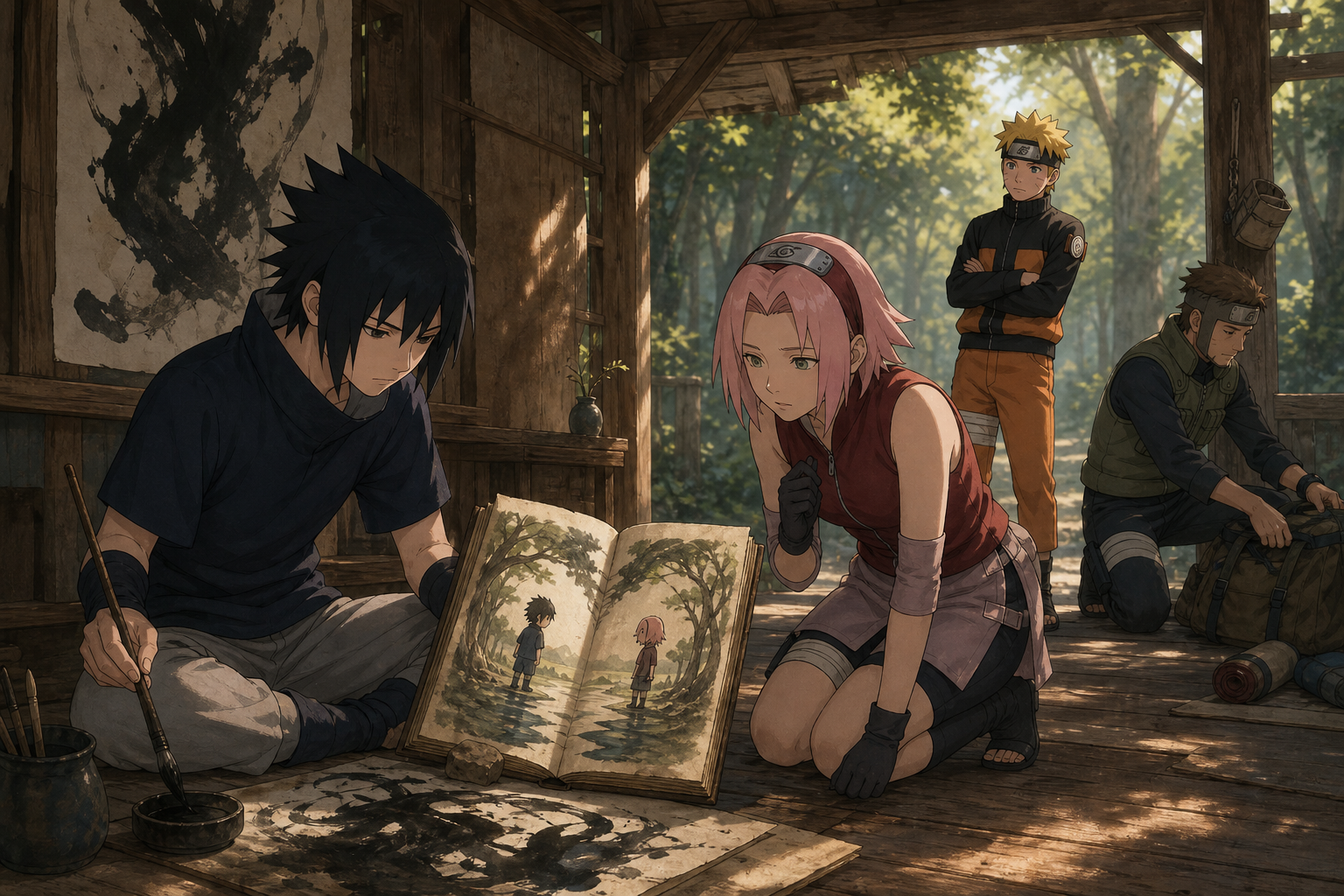
Episode 37 slows New Team Kakashi down long enough for Sakura to notice what Sai does when he is not provoking Naruto. She finds him working on an abstract painting and asks about its title. Sai says it has none.
The answer fits the person the team has met so far. Sai can reproduce the appearance of a smile without understanding its emotional use. He can observe reactions and record useful information. He can create an image, but he cannot connect the image to the language people use to share meaning.
That gap bothers Sakura. She has every reason to distrust him, yet the painting suggests something more complicated than simple cruelty. Sai is making art. He is expressing something through line and ink even while claiming he cannot name it.
The episode title therefore belongs to the painting, the picture book, and Sai himself. Root removed his name and assigned him a functional identity. His work remains untitled because the person making it has been trained to separate creation from personal meaning.
The friendship manual turns intimacy into instructions
Sai studies books about friendship because ordinary conversation does not come naturally to him. The idea is funny in execution. He approaches social connection like a jutsu manual: identify the rule, reproduce the correct behavior, and expect the desired result.
The nickname advice goes badly because Sai understands the instruction without understanding the relationship underneath it. A teasing nickname can signal affection when trust already exists. Applied mechanically, it becomes an insult. Sai selects observable features and says them aloud with the confidence of somebody following a procedure.
Naruto and Sakura react exactly as people would when treated like entries in a social experiment. The problem is not only that the names are rude. Sai seems unaware that context changes meaning.
His failure reveals what Root took from him. Social knowledge is not a decorative skill. Children learn it through repeated relationships, mistakes, repair, and emotional safety. Sai was trained in an environment that treated those experiences as dangerous attachments. Now he needs written instructions for behavior most people learned by being allowed to belong.
That history explains the awkwardness. It does not excuse every hurtful choice. The episode holds both truths at once.
Sakura finds the evidence Sai did not mean to share
The unusual picture book among Sai’s belongings is more personal than the manuals. It is not an external guide telling him how friendship works. It is something he created, a visual sequence built around two boys moving through parallel challenges toward one another.
The book gives Sakura information Sai has not volunteered. His emotional blankness has a history. The mirrored structure suggests connection, separation, and an unfinished meeting. Even without a title, it has intention.
Sakura’s discovery matters because she is the first member of the team to look beyond Sai’s behavior without pretending that behavior is harmless. Naruto remains locked in direct conflict with him. Yamato observes him as a mission risk. Sakura notices an object that contradicts the simplest explanation.
If Sai truly lacked all feeling, why preserve the book? Why continue drawing? Why leave the story unfinished rather than discard it?
The questions do not create trust, but they make contempt harder to maintain. Sai may be withholding information because of secret orders. He may also be withholding it because Root taught him that personal history should not exist.
Art survives where ordinary language was removed
Sai’s ink techniques already connect art to combat. He draws creatures and gives them temporary life. Episode 37 reveals that drawing also carries the part of him Root failed to erase.
This is important because Sai does not lack expression. His expression has been displaced. He cannot comfortably name an emotion, explain a bond, or respond to affection. He can arrange images that imply all three.
Art becomes a container for memory before Sai is capable of discussing memory. The abstract painting does not have a title, but it still exists. The picture book does not explain itself in dialogue, but its mirrored pages create a relationship the viewer can recognize.
That is why the title “Untitled” feels sad rather than empty. A title would require Sai to claim what the work means to him. Root trained him not to make such claims. The absence of a title is evidence of suppression, not absence of meaning.
Naruto sees failure where Sakura sees a clue
Naruto has little patience for Sai’s experiments with friendship. From his perspective, Sai attacks people, insults Sasuke, smiles falsely, and then expects a manual to repair the problem. Naruto values bonds too deeply to accept a procedural imitation.
That reaction is understandable, but it limits what he can see. Naruto recognizes loneliness easily when it resembles his own. Sai’s loneliness looks different. It is quiet, disciplined, and hidden behind competence.
Sakura is better positioned to notice the discrepancy because she is not engaged in the same contest. She can observe Sai’s painting and picture book without immediately turning the discovery into another argument about Sasuke.
The episode does not make Sakura instantly sympathetic. Curiosity is enough. She begins asking what created Sai’s behavior instead of only reacting to the behavior itself.
That shift is the first meaningful opening in the new team. Trust does not begin with absolution. It begins when somebody becomes more than the worst thing they have said.
Root replaced identity with function
Sai’s assigned name is a reminder that Root does not cultivate whole people. It cultivates operatives. Personal histories create loyalties beyond the chain of command, so those histories are suppressed. Emotion creates hesitation, so emotion is treated as failure.
The result may be efficient in narrow tactical terms. Sai can follow orders, hide his motives, and enter a hostile team without demanding comfort. Yet Episode 37 shows the cost. He has to research friendship as though it were foreign doctrine. He reaches for a smile and produces a mask. He creates art and cannot title it.
Danzō’s system does not eliminate humanity cleanly. It forces humanity into indirect forms. The picture book survives because some part of Sai still needs to tell a story about connection.
That makes him both dangerous and vulnerable. His Root training gives him hidden obligations. His suppressed attachment gives those obligations a fault line Danzō may not fully control.
The unfinished book mirrors the unfinished team
The picture book’s structure reflects New Team Kakashi. Two figures move along separate paths, facing obstacles without yet completing the meeting at the center. Naruto and Sai are doing the same thing.
Naruto’s path is built from bonds he refuses to abandon. Sai’s path is built from orders designed to prevent bonds from forming. Both are moving toward Tenchi Bridge, but they interpret the journey through opposing values.
Sakura occupies the space between them. She can read the visual evidence of Sai’s hidden history while understanding Naruto’s refusal to replace Sasuke. Yamato provides the structure that keeps all three on the same route.
The team remains untitled in its own way. “New Team Kakashi” is an administrative label, not yet an identity the members share. They have not decided what they are to one another.
Like the book, their story has pages and direction without a completed center.
RaeRae’s reaction
Sai studying friendship manuals is funny until you remember why he needs them. Somebody trained ordinary human connection out of a child so thoroughly that he has to research nicknames. That is not social awkwardness appearing from nowhere. It is institutional damage.
The nicknames are still terrible. Explanation does not make Sakura or Naruto obligated to enjoy being insulted. What changes is our understanding of the failure. Sai is not naturally gifted at cruelty and mysteriously bad at kindness. He was taught one skill set and denied the other.
I love Sakura’s role in the episode because she does not leap from suspicion to trust. She notices. That is a smaller, more believable step. The painting and picture book give her evidence that Sai contains a private world his fake smile never reveals.
The title is perfect because “untitled” sounds like nothing until the episode shows how much meaning can exist without a name. Sai’s painting has no title. His book has no finished resolution. His own identity is an assignment. Yet all three hold traces of a person Root failed to reduce completely.
Naruto is going to have the hardest time seeing that because Sai keeps attacking his most sacred bond. Naruto understands abandoned children. He does not yet understand a child trained to participate in his own emotional disappearance.
The episode earns sympathy without demanding forgiveness. Sai remains suspicious. Danzō still placed him on the team for a reason. The book does not erase the hidden mission. It simply proves that hidden orders are not the only hidden thing inside him.
A title has to be claimed
By the end of Episode 37, Sai has not explained the picture book or transformed into a genuine friend. The change belongs to the team’s perception. Sakura has seen evidence of a story beneath the performance.
That evidence creates possibility. If Sai can preserve a book about connection, he may be capable of forming one. If he can create an image he cannot name, he may eventually learn the emotional language Root denied him.
A title cannot be assigned from outside and carry the same meaning. Sai will have to decide what the book represents, just as New Team Kakashi will have to decide whether its name describes a real bond or only a mission formation.
For now, both remain unfinished. That does not make them empty. It makes the next page matter.
Official episode reference: Naruto Official episode guide
Licensed episode route: Crunchyroll licensed episode page
The picture book is a relationship Sai can draw but not name
Sai’s unfinished book follows two boys moving through opposite ends of a story. The structure points toward connection before he can explain what that connection means. Art carries memory his ordinary speech has been trained to suppress.
That does not make the book a magical confession. It gives Sakura evidence that Sai’s emotional life is not absent. It is interrupted, hidden, and difficult for him to translate.
Untitled is not the same as meaningless
Sai cannot provide a title because naming would require him to identify the relationship at the center of the book. The blank space marks a limit in access, not a lack of content.
People often mistake what cannot be easily named for what does not exist. The episode asks us to remain curious long enough for meaning to emerge through image, sequence, and omission.
Sakura reads the art without forcing a confession
She notices the unfinished structure and asks questions. She does not immediately demand that Sai produce the correct emotional explanation. That restraint matters after their hostile beginning.
Sakura’s medical training has taught her to observe signs before deciding on a diagnosis. The same patience gives her a better view of Sai than Naruto’s replacement argument or Sai’s own practiced smile allowed.
Abstract ink reveals control without disclosure
Sai’s art demonstrates extraordinary technique. He can create forms with disciplined lines, move ink through ninjutsu, and compose images that communicate more than his face does. Skill becomes a safe channel because Root values it.
The work still exceeds Root’s intended function. A weaponized drawing can carry grief, memory, and longing even when the institution wanted only obedience.
Root removed language because language builds bonds
Naming a relationship makes it easier to remember, defend, and grieve. An operative who can say brother, friend, fear, or love becomes harder to treat as a replaceable instrument.
Sai’s missing title reflects more than personal awkwardness. It shows the political usefulness of emotional silence. Root did not simply fail to teach him. It benefited from the absence.
Naruto resists curiosity because suspicion feels safer
Naruto has strong reasons not to trust Sai. He also uses those reasons to avoid evidence that might complicate the category of unwanted replacement.
If Sai has a history, grief, and unfinished attachment, Naruto must face the possibility that the stranger is not trying to become Sasuke at all. Complexity threatens the clean anger protecting Team 7’s empty place.
Sai’s insults keep building the distance he knows how to survive
Every cutting remark confirms that others will dislike him, which lets him remain outside the demands of real connection. Rejection becomes predictable when he helps produce it.
That pattern protects him from vulnerability while making the team’s distrust rational. Survival habits can create the outcome they claim to expect.
The book suggests a brother before Sai can say brother
The paired boys and converging journey point toward a bond that Root could not erase completely. Sai may not consciously offer the history, but his repeated artistic choices preserve it.
Memory can remain active in form after direct language becomes inaccessible. The page remembers where the speaker cannot.
Yamato’s mission plan also depends on performance
The team intends to impersonate Sasori and approach Orochimaru’s spy. Success will require controlled appearance, rehearsed behavior, and concealment of intention.
That tactical deception mirrors Sai’s social mask. The difference lies in consent and purpose. A mission disguise is chosen for a bounded operation. Root turned concealment into Sai’s permanent way of existing.
Everybody on the team is performing something
Sai performs friendliness. Naruto performs certainty that he will recover Sasuke. Sakura performs control over anger and fear. Yamato performs a captain whose authority has no doubts.
Performance is not automatically false. It becomes dangerous when nobody can acknowledge the gap between the role and the person carrying it.
A title can close meaning too early
The blank book frustrates Sakura because it withholds the final interpretive key. It also keeps the story open. Sai has not yet decided what the two boys become at the center.
Root would prefer a finished assignment with one approved purpose. An untitled work still has room for Sai’s own choice.
The Tenchi Bridge plan turns incomplete trust into operational risk
Yamato will need the team to follow precise instructions while surrounded by enemies and deception. Naruto and Sakura do not know Sai’s hidden mandate. Sai does not trust them with his history.
The picture book creates a small route toward understanding, but the mission deadline will test whether that route opened quickly enough.
Sakura becomes the first teammate to notice rather than classify
Naruto calls Sai a replacement. Danzō calls him an operative. Sai calls himself whatever the mission requires. Sakura begins asking what the art shows that those labels miss.
Noticing is not rescuing. Sai will still need agency in his own change. Her attention simply gives personhood somewhere to land.
Art preserves what institutional language deletes
Root can assign names, missions, and acceptable expressions. It cannot fully control the patterns Sai returns to when he draws for himself.
The book becomes an archive built in a language his conditioning did not completely capture. That makes creativity politically dangerous to any system depending on total obedience.
The missing center is part of the story
The boys approach one another from opposite directions, but the central pages remain unfinished. Whatever happened at the meeting point is the memory Sai cannot complete.
Absence therefore becomes content. The blank is not lazy storytelling. It is the shape of interrupted grief.
The blank title protects a choice Root never wanted Sai to have
A title does more than identify a book. It tells the reader which meaning should organize everything inside. Sai cannot provide one because the central relationship remains painful and unfinished, but the absence also prevents an institution from supplying the answer for him.
Root assigned names, objectives, acceptable expressions, and rules about attachment. Leaving this work untitled creates one small space where Danzō’s vocabulary does not win automatically. Sai may eventually name the bond, the loss, or the person beside him in the drawings. The timing belongs to him.
That agency matters because recovery cannot mean replacing one official script with a friendlier script imposed by teammates. Sakura can notice. Naruto can challenge. Yamato can set boundaries. None of them should seize the book and declare its meaning complete. The person who lost access to his own emotional language has to participate in rebuilding it.
The team receives a clue, not permission to stop being careful
Sai’s art complicates the belief that he is empty, but it does not erase his secret orders or earlier manipulation. Evidence of pain is not proof of safety.
The mature response holds curiosity and caution together. Sakura can recognize the story beneath the mask while continuing to watch what Sai does. Trust should grow from repeated choices, not from turning one vulnerable artifact into a shortcut around accountability.
RaeRae’s full take
Sai can draw a relationship with more honesty than he can discuss one. That is not proof he feels nothing. It is proof Root trained language away from the places where attachment might survive.
Sakura is the first person on this team to look at the evidence without demanding a neat answer. Good. Naruto’s suspicion is justified, but “I do not trust him” cannot become “there is nobody there.” Danzō already built an entire system around that lie.
The book has no title because Sai cannot yet name the person at its center or what losing him did. The pages still remember. Art kept the record open after the institution tried to close the case.
RaeRae checkpoint: An untitled story can still carry a name somebody is not ready to say. The blank space is not emptiness. It is where Root failed to erase everything.
Receipts and official routes
- Episode placement, Sai’s unfinished picture book, his art, and the team’s Tenchi Bridge planning: Naruto Official Site episode guide.
- Licensed episode route: Crunchyroll.