
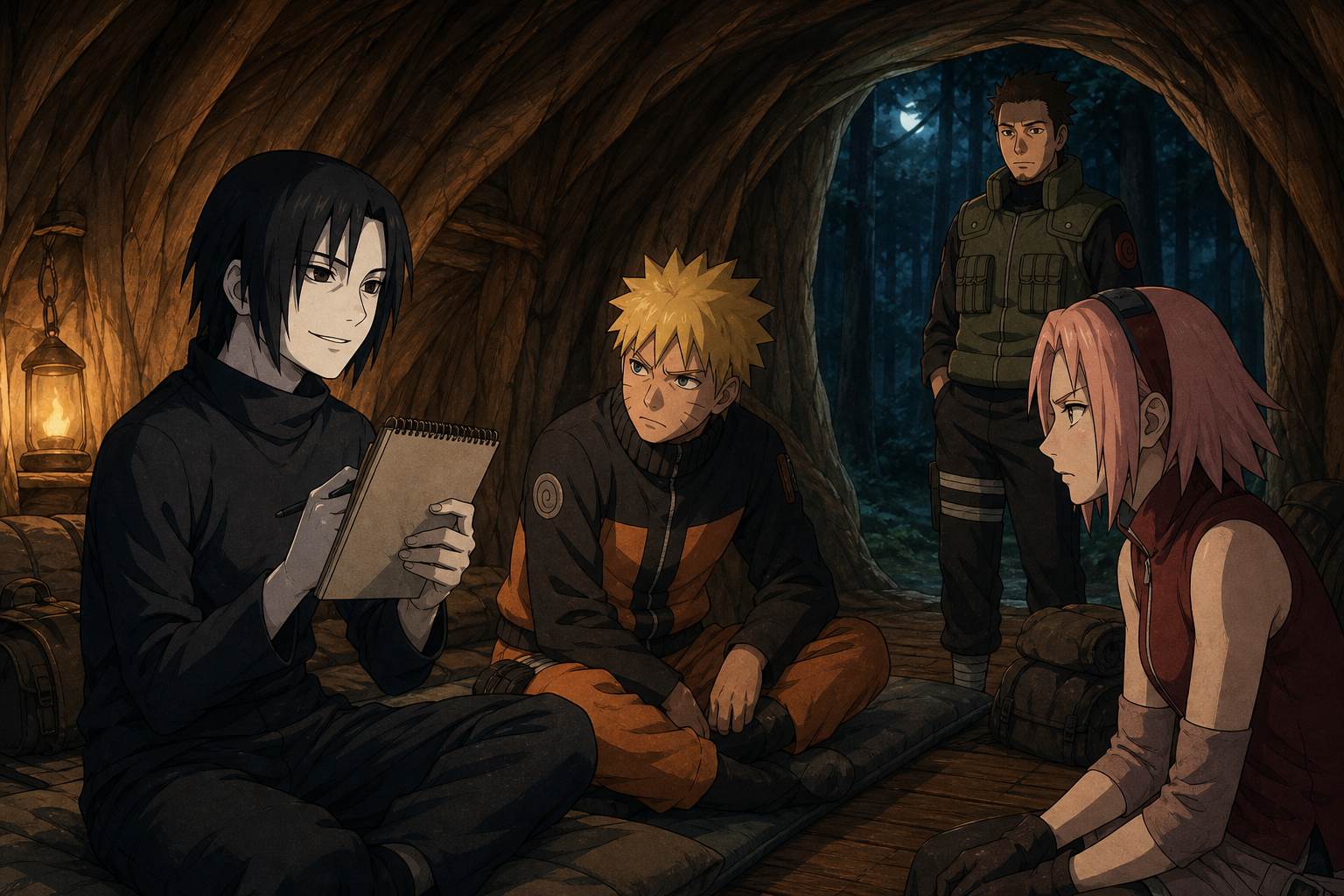
The Fake Smile
A wooden shelter removes the distance, but it cannot manufacture trust.
The road to Tenchi Bridge begins with nowhere to hide
New Team Kakashi finally leaves the village in Episode 36, but movement does not reduce the conflict. Naruto continues treating Sai as a temporary body occupying Sasuke’s place. Sai continues responding to Naruto’s loyalty with contempt. Sakura keeps trying to preserve a mission both boys seem willing to derail.
Yamato understands that distance will not repair the group. The road to Tenchi Bridge gives them a shared destination, yet every conversation returns to the same fracture. Naruto says Sasuke belongs to Team 7. Sai treats that belief as sentimental weakness. Neither is speaking only about team membership. They are arguing over whether a bond still matters when one person has walked away.
The episode moves the team into the forest and then removes the escape routes. Yamato creates a Wood Release shelter and orders them to spend the night together. It is practical lodging, but it is also forced proximity. If the team cannot sit in one room without turning grief into hostility, it is not ready to meet Orochimaru’s spy.
Sai’s smile is a tool he has not learned to use
The title points directly at Sai’s practiced smile. He has learned that smiling is supposed to make interactions easier, but he applies the expression without the emotional timing that gives it meaning. The result is unsettling. His mouth signals warmth while his words and eyes remain detached.
That mismatch matters because it shows Sai is not simply emotionless. He is imitating social behavior. Somewhere in his training, he learned that people expect certain expressions, and he now produces those expressions as techniques. A smile becomes another tool selected for a task.
Naruto reads the performance as dishonesty. He has spent his life searching faces for proof that people accept or reject him. A false smile is not a minor social mistake to somebody with that history. It feels like another person refusing to say what he actually means.
Sakura sees the problem differently. She recognizes that Sai lacks ordinary social instincts, but his ignorance does not erase the cruelty of his remarks. He may not experience bonds the way Naruto and Sakura do. He still knows exactly which subject will hurt them.
Sai’s smile therefore sits between inability and manipulation. He does not know how to express genuine warmth, yet he knows how to use the appearance of politeness while provoking a response.
Naruto’s anger is grief wearing armor
Naruto insists that Sai is only filling in for Sasuke because anything else sounds like surrender. His hostility is repetitive, but the repetition reveals how hard he is working to hold one belief in place. Sasuke is still part of Team 7. Naruto will find him. Nobody gets to close that space before the promise is fulfilled.
Anger is easier for Naruto to display than fear. He can shout at Sai. He cannot easily say that he is terrified Sasuke has moved beyond the reach of the bond Naruto treasures. He can threaten anyone who insults Sasuke. He cannot force Sasuke to want the same reunion.
The closer the team gets to Tenchi Bridge, the harder that uncertainty becomes to ignore. This is the first concrete lead in years. It may bring Naruto closer to Sasuke, but proximity could reveal that the person he remembers has changed.
Sai becomes a convenient target because he makes the emotional argument simple. If Sai is wrong and cruel, then Naruto’s loyalty must be right. The mission ahead will not remain that clean.
Sakura performs control because somebody has to
The “fake smile” does not belong only to Sai in a broader sense. Sakura performs composure throughout the journey. She is angry when Sai insults Sasuke, worried about Naruto’s escalating temper, and desperate for the mission to succeed. Still, she takes on the role of the person who can keep moving.
Her control is real, but it does not mean she is fine. Sakura has learned to function while carrying grief. That growth makes her more reliable than she was in the original Team 7, but it also invites everyone else to depend on her emotional labor.
She repeatedly has to separate Naruto’s understandable feelings from behavior that could ruin their chance to find Sasuke. She also has to judge Sai, whose strange social performance may hide something more dangerous than awkwardness.
Sakura’s suspicion is important because the team should not trust Sai automatically. He was appointed through Danzō, attacked Naruto as a test, and continues revealing almost nothing about himself. Professionalism requires restraint, not blindness.
Yamato can build a house, not a relationship
Yamato’s Wood Release shelter is one of those demonstrations that looks casual because he performs it so efficiently. In minutes, the team has walls, a roof, and a protected place to rest. His chakra turns the forest into infrastructure.
The contrast is deliberate. Yamato can build a physical structure almost instantly. He cannot build trust between Naruto, Sakura, and Sai with the same technique. That construction requires participation from people who do not want to meet one another halfway.
He can, however, control the conditions. By placing everyone under one roof, Yamato makes avoidance impossible. Naruto cannot walk far enough away to pretend Sai is not part of the mission. Sai cannot observe the others only from a detached distance. Sakura cannot manage each conflict in isolation.
The shelter becomes a test without being announced as one. Can these four people share space, exchange information, and sleep without destroying the operation? The standard is low because the team is starting from open hostility.
Yamato’s leadership remains pragmatic. He does not demand emotional honesty before they are capable of it. He asks for enough cooperation to reach the bridge.
Everybody is performing a version of readiness
Sai’s false smile is the most visible performance, but the episode quietly surrounds it with others. Naruto performs certainty. He speaks as though wanting Sasuke back guarantees that the reunion can happen. Beneath that certainty is fear.
Sakura performs control. She keeps the mission in view and manages the boys’ conflict, even while every mention of Sasuke affects her personally.
Yamato performs calm authority. His composure is not entirely false, but it is purposeful. A captain cannot amplify the anxiety of a team already near its limit. He watches, intervenes, and withholds whatever concern he may feel about the hidden orders and volatile power traveling with him.
Even the official identity of “Team Kakashi” is a performance. Kakashi is absent. Sasuke is absent. Half the current team has never served under the person whose name it carries. The title preserves continuity the relationships have not yet achieved.
Performance is not always deception. Sometimes it is the temporary structure people use until they can act from something more secure. The problem with Sai is that he has been taught the structure without being allowed to develop what belongs underneath it.
The mission turns every weakness into pressure
The team is heading toward a spy embedded near Orochimaru. Espionage depends on reading false identities, controlled expressions, and hidden motives. Sai’s presence makes those themes internal before the group reaches the rendezvous.
Can Naruto recognize a lie without reacting so loudly that he exposes the operation? Can Sakura distinguish Sai’s social incompetence from intentional manipulation? Can Yamato maintain command when multiple people have private stakes in the target?
The Tenchi Bridge mission does not merely require combat strength. It requires the team to manage appearances. That is precisely where they are weakest. Naruto is emotionally transparent. Sai’s performance feels artificial. Sakura’s restraint is under strain. Yamato is the only one currently capable of keeping his intentions unreadable.
Their night in the shelter therefore belongs to the operation. Learning how one another lies, reacts, and withdraws may determine whether they survive contact with Orochimaru’s network.
RaeRae’s reaction
Sai’s smile makes my skin crawl because it is technically correct and emotionally wrong. He has the shape of friendliness without the risk that makes friendliness meaningful. Naruto notices immediately, and I cannot blame him for distrusting it.
What I do blame Naruto for is letting Sai control the conversation every time Sasuke is mentioned. Sai presses one button, Naruto explodes, and the entire team has to reorganize around the reaction. Loyalty should not make Naruto that easy to steer.
Sakura is doing far too much unpaid emotional management. She is carrying her own feelings about Sasuke while trying to stop Naruto from wasting the lead and trying to decide whether Sai is merely rude or actively dangerous. The fact that she can handle more now does not mean everyone should hand her more.
Yamato building a house and ordering them inside is perfect. He cannot conduct group therapy on a forest road, and he does not try. He creates a controlled environment where the team has to confront the fact that they are traveling together.
The visual metaphor is almost too neat: walls rise around them, but nobody has lowered a wall inside. Sai hides behind a smile. Naruto hides fear behind anger. Sakura hides pain behind competence. Yamato hides concern behind command.
I appreciate that the episode does not rush to make Sai sympathetic. It gives us evidence that his behavior is learned, not evidence that the harm disappears. Understanding why somebody lacks emotional fluency does not require accepting every cruel thing they say.
A roof is only the beginning
Episode 36 ends without a warm team breakthrough. That restraint is the right choice. Trust built in one night would feel as artificial as Sai’s smile.
What changes is that the team can no longer pretend the conflict is separate from the mission. They share a road, a shelter, and a deadline. Naruto’s grief, Sakura’s restraint, Sai’s performance, and Yamato’s authority all travel to Tenchi Bridge with them.
Yamato has given them a roof. The harder construction remains unfinished. If New Team Kakashi is going to become more than four names on an order, each member will have to risk showing something real beneath the role.
Official episode reference: Naruto Official episode guide
Licensed episode route: Crunchyroll licensed episode page
Yamato can build a house faster than this team can build trust
Wood Release turns an empty clearing into a complete shelter, which is both useful and a little insulting to ordinary construction. The walls appear because Yamato has the technique and authority to make them appear. Human safety does not work that quickly.
Naruto, Sakura, and Sai can share a roof while remaining emotionally miles apart. The shelter protects their bodies from the night. It cannot decide what they reveal inside it.
Sai learned the shape of friendliness without the feeling
Sai explains that smiling can help people connect, so he practices the visible result. Root gave him rules for performance while stripping away the relationships that would have taught him why a smile emerges naturally.
The expression is fake, but the attempt contains information. Sai knows something is missing and is trying to reproduce it with the tools available. That does not make the smile honest. It makes the gap visible.
A mask can be both manipulation and survival
Naruto and Sakura are right not to trust a pleasant face after Sai tested, insulted, and provoked them. Sai also learned concealment in an organization where readable attachment could become weakness.
The same smile helps him deceive others and protects him from an institution that punished emotional ties. Reducing it to one purpose would miss how survival habits keep operating after the immediate danger changes.
Naruto recognizes falseness because he performs too
Naruto often covers loneliness with noise, confidence, pranks, and exaggerated certainty. His performance looks opposite to Sai’s calm smile, but both young men learned to manage how others see them.
That parallel does not make their methods identical. It gives Naruto a possible route toward understanding once he stops treating every difference as proof that Sai has no feelings.
Sakura reads the smile as another insult
Sakura has spent years watching people hide pain behind socially acceptable behavior, including herself. Sai’s expression feels offensive because it arrives without the emotional accountability she expects after conflict.
She is not obligated to reward the attempt. She can demand different behavior and still recognize that nobody taught Sai what repair looks like.
The book offers procedure where experience should be
Sai relies on written advice about names, smiles, and social interaction. The guidance produces awkward results because relationships cannot be reduced to isolated techniques without context.
Still, reaching for a book is evidence of effort. He could dismiss connection as useless. Instead, he studies it like a mission skill because studying is the learning method Root left intact.
Root made emotional emptiness look professional
Danzō’s organization benefits when operatives suppress attachment, obey without hesitation, and reveal nothing a target can exploit. The traits that make Sai unnerving to peers make him valuable to Root.
Calling him naturally cold would let the institution disappear from the analysis. His behavior was cultivated because somebody wanted a child easier to control.
Understanding conditioning does not require tolerating cruelty
Sai’s background explains why empathy and ordinary boundaries are unfamiliar. Naruto and Sakura still have the right to reject insults, tests, and manipulation.
Care without accountability would force harmed people to absorb everything until Sai improves. Accountability without context would punish him for carrying the exact injuries Root designed. The team needs both.
Forced proximity creates evidence, not intimacy
The road and shared shelter prevent everyone from escaping after the first hostile exchange. They have to observe one another through meals, sleep arrangements, travel pace, and mission preparation.
Proximity can deepen resentment as easily as trust. Its value lies in producing more information than the first impression allowed. What they do with that evidence remains a choice.
Yamato watches because leadership requires diagnosis
He cannot order genuine friendship, so he studies the team’s fractures. Naruto reacts around Sasuke. Sakura moves between mediation and anger. Sai uses performance to maintain distance.
A captain needs to know which conflict threatens the mission, which boundary needs enforcement, and which discomfort can be allowed long enough for people to learn.
The fake smile exposes Konoha’s preference for usable surfaces
Villages reward shinobi who report for duty, obey orders, and keep private damage from disrupting operations. Sai takes that expectation to its logical extreme: a pleasant expression over an interior nobody is permitted to access.
The discomfort he creates should push the village to question the system, not merely teach one operative to imitate warmth more convincingly.
Naruto keeps calling Sai temporary
Describing Sai as a temporary fill-in protects Naruto’s promise to Sasuke, but it also tells Sai that belonging is unavailable before the mission begins. Naruto knows the pain of being treated as a category rather than a person.
His growth will require noticing when loyalty makes him reproduce exclusion from the other side.
Sai’s hidden orders make suspicion materially justified
The team’s distrust is not only prejudice against awkward behavior. Sai reports to Danzō and carries a purpose the others do not know. His smile helps conceal a real secret.
The story must preserve that fact while exploring his conditioning. Compassion should sharpen judgment, not switch it off.
A genuine smile cannot be demanded on schedule
Naruto and Sakura may eventually see Sai express something unpracticed, but forcing that outcome would only create another performance. Safety has to exist before vulnerability becomes possible.
The team can begin with predictable boundaries, shared work, and honest consequences. Feeling may follow. It cannot be ordered into existence.
The episode asks whether performance can become practice
People sometimes learn an emotional habit from the outside inward. A rehearsed courtesy can create enough space for a real interaction. A borrowed phrase can become meaningful after experience catches up.
Sai’s fake smile is not proof that growth is impossible. It is the rough first tool of someone who has not yet learned what the tool is for.
The shelter gives everyone a door they have to choose to open
Yamato’s wooden rooms create privacy as well as proximity. Each teammate can retreat behind a wall, carry the same judgment into the morning, and complete the trip without becoming more knowable. Architecture can provide safety. It cannot compel honesty.
That makes the small conversations important. Every question about Sai’s book, every observation of the smile, and every refusal to accept an insult adds information to a relationship still built mostly from assumptions. Nobody needs to confess their deepest wound overnight. They do need to stop treating silence as proof that the first verdict was correct.
Sai’s mask will not disappear because Naruto catches it being fake. Naruto’s hostility will not disappear because Sai identifies it as predictable. Progress begins when each person recognizes that reading a defense mechanism is not the same as understanding the person defending himself.
RaeRae’s full take
Sai’s smile is fake. The damage underneath it is real. Root trained a child to become unreadable, then sent him into a team where trust may decide whether everybody comes home. That is not a personality quirk. That is institutional sabotage wearing a polite face.
Naruto and Sakura do not owe Sai instant forgiveness because he found a friendship manual. He tested Naruto, attacked the Sasuke wound, and keeps hiding an actual mission from them. Boundaries are necessary.
But Naruto calling him temporary is its own refusal to see. Sasuke cannot be replaced, and Sai does not need to replace him to become a person in the room. Yamato built the house in seconds. The team will take longer, because people are not Wood Clones and trust is not a jutsu.
RaeRae checkpoint: A fake smile can conceal a threat, a wound, or an attempt to learn. The team’s job is to gather enough truth to tell the difference without volunteering to be harmed.
Receipts and official routes
- Episode placement, Sai’s practiced smile, Yamato’s shelter, and the team’s continuing distrust: Naruto Official Site episode guide.
- Licensed episode route: Crunchyroll.