
Simulation
The rehearsal succeeds by exposing exactly where the new team fails.
Yamato tests the difference between four shinobi and one team
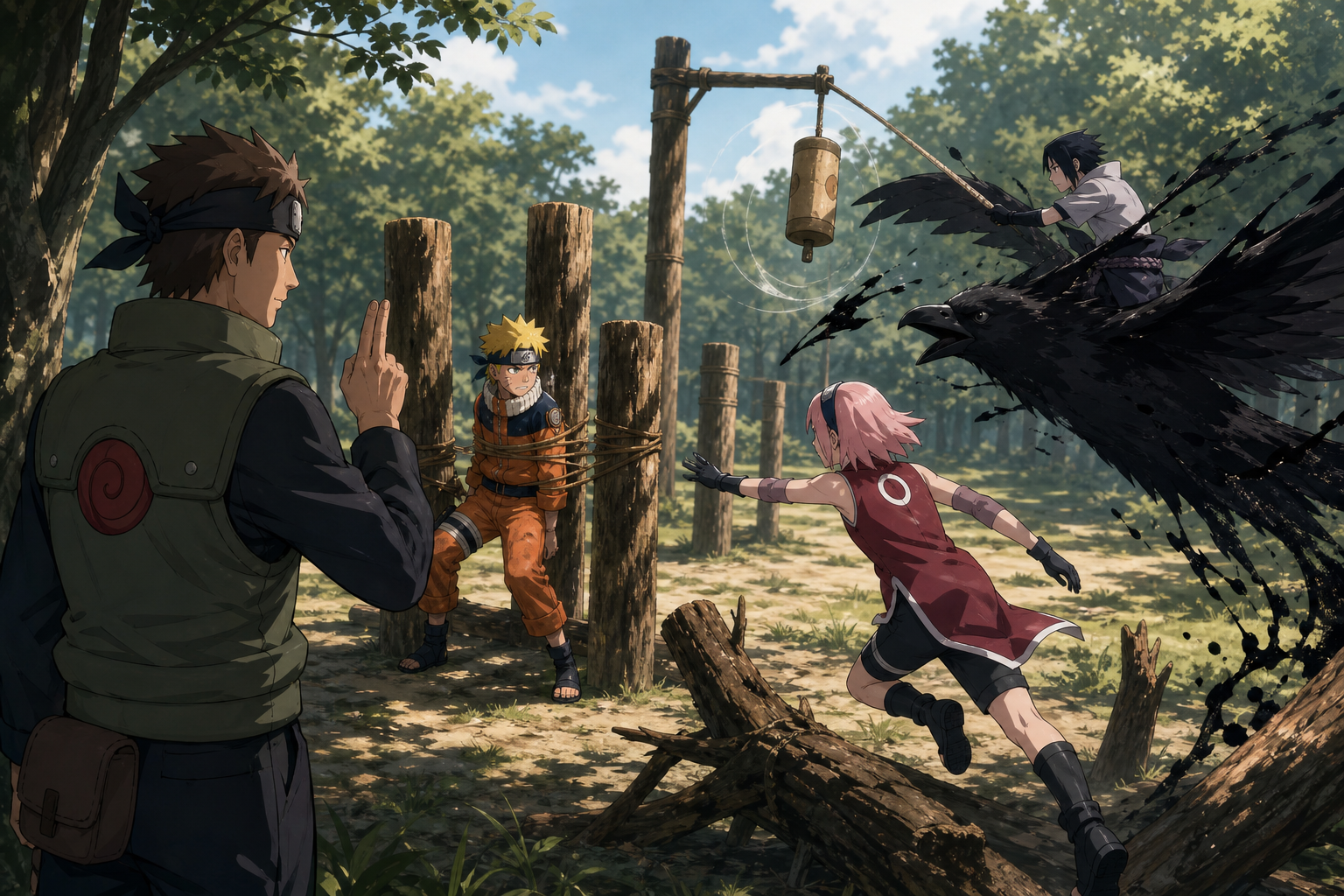
Before New Team Kakashi reaches Tenchi Bridge, Yamato runs a half-day simulation. The exercise is not filler between conversations and the real mission. It is a controlled way to discover how Naruto, Sakura, and Sai make decisions under pressure.
Their individual abilities are not in doubt. Naruto can overwhelm a field with shadow clones. Sakura combines medical knowledge with devastating precision. Sai’s ink creatures provide speed, surveillance, and mobility. Yamato already understands his own role as captain and containment specialist.
The unanswered question is whether those skills form a team. Episode 38 supplies the uncomfortable answer: not yet.
Sai abandons Naruto in order to complete the simulated objective. By the narrow logic of Root, the choice is efficient. The mission result matters more than the individual operative. By the logic Naruto learned from Team 7, the choice proves Sai does not understand teamwork at all.
A simulation makes hidden priorities visible
Real missions punish mistakes before a captain can analyze them. Yamato creates a safer environment where failure becomes information. He can observe positioning, communication, rescue instincts, and the point at which personal hostility changes tactical judgment.
The exercise reveals more than technique. Naruto assumes teammates should protect one another. Sai assumes the objective should be completed even if one teammate is left behind. Sakura tries to preserve both people and mission. Each response grows from a different understanding of what a shinobi owes the group.
That is precisely what Yamato needs to know before the Tenchi Bridge rendezvous. He plans to impersonate Sasori and approach the spy alone while the others remain concealed. If the spy detects the deception, every member must respond according to a shared plan. Conflicting values could expose them faster than an enemy attack.
Simulation cannot create loyalty. It can expose the absence of loyalty before the cost becomes permanent.
Sai completes the task and fails the team
Sai’s decision is not tactically foolish in isolation. If the simulated mission defines success as reaching the objective, rescuing Naruto may consume time and create another vulnerability. Root training rewards operatives who remove emotion from that calculation.
The problem is that a team mission includes the team. Abandoning Naruto may secure one marker while destroying future coordination. A teammate who expects to be discarded will not share risk freely. Trust affects speed, communication, and willingness to follow another person into danger.
Sai treats Naruto as an expendable resource because Root taught him that operatives are tools. Naruto reacts so strongly because he has built his identity around the opposite belief. Kakashi’s first lesson with Team 7 made the principle explicit: abandoning the mission can be a violation, but abandoning comrades is worse.
Episode 38 places those philosophies in direct conflict. Sai can point to the completed objective. Naruto can point to the person left behind. Yamato has to prepare a unit capable of understanding why both facts matter.
Naruto’s loyalty can become tactical blindness
Naruto is morally right to reject a system that discards teammates, but the exercise also exposes his own weakness. His loyalty operates at full emotional volume. When he believes somebody has betrayed a bond, anger can replace situational awareness.
That reaction is dangerous at Tenchi Bridge. The spy may manipulate appearances. Orochimaru’s agents may create false emergencies. Sai’s hidden orders may conflict with the official plan. Naruto cannot protect everyone if an enemy can steer him by threatening one person.
Yamato’s simulation therefore tests Naruto as much as Sai. Naruto needs to preserve his refusal to abandon people while learning to act inside a coordinated strategy. Loyalty without discipline can endanger the same friends it intends to protect.
The episode does not ask Naruto to become colder. It asks him to make care tactically useful rather than emotionally predictable.
Sakura tries to hold mission and people together
Sakura’s role falls between Sai’s efficiency and Naruto’s attachment. She understands that a mission requires objectives, timing, and controlled movement. She also knows a team cannot treat a member as disposable.
Her position is difficult because she is again expected to translate between incompatible values. She can see why Sai made the choice without accepting it. She can understand Naruto’s anger without letting him turn the rehearsal into another fight.
This balancing work reflects her growth. The original Sakura often depended on Naruto, Sasuke, or Kakashi to define the next action. The Shippuden-era Sakura evaluates the field herself. Her medical training reinforces the instinct to preserve life, while her combat experience prevents that instinct from becoming passive.
The simulation shows why Sakura is essential to the new team. She is not merely its healer. She is the member most capable of connecting tactical necessity to human consequence.
Yamato treats preparation as care
Yamato’s leadership style can look severe because he controls first and explains second. Yet the simulation reveals care inside that severity. He is not waiting for the mission to expose a fatal weakness. He creates a rehearsal, watches the failure, and uses the result to adjust the team.
Preparation is one of the least dramatic forms of protection. It does not resemble Naruto’s leap into danger or Sakura’s emergency treatment. It means planning signals, positions, disguises, and contingencies before anyone needs them.
Yamato’s approach contrasts with Danzō’s use of preparation. Both men value control and advance planning. Yamato uses them to keep his team alive. Danzō uses them to place Sai where hidden leverage can be exercised.
The administrative skill may look similar from a distance. The purpose changes everything. Yamato treats teammates as people whose weaknesses should be understood and protected. Danzō treats people as pieces whose weaknesses should be exploited.
The Sasori disguise raises the stakes of performance
The real plan requires Yamato to impersonate Sasori and meet the spy. That places deception at the center of the mission. The team must hide nearby, observe without revealing itself, and respond only when the situation demands it.
This is a difficult assignment for people who have spent the journey reacting openly to one another. Naruto’s anger shows immediately. Sai’s false smile advertises that he is performing. Sakura’s frustration with both can break through her discipline.
Yamato’s disguise may reproduce Sasori’s appearance, but success will depend on the team reproducing the behavior of a coordinated unit. The rehearsal reveals that they do not yet share the assumptions required to do that.
Sai’s decision to abandon Naruto also gains another layer because Sai carries private orders. The others believe they are practicing one mission. Sai may already be preparing for another. A simulation can expose his general priorities, but it cannot reveal instructions he refuses to share.
Practice cannot remove betrayal, but it can reduce chaos
Yamato cannot guarantee that every member will choose the team when the real operation begins. He cannot erase Danzō’s influence or force Sai to disclose his assignment. He can build procedures that keep one betrayal from collapsing the entire formation.
Signals tell concealed teammates when to move. Positions limit accidental exposure. Contingencies establish what happens if the spy attacks, flees, or recognizes the disguise. These structures matter most when trust is incomplete.
The simulation is therefore not a substitute for relationship. It is a protective framework around a relationship that has not formed yet. Yamato cannot rely on instinctive coordination, so he makes expectations explicit.
That approach feels less romantic than Kakashi’s famous teamwork lesson, but it belongs to the same principle. People survive together when they know their responsibility to one another.
RaeRae’s reaction
Sai completing the objective while leaving Naruto behind is the most Root answer imaginable. He can defend the outcome with clean logic, and the logic still feels rotten because it treats the teammate as disposable equipment.
Naruto is right to be furious about that value system. He is also far too easy to provoke once the betrayal lands. If Sai or an enemy can predict every decision by threatening a bond, Naruto’s loyalty becomes a handle somebody else can grab.
I appreciate Yamato more with every episode. He does not assume that talented shinobi will magically coordinate when danger starts. He rehearses the plan, watches the weak point appear, and deals with it before the bridge. That is not flashy leadership. It is responsible leadership.
Sakura again ends up doing the emotional math for everyone. She sees that the objective matters, that Naruto matters, and that Sai’s choice cannot become the team’s standard. Her ability to hold all three truths makes her the stabilizer, even when Yamato is the official captain.
The contrast between Yamato and Danzō is sharp here. Both prepare. Yamato prepares because he expects people to need support under pressure. Danzō prepares because he expects people to become useful pressure points. Same discipline, opposite ethics.
The episode also makes the upcoming disguise feel more dangerous. Yamato can copy Sasori’s appearance, but the team cannot fake unity convincingly if everybody is waiting for Sai to leave someone behind.
The rehearsal succeeds by failing
As a clean demonstration of teamwork, the simulation fails. Naruto is abandoned, Sai prioritizes the marker, and the team’s conflict becomes visible again.
As preparation, that failure is valuable. Yamato now knows exactly where the group breaks. Naruto knows Sai’s mission-first philosophy is not theoretical. Sakura knows she must account for the gap between them. Sai has been confronted with a team that judges success by more than the final objective.
They move toward Tenchi Bridge without perfect trust, but not without information. The rehearsal turns hidden assumptions into visible problems. That may be the only reason those problems can be managed when the mission stops being simulated.
Official episode reference: Naruto Official episode guide
Licensed episode route: Crunchyroll licensed episode page
Yamato tests the team before the enemy gets a turn
The half-day simulation is not busywork. Yamato has inherited a unit with unfamiliar abilities, open hostility, and hidden agendas. Entering the Tenchi Bridge operation without observing them under pressure would make the real mission the first experiment.
He creates controlled danger so failure can reveal habits without immediately handing those habits to Orochimaru’s network.
The objective is simple enough to expose priorities
A complicated exercise would let everyone blame confusion. The simulation gives a clear goal and enough opposition to force choices about speed, coordination, and rescue.
When Sai completes the objective after leaving Naruto restrained, nobody can pretend the issue was unclear instructions. He made a decision about what counted.
Sai treats the team member as optional and the target as mandatory
Root trained Sai to prioritize mission completion over attachment. From that framework, stopping to help Naruto would waste time and risk the objective. His choice is efficient inside the system that shaped him.
The simulation reveals why that system is dangerous for a four-person team. A member abandoned today becomes an unavailable capability, an exposed source of intelligence, or a casualty tomorrow.
Completing the task does not prove the method worked
Sai can point to the captured objective and claim success. Yamato is testing more than whether one operative can move quickly. He needs to know whether the unit can return together, adapt when a member is trapped, and share risk.
Metrics become dishonest when institutions measure the easiest visible result and ignore the bodies left outside the count.
Naruto’s frustration contains a legitimate tactical argument
Naruto hates being left behind because the act confirms his fear that Sai does not consider him a teammate. The anger also identifies a practical flaw. A rescue mission cannot be trusted to someone who abandons people whenever the immediate target looks reachable.
Naruto still needs to express that argument without turning every conflict into a fight about Sasuke.
Sakura understands that medicine begins after extraction
Her work with Chiyo proved that reaching a target is only one stage of rescue. Someone must stabilize injuries, preserve life, and move the person safely. Sai’s version of success ends too early.
Sakura brings a care-based definition of mission completion that Root’s efficiency model excludes.
Yamato observes how each person defines responsibility
Naruto equates responsibility with refusing to abandon a bond. Sakura connects it to practical care and group survival. Sai connects it to completing the assigned objective. Yamato must build a field method that can use their strengths without accepting the most destructive version of any one definition.
The simulation is leadership through diagnosis rather than speeches.
Ink flight gives Sai an advantage and isolates him
Sai’s bird lets him move above the battlefield, bypass obstacles, and reach the target independently. The technique rewards self-sufficiency so strongly that cooperation can look unnecessary.
A useful ability becomes a social trap when the person using it forgets that mobility should expand what the team can protect, not provide an excuse to leave everyone else below.
Being restrained tests Naruto’s deepest fear
Naruto has built identity around movement toward people others abandoned. Immobilizing him while a teammate departs creates more than tactical frustration. It makes him experience the role he refuses for Sasuke and Gaara.
That emotional charge explains the intensity. It does not make every impulsive response safe.
The exercise exposes Root’s definition of a good operative
Sai’s behavior makes sense if comrades are interchangeable resources and an operative’s value rests on isolated completion. Danzō’s system would likely reward the result.
Yamato needs a team capable of surviving contact with Orochimaru. That requires a different definition of competence: judgment that includes other people.
Rescue creates future capacity
Helping Naruto may cost time in the immediate exercise, but it restores another fighter, another perspective, and another person capable of helping later. Care is not opposed to strategy.
Root’s model calls attachment inefficient because it counts only the present objective. Teams plan across the whole mission.
Trust requires predictable choices under pressure
Friendly conversation at the shelter could not prove what Sai would do when objectives competed. The simulation provides the first behavioral evidence.
Naruto and Sakura now know he may choose the target over them. Sai learns that his teammates consider that choice a failure even when the goal is reached. Trust can begin only if future actions revise the pattern.
Yamato cannot order Sai to care, but he can set standards
Emotional attachment will not appear because a captain demands it. Operational rules can still require communication, recovery of teammates, and honest reporting.
Those standards protect the group while Sai develops reasons beyond obedience. Structure can create safer conditions for feeling without pretending to manufacture it.
The simulation also tests whether Naruto can be led
Sai is not the only subject. Naruto reacts quickly, resists restraint, and lets personal judgment shape tactical choices. His loyalty is powerful, but a mission cannot depend on everyone agreeing with his feelings before he follows a plan.
Yamato needs to know how Naruto responds when authority comes from someone other than Kakashi.
Sakura sits between two inadequate extremes
Naruto risks treating relationship as more important than every objective. Sai risks treating the objective as more important than every relationship. Sakura understands that rescue requires both reaching the target and keeping people capable of returning.
Her perspective can become the team’s practical center if the story lets her voice it rather than assigning her only the role of breaking up fights.
A rehearsal matters only if behavior can change
The simulation produces a failure the team can survive. Its value depends on whether anyone uses the evidence. Repeating the same choices at Tenchi Bridge would make the exercise wasted time.
Training is not proof of readiness. Changed judgment is.
The scoreboard cannot measure who will come back for you
Sai’s result looks impressive because it is easy to count. He reached the objective first. Naruto’s complaint looks emotional because the abandoned teammate is harder to turn into one clean number. Yamato’s simulation exposes the bias built into that comparison.
A real mission continues after contact with the target. The team may need to extract intelligence, survive pursuit, treat injuries, carry an unconscious member, or revise the plan when the enemy changes the terrain. The operative who reaches the marker alone has proved speed and initiative. He has not proved that anyone should trust him with the return route.
This is not an argument for stopping every time one teammate experiences discomfort. It is an argument for distinguishing expendable convenience from material danger. Naruto was restrained and removed from action. Leaving him meant surrendering a person, a capability, and sensitive village intelligence. Root’s narrow metric hides those costs because the immediate task can still be checked complete.
Simulation gives Sai something Root rarely offered: feedback from equals
Danzō’s system tells Sai whether he obeyed. Naruto and Sakura tell him what his obedience does to people expected to rely on him. Their reaction is messy, but it introduces a standard beyond usefulness to authority.
Sai does not have to accept that standard immediately. The encounter still places another definition of competence beside Root’s. Once the contradiction exists, future choices can no longer feel completely automatic.
RaeRae’s full take
Sai reaches the objective, leaves Naruto tied up, and acts like the scoreboard should end the argument. Sir, this is a rescue team. If your definition of success requires abandoning the people assigned to stand beside you, Root did not train you to complete missions. It trained you to make casualties look efficient.
Naruto’s anger is justified, but he is also being tested. Loyalty cannot replace judgment every time a plan frustrates him. Yamato needs a team that can follow direction without turning into obedient tools.
The simulation works because nobody gets a flattering result. Sai exposes his mission-only logic. Naruto exposes his triggers. Yamato learns exactly how much structure this unit needs. Sakura sees that reaching a target and bringing people home have to remain one job.
RaeRae checkpoint: An objective captured without the team is not proof of teamwork. The simulation ends when Yamato has evidence. The lesson begins when their next choices change.
Receipts and official routes
- Episode placement, Yamato’s half-day exercise, Sai’s ink bird, and the simulated objective: Naruto Official Site episode guide.
- Licensed episode route: Crunchyroll.