
The All-Knowing
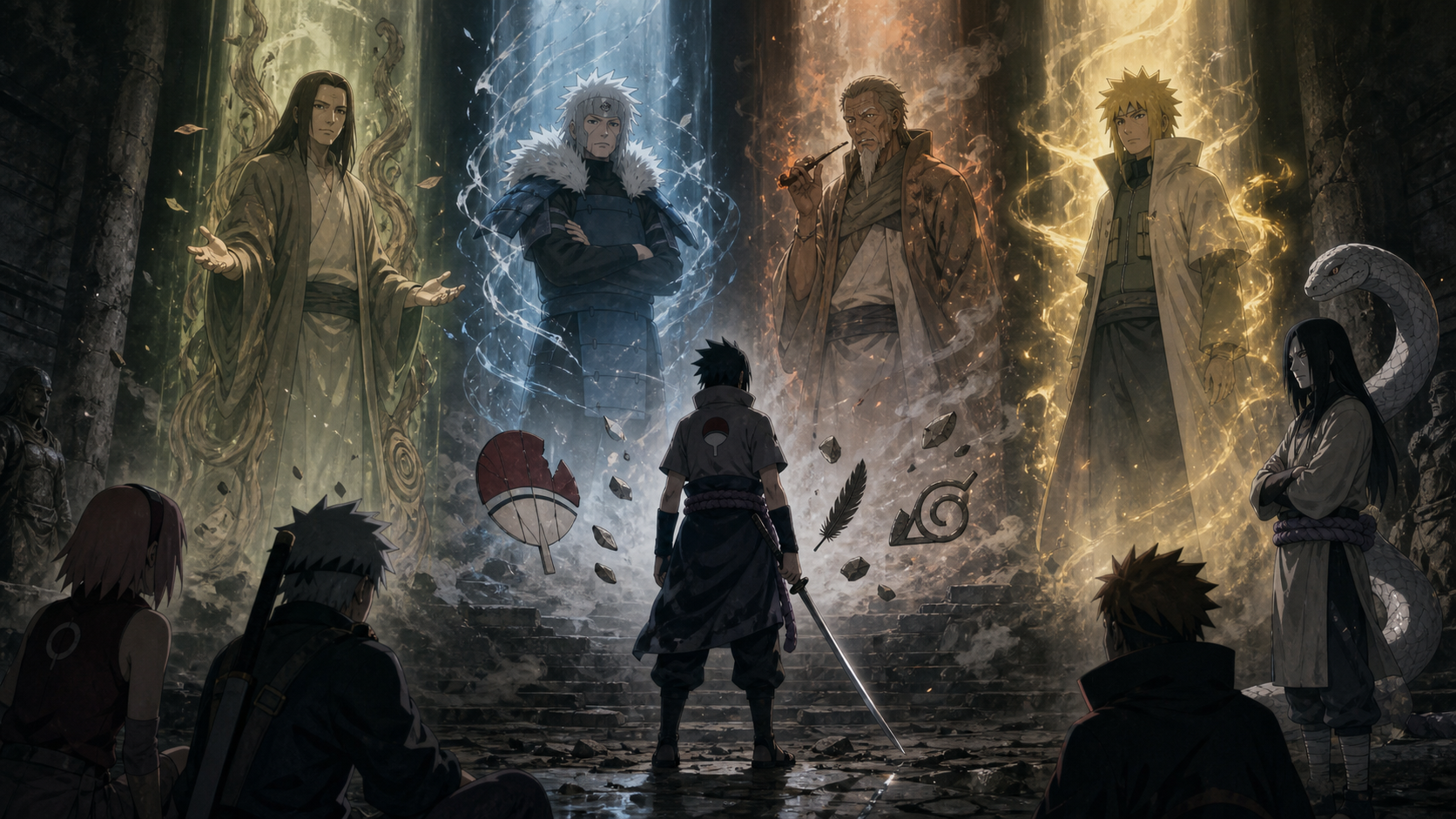
Sasuke returns beneath the village to question four dead Hokage about Itachi, the Uchiha and the system that taught sacrifice as loyalty.
Bottom line
“The All-Knowing” brings Sasuke before four dead Hokage and refuses to let the title make them gods. Hashirama, Tobirama, Hiruzen, and Minato know pieces of Konoha’s history because they built, governed, protected, and damaged the village. They also carry personal interests, political assumptions, blind spots, and responsibility for systems that shaped the Uchiha massacre. Sasuke asks about Itachi because affection and rage have left him unable to decide whether Konoha deserves protection or destruction. Hiruzen confirms the truth of Itachi’s mission. Tobirama explains the Uchiha through a theory that mixes observation with prejudice. Orochimaru controls the entire meeting through reanimation, using captive bodies and dead people to stage an answer session. Sasuke needs testimony, but testimony from powerful men still requires judgment. A village cannot be understood only through the leaders who had the authority to define one.
Sasuke returns to the village he abandoned
Konoha is no nostalgic homecoming for Sasuke. The village holds his childhood, his clan’s district, the site of the massacre, Team 7, and the institution Itachi served while destroying their family.
Returning means entering the physical center of the contradiction he can no longer avoid.
The Naka Shrine holds political memory
The group moves beneath the Uchiha shrine, a place tied to clan history and secret knowledge. The location matters because Konoha pushed the Uchiha toward social and geographic separation while still relying on them as part of the village.
Sasuke seeks state truth inside a clan space marked by exclusion.
Orochimaru prepares the dead as witnesses
Orochimaru uses the Reanimation Jutsu to summon the first four Hokage. The technique gives Sasuke access to people no ordinary inquiry could question.
Access arrives through violation. Death does not become consent because the information may be useful.
White Zetsu bodies become the material
The summoning requires living vessels, and Orochimaru uses White Zetsu attached to Sasuke. The targets are enemy organisms connected to Obito’s surveillance, but their status does not erase the coercive mechanics.
The scene solves one problem by turning bodies into equipment.
Orochimaru controls the room
Sasuke asks the questions, yet Orochimaru chose the method, knows the technique, and holds the initial restraints. Every answer depends on a notorious experimenter deciding to cooperate.
Useful help does not make his authority safe.
Four monuments become four men
Konoha carved the Hokage into a mountain and taught generations to view the office through public reverence. Reanimation strips away some distance.
The leaders argue, react, recognize people, and expose the personalities behind the stone faces.
Minato learns that Naruto is fighting
Minato’s attention turns toward the war and the son he left carrying Kurama. Pride, concern, and unfinished responsibility sit inside that discovery.
Naruto’s success cannot erase the childhood costs imposed by the sealing decision and the village’s treatment of him.
Hiruzen faces the name Itachi
Sasuke asks whether the story told by his brother was true. Hiruzen confirms that Itachi killed the clan under orders connected to Konoha leadership and then lived publicly as a criminal.
The admission gives Sasuke factual confirmation without repairing the harm.
Confirmation changes the burden of proof
Sasuke no longer has to decide whether Obito invented the entire account. A former Hokage acknowledges the state’s role.
The question becomes what responsibility follows when a government sacrifices a family, hides the order, and benefits from the survivor’s silence.
Hiruzen’s regret cannot replace accountability
Hiruzen presents Itachi as a shinobi who thought like a Hokage and carried an unbearable mission. His sorrow feels genuine.
Regret after the massacre does not answer why the political system allowed Danzo’s pressure, failed negotiation, surveillance, segregation, and secrecy to narrow the choices around a child.
Itachi was brilliant and still a child
Konoha admired Itachi’s judgment because he could understand war and village politics unusually young. Adults then used that capacity as justification for giving him an adult institution’s filthiest assignment.
Precocious understanding should have triggered protection, not recruitment into family annihilation.
Calling Itachi a Hokage at heart cuts both ways
The praise recognizes Itachi’s concern for people beyond clan boundaries. The same phrase reveals how Konoha defined ideal service through secrecy, self-erasure, and willingness to be hated.
An institution should not need a child to become a monster in public so leaders can preserve moral distance.
The massacre cannot become one boy’s choice
Itachi acted, and his agency matters. The coup plan, village discrimination, Danzo’s coercion, Hiruzen’s delay, and the state’s demand for silence also shaped the available path.
Responsibility spreads across people and institutions without disappearing from any of them.
Sasuke hears love described as service
The official account asks Sasuke to understand that Itachi loved him and protected the village. Love becomes tangled with lies, torture, abandonment, and a plan designed to make Sasuke kill his brother.
Knowing the motive does not make the method emotionally clean.
A victim does not owe the village gratitude
Konoha benefited from Itachi’s silence and Sasuke’s ignorance. Sasuke survived, but survival inside a fabricated story left him vulnerable to manipulation and consumed by revenge.
The village cannot claim his life as proof that the arrangement worked.
Tobirama treats the Uchiha as a category
The Second Hokage responds to Sasuke with suspicion and speaks about the clan through a theory of intense love, loss, chakra, and the Sharingan. Parts of the explanation connect emotion and power within the story’s mechanics.
The political use of that explanation remains dangerous.
Biology becomes a shortcut for governance
Tobirama turns a clan’s patterns into a broad risk assessment. Once officials treat identity as a security forecast, individual conduct matters less than inherited membership.
That logic makes surveillance and exclusion feel preventive instead of discriminatory.
The Curse of Hatred can hide material causes
Uchiha characters experience grief, anger, obsession, and escalating power. They also endure warfare, clan loss, political isolation, police containment, and suspicion from the village leadership.
Naming hatred as a clan tendency can conceal the conditions that repeatedly produce rage.
Strong love does not cause state exclusion
Tobirama frames Uchiha emotion as unusually dangerous when loss activates the Sharingan. The claim explains a fictional power mechanism, not why a government may deny equal trust to a whole population.
Risk does not cancel rights, evidence, or individual judgment.
The police force was power and containment
Tobirama gave the Uchiha responsibility for Konoha’s police. The role offered formal authority and a visible place within village administration.
The office also concentrated the clan in enforcement, separated members from other governing institutions, and made public resentment easier to direct toward them.
Institutional design shapes public suspicion
When one group becomes the face of policing, residents meet that group most often through rules, arrest, and discipline. Leadership can then point to social distance as though the community created the entire problem alone.
Political structure produces some of the evidence later used to defend political structure.
Tobirama sees danger faster than responsibility
His immediate reaction to Sasuke reflects a leader trained by wars against the Uchiha. Personal history helps explain the vigilance.
Explanation does not make inherited suspicion fair to descendants who did not fight those wars.
Hashirama checks his brother’s hostility
Hashirama stops Tobirama from escalating the encounter and insists that Sasuke be heard. The intervention prevents old rivalry from taking control of the room.
Restraint is useful, though Hashirama’s founding ideals also require examination against what Konoha became.
Power enters before persuasion finishes
The reanimated Hokage release enough presence to remind everyone why their names became legend. Hashirama’s strength is especially difficult for Orochimaru to contain.
Sasuke’s inquiry takes place among people capable of ending discussion through force.
Orochimaru’s control has limits
He presents improved reanimation as proof that he can restrain the Hokage. Hashirama’s ability reveals that the technique does not give Orochimaru equal command over every subject.
The imbalance turns the meeting into a negotiation backed by unstable coercion.
Sasuke refuses to be rushed into allegiance
The war creates obvious pressure to join the alliance immediately. Sasuke still demands answers before deciding whether he will protect Konoha, destroy Konoha, or choose another course.
Urgency cannot make unresolved state violence disappear.
His question is larger than Itachi
Sasuke asks what a village means and what a shinobi is. He wants to understand the ideal that convinced Itachi to sacrifice clan, reputation, future, and life.
The question tests the moral architecture behind the mission rather than only the mission’s facts.
Shinobi duty has protected institutions from scrutiny
Characters often praise endurance, secrecy, sacrifice, and obedience as proof of shinobi strength. Those values can protect communities during danger.
The same values can shield leaders from consequences when obedience carries out an unjust policy.
A village is more than the Hokage office
The four leaders can explain founding intentions, security pressures, wars, and decisions made at the highest level. Civilians, minor clans, branch families, orphans, working shinobi, and excluded residents experienced Konoha from different positions.
Leadership testimony is necessary and incomplete.
Hiruzen’s account protects Itachi’s dignity
Hiruzen refuses the public lie that Itachi acted as a simple clan murderer. That correction matters because Itachi bore hatred designed by adults.
Restoring dignity should not turn Itachi into a flawless saint or make the massacre admirable.
Truth does not dictate Sasuke’s verdict
Facts can establish who ordered what, who knew, and how leaders justified the decision. Sasuke still has to decide what those facts mean for his relationship with Konoha and his own future.
No witness can perform that moral judgment for him.
Suigetsu understands the danger in the room
Suigetsu reacts to legendary leaders with the practical fear the situation deserves. His nervousness punctures the grandeur without turning the scene into a joke.
Someone should notice that five extremely dangerous men are discussing history in a confined underground space.
Jugo watches Sasuke’s direction
Jugo’s presence keeps attention on Sasuke’s changing purpose. He has followed Sasuke through several identities and missions, often reading instability before others name the danger.
Loyalty here means staying alert, not pretending Sasuke already knows the answer.
The dead are being asked to solve a living crisis
Sasuke reaches backward because Konoha buried the evidence and killed or lost many people who could explain the system. Reanimation becomes an extreme response to institutional secrecy.
Transparent records and accountable testimony would have made necromancy unnecessary.
Memory remains interested evidence
Each Hokage speaks from personal experience and self-understanding. Memory may be sincere while still selecting, interpreting, excusing, or overlooking details.
Sasuke needs comparison across accounts rather than reverence for rank.
“All-knowing” is an ironic title
The four Hokage possess extraordinary knowledge, but none holds the entire truth of Konoha. Hashirama knows founding hope, Tobirama knows institutional design, Hiruzen knows the massacre era, and Minato knows a later security crisis.
Their knowledge overlaps with their failures.
Leadership cannot narrate harmed people away
An explanation of why officials feared a coup does not erase Uchiha exclusion. Praise for Itachi does not erase the coercion placed on him. Concern for village survival does not erase the civilians and children killed.
Policy context can deepen judgment without dissolving victims.
Sasuke’s anger deserves evidence and limits
His rage grows from real betrayal, but pain alone cannot determine who deserves punishment. Destroying Konoha would target people who did not order the massacre and may never have known the truth.
Institutional guilt requires accountability more precise than collective revenge.
The episode makes listening an active choice
Sasuke has enough power to attack and enough pain to leave. He stays, asks, challenges, and listens to people he has reason to distrust.
Listening does not promise forgiveness. Listening gives his next decision a chance to become more than reaction.
Sasuke convenes a hearing nobody offered him
Konoha never created a lawful place where Sasuke could question the leaders connected to his family’s destruction. He has to resurrect four dead men through Orochimaru to obtain direct testimony. The extremity of the method reveals the size of the institutional silence.
His questions are not adolescent ingratitude. They are an overdue demand for records, motives, responsibility, and a definition of village loyalty that can survive what happened to Itachi.
The title overstates every witness
None of the Hokage is all-knowing. Hashirama remembers his intentions and early compromises. Tobirama explains policies through his suspicions. Hiruzen knows decisions he made and failures he permitted. Minato understands his own brief leadership and the night he died.
Together they expand the record without completing it. The dead Uchiha, ordinary residents, Root operatives, jinchūriki, and surviving children still hold perspectives the room cannot supply.
Office gives access, not innocence
Each man led Konoha, which makes his testimony valuable and his responsibility unavoidable. The title Hokage does not turn policy into wisdom after the fact. Leaders can love a village and still create systems that harm people inside it.
Sasuke should directly judge explanations against outcomes: surveillance, segregation, secret command, clan extermination, repeated war, and the pressure placed on children to absorb conflicts adults would not resolve openly.
Tobirama names suspicion as governance
His account treats Uchiha emotion and power as categories requiring containment. Even when observations about the Sharingan are accurate, collective policy transforms possible risk into inherited suspicion. Individuals face consequences for what leaders imagine their clan might become.
The police force offered status while physically and politically separating the Uchiha from central authority. A role can look prestigious and still function as a boundary around belonging.
Hashirama’s good intentions need an outcome audit
Hashirama wanted a village where children would not die in clan wars. That founding hope matters. Good intent cannot close the inquiry when later institutions reproduce expendability through different uniforms.
The relevant question is not whether he cared. Sasuke needs to know which compromises, succession choices, and assumptions allowed peace for some residents to depend on pressure carried by others.
Hiruzen must answer for tolerated shadow power
Danzō did not operate in a universe separate from Hiruzen’s administration. Root recruitment, covert orders, Shisui’s eye, the massacre plan, and manipulation of Itachi grew within authority Hiruzen failed to stop in time.
Minato enters as Naruto’s father and a public official
Sasuke did not summon him for a family reunion. Minato’s private identity cannot replace questions about the Fourth Hokage’s village, war policy, jinchūriki system, or the conditions inherited by Naruto and Sasuke.
Personal grief and public responsibility can coexist. The episode becomes stronger when Minato is allowed love, limitation, achievement, and an office whose choices affected children he never lived to raise.
Orochimaru controls the room’s physical conditions
He supplies the bodies, technique, and binding that make testimony possible. That practical control should make everyone cautious. The revived Hokage are witnesses under a coercive jutsu, not freely gathered elders.
Sasuke currently holds leverage over Orochimaru, but history gives no reason to treat the arrangement as safe. Useful access needs boundaries, observation, and readiness for the facilitator to pursue his own objective.
Suigetsu and Jūgo are more than an audience
They stand close to four legendary leaders and the man who experimented on both of them. The danger affects their bodies too. Sasuke’s inquiry should not make their consent irrelevant merely because the answers concern his clan.
Itachi cannot be reduced to loyal sacrifice
Sasuke is asking what made his brother choose massacre, silence, exile, and a death staged through him. Calling Itachi a hero may recognize intention while hiding the system that cornered a child into atrocity.
Love for the village does not make every act committed under that love just. Itachi deserves compassion, accountability, and a record that names the adults who converted his devotion into operational access.
Truth must change Sasuke’s available choices
Information is not healing by itself. The answers matter because Sasuke is deciding what to protect, destroy, or rebuild. A testimony that only asks him to inherit another leader’s conclusion fails the purpose of the hearing.
He needs enough history to locate responsibility without turning every present resident into a substitute target. The ethical test begins after the story is told: whether fuller knowledge expands his choices beyond repetition.
RaeRae’s verdict
“The All-Knowing” works because Sasuke refuses a convenient answer. Hiruzen confirms that Itachi served Konoha through a mission no child should have received. Tobirama exposes both the logic behind Uchiha policy and the prejudice that helped make that policy dangerous. Hashirama checks immediate hostility, Minato confronts news of the son he left behind, and Orochimaru keeps the whole inquiry ethically compromised through reanimation.
The Hokage can provide crucial receipts, but leadership does not own the meaning of the village. Sasuke must weigh testimony against bodies, secrecy, exclusion, and the lives hidden beneath official necessity. Konoha deserves neither automatic destruction nor automatic absolution. The episode earns its pause in the war by asking whether a political home can survive the truth about what leaders did to preserve that home.
RaeRae’s call
Sasuke has to resurrect four Hokage because Konoha left no living route to an honest hearing. Their testimony matters, but none is all-knowing and none receives innocence from office. He must compare intention with outcomes, name Danzō’s power inside Hiruzen’s administration, and keep Itachi human rather than converting him into a patriotic slogan. Truth earns value when it widens the future.
Episode details and viewing routes
- Official episode reference: Naruto Official episode guide
- Licensed episode route: Crunchyroll licensed episode page
What I am carrying forward
Sasuke has returned to Konoha and heard Hiruzen confirm the truth about Itachi’s mission and the Uchiha massacre. Tobirama has described his view of Uchiha emotion, the Sharingan, and the clan’s political danger, exposing the assumptions beneath village policy.
Sasuke asks Hashirama what a village and a shinobi truly are before choosing his next action. Episode 367 turns to Hashirama’s history with Madara and the relationship that preceded Konoha’s founding.