
Those Who Dance in the Shadows
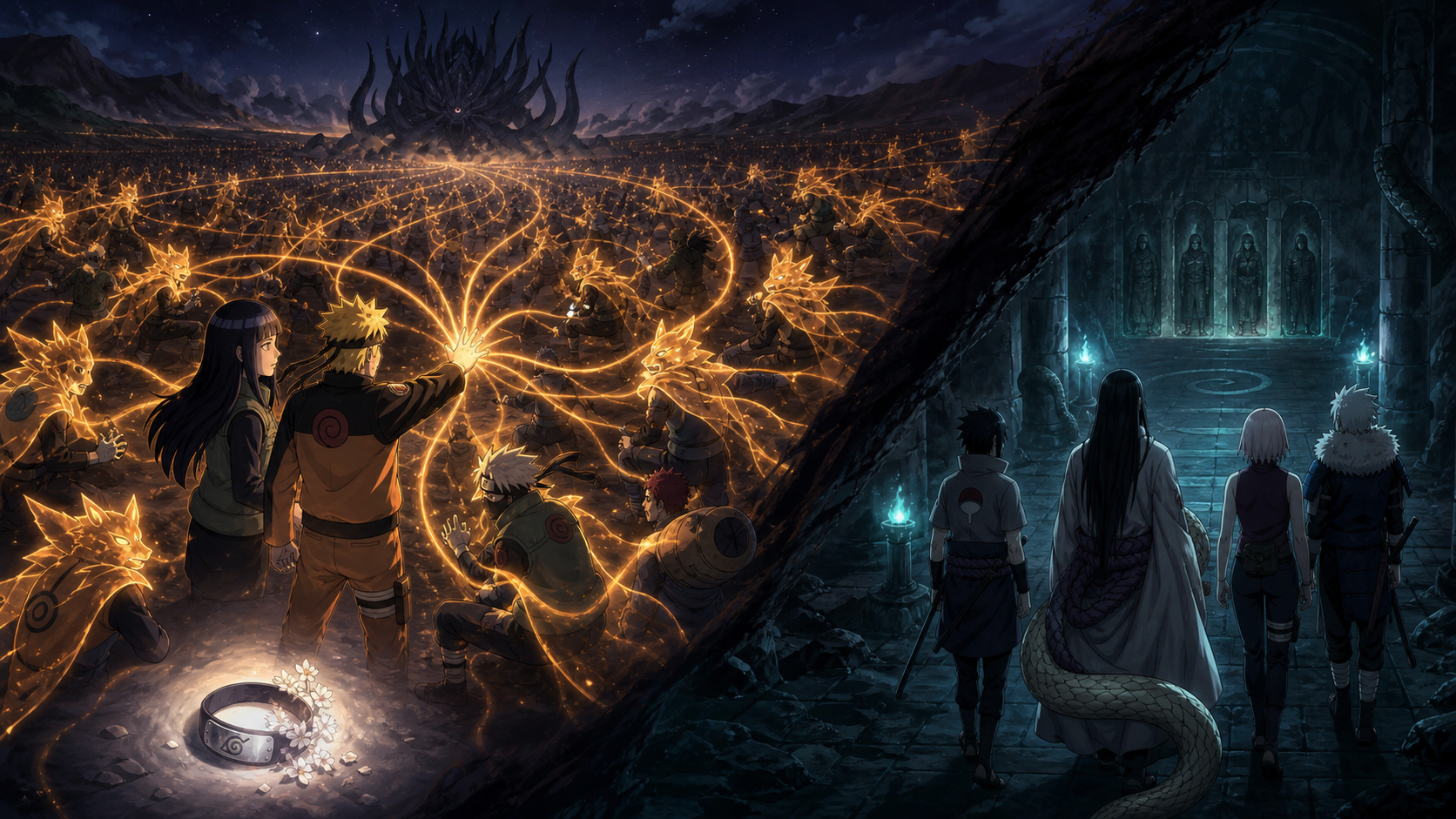
Naruto distributes Kurama’s chakra through the alliance while Sasuke follows Orochimaru toward a different inheritance hidden beneath the village.
Bottom line
“Those Who Dance in the Shadows” lets Hinata do what Obito refuses to do: face a real death without using grief to erase everybody else’s choices. Naruto nearly folds after Neji dies protecting him, and Hinata brings him back to the present with words, touch, and a reminder that Neji’s life cannot be reduced to the wound in front of them. Shikaku’s final strategy reaches the battlefield after Allied Headquarters falls. Kurama then shares chakra across the Allied Shinobi Forces, turning Naruto from a lonely miracle worker into one part of a much wider exchange. The episode works because survival becomes collective labor. Hinata does not cure grief. Shikaku’s death does not make his plan valuable. Kurama does not become a disposable battery. People and a tailed beast choose to carry one another while the loss remains real.
Naruto is still standing beside Neji
The battlefield gives Naruto no private place to understand what happened. Neji’s body lies close, the Ten-Tails remains active, and Obito keeps talking before shock can settle into thought.
Naruto hears an argument while his mind is trying to register a death.
Obito presses on the broken promise
Obito points at Neji as evidence that Naruto failed to protect his comrades. The accusation lands because Naruto has said those words sincerely and built part of his identity around keeping them.
A promise can direct effort without granting control over every weapon, every choice, and every death. Obito demands omnipotence, then calls ordinary human limitation hypocrisy.
Grief makes the lie feel plausible
Naruto does not need to agree with Obito’s whole worldview for the attack to work. He only needs to look at Neji and feel that his own words have become unbearable.
That moment is human. Conviction does not protect a person from shock, guilt, or the ugly thought that caring was pointless.
Obito turns a person into evidence
Neji disappears from Obito’s version of the scene. His history, judgment, bonds, anger, skill, and final choice become one exhibit in a speech about despair.
That reduction repeats the violence. The attack kills Neji’s body, and Obito’s argument tries to strip the life around that body of every meaning except failure.
Hinata interrupts the recruitment attempt
Hinata reaches Naruto while Obito is trying to define reality for him. Her intervention matters because she does not offer a fantasy where Neji survived or promise that the pain will vanish.
She names the responsibility still in front of Naruto and brings his attention back to the people who remain.
Hinata is grieving too
The scene cannot be read honestly if Hinata becomes a motivational device placed beside Naruto. Neji was her cousin, teammate, protector, and one of the people bound to her through the Hyuga clan’s cruel main and branch hierarchy.
She speaks while carrying a family loss of her own. Her ability to help Naruto does not mean she feels less.
Support does not require emotional perfection
Hinata does not wait until she has processed every layer of guilt, anger, love, and clan history. She acts because Naruto is slipping away in front of her and the battlefield will not pause.
People can offer useful support while wounded. That support should not become proof that they have finished mourning.
Her words return Neji to his own life
Hinata reminds Naruto that Neji’s will survives in the people who knew him. The strongest version of that idea respects what Neji chose without treating his death as a transaction that purchased Naruto’s resolve.
Neji mattered before the sacrifice. His value did not begin when his body became a shield.
The handclasp makes the support physical
Hinata’s touch brings the argument out of abstraction. Naruto is not debating a philosophy alone. Another person is beside him, equally exposed, asking him to feel the connection Obito wants him to reject.
The physical contact is grounding rather than magical. Grief remains after Naruto stands.
Romance cannot swallow Hinata’s work
Hinata loves Naruto, but love is not the only source of her courage or judgment. She has trained, failed, confronted fear, challenged family expectations, and chosen her own shinobi way across years.
Reading the scene only as romantic encouragement shrinks a developed fighter into emotional equipment for the male lead.
Naruto accepts help instead of manufacturing strength
Naruto’s recovery does not come from discovering a fresh reserve of solitary will. He listens to Hinata, feels Kurama’s presence, and reconnects with the alliance around him.
That change matters for a character who spent years trying to force recognition through individual endurance.
Kurama corrects Naruto’s despair
Kurama reminds Naruto that his parents also gave their lives while entrusting him with a future. The reminder could sound like another demand that dead people become motivation, but Kurama’s deeper point concerns connection and choice.
Naruto carries relationships. He does not owe the dead a performance of invulnerability.
Kurama speaks as a participant
The Nine-Tails is no longer a locked resource that Naruto opens when the plot needs power. Kurama observes, argues, chooses, and helps determine how their shared chakra will move.
That agency changes the ethics of the power transfer.
Chakra sharing requires Kurama’s consent
The plan depends on Kurama distributing chakra through Naruto’s existing connections with the alliance. Kurama agrees to act, making the tailed beast a collaborator rather than fuel owned by a jinchuriki.
The distinction matters in a world that repeatedly captured tailed beasts, assigned them military value, and ignored their personhood.
Naruto becomes a connection point
Naruto sends Kurama’s chakra to thousands of shinobi. The visual scale is enormous, but the function is more interesting than a simple power boost.
He becomes a node through which another being’s chosen power reaches people already capable of fighting, thinking, healing, sensing, and protecting.
The cloaks expand existing capacity
The chakra cloaks do not replace the alliance with copies of Naruto. Each recipient keeps personal training, unit role, relationships, and judgment while receiving added protection and strength.
Collective power works because difference remains useful.
Distribution answers the enemy’s concentration
Madara and Obito control overwhelming force through the Ten-Tails and direct destruction outward from a narrow command structure. The alliance moves power in the opposite direction.
Kurama’s chakra spreads across the field, giving many bodies more ability to act instead of reserving every answer for one hero.
Shared power also creates responsibility
Receiving chakra does not make the alliance invincible. Fighters still need coordination, restraint, medical support, and awareness of who cannot sustain the same demands.
A gift used carelessly can become another route to exhaustion.
Shikaku’s plan arrives after headquarters falls
The alliance receives strategy from people who can no longer revise, clarify, or respond to changing conditions. Shikaku used his remaining time to communicate intent before the Tailed Beast Bomb destroyed headquarters.
The plan survives because communication labor carried knowledge across distance.
Strategy was shared before death
Shikaku’s thinking did not gain value when he died. Years of attention, analysis, collaboration, and knowledge of other shinobi made the strategy useful.
His final transmission preserved work that already mattered.
Inoichi made the final transmission possible
Shikaku could devise the plan, but Inoichi’s technique and the broader communications system allowed thousands to receive the strategy. Maps, sensors, reports, relays, and support staff also shaped what command knew.
Calling the result Shikaku’s plan should not erase the workplace that helped produce and transmit that strategy.
The alliance must interpret intent
No distant headquarters remains available to direct each adjustment. Unit leaders and individual shinobi have to understand the purpose of the plan, apply local knowledge, and respond when the Ten-Tails changes behavior.
Distributed judgment becomes a survival requirement.
Leadership continues without pretending nothing broke
The Allied Shinobi Forces act after losing command, but action does not mean the institution escaped damage. Knowledge, relationships, and experienced decision makers died in the strike.
Succession can keep people moving while grief and operational loss remain unresolved.
Shikamaru and Ino carry personal losses
The final strategy reaches the battlefield as Shikamaru and Ino lose their fathers. They must work inside a plan connected to voices they will never hear again.
Competence during crisis should never be mistaken for emotional closure.
Children should not inherit only useful work
Shikamaru and Ino may carry techniques, habits, responsibilities, and knowledge from their fathers. They also inherit memories that have nothing to do with military usefulness.
Family love cannot be measured by how efficiently a child continues the parent’s job.
The alliance acts for the living as well as the dead
The language of making sure comrades did not die in vain can help people move when stopping means more deaths. The same phrase can become cruel when victory is treated as payment that balances a life.
The alliance fights because living people remain in danger. Memory accompanies that duty without becoming a debt that death demanded.
Neji cannot become the price of unity
Naruto and the alliance regain purpose after Neji’s death, but unity was already present in the coordinated assault and the relationships that built the coalition.
Neji’s death reveals those ties. The death did not need to happen to create them.
Hinata’s grief stays beside Naruto’s resolve
When Naruto moves again, Hinata remains part of the action rather than vanishing after completing an inspirational speech. Her loss travels with her choices on the field.
That continuity protects her from becoming a temporary cure in somebody else’s arc.
Kurama’s choice changes the old weapon system
Villages built jinchuriki systems around confinement, deterrence, and forced access to tailed-beast power. Kurama now shares power through a relationship built after years of hostility, negotiation, and recognition.
The scene does not erase the imprisonment that came first. Kurama’s consent exposes how different cooperation looks.
Collective capacity challenges the chosen-one shortcut
Naruto remains central, but the episode gives the alliance more than an audience role. Thousands receive the means to survive and execute a plan together.
The hero becomes most useful when power passes through him instead of ending with him.
Those in the shadows keep the field moving
The title fits strategists, communicators, sensors, medics, parents, teammates, and fighters whose labor rarely receives the brightest frame. Their work creates the conditions for visible attacks to succeed.
War stories become dishonest when only the person throwing the final blow counts.
Hidden labor is still human life
Recognizing support roles cannot reduce people to functions. Headquarters staff, clan members, and ordinary shinobi each had relationships and futures beyond the service they provided.
Respect begins by remembering both contribution and personhood.
Obito’s worldview fails in practice
Obito argues that bonds lead inevitably to despair. The episode shows bonds producing pain, correction, consent, communication, and coordinated resistance at the same time.
Loss hurts because connection was real. Pain does not prove the connection was an error.
Naruto’s answer is collective rather than rhetorical
Naruto does not defeat Obito’s claim through a longer speech. He takes Hinata’s hand, accepts Kurama’s judgment, shares chakra, and returns to the coordinated plan.
The response becomes credible through action distributed across other people.
Naruto shares power instead of concentrating it
Kurama’s chakra could have remained one spectacular advantage around Naruto. He distributes that protection across the alliance, giving exhausted fighters another layer of strength and connecting people who cannot all reach him physically.
The choice answers the war’s obsession with ownership. Madara and Obito gather bodies, eyes, beasts, and techniques upward. Naruto moves power outward until survival becomes less dependent on one chosen person.
The chakra cloak does not erase individual labor
Receiving Naruto’s chakra does not turn thousands of shinobi into extensions of Naruto. They still hold formation, protect neighbors, execute techniques, carry the wounded, and decide whether fear will stop them.
Support expands their capacity without stealing authorship. The alliance’s resistance remains collective because shared power strengthens distinct decisions rather than replacing them.
Kurama participates as a partner
The distributed chakra comes through a relationship Naruto and Kurama built after years of confinement, anger, and forced extraction. Kurama is not a battery Naruto finally learned to operate. He recognizes the alliance’s need and participates in the transfer.
That consent matters in a story where tailed beasts are repeatedly treated as weapons, property, and ingredients. Partnership changes what power means before it changes the battlefield.
Neji’s absence remains inside the network
New protection arrives after Neji has already died. The cloak cannot retroactively make the previous defense adequate or turn his death into the price required for everyone else’s unity.
Naruto carries grief while extending what protection remains possible. Action after loss honors Neji only if mourning keeps his personhood visible and the survivors refuse to romanticize preventable exposure.
Hinata’s steadiness is not emotional cleanup
Hinata helps Naruto return to the immediate fight because she understands what Neji chose and what the alliance still faces. Her strength does not make her responsible for absorbing everyone else’s grief quietly.
She lost her cousin. The Hyūga history belongs to her loss too. Supporting Naruto can coexist with needing space, truth, and institutional change after the battlefield stops demanding motion.
Shikaku’s final plan becomes a living inheritance
Naruto’s distribution carries forward strategy created by a commander who will not see the outcome. The plan survives because it can be understood and enacted by others, not because Shikaku’s death granted it special authority.
Good leadership leaves usable knowledge. The alliance honors Shikaku by adapting his work, crediting the chain behind it, and refusing to make headquarters casualties disappear beneath a successful maneuver.
Sasuke seeks testimony before choosing a future
On another route, Sasuke refuses to let Orochimaru, Tobi, Itachi, or Konoha’s official story become the only narrator of his clan. He wants the Hokage themselves to answer for the village they built and the decisions inherited by later generations.
The search is dangerous, but the demand is sound: judgment should follow evidence from people with direct responsibility, not whichever secret keeper reaches him first.
Orochimaru is a route, not a trustworthy guardian
Orochimaru can perform the technique Sasuke needs and knows how to reach buried records. Utility does not erase experimentation, coercion, attempted body theft, or the danger he still represents.
Sasuke’s control over the arrangement must remain explicit. Cooperation with a harmful person for a limited purpose is not absolution, friendship, or proof that safeguards are unnecessary.
Suigetsu and Jūgo remain stakeholders
Sasuke’s decision changes the risk carried by the people traveling with him. They deserve information about the destination, the resurrection plan, Orochimaru’s role, and the possibility that former Hokage may respond with force.
Leadership cannot mean silently selecting danger for everyone nearby. Sasuke’s need for answers is urgent, but urgency should widen communication rather than reduce companions to transport and backup.
The Hokage will answer as decision-makers
Resurrection makes history speak, but it does not make history neutral. Each Hokage will interpret policy through loyalty, regret, self-defense, and the limits of what he knew at the time.
Sasuke must compare testimony with outcomes: the Uchiha district, Foundation, the massacre, repeated wars, jinchūriki treatment, and the lives spent maintaining village power. Office does not convert perspective into complete truth.
Both storylines ask what inheritance requires
Naruto receives chakra, strategy, grief, and trust, then redistributes protection. Sasuke receives secrecy, clan trauma, contradictory testimony, and the power to summon witnesses, then seeks a basis for judgment.
Neither young man created the institutions now demanding his decision. Both remain responsible for what they do with inherited power. The episode places community-building and historical inquiry beside each other as two answers to the shadows adults left behind.
The parallel exposes the cost of delayed honesty. Naruto’s network works because people exchange chakra and information promptly to protect one another. Sasuke’s crisis exists because leaders buried history until manipulation filled the silence. Connection is not closeness. It is access to resources, clear warnings and durable records before danger becomes irreversible. A village that wants loyalty must build those channels during life, not improvise them when war threatens everyone.
RaeRae’s verdict
“Those Who Dance in the Shadows” earns Naruto’s return to the fight because he does not drag himself up alone. Hinata reaches him while grieving Neji herself. Kurama challenges him as a partner and willingly shares chakra. Shikaku, Inoichi, and headquarters leave usable knowledge because they communicated before the strike. The alliance then turns that knowledge into many local choices.
The episode still risks making death sound worthwhile because survivors continue. Neji and the headquarters staff were never a price the alliance needed to pay for unity. Their lives already held value. The strongest answer to Obito is not that grief disappears when people fight harder. People can grieve, accept help, share power, and protect those still alive without calling the deaths fair.
RaeRae’s call
Naruto moves power outward while Sasuke moves toward buried testimony. One protects an alliance in the present; the other demands answers from the leaders who shaped the past. Kurama is a partner, Neji is a person rather than a price, and the resurrected Hokage will be witnesses rather than automatic truth. Inheritance becomes ethical through what the living question, share, and refuse to repeat.
Episode details and viewing routes
- Official episode reference: Naruto Official episode guide
- Licensed episode route: Crunchyroll licensed episode page
What I am carrying forward
Hinata helps Naruto resist Obito’s attempt to turn Neji’s death into proof that bonds are meaningless. Kurama agrees to distribute chakra through Naruto, strengthening the Allied Shinobi Forces so they can carry out Shikaku’s final strategy after the destruction of headquarters.
The alliance acts through shared power and distributed judgment while Shikamaru, Ino, Hinata, Naruto, and others remain inside fresh grief. Episode 366 turns toward Sasuke’s demand for answers and the people he believes can provide them.