
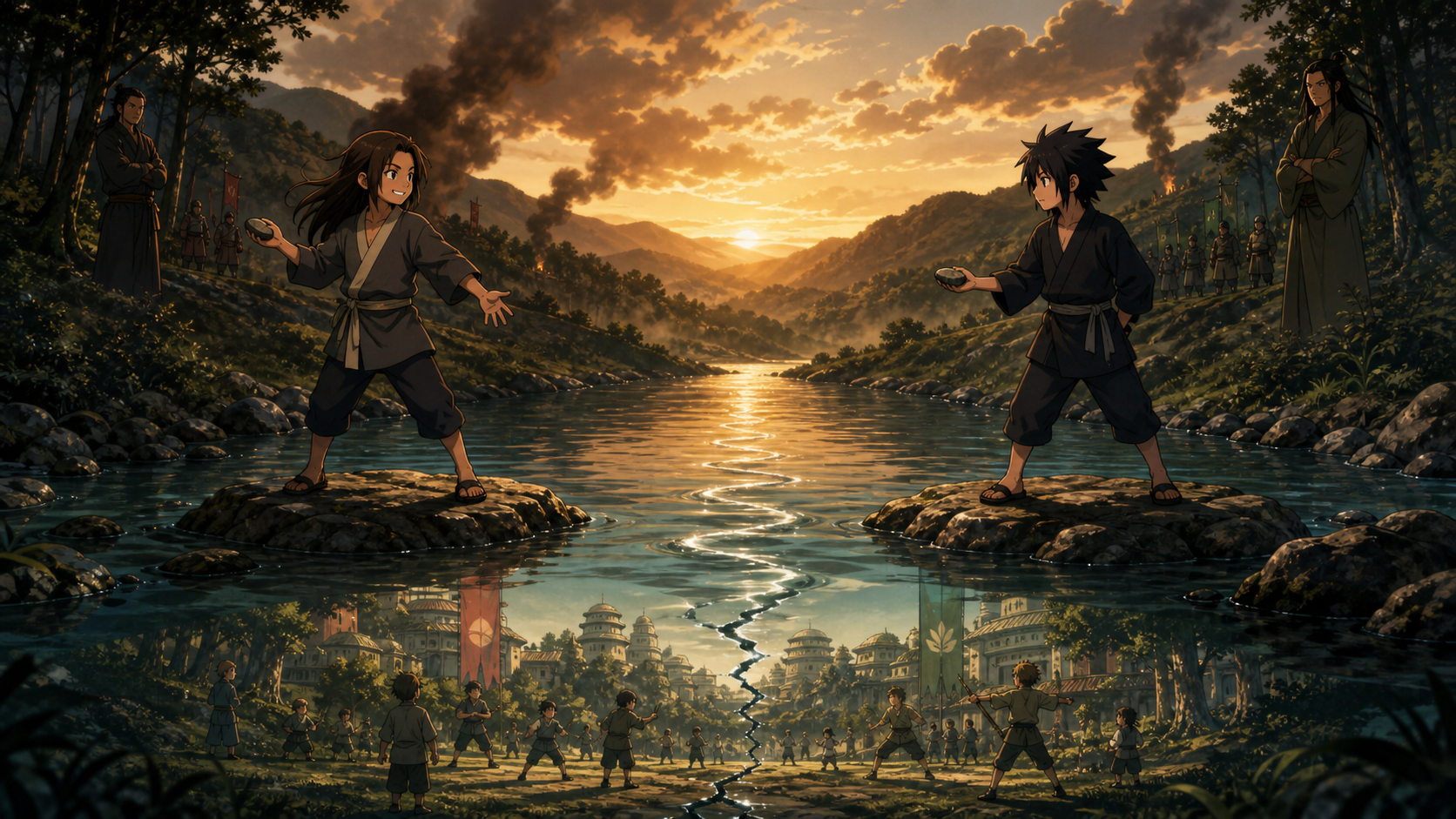
Hashirama and Madara
Two boys meet across a river, hide the clan names that would make them enemies and imagine a world where children no longer have to die for inherited grudges.
Bottom line
“Hashirama and Madara” begins Konoha’s history with dead children rather than a shining village. Hashirama grows up in a Senju household where his younger brothers enter clan warfare, funerals arrive early, and adults call that arrangement unavoidable. Madara meets him by a river before either boy shares a surname. They compete, insult each other, skip stones, and discover that both want a place where children can live long enough to become adults. Their friendship is not naive because they understand violence poorly. Their friendship is radical because both understand violence from inside families that depend on the next generation continuing the feud. Once their clan identities become known, fathers and brothers turn the boys’ bond into a security threat. The future founders of Konoha first imagine the village as protection from adults who keep handing children weapons.
Hashirama answers Sasuke with a memory
Sasuke asks what a village and a shinobi mean. Hashirama does not begin with a law, a slogan, or praise for the Hokage office.
He returns to a childhood before hidden villages existed, when clans sold military skill and family survival depended on continuous fighting.
The Warring States period had no safe childhood
Children born into shinobi clans inherited enemies before forming opinions about them. Training prepared small bodies for contracts created by adults.
Clan membership functioned as family identity, employment, military assignment, and probable cause for retaliation.
Kawarama’s funeral establishes the cost
Hashirama stands at the grave of his young brother Kawarama. The family grieves a child killed in combat, yet the clan system treats the death as part of ordinary duty.
The grave makes the political problem physical before anybody discusses reform.
A child’s age does not reduce military use
Kawarama’s lack of adulthood did not protect him from deployment. Skill and clan need mattered more than developmental limits or informed consent.
Calling him a shinobi cannot make the arrangement appropriate.
Hashirama refuses the accepted explanation
He challenges the idea that dying in battle naturally proves honor. His anger targets a world where adults repeat the same rule after each funeral.
Grief becomes political because the family system expects silence where a question should be.
Butsuma protects the clan order
Hashirama’s father responds as a commander responsible for Senju survival. In his logic, questioning a dead fighter’s honor weakens the values keeping the clan together.
That authority turns a grieving child’s protest into disobedience.
Violence inside the home mirrors violence outside
Butsuma strikes Hashirama during the argument. The father who sends children into battle also uses force to enforce the interpretation of their deaths.
The household teaches that power settles both political conflict and family disagreement.
Tobirama describes the system plainly
Tobirama explains that constant war drives average life expectancy brutally low. His analysis is cool, but the facts support Hashirama’s outrage.
Children are not rare emergency combatants. They are part of the labor supply sustaining the era.
Statistics cannot absorb one brother
Life expectancy shows the scale of the crisis without representing Kawarama’s voice, habits, relationships, or missing future. Hashirama is not mourning a number.
Policy needs both pattern and person.
The Senju are harmed and still participate
Their clan loses children and faces real enemies. The Senju also train, deploy, and kill young people from other families.
Victimhood inside a violent system does not prevent participation in that system.
Hashirama goes to the river
The river creates distance from command, funerals, and clan surveillance. Hashirama can think there without immediately performing the role his family assigned.
The setting becomes neutral ground only because neither boy initially names his clan.
Madara enters through competition
Their first connection grows through stone skipping, boasting, irritation, and mutual attention. Neither delivers a polished peace speech on arrival.
Play gives them a way to measure each other without bloodshed.
The comedy protects their personhood
Hashirama’s dramatic sulking and Madara’s impatience let both boys act silly in an era that keeps demanding lethal seriousness. Humor is not a distraction from the war.
Humor shows what childhood might contain when nobody is issuing orders.
Rivalry becomes a safer language
They want to win, but losing a stone-skipping contest does not require revenge against a household. Competition has a limit both can accept.
The small game models conflict without extermination.
Neither boy gives a surname
They understand that clan identity could make an ordinary meeting dangerous. First names create temporary space before inherited allegiance closes around them.
Secrecy allows friendship and also reveals why the world needs to change.
Anonymity lets them see a person first
Hashirama knows Madara as a proud, talented, easily annoyed boy before learning “Uchiha.” Madara meets a strange, capable rival before hearing “Senju.”
The order matters because personal knowledge arrives before political stereotype.
Shared grief sits beneath the jokes
Both boys have lost brothers to the conflict. They do not need a lecture explaining why the other understands.
The friendship grows from recognition that family mourning crosses the enemy line.
Madara guards vulnerability
He reveals pain carefully and responds to embarrassment with pride. In a clan war, exposing affection gives enemies a target.
His defensive personality develops inside material danger rather than appearing as an Uchiha defect.
Hashirama keeps asking the forbidden question
Why must children fight? Why do clans repeat retaliation? What would prevent another young brother from entering the same grave?
The questions sound simple because the era has made an obvious wrong politically complicated.
Their dream begins with survival
They imagine a settlement where clans can cooperate and children can train without immediate deployment. The goal is practical before becoming symbolic.
Walls, shared institutions, and agreements are supposed to create time for childhood.
The village idea is an anti-conscription project
Later generations may treat the hidden village as a military center. Hashirama and Madara first imagine a structure that removes children from clan battlefields.
The founding promise should be judged against that original purpose.
Safety needs more than a location
A settlement alone cannot end the values, economies, and command habits that use children. Governance, conflict resolution, education, and limits on deployment must change too.
Otherwise, clan warfare can move inside village walls.
The cliff gives the dream a horizon
From high ground, the boys can imagine homes and institutions where none exist. Their view turns scattered wishes into a possible shared project.
The landscape offers room, but people still have to build political trust.
Hashirama and Madara contribute different strengths
Hashirama reaches outward, argues emotionally, and imagines cooperation. Madara notices weakness, demands competence, and refuses easy reassurance.
The dream gains force because neither boy is merely agreeing with a copy of himself.
Friendship does not erase clan loyalty
Both remain attached to brothers and families who have protected them and suffered losses. Peace cannot require pretending those bonds are meaningless.
Any lasting alliance must make room for grief without letting grief dictate endless retaliation.
Fathers turn contact into intelligence
The adults eventually notice the repeated meetings and investigate. A private friendship becomes a possible route for ambush, information leakage, or manipulation.
Their concern fits the war’s security logic while destroying the trust that might end the war.
Surveillance reproduces the conflict
Clan leaders cannot allow children to choose relationships outside assigned lines. Monitoring becomes necessary because the system assumes every cross-clan bond hides betrayal.
The assumption makes honest cooperation nearly impossible to demonstrate.
The boys learn the surnames they feared
Hashirama discovers that Madara belongs to the Uchiha. Madara learns that Hashirama is Senju.
The revelation does not create their differences. The revelation activates obligations already waiting for them.
Personal evidence collides with inherited stories
Each boy knows the supposed enemy can laugh, grieve, compete, and imagine peace. Family history tells each that the other clan kills brothers and cannot be trusted.
Both forms of knowledge are real, and neither gives an easy route forward.
Warning each other becomes a dangerous choice
The boys recognize that their next meeting may be watched and that relatives could use them to reach the enemy. Communication becomes an attempt to prevent the friendship from becoming an ambush.
Protecting each other risks appearing disloyal to their own families.
The stones carry more than play
An object used for competition becomes a discreet warning. The change shows how war recruits ordinary childhood behavior into survival work.
Even play needs an emergency function.
Tobirama and Izuna inherit the same division
The younger brothers stand beside their clan leaders as the families converge. They are intelligent, loyal, and already positioned to treat one another as mortal threats.
The next generation is present before the previous generation chooses peace.
Brothers are both loved and mobilized
Hashirama wants to protect Tobirama. Madara wants to protect Izuna. Clan command turns those loving bonds into reasons to fight the other family.
Care becomes fuel for retaliation when no shared institution can protect both sides.
Butsuma and Tajima repeat the adult pattern
The fathers meet through weapons and tactical calculation rather than conversation. Each sees the opposing household as the source of his own family’s losses.
Neither belief is invented, but both become incomplete when used to justify another cycle.
The river stops being neutral ground
Once the clans arrive, the place where two boys imagined cooperation becomes another battlefield. Political identity occupies the space that anonymity briefly opened.
Peace needs protection strong enough to survive recognition.
Hashirama faces the first test of the dream
Imagining a village with Madara was easier before family members stood ready to kill one another. Hashirama now has to decide what peace requires when loyalty demands immediate violence.
The dream becomes real when carrying the dream costs something.
Madara cannot choose as an isolated individual
He is a son, brother, clan heir, and survivor of Senju attacks. Asking him to trust Hashirama also asks him to gamble with Izuna’s life and his family’s security.
Personal friendship needs structural guarantees before that gamble becomes fair.
Childhood insight exposes adult failure
The boys identify the central problem with embarrassing clarity: children keep dying because clans refuse a common framework for safety. Adults possess more experience but remain invested in roles built by the war.
Wisdom here means refusing normalization, not knowing every tactical detail.
The founders begin as children failed by policy
Later history turns Hashirama and Madara into near-mythic figures. This episode restores the funerals, fear, jokes, siblings, and constrained choices beneath the legend.
Konoha begins as an answer to lived institutional harm.
The river gives them a temporary world without surnames
Hashirama and Madara meet first as boys frustrated by stones, grief, and a reality neither chose. Their hidden clan names let curiosity arrive before inherited categories. Conversation becomes possible because Senju and Uchiha have not yet been spoken into the space.
The friendship does not prove identity is irrelevant. It proves the feud taught them what identity was supposed to require before either child had a chance to evaluate the other.
Children recognize the war’s absurdity clearly
Both boys know younger brothers are dying for objectives adults keep describing as necessary. Their questions are basic because the injustice is basic: why should children master killing before they have been allowed ordinary futures?
Clans call early combat duty, but repetition does not make the practice natural. Hashirama and Madara see that the system survives by teaching each new generation to inherit grief as an assignment.
Hashirama’s humor protects a serious imagination
He can look foolish, become discouraged, and recover without treating vulnerability as defeat. That emotional range creates room for a future larger than revenge. He imagines a place where children train, learn, and grow instead of becoming replacement bodies.
The dream is political even while expressed beside a river. Safety needs land, institutions, agreements, and adults willing to stop measuring honor through a child’s readiness to die.
Madara’s caution is learned survival
He enjoys the competition and connection while withholding the name that could get both boys killed. Secrecy is not evidence that he was born untrusting. Clan warfare made honest introduction dangerous.
Madara’s guardedness should be read alongside the losses already shaping him. Trust requires more than personal warmth when relatives, patrols, and command structures punish contact across the line.
Shared grief does not make their losses identical
Hashirama and Madara recognize the same pattern without becoming interchangeable. Each brother had a name, relationship, and future. Each clan has its own memories, decisions, and internal pressures.
Solidarity becomes useful when it connects distinct experience to a shared demand. Neither boy has to surrender his family’s pain to understand that the system producing both families’ funerals must change.
The stone-skipping contest practices another rivalry
They compete without needing the loser to die. Skill can create laughter, frustration, instruction, and another attempt. That small game offers a model of difference where comparison does not automatically become annihilation.
The village dream begins as child protection
Before monuments, offices, police forces, and Hokage portraits, the idea is simple: create a place where younger siblings do not have to fight. Later institutions should be audited against that founding purpose.
If a village sends children into war, isolates clans, seals bodies, or demands secret sacrifice, invoking the founders cannot excuse the contradiction. Founding memory should become a standard residents can use against present policy.
But a wall cannot create peace by itself
Hashirama imagines a protected settlement, yet safety needs rules about power inside the wall. Who decides missions? Which clans receive authority? How are accusations reviewed? Can residents challenge leaders without becoming enemies?
The future fracture is already visible in the unanswered governance. Ending open clan combat is a major achievement, not the final form of justice.
The fathers convert children into intelligence assets
When Butsuma and Tajima discover the meetings, neither begins with what the friendship reveals about peace. They use their sons’ access to plan an encounter with the enemy.
Parental love exists inside clan duty, but love does not excuse placing children in a lethal trap. Adults control orders, information, and the choice to turn a private bond into battlefield advantage.
Tobirama and Izuna inherit the same machinery
The younger brothers matter beyond motivating the founders. They are children developing loyalty, fear, talent, and hostility inside a system that expects them to defend the clan immediately.
Hashirama and Madara’s dream must include their brothers as people, not merely the losses that teach future leaders a lesson. Protection becomes real when it reaches the child who does not share the visionary friendship.
The warning stones preserve choice under surveillance
Both boys understand that speaking openly may expose the other to death. Their coded warning lets each protect a friend without pretending family danger has disappeared.
The act is significant. They use the limited agency available to interrupt adult plans. Responsibility belongs to them for the warning and to the adults for creating a situation where children need code to prevent their fathers from killing one another.
Friendship cannot carry institutional repair alone
Hashirama and Madara can humanize the enemy for each other. They cannot personally rewrite every clan incentive, grievance, leadership structure, or material fear. Expecting their bond to do all that work turns affection into another impossible assignment.
Peace needs their vision plus negotiated rules, shared accountability, protection for dissenters, and structures that remain fair when the friends disagree. Otherwise private trust becomes the single point of failure for an entire village.
Sasuke is hearing a founder’s interpretation
Hashirama tells this childhood because Sasuke asked what the village and shinobi mean. The story explains his hopes, but it also selects which events frame later policy.
Sasuke must listen for both insight and omission. The origin matters because the village failed its child-protection promise in Itachi’s generation. A founder’s sincerity can clarify the standard without settling whether his institutions met it.
RaeRae’s verdict
“Hashirama and Madara” understands that peace does not begin when two powerful men become tired of fighting. Peace begins when two children notice that the adults’ definition of necessity keeps filling graves. Hashirama and Madara connect through competition, embarrassment, loss, and a practical dream of protecting younger siblings. Their bond matters because neither boy needs the other clan to become abstractly innocent. Both need a system where family safety no longer requires another family’s child to die.
The episode also refuses to pretend friendship alone can carry that change. Surnames bring fathers, brothers, surveillance, military obligation, and accumulated grief into the river clearing. Hashirama and Madara can imagine a village together, but their families control the weapons and the terms of loyalty. Konoha’s founding question is already visible: can an institution protect children without rebuilding clan warfare under a larger name?
RaeRae’s call
Hashirama and Madara were children before they were founders, rivals, statues, or inherited symbols. Their friendship proves the feud had to be taught, and their losses explain why a protected village felt revolutionary. The dream remains incomplete without fair governance inside the walls. Child protection, accountable power, clan belonging, and peaceful dissent are not decorations. They are the standard the future village must meet.
Episode details and viewing routes
- Official episode reference: Naruto Official episode guide
- Licensed episode route: Crunchyroll licensed episode page
What I am carrying forward
Hashirama and Madara met as children during the Warring States period, bonded without sharing their surnames, and discovered a shared desire to build a place where children would not be sent to die in clan wars. Their friendship formed while both families continued losing sons.
The Senju and Uchiha discover the meetings, bringing Butsuma, Tobirama, Tajima, and Izuna into direct conflict at the river. Episode 368 follows Hashirama and Madara as they grow into clan leaders while the war continues and the possibility of alliance becomes a political choice.