
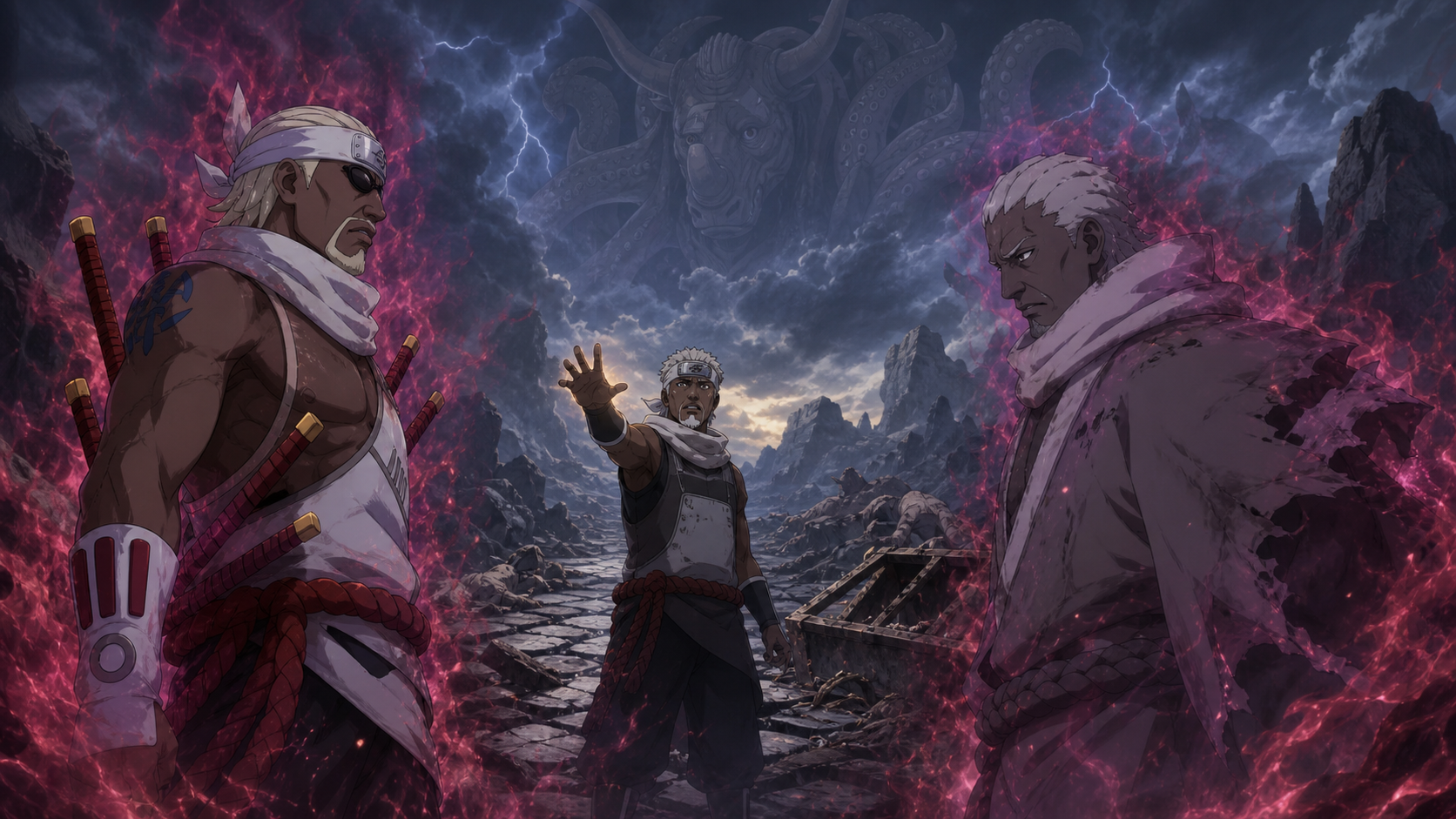
A Hole in the Heart: The Other Jinchuriki
Killer B meets the former host blamed for an Eight-Tails rampage and uncovers the experiment that manufactured Fukai’s failure.
Bottom line
“A Hole in the Heart: The Other Jinchuriki” puts Killer B across from Fukai, Kumogakure’s previous Eight-Tails host, and asks why one man survived the role while another died inside the burden. Kabuto gives Fukai chakra from Gyūki’s severed horn and forces him into a Version 2 cloak. The fight uncovers an uglier truth: Orochimaru drugged Fukai, extracted Gyūki, and caused the old rampage so he could steal tailed-beast cells. Fukai’s failure was manufactured, then remembered as personal weakness. B reaches him with help from Motoi and shows that bonds, music, brotherhood, and a partnership with Gyūki filled the isolation Kumogakure left untreated. The answer is emotionally satisfying, though no village should need a perfect host before treating a jinchūriki like a person.
Gyūki notices Naruto pulling ahead
Killer B pauses again while Naruto’s clones spread across the war. Gyūki points out that Naruto has already moved far ahead, and B’s slow pace tests the tailed beast’s patience.
The comedy fits their partnership because Gyūki can complain without fearing punishment. Their arguments sound like two people who expect the relationship to survive irritation.
Motoi joins the route
Motoi catches up and explains that he has been sent to support B. Their presence together matters because Motoi carries the memory of an earlier Eight-Tails rampage and the people lost during that disaster.
B does not treat the old attempted betrayal as a reason to reject him. Their repaired friendship becomes part of the evidence Fukai will need later.
White Zetsu blocks the road
The pair runs into a White Zetsu ambush before reaching the larger battlefield. The copies exploit numbers and confusion rather than matching B’s power directly.
Kabuto learns B’s location through the disruption and selects a weapon designed to attack personal history, not merely physical strength.
Kabuto opens another coffin
Kabuto summons Fukai, the previous jinchūriki of the Eight-Tails. A White Zetsu caught around the emerging coffin adds a comic beat to an act that remains grave robbery.
Kabuto has no relationship to Fukai’s pain. He only sees a former host whose body can delay or capture the current one.
Fukai warns B to run
Fukai retains enough control to tell B and Motoi that Kabuto will take over. His first free choice after resurrection is an attempt to protect the men facing him.
That warning immediately challenges the idea that Fukai was simply an unstable failure. Even under forced control, he prioritizes people who inherited his burden.
B underestimates the empty host
B initially assumes Fukai cannot pose the same threat without Gyūki sealed inside him. The calculation makes sense because jinchūriki power normally depends on the beast and the seal.
Kabuto has prepared around that limitation. Knowing the standard mechanism does not guarantee that an experimenter respected the standard mechanism.
Fukai enters Version 2
Fukai releases Eight-Tails chakra and forms a Version 2 cloak. The transformation proves Kabuto supplied enough chakra to recreate a dangerous portion of the old bond.
The body no longer houses Gyūki, yet stolen biological material allows Kabuto to imitate the weapon while excluding the tailed beast’s consent.
The stolen horn becomes a power source
Kabuto uses cells or chakra connected to a piece of Gyūki’s horn. The fragment traces back to the earlier rampage in Kumogakure.
Orochimaru collected the material after causing the disaster. Kabuto now turns evidence of that crime into fuel for another attack.
B answers with his own cloak
Killer B enters Version 2 and meets Fukai at comparable power. Their collision is not just a contest between two hosts.
B fights with an active partner inside him, while Fukai moves under Kabuto using residue stolen from Gyūki. Similar appearances hide completely different relationships.
Fukai’s isolation becomes visible
The title’s hole describes the loneliness created by being treated as a vessel before being treated as a person. Fukai carried power that made the village need him and fear him at the same time.
Isolation was not a private personality defect. Kumogakure’s military structure assigned the role, controlled the seal, and left the host to absorb public suspicion.
A jinchūriki is not just a containment system
Villages often discuss hosts through stability, combat output, and risk. Those categories matter for public safety, but none replaces care, friendship, privacy, or a life outside deployment.
Fukai’s emotional void grew inside a system that measured whether he could hold Gyūki while ignoring what helped him keep living.
Orochimaru entered Kumogakure
The episode reveals that Orochimaru infiltrated the village decades earlier. He did not stumble into a rampage and collect cells afterward.
He arrived with a plan to reach the jinchūriki, compromise the seal, and harvest biological material from the resulting violence.
Fukai was drugged
Orochimaru incapacitated Fukai before extracting Gyūki. That detail destroys the easy story that Fukai lost control because his will was too weak.
A powerful outsider medically sabotaged him. Blaming the host allowed the actual attacker to disappear from the village’s memory.
Gyūki was forcibly extracted
Removing a tailed beast usually kills the host and destabilizes the beast. Orochimaru used that lethal process as a research method.
Fukai’s death was not the inevitable cost of being a jinchūriki. Someone chose to kill him for access to Gyūki’s cells.
The rampage was engineered
Gyūki’s violent outbreak followed abduction, extraction, and separation from the host. The village saw the destruction but lacked the cause.
Public memory attached blame to the visible beast and the dead jinchūriki. Orochimaru benefited from the confusion he designed.
Motoi lived with the consequences
Motoi lost his father during an Eight-Tails rampage and later directed that grief toward B. His history shows how institutional silence spreads harm across generations.
Without the truth, survivors build explanations from whatever the village admits. A child may blame the next host because the actual perpetrator remains unnamed.
B survived the same village role differently
Killer B also faced fear, ridicule, and expectations tied to the Eight-Tails. His personality did not magically erase those pressures.
He built several anchors: devotion to A, music, self-expression, training, Motoi’s eventual return, and a genuine working relationship with Gyūki.
A gave B a brother’s name
B’s bond with A offered identity beyond “host.” Brotherhood gave him a person to challenge, impress, annoy, and protect.
That relationship was imperfect and sometimes controlling, but B knew someone saw his life as personally important rather than strategically useful.
Music gave B a private language
Rapping lets B turn judgment into rhythm he controls. Other people can hate the performance, but they cannot decide what the voice means to him.
Creative work does not cure institutional harm. Music gives B a place to speak from while he builds the relationships that make survival possible.
Gyūki became a partner
B learned to communicate with the Eight-Tails instead of treating him as an animal locked behind a seal. Cooperation improved combat control because respect came before efficiency.
The village wanted a stable weapon. B and Gyūki created something more demanding: a relationship where both parties argue, advise, and share risk.
Motoi helps B reach Fukai
Motoi supplies the personal bridge during the fight. He knows the old tragedy and can help B distinguish Fukai’s pain from Kabuto’s commands.
Repairing his bond with B gives Motoi credibility. He has already moved from resentment toward honest recognition of the person carrying the beast.
B does not win through pity
Killer B meets Fukai’s power directly while also communicating what changed in his own life. He neither dismisses Fukai as weak nor romanticizes suffering as a necessary teacher.
B shows that the hole can be filled because people chose connection. The answer remains practical: names, habits, loyalty, arguments, and shared work.
Fukai sees the life he wanted
Fukai recognizes that B found relationships capable of surviving the jinchūriki role. That knowledge releases some of the shame attached to his own death.
B’s success does not prove Fukai should have tried harder. B had a different set of people, opportunities, and truths available to him.
Emotional release weakens Kabuto’s hold
Fukai’s acceptance allows his soul to move beyond the conflict. Edo Tensei repeatedly leaves room for powerful emotional resolution to interrupt control.
The device can feel convenient, but the episode earns the moment by naming the false story that kept Fukai trapped: he did not fail Gyūki through personal emptiness.
Fukai asks B to finish the war
Before leaving, Fukai places the future with the living jinchūriki. The request does not demand that B avenge him personally.
Ending the war protects other people from becoming bodies, vessels, experiments, or reanimated tools in the same chain.
B declares his war has begun
Killer B returns to the route with renewed purpose. His confidence after the encounter carries Fukai’s history without turning the dead man into a temporary power-up.
B already knew how to fight. The episode gives him a clearer reason to bring his whole partnership with Gyūki into the larger battle.
Orochimaru remains the unanswered liability
The revelation adds another atrocity to Orochimaru’s research history. He infiltrated an allied village, killed a jinchūriki, caused mass casualties, and harvested tailed-beast material.
Any future tolerance of Orochimaru must account for victims like Fukai. Useful knowledge does not cancel the people used to obtain that knowledge.
Kumogakure also owes an accounting
Orochimaru caused the disaster, but the village built the conditions around Fukai’s isolation and preserved an incomplete explanation afterward.
Security secrecy may have hidden uncertainty, yet survivors deserved a real investigation. Hosts deserved support before another catastrophe forced reform.
The episode’s central comparison works
Fukai and B are not opposites because one was weak and one was strong. They show how similar burdens can produce different outcomes when relationships, information, and agency differ.
The contrast respects B’s work while refusing to make Fukai morally responsible for being drugged and killed.
Connection is support, not a magical cure
B’s relationships did not erase every insult, duty, or danger attached to his seal. He still had to train, negotiate with Gyūki, survive village expectations, and decide what kind of man he wanted to become.
Calling connection the answer should never become another way to blame a lonely person. Communities have to provide safe chances for trust, and institutions have to stop manufacturing isolation while demanding emotional stability from the people they isolate.
The anime-original history has a continuity cost
Orochimaru secretly causing a major Eight-Tails rampage adds a large unseen operation to Kumogakure’s past. The village’s failure to uncover him can feel designed around the episode’s reveal.
The story still uses that addition for a worthwhile correction. Fukai’s legacy moves from failed host to murdered victim who tried to protect his successor.
Fukai’s warning proves Kabuto never owns the whole person
His first instinct is to tell B to run, even while Edo Tensei positions him as an attacker. The warning preserves responsibility and care inside a body controlled by someone else.
That brief resistance should shape the Alliance response. Reanimated opponents can provide intelligence, delay attacks, or signal danger when control loosens. Soldiers need permission to listen without confusing a lucid moment with complete freedom from Kabuto.
The stolen horn links bodily violation to military power
Orochimaru does not merely extract Gyūki. He preserves part of the Eight-Tails as material that can later be attached to another experiment and turned into a weapon.
The horn is evidence of theft from both beast and host. Kumogakure should track tailed-beast remains, extraction sites, medical records, and every official who handled the aftermath. Powerful body parts cannot disappear into classified storage without inviting another laboratory to claim them.
Kumogakure treated jinchūriki survival as sufficient care
Fukai could contain Gyūki, fulfill the village role, and still live with profound isolation. A stable seal did not mean the person inside that system was safe.
Monitoring should have included mental health, chosen relationships, rest, public harassment, and the host’s ability to refuse nonessential deployment. Villages repeatedly measure whether a weapon functions while ignoring whether the human being has a life worth returning to afterward.
B’s support network was built, not destined
A gave him a brother’s name, Motoi confronted guilt, music gave private expression, and Gyūki gradually became a partner. None of those relationships arrived as an automatic reward for endurance.
B also performed the work of remaining open after rejection. The episode respects connection most when it shows a network created through repeated choices. His outcome cannot become evidence that every isolated host could have healed through attitude alone.
Motoi carries knowledge the commanders missed
He understands the social history surrounding both hosts and recognizes what B’s apparent confidence cost. That perspective lets him translate emotional stakes without replacing either jinchūriki’s voice.
Support staff and community witnesses often hold intelligence absent from formal mission files. Command should include them carefully, protect them from combat they cannot survive, and credit their contribution. Motoi matters because proximity taught him what the official containment record did not.
Gyūki’s partnership challenges the language of possession
B does not simply own greater tailed-beast power than Fukai. He and Gyūki communicate, argue, warn one another, and coordinate. The strength comes from relationship rather than superior mastery over a captive creature.
That distinction changes the ethical comparison. A village seeking B’s result cannot reproduce it through tighter seals or harsher training. Partnership requires recognizing Gyūki as a participant whose consent, memory, anger, and judgment affect every use of shared power.
Fukai deserves records beyond being the previous host
His identity is presented through the role that consumed him and the tragedy that ended it. Even the title defines him relationally as another jinchūriki.
Kumogakure owes a fuller archive: his family, training, preferences, service, warnings, death investigation, and the people who tried to reach him. Restoring those details would not undo exploitation, but it would prevent the village from preserving only the weapon specification.
The engineered rampage demands an independent inquiry
Drugging Fukai and extracting Gyūki created casualties that may have been blamed on the host. Orochimaru’s intervention does not erase the village decisions that allowed access and controlled the public explanation.
An inquiry should separate sabotage from host responsibility, identify security failures, compensate survivors, and correct any record that describes Fukai as the sole cause. Truth matters because stigma can outlive everyone who created the lie.
B reaches Fukai without making pain compete
He does not argue that his friendships prove Fukai failed. B shows another outcome while recognizing how different support changed what each man could survive.
That is the humane center of the comparison. Trauma does not need a winner, and connection is not a moral ranking. B can be proud of his life while refusing to use that life as a judgment against someone who was denied similar conditions.
Release from Edo Tensei is not a complete repair
Fukai regains enough clarity to acknowledge B and ask him to finish the war. The emotional release weakens Kabuto’s claim, but the larger violations remain.
His remains were stolen, his history distorted, Gyūki’s body was harvested, and survivors carried consequences without full truth. Closure belongs to the moment between hosts. Accountability belongs to the institutions that must preserve evidence and change what made the exploitation possible.
A village cannot outsource healing to one brother
A’s public decision to name B as his brother changes B’s life, but the Raikage should not become the entire care system for a jinchūriki. Personal devotion can protect someone from isolation while also hiding how little institutional support exists around them. If that relationship breaks, deploys elsewhere, or becomes controlling, the host needs other trusted adults, peers, clinicians, and advocates with independent authority. B’s music, Motoi’s repaired friendship, and Gyūki’s partnership widen the network, yet each bond developed through struggle rather than guaranteed policy. Kumogakure should learn from that history without turning A into proof that the village did enough. Build confidential mental-health care, anti-harassment enforcement, civilian education, rest protections, and a way for hosts to challenge missions without being labeled disloyal. Connection matters because people sustain it, not because leaders can order it into existence. Fukai’s isolation shows what happens when everyone assumes endurance equals stability. B’s survival shows what becomes possible when several relationships make room for a whole person. The policy lesson is collective responsibility, not finding one exceptional protector and asking love to cover every institutional failure for the rest of his dangerous military life alone.
RaeRae’s verdict
“A Hole in the Heart: The Other Jinchuriki” gives Killer B a meaningful mirror and refuses the lazy conclusion that emotional control belongs to individual willpower alone. B survived through relationships he actively built, while Fukai was isolated, sabotaged, and blamed for Orochimaru’s crime.
The fight lands because Motoi and Gyūki matter alongside B. Fukai leaves knowing another host found a fuller life, but responsibility stays where responsibility belongs: with Orochimaru’s experiment and the village systems that treated jinchūriki care as secondary to containment.
RaeRae’s call
B’s life does not prove Fukai lacked strength. It proves support, chosen language, honest companionship, and partnership with Gyūki changed what survival could become. Investigate the engineered rampage, restore Fukai’s record, treat the stolen horn as evidence, and stop measuring jinchūriki care by whether the seal still works.
Episode details and viewing routes
- Official episode reference: Naruto Official episode guide
- Licensed episode route: Crunchyroll licensed episode page
What I am carrying forward
Fukai returns to the afterlife, Kabuto loses the reanimated former host, and B continues toward the main battlefield with Motoi. Gyūki’s stolen horn cells explain Fukai’s temporary Version 2 power.
Episode 319 shifts to the puppet master Sasori and his human connection to Komushi. I am carrying forward Kabuto’s exploitation of unresolved history, not extending Fukai’s completed fight beyond its ending.