
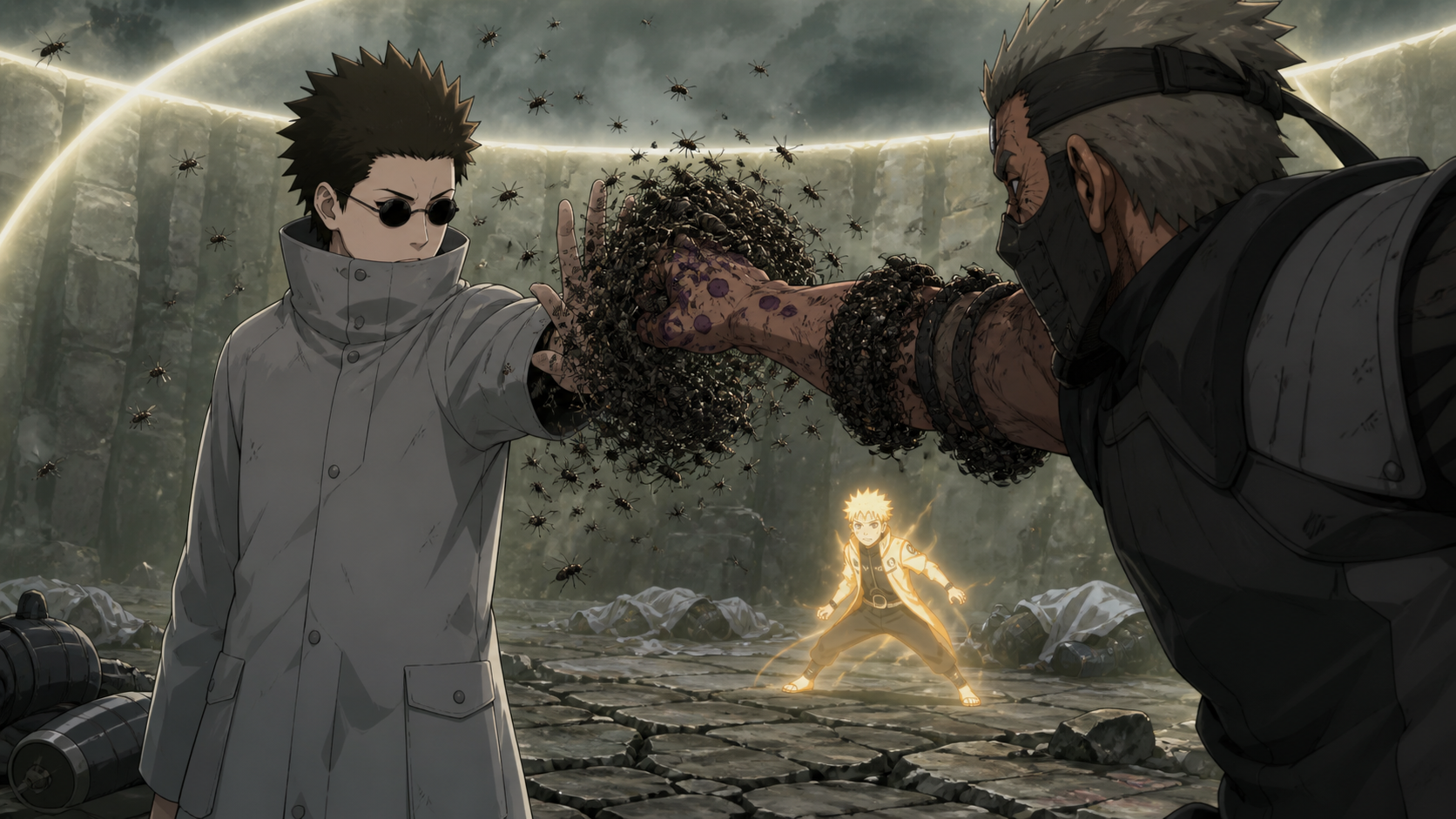
Shino vs. Torune!
Shino answers Torune’s forbidden poison technique with years of patient preparation and the freedom Torune sacrificed to protect.
Bottom line
“Shino vs. Torune!” finally gives Shino a war episode worthy of his quiet competence. Shino tracks the escaped Torune before a forbidden insect technique can poison a huge section of the Allied Forces. Their fight reveals that Torune lived with Shino’s family after losing his father, became an older-brother figure, and volunteered for Root so Danzō would not take Shino. Naruto arrives with power, but Shino supplies the knowledge, preparation, and final seal. He bred insects resistant to Torune’s venom after Torune left, turning grief into a defense nobody else could build. The episode also refuses to pretend Root gave Torune nothing human. Torune found friendship with Fū, yet that bond existed inside an institution that stole both boys’ freedom.
Shino’s insects detect the loose threat
The Allied Forces continue fighting White Zetsu when Shino’s kikaichū sense another insect user. The signal does not match the ordinary enemy around him.
Shino trusts specialized evidence and leaves Kiba and the others to manage the current fight. That decision prevents Torune’s escape from becoming a mass-casualty event.
Torune chooses an isolated site
Torune reaches ground far enough from the main force to prepare his forbidden technique. Distance gives him time and a field of bodies without immediate interference.
Kabuto’s control turns Torune’s tactical judgment against the people he once protected. The same patience that helped him survive Root now helps a summoner build a poison zone.
The Jar of Poison needs corpses
Torune’s technique uses a large number of dead bodies inside a barrier to multiply his rinkaichū. Once released, the poisonous cloud would spread without distinguishing allies from enemies.
The setup makes the war’s casualties feed the next attack. Dead soldiers stop being people twice: first as battlefield losses, then as material for an indiscriminate weapon.
Shino understands the clock
Shino does not wait for a full briefing team. He recognizes the insect signature and knows Torune’s preparation cannot be allowed to finish.
His urgency stays controlled. Shino moves because he understands the mechanism, not because the episode suddenly turns his quiet personality into loud panic.
Torune recognizes family before combat
When Shino arrives, Torune asks whether he made friends. The question reaches past uniforms, summons, and the war.
Torune remembers the child whose future he tried to protect. Kabuto can command his body, but the personal concern survives inside the command.
Shibi became Torune’s guardian
After Shikuro died, Shibi took Torune into the Aburame household. Torune and Shino grew together with the closeness of brothers rather than distant clan acquaintances.
The arrangement gives Torune a home while making his later removal more painful. Root did not recruit an unattached tool. Root took someone already embedded in family life.
Torune shared the insects he carried
Young Torune showed Shino the rare insects living inside his body. For an Aburame child, that exchange is practical knowledge and personal trust at once.
Torune’s rinkaichū could kill through contact, so intimacy required boundaries. Teaching Shino about the danger was one way of keeping him safe without treating Torune himself as contamination.
Danzō came for an Aburame child
Root wanted a recruit from the clan, and Shino stood inside that demand. Danzō’s system frames the selection as service while holding family safety and village authority over a child.
Consent cannot exist cleanly under that pressure. A family may choose who goes, but the institution has already decided that somebody must be surrendered.
Torune volunteered in Shino’s place
Torune stepped forward so Shino could remain outside Root. The sacrifice preserved Shino’s chance to attend the Academy, build a team, and keep an ordinary public identity.
Torune did not merely save Shino from a dangerous assignment. He saved Shino from enforced emotional erasure, secrecy, and a life designed around obedience to Danzō.
Shino’s friendships answer the sacrifice
Torune asks whether Shino made friends because friendship was part of the future he bought. Team 8, Kiba, Hinata, Akamaru, and the larger Konoha group are evidence that the choice mattered.
Shino often feels overlooked, but being overlooked is not the same as being alone. His bonds may be quieter than Naruto’s, yet they repeatedly show up when work needs doing.
Root did not erase every bond
Torune tells Shino that he found a friend in Fū Yamanaka. The admission complicates any simple claim that Root members became empty machines.
People create attachment even inside abusive institutions. That human survival does not redeem Root. Fū and Torune deserved friendship without Danzō owning their labor, identities, and deaths.
Kabuto weaponizes Torune’s training
Root taught Torune precise taijutsu, assassination discipline, and emotional containment. Under Edo Tensei, those skills serve another controller.
Danzō treated self-erasure as loyalty. Kabuto benefits because a person trained to act without hesitation remains effective even when the mission violates everything he valued.
Torune’s kick breaks Shino’s position
Torune lands a clean kick to Shino’s stomach and knocks him toward the forbidden-jutsu area. The strike proves that avoiding skin contact does not remove every danger.
Torune can combine ordinary physical skill with lethal insects. Focusing only on the poison leaves an opponent open to the fighter carrying that poison.
Naruto’s clone interrupts the fall
A Naruto shadow clone arrives before Shino drops into the active setup. Naruto brings speed and enough strength to create breathing room.
The rescue matters without replacing Shino’s role. Naruto can stop immediate impact, but he does not understand the insects, the barrier, or the family history well enough to lead the solution.
Shino gives the contact warning
Shino tells Naruto not to touch Torune’s bare skin. Rinkaichū can transfer into another body and destroy cells from within.
Clear operational language keeps Naruto alive. Shino names the boundary before offering a theory about how Torune might attack beyond direct contact.
Torune expands the threat into air
Torune uses Poison Cloud Technique, proving touch is not the only delivery route. The airborne attack can reach fighters who believe distance alone protects them.
The escalation justifies Shino’s concern about the larger forbidden technique. A concentrated cloud is dangerous enough before the corpse-powered barrier multiplies the scale.
Shino’s swarm blocks the cloud
Shino sends his insects against Torune’s poison and prevents the attack from reaching Naruto. Clan knowledge becomes environmental protection rather than a simple duel weapon.
The defense also shows years of study. Shino did not inherit a single fixed swarm. He breeds, trains, and selects insects for specific conditions.
Naruto takes the close fight
With Shino’s warning in mind, Naruto pressures Torune. Torune draws a blade and uses kenjutsu to keep the clone moving.
Naruto breaks the sword, but destroying a weapon does not disarm an Aburame fighter. Torune’s most dangerous tools live beneath his skin.
Rasengan does not finish the problem
Naruto lands a Rasengan and damages Torune’s reanimated body. Edo Tensei begins repairing the injury, leaving the underlying poison technique and contract intact.
Raw force creates an opening. Sealing and specialized control still determine whether the opening becomes a victory.
Torune nearly reaches Naruto
Torune attacks immediately after the Rasengan and comes close to landing a poisoned punch. Naruto’s speed does not automatically solve an unfamiliar microscopic threat.
The sequence respects Torune’s danger. Kabuto underestimated him, but Shino never does.
Shino steps between them
Shino intercepts the punch that would have infected Naruto. The choice mirrors Torune volunteering for Root years earlier.
This time Shino is not a child being protected from the decision. He has prepared for the risk and chooses the position with knowledge Torune does not possess.
The punch lands on insects
Torune expects his rinkaichū to spread through Shino. Instead, the contact reaches a defensive layer of insects bred to survive the venom.
The reveal belongs to Shino because the preparation began long before Naruto entered the fight. His solution comes from memory, experimentation, and patient care.
Shino bred resistance from Torune’s insects
After Torune joined Root, Shino used insects connected to Torune’s colony to develop a resistant breed. He carried the older boy’s lesson forward rather than treating the dangerous swarm as forbidden knowledge.
The work turns absence into practical continuity. Shino could not bring Torune home, but he learned enough from Torune to prevent the same poison from taking somebody else.
Science wins the emotional rematch
Shino’s defense is not a sudden friendship boost. Breeding resistance requires observation across generations, controlled exposure, failure, and time.
That labor fits his character better than a louder transformation would. Shino wins because he kept studying a problem everybody else forgot to see.
The resistant insects paralyze Torune
Shino uses the adapted swarm to immobilize Torune. The countermeasure does more than survive contact; the resistant insects create the restraint needed for sealing.
Family knowledge defeats institutional weaponization. Danzō cultivated Torune as a lethal body, while Shino cultivated living partners capable of stopping that body without hatred.
Shino applies the sealing tag
Once Torune cannot move, Shino places the tag and ends the forbidden technique. The nearby corpses no longer become fuel for a poison cloud.
The final action is quiet and procedural. Shino does not need a victory speech because the stopped barrier and protected soldiers already state the result.
Naruto helps without taking ownership
Naruto’s clone saves Shino and creates combat openings, but the episode lets Shino finish his own conflict. That balance matters in a series where Naruto’s arrival can flatten another character’s specialty.
Support does not reduce Shino’s accomplishment. Naruto makes the duel survivable; Shino makes the solution possible.
Torune’s sacrifice receives an answer
Shino’s life outside Root produced friendships, expertise, and the freedom to choose how his skills serve others. Torune can see that the child he protected grew into someone capable of protecting him in return.
Sealing Torune is not rejection. Shino releases him from Kabuto’s immediate control and prevents Torune’s body from committing mass harm.
Danzō’s damage outlives Danzō
Danzō is dead, yet Root’s decisions continue shaping the war. Torune’s recruitment, training, partnership with Fū, and eventual use by Obito and Kabuto all grow from the institution’s belief that people were replaceable tools.
Closing Root cannot restore the childhoods already taken. Accountability requires remembering who benefited and who carried the cost.
The episode finally sees Shino
Shino rarely receives the emotional center despite being one of Konoha’s most reliable young shinobi. Episode 317 connects his reserve, technical thinking, and loyalty rather than asking him to imitate a louder teammate.
His affection appears through preparation. He remembers Torune by building something that can survive him.
The anime-original history earns its place
Torune’s manga role is brief, so the episode expands a relationship only the anime explores. The addition fits known Root recruitment practices and Shino’s clan background.
The story works because the new history explains existing character traits instead of demanding that every later event revolve around a previously hidden best friend.
The Jar of Poison turns casualties into raw material
Torune’s plan needs bodies, isolation, and enough time for contamination to spread. Kabuto’s larger system already treats the dead as inventory, while this technique converts fresh casualties into fuel for another weapon.
The Alliance response must protect remains as carefully as living positions. Recovery teams need sealed transport, contamination markers, and specialists who can distinguish infection from ordinary battlefield injury. Leaving bodies unsecured gives the enemy both evidence and ammunition.
Shino recognizes Torune without surrendering the mission
The family connection changes the emotional stakes, yet Shino never lets recognition become permission for the poison jar to mature. He listens, warns Naruto, studies the insects, and keeps the sealing objective visible.
That balance is one reason the episode finally serves him well. Shino does not need to become loud or reckless to prove love. His restraint contains grief, tactical judgment, and respect for the person trapped inside Kabuto’s control.
Torune’s childhood sacrifice belonged to a coercive system
Torune volunteers when Danzō comes for an Aburame child, protecting Shino from Root recruitment. The choice shows love, but the surrounding power makes any celebration uneasy.
A child choosing which child an armed official may take is not meaningful institutional consent. Danzō created the threat, narrowed the options, and benefited from Torune’s devotion. The sacrifice was brave because the system was abusive, not because Root deserved his service.
Shibi’s guardianship created a family beyond blood
Torune’s place in the household is built through care, instruction, shared insects, and daily presence. The episode treats guardianship as a real family relationship rather than a temporary substitute.
That matters when Shino confronts him. He is not battling a distant clan acquaintance inserted for drama. He is answering someone whose sacrifice shaped his childhood and whose knowledge remained inside the insects Shino continued to raise.
Insect inheritance becomes an archive of care
Torune shares insects, techniques, and knowledge before Root removes him from the household. Shino later breeds resistance from that living inheritance, turning biological study into memory carried across years.
The answer is not sentimental magic. Shino observes, experiments, and prepares. Love motivates the work, but disciplined science makes the defense possible. The episode respects both feeling and expertise by refusing to pretend either can replace the other.
Naruto’s clone understands when to follow Shino
Naruto saves Shino from a fall and handles close pressure, but he accepts warnings about touch, poison, and airborne insects. The partnership works because help does not become command theft.
Shino remains the specialist who interprets Torune’s technique and designs the finish. Naruto contributes mobility and force where they are useful. Supporting-character ownership survives because the hero listens instead of turning every battlefield into proof that only his instincts matter.
Contact warnings protect more than the hero
Torune’s body makes a single touch potentially fatal, and airborne insects expand the risk beyond the immediate duel. Shino gives Naruto direct instructions before urgency erases caution.
The same warning should travel to medics, sealers, recovery crews, and anyone entering the contaminated zone. Clear language needs the transmission route, symptoms, safe distance, protective equipment, and decontamination plan. Specialist knowledge saves lives only when command distributes it.
Resistance is not immunity without limits
Shino’s specially bred insects withstand Torune’s poison long enough to create paralysis and a sealing opening. That success should not become a blanket claim that every Aburame insect or handler is safe.
Command needs samples, exposure times, failure thresholds, and medical observation after contact. Responsible science describes conditions and uncertainty. The episode shows preparation beating a specific threat, not a miracle cure that removes every future contamination risk.
Sealing Torune should begin a recovery investigation
The tag ends immediate movement, but it does not answer how much poison remains, whether insects escaped, or what Kabuto learned from the encounter. The site needs quarantine and evidence collection.
Shino also deserves a debrief that separates tactical facts from family grief. Asking him to provide clan expertise is reasonable; making him carry the entire investigation alone is not. Support begins after the victory pose, when institutions decide whose burden the aftermath becomes.
Danzō’s recruitment practices require a public record
Torune’s story shows Root extracting children through pressure hidden behind village security language. Danzō’s death does not repair the families divided or the operatives trained to disappear.
Konoha needs names, recruitment ages, guardianship records, missions, medical harms, and survivor testimony preserved outside Root’s sealed archives. Accountability cannot stop at condemning one dead leader. The village benefited from the institution and owes repair to everyone it consumed.
The Aburame deserve narrative visibility beyond utility
Shino repeatedly protects entire field teams through observation, restraint, tracking, and techniques other people cannot duplicate, yet the series often remembers him only when insects solve a problem. Episode 317 works because it gives his quiet method an emotional history. His reserve is not emptiness. Shino carries a guardian’s sacrifice, a clan’s living knowledge, childhood friendships, and the discipline to prepare for a threat nobody else could safely touch. That depth should remain visible after Torune is sealed. Konoha can value Aburame expertise without treating clan members as specialist equipment summoned for contamination. They need recognition in planning rooms, medical research, memorial records, and leadership conversations before emergencies begin. Shino also deserves ordinary scenes where friendship does not require him to prove usefulness. The episode makes a strong correction by allowing his precise way of loving someone to drive the victory. Future stories should remember that the person is larger than the technique.
RaeRae’s verdict
“Shino vs. Torune!” turns an overlooked Root operative into the source of Shino’s freedom and an overlooked Konoha fighter into the only person prepared to stop him. The poison mechanics stay clear, Naruto contributes without hijacking the ending, and the final seal carries emotional weight without a speech explaining every feeling.
Root remains the real villain underneath the duel. Torune protected Shino from Danzō, found Fū inside the system, and died serving people who treated loyalty as ownership. Shino honors him by choosing knowledge, friendship, and protection on his own terms.
RaeRae’s call
Torune protected Shino when Danzō forced an abusive choice, and Shino answers years later with care sharpened into preparation. Naruto helps without stealing the finish. Seal the threat, quarantine the site, preserve Torune’s record, and make Konoha confront the child-recruitment system that turned family love into Root’s supply chain.
Episode details and viewing routes
- Official episode reference: Naruto Official episode guide
- Licensed episode route: Crunchyroll licensed episode page
What I am carrying forward
Torune is sealed, the Jar of Poison Technique is stopped, and the two-episode reserve-army story ends. Shino’s resistant insects and childhood history remain part of his anime continuity, while Naruto’s clone returns to the larger battlefield mission.
Episode 318 shifts to Killer B, Motoi, and Fukai, the previous Eight-Tails jinchūriki. I am carrying forward Kabuto’s pattern of targeting old relationships, not importing Torune’s resolved fight into that separate story.