
The Reanimated Allied Forces
Kabuto turns his weakest reanimated inventory into a recovery team, and Torune proves one overlooked body can still escape the seal.
Bottom line
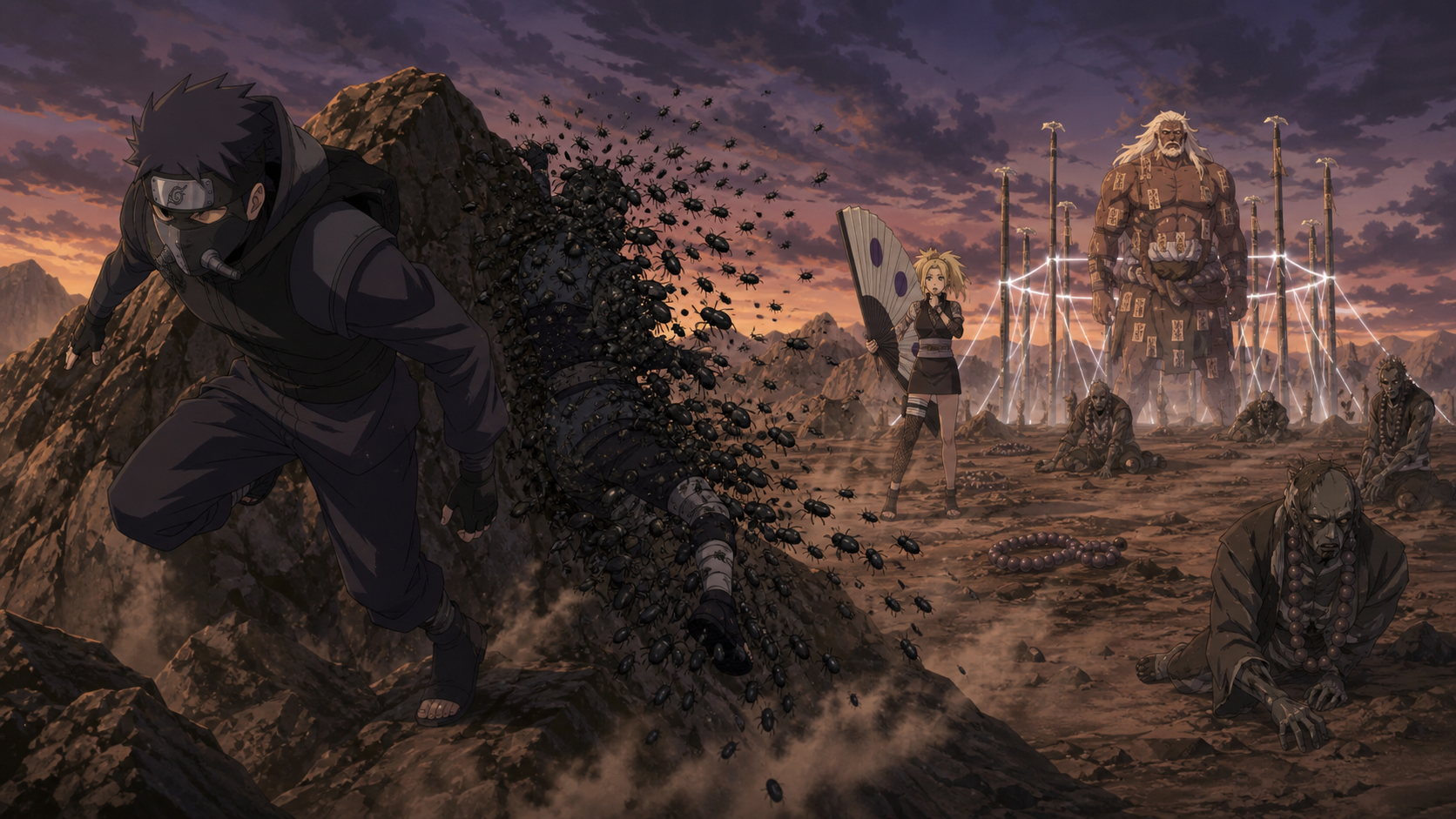
“The Reanimated Allied Forces” gives Kabuto a backup plan made from people he considered failures. He sends a weak group of reanimated shinobi, led by Torune Aburame, to free stronger bodies already sealed by the Alliance. Most of the group cannot overpower the living soldiers, but raw strength was never the point. Familiar faces create hesitation, smoke creates an escape route, and several oddball specialists nearly reach the Third Raikage’s seal. Temari stops the attempt, receives a battlefield love confession from Daimaru, and watches Torune escape through an insect clone. The episode plays some of the dead for comedy, yet the strategy is serious. Kabuto treats every corpse as inventory, including bodies he once dismissed.
Kabuto audits his losses
The Allied Forces have sealed several of Kabuto’s strongest reanimated fighters. Losing those bodies reduces his battlefield reach and wastes the grave robbery, preparation, and control work behind each summon.
Kabuto responds like a manager protecting assets rather than a person confronting the dead. Human remains become units to recover, deploy, or discard according to combat value.
The reserve army looks unimpressive
Kabuto deploys reanimated shinobi who appear weaker than the famous legends already fielded. White Zetsu recognizes the group as failed or low-value results from Edo Tensei preparation.
That contempt sets up the episode’s trick. A weak fighter can still carry information, remove a seal, trigger a trap, or create cover for someone more dangerous.
Torune becomes the field leader
Torune Aburame stands apart from the others. Danzō once trusted him as an elite Root operative, and Obito preserved his body after using him as an Edo Tensei sacrifice demonstration.
Kabuto initially groups Torune with disposable reserves. Torune’s discipline, insects, and escape skill soon prove that the label says more about Kabuto’s incomplete knowledge than Torune’s ability.
Edo Tensei turns death into logistics
Kabuto uses Torune to summon the reserve fighters and directs them toward sealed assets. The dead become a recovery crew for other dead people.
Every layer removes consent. The summoned shinobi did not choose the mission, the stronger fighters did not choose resurrection, and the Alliance must spend living bodies to keep both groups contained.
Numbers create the first advantage
The reserve fighters struggle individually, but several bodies appearing together force Allied units to divide attention. Sealing requires tags, coordination, and time even when the target lacks elite combat power.
Kabuto exploits process. An immortal nuisance can consume specialists while the actual objective moves somewhere else.
Familiar faces slow the Alliance
Some living soldiers recognize friends, relatives, or former comrades among the reanimated group. Surprise and grief interrupt the clean response the sealing teams need.
Kabuto depends on that pause. The war repeatedly proves that emotional knowledge can become an attack surface when one side has no respect for the dead.
Osoi warns the living
Osoi, once connected to Toroi and known as Musai’s father, retains enough awareness to expose Kabuto’s plan. He tells the Alliance that the reserve group is trying to recover stronger sealed fighters.
The warning turns a chaotic skirmish into an intelligible operation. A controlled victim still finds a way to protect the living from the person controlling his body.
The Alliance sends the warning upward
Once the soldiers understand the objective, they contact headquarters. The Third Raikage becomes an obvious high-value target because releasing him would restore one of Kabuto’s most destructive weapons.
Battlefield reporting matters as much as individual victory. Sealing the nearest enemy means little if another unit quietly removes the tag from a legendary fighter.
Kabuto’s grave robbery gets a flashback
The episode recalls Kabuto searching for bodies after absorbing Orochimaru’s cells and research. That work did not begin with tactical necessity on the battlefield.
Kabuto built an inventory by disturbing graves and collecting remains long before each victim had a name in his current plan. The war merely gives his obsession a larger workplace.
Failed experiments still had lives
Calling these shinobi failures reduces whole people to the usefulness of their reanimated bodies. Some lacked famous bloodlines or overwhelming techniques. Others simply did not match the role Kabuto imagined.
Nobody becomes disposable because a grave robber expected a better weapon. The episode’s comedy should not erase the violation holding every member of the group in place.
Heiji creates the escape window
Heiji uses the Winding Smoke Technique to cover the reserve group’s movement. Smoke interrupts sight lines and creates the confusion Torune needs to pull several bodies away from the main fight.
The technique proves why support skills matter. Heiji does not have to defeat an army when obscuring the right ten seconds can advance the mission.
The fugitives reach the sealed Raikage
Torune’s group locates the Third Raikage’s containment point. The target is already defeated and tagged, but a completed seal still requires protection.
The Alliance cannot treat sealed bodies as finished paperwork. Kabuto knows the locations have become recovery sites and sends specialists designed to disturb them.
The first rush meets a trap
One reanimated fighter runs directly toward the Third Raikage’s sealing tag and triggers the defenses around the site. Immortality does not make careless movement useful.
The trap does exactly what perimeter security should do: delay the intruder, reveal the approach, and protect the seal long enough for defenders to respond.
Daimaru clears the approach
Daimaru uses Earth Release: Sand Dance to remove sealing tags blocking the path. His contribution is not glamorous, but environmental control creates room for the group to advance.
Kabuto’s reserve team works because mismatched specialties briefly align. Smoke hides movement, earth clears obstacles, and another member focuses on the central tag.
Chūkaku brings prayer beads to a seal fight
Chūkaku approaches the Third Raikage’s tag with prayer beads and begins the release process. The image looks eccentric beside the shinobi war’s giant techniques.
Eccentric does not mean harmless. Ritual knowledge aimed at the correct mechanism can accomplish more than a loud attack aimed at the body.
The sealing tag begins to fail
The group gets close enough to threaten the Third Raikage’s containment. Kabuto’s supposed failures nearly restore a fighter who previously required enormous effort to stop.
That near success justifies the operation. A disposable team only needs one opening to change the battlefield.
Temari arrives before the release
Temari interrupts Chūkaku and protects the seal. Her wind attacks suit the situation because she can clear space, disrupt the ritual, and strike without standing inside the group.
She does not waste time mocking the reserve team’s weak reputation. Temari responds to what they are doing, which is the correct measure of danger.
Daimaru recognizes Temari
Daimaru steps in front of Temari and declares his love. Forced resurrection turns a private feeling into battlefield dialogue at the worst possible moment.
The confession supplies comedy, but the surrounding fact remains ugly. Daimaru has no control over when he returns, where he meets her, or how long the conversation lasts.
Temari refuses to become sentimental cover
Temari listens without forgetting the mission. A dead man’s affection does not require her to abandon the Third Raikage’s seal or place living soldiers at risk.
Her response respects Daimaru more than empty indulgence would. She treats him as a shinobi whose current body must be stopped, not a fragile memory who cannot face an answer.
The battlefield confession has limits
Daimaru’s declaration works as a character joke because Temari’s bluntness meets his dramatic timing. The scene also risks turning forced resurrection into a dating interruption.
Humor belongs here only while the episode remembers that Kabuto dragged Daimaru back without permission. The absurdity comes from the people, not from pretending the violation is harmless.
Daimaru is sealed
The Alliance contains Daimaru after the exchange. Sealing ends his usefulness to Kabuto and stops the current threat without asking Temari to kill him again.
For a reanimated victim, containment can be mercy. The body stops attacking while the soul waits for the technique itself to end.
Temari hunts the last visible target
Torune appears to hide behind a rock after the rest of the recovery team falls. Temari attacks the position and expects to close the operation.
Her first strike forces a reaction. The second reveals that Torune has already moved beyond the obvious hiding place.
Torune leaves an insect clone
The figure behind the rock is a clone made from insects. Torune uses the decoy to keep Temari’s attention on a body that can collapse without exposing his route.
The escape finally shows Kabuto what Danzō already knew. Torune is patient, technical, and dangerous precisely because he does not need spectacle.
Kabuto revises Torune’s value
Kabuto watches Torune survive and decides the former Root operative may be useful after all. The reassessment is practical, not respectful.
Torune’s reward for proving himself is greater exploitation. Competence does not earn freedom inside Kabuto’s system. Competence earns a harder assignment.
Root trained a person to disappear
Torune’s movement carries Danzō’s institutional fingerprints. Root demanded secrecy, obedience, and mission completion while suppressing ordinary identity and attachment.
Those skills help Torune evade the Alliance, but they also make him an ideal body for another controller. Danzō trained people to function as tools, and Kabuto inherits the result.
Shino belongs in the unfinished question
An Aburame specialist loose on the battlefield should draw the attention of the living Aburame who can understand the insects. Torune’s escape points directly toward Shino even before their meeting occurs.
Episode 316 stops before that confrontation. The family history, poison risk, and Root connection belong to Episode 317’s answer.
The Alliance needs guards after every seal
The recovery attempt exposes a procedural weakness. A sealing squad can win the fight and still lose the result if nobody protects the tag, records the location, and watches for support techniques.
Headquarters should treat each sealed elite as an active objective. Perimeter traps help, but defenders and rapid communication remain necessary.
The episode values support techniques
Smoke, sand, prayer, warning, communication, and insect clones drive the operation. None carries the reputation of the Third Raikage’s power.
Together, those smaller abilities nearly reverse a major Allied victory. The episode understands that war is made from access, timing, information, and labor as much as finishing attacks.
The anime-original detour fits the war
Kabuto having imperfect summons and reserve bodies makes sense within the scale of his experimentation. The mission also expands the cost of Edo Tensei beyond famous characters.
The uneven comic tone keeps the episode from landing every moral consequence. Still, the central strategy feels compatible with an enemy who collects bodies and learns through use.
Kabuto’s reserve roster exposes the scale of stolen labor
He evaluates reanimated people as remaining inventory, sorting useful techniques from disappointing bodies. The language of reserves makes desecration sound like ordinary staffing.
Every name on that list once belonged to a community with burial customs, survivors, and unfinished grief. The episode’s comedy around an awkward squad should not obscure the underlying system: Kabuto turns people into replaceable labor after death and calls efficiency the only measure that matters.
Osoi’s warning is an intelligence success
Recognizing familiar faces slows the Alliance, but Osoi uses that hesitation to communicate the danger instead of exploiting it. He gives the living enough information to adapt before Kabuto’s control closes around him.
That act deserves formal credit. Battlefield intelligence often comes from frightened people making one clear choice under coercion, not only from elite sensors or headquarters analysts. Recording his warning preserves agency inside a technique designed to erase it.
The Alliance needs a protocol for familiar enemy faces
Soldiers should expect reanimated relatives, teachers, rivals, and former comrades to appear without warning. Telling them to suppress emotion is neither realistic nor tactically useful.
Units need paired confirmation, short challenge phrases, remote sealing support, and permission to rotate a soldier who freezes. Emotional preparation belongs beside weapons training. Kabuto relies on shame and surprise, so a humane protocol can protect both readiness and the dignity of the people being used.
Failed experiments are still victims
Kabuto’s flashback frames unsuccessful subjects as discarded research. Failure describes his desired result, not the value of the person whose body absorbed the experiment.
The missing record matters again. Villages should identify remains, notify families, preserve evidence, and investigate how bodies entered Orochimaru’s network. When institutions accept anonymous loss, researchers like Kabuto inherit a supply chain built from people nobody expects to be returned.
Guarding a completed seal is part of the mission
The Third Raikage’s sealed body remains strategically dangerous. Treating the seal as a finished victory leaves one of the war’s strongest weapons available to any infiltrator with time and a release method.
Every high-risk seal needs layered guards, tamper indicators, rotation schedules, and an evacuation plan if the barrier weakens. Sealing ends movement, not responsibility. The Alliance learns this only because an improvised reserve squad nearly converts yesterday’s victory into today’s disaster.
Temari refuses to let romance become a weapon
Daimaru’s recognition and confession create a human pause, but Temari does not surrender command to his unfinished feelings. She hears him without allowing sentiment to open the seal.
The response is not cruelty. Daimaru is being controlled, nearby soldiers remain at risk, and the Third Raikage could be released. Temari grants him recognition while completing the necessary seal, showing that compassion can exist inside a firm battlefield boundary.
Daimaru deserves more than a joke about rejection
His confession arrives under grotesque conditions: dead, controlled, and moments away from losing speech again. The awkwardness can be funny without making his personhood disposable.
He also clears the approach and creates consequences that Temari must manage. A fair reading lets him be foolish, useful, frightened, and sincere at once. Supporting characters become memorable when the story allows contradictory humanity instead of reducing them to a single punch line.
Torune’s escape reflects Root training
The insect clone succeeds because Torune understands how to make his body, presence, and intentions difficult to read. Root trained operatives to disappear inside missions long before Edo Tensei removed their autonomy.
Kabuto exploits skills developed by another coercive institution. That connection should remain visible. Torune’s danger does not begin with personal malice; it grows from techniques, secrecy, and obedience systems that powerful adults built around a child and later left available for reuse.
Shino’s absence creates an ethical and tactical gap
Torune’s insects, clan knowledge, and personal history make Shino an obvious specialist, but involving him cannot mean treating family connection as free labor. Command should disclose what it knows and ask what role he can safely take.
Shino may identify insect behavior nobody else understands, yet he also deserves support and the option to step back. Expertise and grief can occupy the same person. Good command plans for both instead of demanding that professionalism erase kinship.
Support techniques decide whether power stays contained
This episode gives warning systems, barriers, prayer beads, wind control, sealing tags, and insect deception more importance than a spectacular duel. The war survives through people who manage conditions around overwhelming force.
That emphasis fits CVM Sekai’s supporting-character standard because it shows exactly whose labor keeps celebrated fighters from returning to the field. A sealed legend remains sealed only when guards, communicators, sealers, and responders perform their work together.
The reserve squad exposes unequal remembrance after death
Some reanimated shinobi arrive with nationally famous names, detailed records, and entire divisions prepared for their abilities. Others return as barely remembered bodies whose techniques surprise both sides. That difference reflects the unequal way villages preserve military history. Rank, clan status, political usefulness, and proximity to leadership decide whose life becomes institutional knowledge. Kabuto benefits from every gap. The Alliance needs a casualty archive that records ordinary shinobi with the same care given to celebrated commanders: confirmed identity, family notification, known techniques, circumstances of death, burial location, and risks attached to the remains. Such a record serves more than strategy. It tells surviving families that their person mattered before an enemy made the body useful again. Osoi, Heiji, Daimaru, Chūkaku, and the others should not become memorable only because Kabuto violated them. Their names, choices, warnings, mistakes, and communities deserve a place outside his roster. The episode’s odd little army becomes sharper when we see the political insult beneath the joke. These people were overlooked in life, underestimated after resurrection, and still capable of changing a battlefield. Remembrance should arrive before exploitation forces everyone to pay attention, with full public accountability.
RaeRae’s verdict
“The Reanimated Allied Forces” turns Kabuto’s weakest inventory into a credible recovery operation. Osoi’s warning and Temari’s intervention prevent the Third Raikage from returning, while Heiji, Daimaru, and Chūkaku prove that narrow skills can threaten a major seal.
Torune’s insect clone supplies the important ending. Kabuto finally recognizes the danger Danzō cultivated, and the Alliance finishes the episode with one highly trained Root operative loose beyond the containment site.
RaeRae’s call
Kabuto calls them reserves because inventory language hides what he stole. They are dead people carrying community ties, institutional wounds, and useful knowledge into battles they did not choose. Guard every seal after victory, prepare soldiers for familiar faces, credit coerced warnings, and pursue Torune as a person being exploited rather than a disposable insect weapon.
Episode details and viewing routes
- Official episode reference: Naruto Official episode guide
- Licensed episode route: Crunchyroll licensed episode page
What I am carrying forward
The Third Raikage remains sealed, the reserve fighters around him are contained, and Torune escapes after fooling Temari with an insect clone. Kabuto now sees Torune as a valuable weapon rather than a failed summon.
Episode 317 must resolve Torune’s route, his poisonous insects, and his history with Shino. I am not carrying that fight backward into this React. Episode 316 ends with recognition of the threat, not Torune’s defeat.