
The Soul Living Inside the Puppet
Kankurō meets reanimated Chiyo with Sasori’s inherited craft and the memory of a friend whose death changed puppetry forever.
Bottom line
“The Soul Living Inside the Puppet” makes Chiyo fight Kankurō while Sasori’s preserved body stands between them, then uses that battle to confront the choices that shaped Sasori’s obsession. Chiyo remembers Komushi, Sasori’s only childhood friend, losing an arm, receiving a puppet prosthesis, dying after an accident with Sasori’s poison, and becoming Sasori’s first human puppet at his mother’s request. The episode refuses a clean answer about where grief ends and desecration begins. Kankurō argues that Sasori entrusted his art to the next generation, especially the Mother and Father puppets. Chiyo accepts that legacy, but Kabuto’s control keeps the battlefield dangerous. Love lives inside the craft. So do secrecy, guilt, and bodies whose consent the adults never seriously discuss.
Mifune’s division meets two dead masters
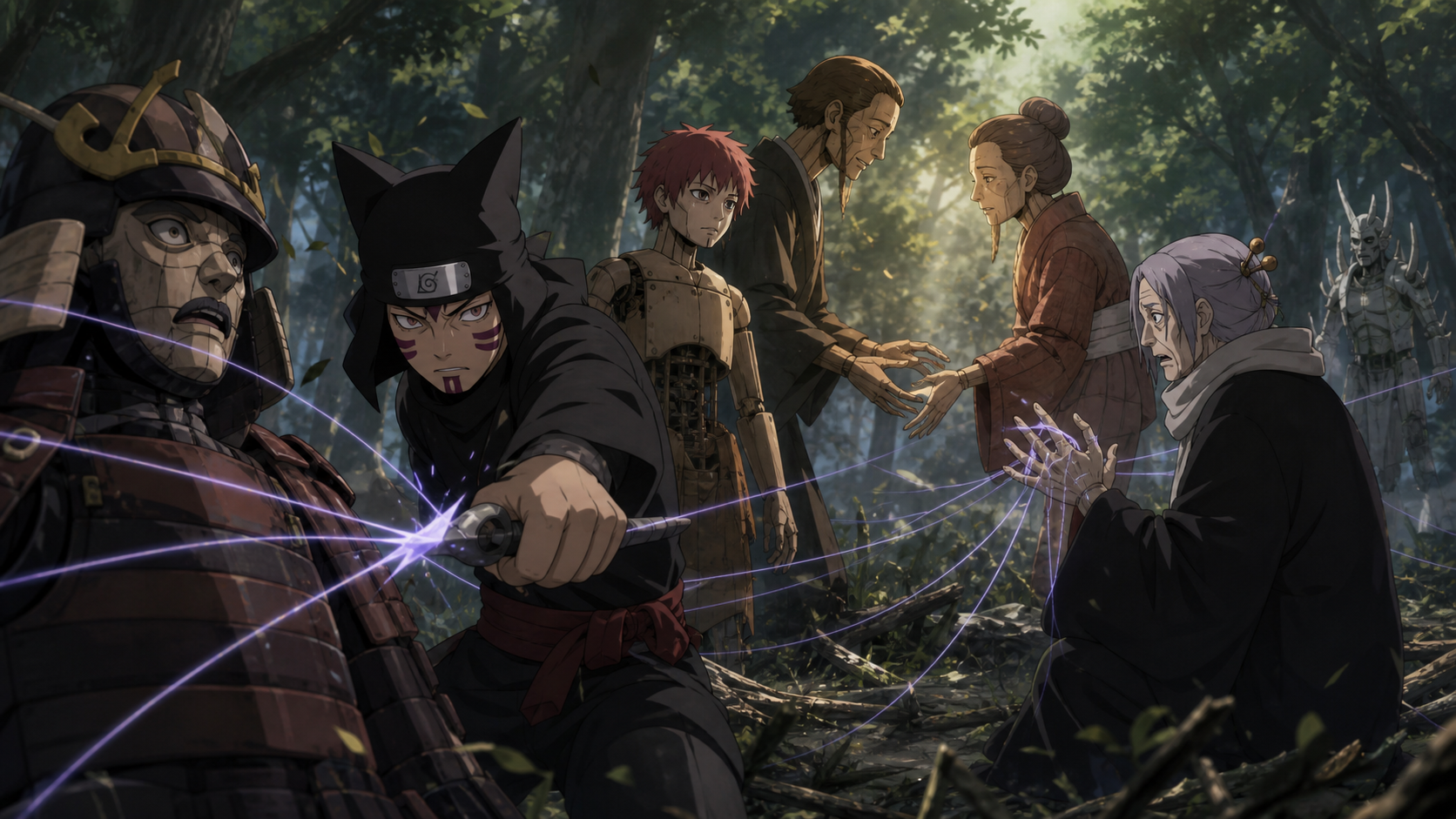
The Fifth Division encounters reanimated Kimimaro and Chiyo in the forest. One brings a body built for direct killing, while the other can turn nearby fighters into weapons through chakra threads.
The pairing forces Mifune to protect formation and identity at once. His soldiers cannot assume the person beside them still controls his own limbs.
Kimimaro breaks the front line
Kimimaro charges through Allied units with the same bone techniques and physical commitment that once carried him toward death for Orochimaru.
Mifune orders soldiers away from a fight they cannot safely win. Withdrawal is not cowardice when the opponent regenerates and treats injury as irrelevant.
Chiyo chooses a living samurai
Chiyo attaches chakra threads to a samurai and uses his body as a puppet. Kabuto’s technique forces her to repeat the same reduction of a person into an instrument.
The controlled samurai remains alive inside the attack. Every defensive strike risks punishing the victim instead of stopping the puppeteer.
Mifune nearly cuts his own man
Chiyo drives the samurai toward Mifune, making the division leader defend himself against an ally. The sword comes close to solving the immediate threat by killing the wrong person.
That trap captures Edo Tensei’s larger cruelty. Kabuto makes relationships and restraint into tactical weaknesses.
Kankurō cuts the chakra threads
Kankurō arrives before Mifune’s blade finishes the exchange. He severs Chiyo’s control and frees the samurai without killing him.
The rescue shows why a puppet specialist belongs in this fight. Kankurō reads the mechanism rather than treating the moving body as the enemy.
Chiyo recognizes the next generation
Seeing Kankurō surprises Chiyo. He was once a younger Sand puppeteer with less experience than Sasori, and now he carries technique, command responsibility, and Sasori’s preserved puppet body.
The encounter gives Chiyo proof that Sunagakure’s art continued after both she and Sasori died.
Sasori’s body returns as a chosen tool
Kankurō uses the puppet Sasori made from himself. That body differs from Kabuto’s reanimated corpses because Sasori deliberately converted himself and later entrusted the form to Kankurō.
Consent does not make every use simple, but the transfer carries a clearer line of agency than stealing a body from a grave.
The sight opens Chiyo’s guilt
Sasori’s puppet forces Chiyo to remember the child she raised after his parents died. Her grief includes love, failure, and decisions made while trying to keep him functioning.
She taught him puppetry and watched craft become his language for attachments he could not safely express.
Sasori lost his parents before he had words for loss
The deaths of Sasori’s parents left a child inside a military village that expected useful adaptation. Chiyo gave him tools and training, but tools could not replace honest mourning or living care.
Sasori built Mother and Father puppets because wood and mechanisms were the only materials he could control.
Chiyo answered grief with craft
Teaching puppetry gave Sasori competence and a shared activity. The choice was not cruel by itself.
The failure came when adults treated technical focus as evidence that the deeper wound had closed. A child can become brilliant while remaining profoundly abandoned.
Komushi became the human connection
Komushi carried messages between Chiyo and Sasori and grew into Sasori’s closest friend. He entered the workshop without demanding that Sasori perform ordinary warmth.
Their bond gave Sasori someone living to build for, argue with, and trust beyond the parent puppets.
Komushi loses an arm
Komushi returns injured after losing his right arm on duty. The loss threatens work, independence, and identity inside a shinobi village built around physical performance.
Sasori responds with the language he knows best. He designs a puppet prosthesis rather than offering sympathy he cannot easily say aloud.
The prosthetic arm shows Sasori’s care
The mechanical arm restores function and includes tools suitable for a shinobi. Sasori’s skill becomes direct practical support for his friend.
Care expressed through construction still counts as care. The danger appears when weapon features and poison enter a device attached to a living body.
Poison turns assistance into risk
Komushi’s puppet arm contains a hidden poisoned blade. A mechanism meant to expand his ability also creates a lethal hazard close to his own skin.
Sasori understands poison as part of shinobi design, but technical possibility should never replace testing, training, safeguards, and informed consent.
Komushi is poisoned by the device
An accident exposes Komushi to the poison. The intervention fails catastrophically, and Sasori cannot reverse the damage in time.
The death is not proof that Sasori intended to kill his friend. The episode supports guilt and faulty design more clearly than premeditated murder.
A young inventor needed supervision
Sasori possessed extraordinary ability, but genius did not grant medical authority or mature risk judgment. Adults around him should have reviewed a poisoned prosthesis before Komushi used the arm.
Sunagakure celebrated weapon skill while leaving a grieving child to decide where assistance ended and experimentation began.
The village also needed a real prosthetic-care process: medical review, poison-free testing, maintenance training, emergency treatment, and Komushi’s informed choice about every weapon built into the replacement arm. Friendship could motivate the design, but friendship could not supply those safeguards by itself.
Komushi’s mother asks for a puppet
After Komushi dies, his mother asks Sasori to preserve him as a puppet. Grief makes the request understandable without making the ethics settled.
A parent can authorize funeral decisions, but turning a shinobi’s body into an operational weapon reaches beyond ordinary remembrance.
Komushi cannot consent after death
The episode never gives Komushi a clear earlier wish to become a human puppet. His mother’s grief and Sasori’s guilt fill the silence.
That absence matters. Love for a dead person does not automatically grant ownership of the body or permission to reuse the person’s abilities.
Sasori creates his first human puppet
Komushi becomes the first known human puppet in Sasori’s history. The transformation preserves a physical form and potentially preserves chakra-based capability.
The result teaches Sasori that bodies can be converted into durable craft. A personal tragedy becomes the prototype for later collection and violence.
Grief becomes a production method
Sasori’s move from Komushi to other human puppets does not happen because puppetry itself is evil. The method gives him control over loss: a body cannot leave if the body becomes an object he owns.
Control reduces uncertainty while destroying the reciprocity that made the relationship human.
Chiyo sees her influence clearly
Chiyo recognizes that her teaching and emotional distance helped shape the path. She did not order Sasori to kill people for puppets, but adults still carry responsibility for what they normalize and ignore.
Guilt becomes useful only when connected to specific choices. General self-condemnation cannot repair Komushi, Sasori, or the other bodies.
Kankurō refuses to reduce Sasori to a monster
Kankurō understands the crimes and still treats Sasori as a master whose techniques changed Sand puppetry. Respecting skill does not require excusing murder.
The harder position holds both truths: Sasori harmed people, and Sasori created work that another artist can carry differently.
Mother and Father return to the battlefield
Kankurō summons the parent puppets Sasori built as a child. Their shapes reach Chiyo more directly than an argument could.
Those puppets began as substitutes for dead parents, later became weapons in Sasori’s final fight, and now stand as inherited craft rather than a private loop of grief.
Kankurō positions them with care
The arrangement reminds Chiyo of Sasori’s early longing and of the moment the parent puppets pierced his core. Kankurō knows the emotional history inside their mechanics.
Using them is not empty imitation. He demonstrates that he studied the person, not merely the technique.
Sasori entrusted the puppets forward
Kankurō tells Chiyo that Sasori left Mother and Father for future generations. The claim gives the legacy a direction beyond preservation.
Sasori spent much of his life freezing bodies against change. His final transfer allows another puppeteer to adapt, teach, and choose.
Chiyo admits the craft is in good hands
Chiyo recognizes Kankurō as a worthy successor. The acceptance carries relief because Sasori’s work did not end as evidence of failure alone.
Kankurō inherits no obligation to reproduce Sasori’s ethics. A living tradition can keep technical brilliance while refusing human puppetry.
Kabuto does not release her cleanly
Emotional recognition appears to stop Chiyo, and Kankurō briefly hopes the encounter has broken control. The pause cannot be trusted while Edo Tensei remains active.
Kabuto has already shown that personality can surface without ending the command. A controlled elder may confess, joke, and still attack.
Chiyo’s trick preserves danger
Chiyo’s apparent stillness becomes another tactical move rather than a full departure. The episode undercuts Kankurō’s emotional certainty with her continuing awareness.
That ending is tonally odd after the Komushi story, but the warning is fair. Closure in conversation does not equal battlefield containment.
Kimimaro remains a separate threat
The focus on Chiyo and Sasori does not remove Kimimaro from Mifune’s battlefield. Allied troops still have to avoid his bone attacks and find a sealing opportunity.
Personal history can dominate one section of the fight while the division’s operational risks continue around that history.
Puppets can carry memory without carrying souls
Kankurō’s Sasori puppet, Mother, and Father hold design choices, wear, movement patterns, and stories. Those traces can feel like presence.
Calling the trace a soul should remain metaphorical. The living person operating the puppet decides whether memory becomes care, study, exploitation, or violence.
The episode asks better questions than answers
Komushi’s prosthesis, death, and conversion raise issues of disability, medical risk, posthumous consent, and parental grief. A single flashback cannot resolve all four.
The value comes from refusing to make Sasori’s human puppets appear from nowhere. His worst method grew through relationships, institutional gaps, and a catastrophic attempt to help.
Chiyo’s control of a living samurai repeats the central danger
Kabuto controls Chiyo, and Chiyo immediately turns a living fighter into another body moved by chakra threads. The tactical trick creates hesitation inside Mifune’s division, but it also repeats the violation being done to her.
The living samurai needs medical assessment, consent-sensitive debriefing, and protection from blame. A controlled body can cause real harm without becoming the author of that harm. The Alliance must separate responsibility from physical involvement before fear turns victims into suspects.
Kankurō cuts the threads before chasing recognition
He sees Chiyo, Sasori’s body, and techniques tied to Sunagakure history, yet his first useful act frees the controlled samurai. Immediate harm takes priority over the emotional reunion.
That choice defines mature inheritance. Kankurō does not prove himself by displaying more elaborate puppets. He proves himself by recognizing where control operates and restoring another person’s movement before asking what the past means for him.
Sasori’s puppet body needs a clear custody record
Kankurō carries a body Sasori created from himself, filled with weapons and bound to deeply personal history. Calling it equipment alone misses both security risk and funerary meaning.
Sunagakure needs documented custody, authorized use, maintenance logs, poison inventories, and a plan for final disposition. Respect does not require pretending the puppet contains Sasori’s living consciousness. It requires treating human remains and inherited craft with more care than an ordinary tool receives.
Chiyo’s craft began as care and became avoidance
She made Mother and Father to comfort a grieving child who could not understand his parents’ deaths. The act carries tenderness, technical brilliance, and a refusal to sit inside the loss with him.
A substitute object can support grief without replacing truthful explanation, community care, or time. Chiyo’s tragedy is not that she built puppets. She allowed craft to become the only language available, then failed to notice when Sasori used the same language to keep death permanently close.
Komushi’s injury reveals the need for design supervision
Sasori’s prosthetic arm shows genuine attention to a friend’s needs, but the hidden poison mechanism turns assistance into lethal risk. Good intention cannot substitute for safety review.
A medical device carrying weapons requires independent testing, clear labeling, training, maintenance, and emergency treatment protocols. Sasori was a young inventor working inside a militarized craft culture. Adults should have supervised the design instead of waiting for a fatal failure to define his character.
Komushi cannot consent to becoming a human puppet
His mother’s grief and Sasori’s attachment explain why they want his presence preserved. Neither can provide consent on behalf of a dead person for transformation into a controlled body.
The act changes mourning into possession. Komushi’s identity becomes material for someone else’s comfort, just as Edo Tensei later turns Chiyo into material for Kabuto’s war. Emotional pain makes the decision understandable without making it ethically acceptable.
Komushi’s mother deserved support before desperation
Her request emerges from unbearable loss and a world where puppet craft appears capable of defeating absence. Condemning her alone ignores the community that left a grieving parent to negotiate resurrection with another grieving child.
Sunagakure needed death notification, burial support, counseling, neighbors, and truthful limits around puppet technology. Grief becomes easier to exploit when every institutional answer is silence and the only person offering action has no safe boundary.
Kankurō preserves Sasori without preserving every harm
He respects Sasori’s genius, carries forward techniques, and handles Mother and Father with care. He also refuses the belief that mastery requires turning more people into puppets.
That distinction is the inheritance Chiyo needs to see. A successor can honor an artist while rejecting the violations embedded in the artist’s practice. Tradition remains alive through examination and change, not through perfect repetition of whatever an elder left behind.
Mother and Father carry memory through use and context
The puppets do not need literal souls for their presence to matter. They carry Sasori’s first attempt to hold family, Chiyo’s imperfect care, and Kankurō’s decision to move the craft forward.
Meaning lives in materials, workmanship, stories, and the people who handle an object. Calling that memory is richer than claiming proof of consciousness. The episode is strongest when it lets symbolism remain emotionally true without forcing a supernatural answer.
Chiyo’s acknowledgment does not finish accountability
She recognizes Kankurō as a worthy successor and understands more clearly how her choices shaped Sasori. The admission creates emotional movement, but Kabuto’s control prevents a full reckoning.
Sunagakure still needs records about Sasori’s childhood, Komushi’s death, human-puppet creation, poison research, and the elders who missed escalating harm. Personal regret matters. Institutional memory determines whether the same conditions survive after everyone involved is gone.
Craft education must include ethics before mastery
Sasori learns early how to animate forms, build mechanisms, preserve bodies, and hide poison, but the adults around him do not appear to give equal weight to consent, grief, medical safety, or the treatment of remains. That imbalance is not unique to one gifted child. A militarized village rewards what a technique can accomplish long before asking what the practitioner is becoming. Puppet education should require supervised work, documented materials, poison controls, human-remains law, device testing, and direct discussion of who may authorize each use. Young inventors also need mentors outside the chain that benefits from stronger weapons. Chiyo could teach extraordinary craft while a medic reviews prosthetics and a civilian advocate protects recipients. Komushi’s death should have triggered a transparent safety investigation, not a private spiral toward human puppetry. Kankurō’s generation has the chance to build those boundaries into training. Skill becomes more trustworthy when accountability grows beside it. The goal is not to make puppet masters timid. The goal is to ensure technical confidence never outruns the rights of the people whose bodies, injuries, and grief make the invention possible. That is how inherited brilliance becomes a public good instead of another private danger.
RaeRae’s verdict
“The Soul Living Inside the Puppet” gives Chiyo and Kankurō a strong generational confrontation while making Komushi more than a footnote in Sasori’s descent. Kankurō saves a living samurai by understanding puppet control, then challenges Chiyo with an inheritance he intends to use differently.
The episode’s weakest choice is the abrupt comic-tactical turn after Chiyo’s acceptance. The emotional work still lands. Sasori’s craft carries love and harm together, and Kankurō’s responsibility is not to preserve both.
RaeRae’s call
Kankurō honors Sasori best by carrying forward the craft without carrying forward possession, unsafe design, or human-puppet violence. Free the living body first, document custody of Sasori’s remains, tell the truth about Komushi, and let Mother and Father hold memory without pretending grief grants ownership of another person.
Episode details and viewing routes
- Official episode reference: Naruto Official episode guide
- Licensed episode route: Crunchyroll licensed episode page
What I am carrying forward
Kankurō has freed Mifune’s controlled samurai, shown Chiyo Sasori’s inherited body and parent puppets, and received her recognition as the next keeper of the craft. Chiyo and Kimimaro remain active reanimated threats rather than confirmed sealed bodies.
Episode 320 moves to Omoi leaving his assigned post to rescue the Thundercloud Unit. I am carrying forward the ongoing war conditions, not pretending Episode 319 completely resolves every fight in Mifune’s division.