
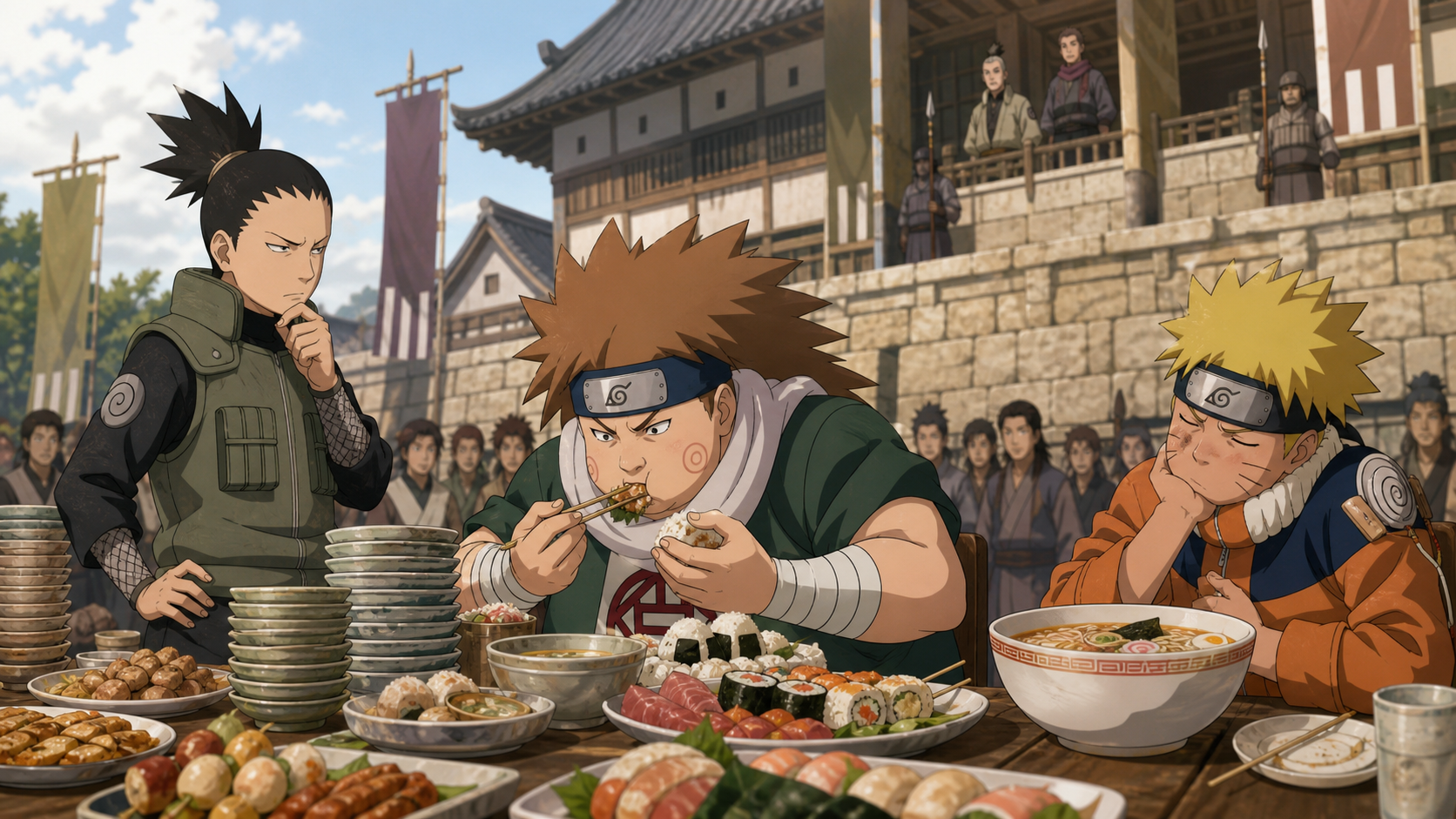
The A-Rank Mission: Food Fight!
A castle eating contest hides a careful extraction plan for a young lord trapped inside a political treaty.
Bottom line
“The A-Rank Mission: Food Fight!” drops Naruto into Karui's fight against a reanimated samurai, then uses his recognition of Tatewaki to open a mission from years earlier. Tsunade sent Naruto and Team Asuma to retrieve Shū, a young lord held in the Land of This under a political treaty. Shikamaru built their infiltration around a castle eating contest: Chōji would take second place, Ino would borrow Shū's body, and Naruto would replace him through Transformation. The food comedy is broad, but the real story concerns a child treated as diplomatic collateral and shinobi asked to call extraction a kidnapping. Episode 309 is the setup half of the Tatewaki story, so the castle's fall and the samurai's final wartime choice belong to Episode 310.
Naruto recognizes the enemy in front of Karui
Karui's Allied unit struggles against a reanimated samurai until Naruto arrives. He recognizes the man as Tatewaki, which changes the encounter from an anonymous war obstacle into unfinished history.
Recognition does not make the controlled samurai less dangerous. Naruto still needs to protect the unit while remembering why Tatewaki once stood against him.
Edo Tensei turns another guardian against his values
Tatewaki served as a protector. Kabuto's technique now uses that discipline to threaten the same kind of people a samurai's duty should defend.
The pattern follows Hayate's story but changes the relationship. Naruto knew Tatewaki through one mission, not intimacy, and must recover the truth of that encounter before deciding how to answer him.
The flashback returns Naruto to a younger self
Naruto remembers a time when missions still arrived through Tsunade's office and Team Asuma operated together. The lighter visual rhythm cannot hide the political stakes beneath the assignment.
His younger self hears a rescue objective and moves toward action. Shikamaru immediately looks for the structure controlling access to the target.
Tsunade labels the assignment A-rank
The mission requires entering another territory, removing a daimyō's son, and escaping a guarded castle. An A-rank classification acknowledges the diplomatic and tactical risk even before combat begins.
Rank does not answer the ethical question. The team needs to know who authorized Shū's transfer, whether the boy consents, and what danger follows if the operation succeeds.
Shū is held under a treaty
Shū lives in the Land of This as a political hostage tied to an agreement between rulers. Adults call that arrangement diplomacy because the language makes coercion sound orderly.
A child cannot meaningfully consent to becoming collateral for peace. Treaties that depend on controlling a young person's movement place stability above his safety and autonomy.
The word kidnapping hides a rescue
Konoha's orders describe taking Shū from the castle, an act that looks like kidnapping from the host territory's perspective. From Shū's position, removal may mean release from captivity.
The episode benefits from that ambiguity. A legal label cannot settle whether an operation protects a child or moves him between adults claiming authority.
Shikamaru builds the plan around access
Direct assault would alert the castle, endanger Shū, and create a political incident. Shikamaru instead studies the public event that allows outsiders through the gate.
The eating contest becomes an access credential. Contestants, attendants, food deliveries, and spectators create movement that guards already expect.
Chōji is more than a joke in the plan
Chōji's appetite gives the team a credible reason to enter the competition. His skill is treated comically, but Shikamaru depends on Chōji's control as much as his capacity.
Winning outright would break the timing. Chōji must dominate early rounds, remain believable, then finish exactly where the extraction plan needs him.
Naruto turns competition into chaos
Naruto attacks the food challenge with confidence and discovers that enthusiasm cannot replace pacing. Each plate makes the next round harder, even when ramen appears.
The comedy fits his younger impatience. Naruto sees a contest and wants to win before understanding that the mission requires a specific loser as carefully as a winner.
Food excess sits beside a captive child
The castle displays abundance through enormous servings while Shū speaks as someone whose future has already been decided. That contrast deserves more attention than the episode gives.
Public spectacle lets the ruling household perform generosity. A table full of food does not prove that people inside the castle possess freedom.
Tatewaki trains Shū harshly
Tatewaki supervises Shū's sword practice with demanding discipline. His severity can look cruel until the surrounding political danger becomes clear.
Training may be the only protection Tatewaki can provide inside a system he does not control. A hostage who can move, defend himself, and read danger has more options than one kept ornamental.
Shū believes his fate cannot change
Shū sees no purpose in training because good behavior will not end his captivity. His resignation is a rational response to adults presenting powerlessness as duty.
The series often celebrates effort as the answer to fate. Shū exposes the limit of that message when political authority controls the walls around him.
Chiyo offers gentleness inside the castle
Princess Chiyo challenges Tatewaki when training becomes too harsh and checks on Shū afterward. Her care gives him companionship without granting either child power over the treaty.
Their bond makes extraction more complicated. Rescuing Shū may separate him from the person who understands his daily life.
Tatewaki's duty has competing meanings
Tatewaki is responsible to the castle, the young people under his eye, and a samurai code shaped by service. Those obligations do not point in one direction.
Obeying the ruler may keep order while preserving an unjust captivity. Protecting Shū may eventually require refusing the institution that employs him.
Ino creates the opening
Before the final contest round, Ino uses Mind Body Switch on Shū and moves his body toward a private castle washroom. Her precision makes the substitution possible without an open fight.
The technique also raises a consent problem. Shū does not agree before losing control of his body. A rescue plan should minimize harm without pretending forced possession becomes harmless because the goal is protective.
Naruto becomes the visible decoy
Naruto uses Transformation to take Shū's appearance while the real boy meets Shikamaru. The swap keeps guards focused on a familiar face and buys the extraction team time.
Naruto accepts the dangerous position inside the castle. If the disguise fails, defenders will treat him as an intruder near a political hostage.
The washroom is a clever but fragile boundary
A washroom offers temporary privacy in a building organized around surveillance. The plan exploits the one place where a young lord may reasonably request a closed door.
Every extra minute increases suspicion. Tatewaki's attention to Shū's habits makes him the person most likely to notice that something has changed.
Shikamaru explains the mission to Shū
Once Shū regains control, Shikamaru tells him why the team came. That conversation is late, but at least the target finally receives information rather than being moved as silent cargo.
Shū's consent should determine the next step. A treaty does not erase his right to understand where Konoha intends to take him and what risks accompany escape.
The final food round requires second place
The contest structure makes the runner-up useful to the mission, so Chōji must stop short of the victory everyone expects. Shikamaru's plan depends on controlling a result that looks accidental.
That is harder than simply eating fastest. Chōji has to preserve the cover story while Naruto and Ino complete a separate operation inside the castle.
Isono becomes the necessary winner
Isono can take first place if Chōji slows at the right moment. The unsuspecting competitor gives the public event a legitimate outcome and keeps attention away from Shū.
Using civilians as unknowing pieces is common shinobi practice. The team should still consider what happens if guards later accuse the contestants of helping the escape.
Shikamaru stops Chōji with shadow
Chōji's competitive appetite carries him toward the final serving, so Shikamaru uses Shadow Possession to freeze him. The gag works because their friendship can survive a plan built around forced restraint.
The same action also shows how little margin remains. Shikamaru cannot rely on a signal or conversation once the contest reaches its decisive seconds.
Comedy masks a tightly synchronized operation
The episode cuts between eating, body possession, transformation, surveillance, and extraction. Every ridiculous plate corresponds to a serious timing problem elsewhere.
That structure is stronger than a simple filler detour. Team Asuma's specialties fit together in a plan that avoids unnecessary violence while keeping a vulnerable target moving.
Naruto is the least subtle part of the disguise
Transformation can copy Shū's face, but Naruto must also imitate posture, speech, restraint, and familiarity with the castle. Physical resemblance is only the first layer of an identity swap.
His impulsiveness creates the tension Episode 310 will inherit. Tatewaki protects Shū closely enough to read behavior that ordinary guards might miss.
Karui's battlefield frame changes the memory
The flashback is not a disconnected comedy. Naruto remembers the mission while Tatewaki stands reanimated in front of Allied shinobi.
Every scene of the samurai guarding Shū becomes evidence about the man Kabuto is controlling. Naruto knows Tatewaki's opposition once came from duty, not cruelty.
The episode gives Team Asuma a useful showcase
Shikamaru designs the timing, Chōji supplies access, Ino performs the body swap, and Naruto carries the decoy role. Nobody could execute the plan alone.
The teamwork feels grounded because their abilities solve different problems rather than becoming four versions of combat power.
The title undersells the political story
“Food Fight” promises a broad comedy episode, and the eating contest delivers that surface. The deeper conflict concerns hostage diplomacy, child autonomy, and the ethics of covert extraction.
The mismatch can be charming, but viewers who skip the episode as a joke miss the setup for Tatewaki's wartime return.
Shū deserves a plan after the escape
The operation concentrates on getting Shū through the castle boundary, but rescue does not end at the gate. He needs a safe destination, trusted care, education, contact with people he chooses, and an explanation of the treaty that shaped his childhood.
Konoha also needs a response if the Land of This demands his return. Without diplomatic protection, the shinobi may complete a perfect extraction only to leave Shū carrying the political consequences alone.
The anime-original placement is disruptive
Another past mission interrupts the Fourth Shinobi World War just after the Hayate detour. Momentum slows while the main battlefield waits outside the memory.
Placement is the largest weakness. The character material has value, but two consecutive two-part flashback stories make the war feel assembled from side files.
The food contest is camouflage for a treaty failure
The castle turns abundance into entertainment while a child remains confined because adults negotiated his body into political security. Calling the operation a food fight keeps the public surface cheerful.
The mission underneath is extraction from coercive custody. Konoha should record why the treaty permitted Shū’s confinement and which officials decided rescue required secrecy instead of open challenge.
Shū is a child before he is a diplomatic problem
He has been taught that duty means accepting captivity and that personal desire threatens a larger peace. That lesson makes compliance look voluntary when every meaningful alternative has been removed.
The rescue team owes him honest choices about destination, guardianship, education, and contact with Chiyo and Tatewaki. Removing him from one castle without a life plan would only relocate uncertainty.
Tatewaki mistakes harshness for preparation
He trains Shū as if enough discipline can make captivity safe. The approach may come from fear and a belief that competence is the only protection he can provide.
Intent does not erase what the child experiences. Training should build capacity without teaching Shū that pain proves devotion or that failure makes him responsible for the treaty surrounding him.
Chiyo provides care the political arrangement forgot
Her gentleness gives Shū a relationship not organized around rank, performance, or future usefulness. That ordinary care becomes radical inside a household treating him as leverage.
The escape plan should consider whether continued contact is safe and wanted. Bonds formed during confinement do not become irrelevant once the locked door opens.
Shikamaru designs around access instead of force
A direct assault could injure Shū, trigger diplomatic retaliation, and expose the team before they understand the castle. The contest creates movement, distraction, and a reason for outsiders to enter.
His strategy succeeds because he studies the institution’s routines. The ridiculous surface is not separate from the intelligence work. The ridiculous surface is how the team reaches the child without turning him into a battlefield.
Chōji’s appetite becomes a specialist skill
The episode jokes about his eating, but the plan depends on endurance, control, and the ability to remain convincing through round after round. Chōji is not merely the body assigned to consume food.
He understands pacing, competitors, and the moment when winning would ruin the extraction. His contribution deserves credit without recycling the idea that his size is automatically the punchline.
The food excess should remain uncomfortable
Tables overflow while a confined child, castle workers, and surrounding communities exist inside a political system the episode barely describes. Spectacle turns food into waste and status.
A RaeRae React can enjoy the comedy and still ask who prepared the dishes, what happens to leftovers, and why abundance is easier to display than safety for Shū.
Ino creates the opening people forget
Her timing and infiltration support let the visible contestants pull attention where Shikamaru needs it. The operation would fail if every person chased the loudest role.
Intelligence work often disappears because success looks like nothing happened. The after-action report should name the communications, observation, and precise intervention that made the washroom transfer possible.
Naruto is useful because subtlety is not the only tool
He attracts attention, raises the emotional temperature, and turns a formal contest into chaos large enough to hide coordinated movement. The behavior fits the disguise because everybody expects him to be obvious.
Decoy work is still disciplined when the disruption has timing and boundaries. Naruto’s job is not to improvise until friends repair the damage. His noise has to serve Shikamaru’s route.
The washroom plan protects privacy and risks isolation
A private room gives Shikamaru space to explain the rescue away from guards. The same isolation could frighten Shū or make the approach resemble another abduction.
Shikamaru should identify himself, state what he knows, explain the immediate options, and leave Shū a way to refuse contact. Speed matters, but clarity keeps rescue from copying the methods of captors.
Isono’s victory is an operational requirement
The final round must produce a winner who is not Chōji, which turns an overlooked competitor into the person carrying the public result. Shikamaru uses shadow to stop his teammate at the exact point success would become failure.
The moment is funny and precise. Strategy means controlling the definition of winning, not collecting first place in every visible contest.
The current battle changes how Naruto remembers the mission
Seeing Tatewaki reanimated forces Naruto to revisit somebody whose duty and violence were more complicated than a simple enemy label. Karui witnesses that recognition while facing the immediate danger.
The memory can supply tactics and context, but Naruto still has to tell her what matters now. Private nostalgia cannot replace a battlefield briefing for the person standing beside him.
Tatewaki remains a victim and an immediate threat
Kabuto has taken a guardian who once fought Naruto and converted his unresolved duty into another attack. The Alliance must stop the body without pretending reanimated violence represents Tatewaki’s final choice.
Naruto’s knowledge may help reach the consciousness inside, yet sealing remains necessary. Recognition creates options. Recognition does not make the blade harmless.
The mission needs an aftermath the flashback skips
Shū’s extraction could alter treaties, household safety, succession, and the lives of everyone who helped him leave. Those consequences should not vanish because the young ninja completed the assignment.
A responsible file needs guardianship, diplomatic response, medical assessment, and Shū’s own account. Rescue becomes complete when the child has a safe future, not when the team reaches the gate.
RaeRae’s verdict
“The A-Rank Mission: Food Fight!” is a clever Team Asuma caper wrapped around an uncomfortable political premise. Chōji's contest, Ino's possession, Naruto's disguise, and Shikamaru's timing form a readable plan with real personality.
Shū is the reason the episode matters. His captivity should never become background decoration for the food jokes, and Tatewaki's duty deserves the complication the final scene promises.
RaeRae’s call
The food contest works because every ridiculous beat hides a precise rescue job. Chōji controls the competition, Ino creates access, Naruto makes noise, and Shikamaru knows that first place would lose the mission. The real question is whether Shū receives a life after adults stop calling his captivity peace.
The adults should also ask what peace meant to the workers and children inside the castle. A treaty that depends on one child’s confinement may protect borders while making private violence invisible. Shū’s testimony belongs in any review of that agreement. Chiyo and Tatewaki’s roles belong there too. Diplomacy cannot claim success by counting years without open war while refusing to count the person kept under guard.
Episode details and viewing routes
- Official episode reference: Naruto Official episode guide
- Licensed episode route: Crunchyroll licensed episode page
What I am carrying forward
I am carrying forward Naruto disguised as Shū inside the castle, the real Shū learning why Konoha came, Chōji deliberately taking second place, and Tatewaki positioned to notice the substitution.
I am also carrying forward the unresolved choice beneath the mission: removing a child from one treaty does not prove where he will be free. Episode 310 must show what protection means when rulers, shinobi, and a samurai all claim to know what Shū needs.