
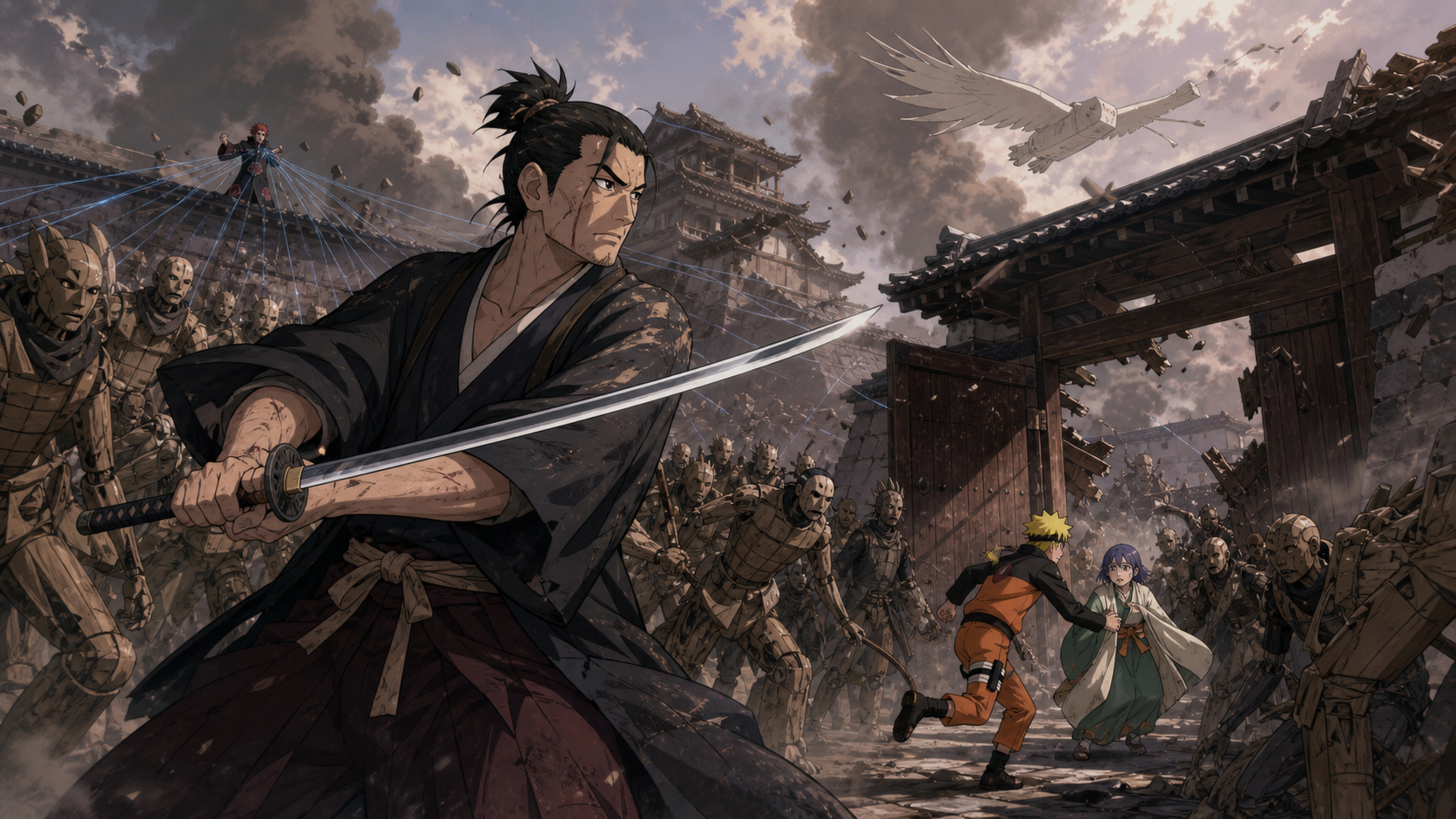
The Fallen Castle
The castle falls to Akatsuki while Tatewaki protects the children and Naruto carries the truth into their wartime reunion.
Bottom line
“The Fallen Castle” finishes Naruto's memory of Tatewaki by showing how quickly a covert rescue becomes a catastrophe. Team Asuma gets Shū to an inn while Naruto remains inside the Land of This castle as his double. Tatewaki and Princess Chiyo expose the disguise, but the argument stops when Deidara and Sasori attack. Naruto escorts Chiyo away while Tatewaki makes a final stand against Sasori's puppets and dies from poison. In the present, Naruto tells the reanimated samurai that Shū and Chiyo survived under protection. Tatewaki accepts the news and releases his hold on the battlefield. The episode gives his duty emotional dignity, although loyalty to a dead ruler receives more praise than the children's right to live free of political ownership.
Shū reaches the inn alive
Team Asuma completes the first extraction stage and hides Shū in a room away from the castle. The quiet location gives the boy a temporary boundary from guards, schedules, and treaty obligations.
Safety remains provisional. A room is not a long-term plan, and the team still needs transport, diplomatic cover, and protection against anyone sent to reclaim him.
Ordinary freedom feels unfamiliar
Shū experiences small choices he could not make as a hostage. Rest, food, movement, and conversation become remarkable because castle life controlled each part of his day.
The episode understands freedom through ordinary moments rather than a speech. A child should not need an international extraction mission to discover what an unscheduled afternoon feels like.
Naruto remains inside as the decoy
Naruto keeps Shū's appearance and absorbs the danger that would otherwise follow the real boy. His role buys the extraction team time while directing castle attention toward the wrong person.
Transformation copies a body, not a life. Naruto has no access to Shū's routines, education, relationships, or private signals with his protectors.
Daily duties strain the disguise
The young lord's schedule demands restraint and knowledge Naruto cannot improvise forever. Each interaction creates another chance for somebody to notice the difference.
The plan relied on speed because behavioral impersonation grows weaker over time. Shikamaru solved entry and substitution; the castle itself keeps testing the replacement.
Tatewaki knows Shū through movement
Tatewaki notices that the supposed Shū moves with skills and instincts the boy never displayed. A guardian who supervised daily training can read posture more accurately than a guard checking a face.
That recognition proves the relationship carried attention beneath harsh discipline. Tatewaki knew the child well enough to spot a stranger inside a perfect visual copy.
Chiyo also sees the person behind the face
Princess Chiyo recognizes that Naruto's behavior does not belong to Shū. Her closeness provides evidence no transformation can counterfeit.
The children built a bond inside an arrangement neither controlled. Removing Shū without acknowledging Chiyo risks treating that bond as another disposable detail.
Naruto's cover finally breaks
Tatewaki and the castle guards surround Naruto after the disguise fails. Escape by speed or force would confirm every fear about a foreign shinobi infiltrating their home.
Naruto has to explain why Konoha removed Shū and why he stayed behind. The truth arrives only after deception can no longer hold.
The rescue plan needed earlier consent
Naruto's explanation may justify the team's goal, but neither Tatewaki nor Chiyo received a choice before the substitution. Shū himself learned the plan only after Ino occupied his body.
Urgency can narrow consultation. Secrecy should still be recognized as a cost, especially when the mission claims to restore a child's autonomy.
Deidara and Sasori erase the argument
The Akatsuki assault begins before anyone can resolve the extraction dispute. Deidara attacks from above with explosive clay while Sasori sends puppets through the castle defenses.
External violence does not prove Konoha's methods were correct. The attack creates a more immediate duty and forces former opponents to cooperate.
The castle falls under asymmetric force
Guards trained for ordinary intruders face airborne explosives and a puppet army designed to overwhelm formations. Walls and numbers offer little protection against Akatsuki methods.
The spectacle finally shows why Sasori's claim about conquering a nation carried weight. His hundred puppets are not decoration; they turn a protected seat of power into a killing ground.
Civilians disappear behind the battle scale
An assault on a castle town affects servants, workers, contestants, families, and visitors who never chose the political conflict. The episode focuses on named fighters while destruction expands around them.
Naruto's first responsibility should be evacuation. Defeating an attacker means little if people remain trapped beneath the display of power.
Naruto and Tatewaki fight on the same side
The failed impostor and the suspicious guardian become allies once the castle is attacked. Their cooperation reveals that both were trying to protect Shū through different obligations.
Common danger creates clarity without erasing the earlier conflict. Tatewaki can oppose Konoha's deception and still trust Naruto with Chiyo's life.
Tatewaki entrusts Chiyo to Naruto
Tatewaki asks Naruto to escort Princess Chiyo away. That decision gives Naruto a responsibility more important than defending his cover or proving his strength.
Trust here is specific. Tatewaki does not surrender every judgment about Shū; he sees Naruto protecting children during a collapse and chooses the best available path for Chiyo.
Chiyo should have a voice in the escape
Adults repeatedly move Shū and Chiyo according to political or military necessity. Protecting them is essential, but protection without explanation can reproduce the same powerlessness.
Chiyo deserves to know where Shū went, why Naruto wore his face, and what Tatewaki expects. Fear does not cancel her right to information.
Yamato protects the mission from the margins
Yamato monitors the extraction and helps ensure the children reach safety without becoming the visible center of the operation. His restraint keeps the mission from escalating before the Akatsuki attack.
The later reveal of his support also shows that Team Asuma was not abandoned with a diplomatic crisis. Konoha planned a deeper security layer than Shū could see.
Shū refuses to remain passive
The real Shū does not simply enjoy freedom while the castle burns. His concern for Chiyo and Tatewaki pulls him back toward the people left behind.
That choice complicates the rescue narrative. Autonomy includes the right to care about relationships rescuers consider strategically inconvenient.
Deidara treats destruction as performance
Deidara's explosives turn the attack into spectacle. The castle becomes another surface on which he can prove an artistic doctrine through fear.
People living below his creations carry the consequences. Calling violence art never transfers consent to the audience forced inside the blast radius.
Sasori brings an army without soldiers
Sasori's puppets let one operator surround defenders, attack from multiple angles, and replace human risk with manufactured bodies. The tactical advantage is enormous.
The puppets also reflect his rejection of vulnerable flesh. Tatewaki stands against them with a mortal body, a limited weapon, and a duty that cannot be repaired after poison enters his blood.
Tatewaki confronts Sasori alone
Tatewaki remains behind as Naruto moves Chiyo toward safety. His final stand buys time, but the story should not confuse isolation with the only honorable form of service.
Retreating with the children could also fulfill his duty. The collapsing castle and overwhelming puppet force leave him with few routes, not a pure choice between courage and shame.
Loyalty to the daimyō survives his death
Tatewaki tells Sasori that his allegiance continues even after the ruler dies. The declaration gives him resolve while revealing how thoroughly service defines his identity.
Loyalty becomes dangerous when attached to office rather than people. The daimyō helped maintain a system that held Shū as collateral; preserving that authority is not automatically justice.
Protecting the children is his stronger legacy
Tatewaki's most meaningful actions are not obedience to a dead ruler. He trained Shū, watched closely enough to recognize Naruto, defended the castle population, and entrusted Chiyo to someone who could save her.
Those choices center living people. They deserve to define his honor more than allegiance to the institution that failed them.
Sasori's poison ends the stand
Sasori strikes Tatewaki with poisoned senbon from his puppet weapon. The wound turns courage into a countdown no determination can reverse.
Poison is an especially cruel answer to samurai discipline. Tatewaki can block blades and read opponents, yet a small hidden puncture defeats the body after the exchange appears finished.
The story gives Sasori another erased victim
Tatewaki dies before the main series introduces Sasori to Naruto's generation. His name becomes one more life inside the reputation of a villain said to have conquered a nation.
Episode 310 restores a face to that scale. A castle did not simply fall; a guardian died while children carried the memory forward.
The children survive the collapse
Shū and Chiyo escape under protection, aided by the Leaf operation and Tatewaki's decision. Survival does not resolve the political conditions that endangered them.
They need stable guardianship that respects their bond and keeps them from becoming hostages under a new name. Security should not mean permanent confinement beside a different ruler.
The present returns responsibility to Naruto
On the war's battlefield, Naruto faces the reanimated Tatewaki and understands what information might reach the man beneath Kabuto's control. He does not reduce him to a target.
Naruto tells Tatewaki that Shū and Chiyo are alive and protected alongside the feudal lords. That answer reaches the duty that kept the samurai resisting.
Tatewaki chooses release after hearing the truth
Relief loosens Tatewaki's attachment to the reanimated body. He no longer needs combat to search for an answer about the children he failed to see again.
His departure differs from a forced seal. Knowledge restores enough agency for him to stop serving Kabuto and return to death on his own terms.
Naruto wins without a finishing attack
Karui's unit expected help defeating a powerful samurai. Naruto resolves the encounter through memory, truthful information, and recognition of Tatewaki's actual concern.
The outcome fits Naruto's best victories. Understanding does not excuse danger; understanding identifies the bond that can interrupt an enemy's control.
The memory manipulation remains troubling
Anime-original stories sometimes explain missing continuity by limiting or erasing what characters remember. That device protects the main timeline while weakening emotional accountability.
If Naruto once helped rescue Shū and witnessed Tatewaki's stand, the experience should matter without requiring a convenient gap until the war summons the memory.
The pacing carries too many endings
The episode resolves the food-contest swap, the hostage extraction, Naruto's exposure, an Akatsuki invasion, Tatewaki's death, the children's survival, and the present reanimation.
Individual scenes land, but the final stand needs more room than the crowded structure allows. Tatewaki becomes important at the exact moment the story must hurry toward closure.
Shū reaches safety before safety feels real
The inn offers food, ordinary chores, and distance from the castle, yet a child trained as diplomatic leverage cannot immediately trust freedom. He may expect guards, punishment, or another adult announcing where he belongs.
Rescue workers should explain the plan repeatedly, offer choices small enough to use, and avoid reading caution as ingratitude. A locked life does not vanish when the first door opens.
Naruto’s disguise requires labor other people absorb
Remaining inside as the decoy keeps attention away from Shū, but daily duties expose gaps in Naruto’s knowledge and force Chiyo and Tatewaki to react around him.
Undercover work needs cultural briefing, routines, names, and a clean extraction signal. Charm can cover one mistake. Depending on charm for the whole mission shifts risk onto the people whose home he entered.
Tatewaki recognizes the child through movement
Shū’s appearance can be imitated, but habits formed through years of training are harder to fake. Tatewaki sees difference because he paid attention, even when that attention came through harsh instruction.
The recognition proves intimacy without proving the training was healthy. Knowing a child deeply does not give an adult ownership over the child’s future.
Chiyo deserves more than being entrusted between men
Tatewaki asks Naruto to protect her as the castle collapses. The request carries love and urgency, but Chiyo remains a person who can hear, judge danger, and state what she wants.
Naruto should explain the route and ask whether she knows civilians, exits, or responsibilities he cannot see. Protection becomes stronger when the protected person can shape the plan.
The Akatsuki attack destroys every diplomatic fiction
Deidara and Sasori arrive with force so disproportionate that the earlier argument about treaty custody becomes physically irrelevant. The castle cannot negotiate with explosives and puppet troops.
That does not make the treaty harmless. The attack proves how quickly systems built around one guarded child abandon that child when a larger power chooses destruction.
Civilians need names inside the collapse
The scale of Deidara’s explosions turns workers, guards, families, and nearby residents into background movement. A castle is a workplace and home before it becomes a dramatic ruin.
Evacuation records should track exits, missing people, injuries, shelters, and who never reached the gate. Spectacle cannot be the only archive of what happened there.
Yamato’s protection should remain visible
He supports the operation from the margins, manages escape conditions, and contains risks created by Naruto’s improvisation. Quiet command makes the visible heroism possible.
The report should name that work. A leader who prevents disaster can disappear from the story because the prevented event leaves no dramatic image.
Shū refuses the role of passive package
He wants information and participation because adults have moved him through treaties, disguises, and rescue plans without giving him control. That insistence is not childish interference.
He can help with knowledge of the castle and Chiyo while adults retain responsibility for combat decisions. Agency does not require placing him back in danger to prove bravery.
Tatewaki chooses people over the institution too late
He fights beside Naruto and entrusts Chiyo’s escape after the daimyō and castle system collapse around him. The choice reveals that his deepest loyalty belongs to the children.
That recognition matters and hurts because he enforced the institution before the attack. A final stand can clarify values without erasing earlier harm.
Sasori turns distance into disposable death
Puppet forces let him flood the castle with bodies while remaining insulated from the people those bodies kill. Tatewaki faces an army without soldiers who can surrender, hesitate, or recognize him.
The tactic converts craft into industrial violence. Documenting each puppet and poison route matters because survivors deserve more than the explanation that Akatsuki arrived.
Sasori’s poison makes heroism a delayed casualty
Tatewaki can keep fighting after contact, which allows the episode to stage a noble final defense while death has already entered his body. The delay separates visible courage from medical reality.
Field teams need antidote access and exposure checks after every puppet encounter. A fighter walking away from the strike is not proof that the fighter escaped.
The children survive because several adults choose differently
Naruto escorts, Yamato supports, Tatewaki holds the line, and people at the inn keep Shū outside the castle’s control. No single choice saves everyone.
The chain matters because Tatewaki’s sacrifice should not swallow the living labor around him. Survival comes through coordinated departures from the roles the political system assigned.
Memory manipulation stains the mercy
Naruto later gives Tatewaki enough truth to understand that the children lived, allowing him to release his anger under reanimation. The outcome is compassionate.
Any altered or curated memory still raises consent questions. Relief created through deception should be documented honestly, even when no kinder route appears available during combat.
Tatewaki’s release is not Naruto’s forgiveness to grant
Naruto can tell him Shū and Chiyo survived and refuse a finishing attack once resistance replaces hostility. The sealing process ends Kabuto’s control.
Shū and Chiyo retain their own judgments about Tatewaki’s care, harshness, and final choice. Naruto witnesses the story. He does not own everybody’s closure.
RaeRae’s verdict
“The Fallen Castle” is an ambitious conclusion that turns a comic infiltration into a painful account of duty under collapsing authority. Sasori's puppet army gives the castle attack real scale, while Naruto's news about Shū and Chiyo gives Tatewaki the release Kabuto tried to deny him.
The episode works best when honor means protecting living children, not obeying a dead office. Tatewaki's final stand matters because people escape, not because sacrifice is the only language a samurai understands.
RaeRae’s call
The castle falls, but the children survive because several people stop serving the roles a treaty assigned. Tatewaki’s final stand matters. So do Chiyo’s choices, Shū’s future, Yamato’s quiet support, and the civilians a giant explosion tries to turn into scenery. Naruto carries truth into the present without owning the ending.
The aftermath should follow the children beyond the gate. Shū needs a guardian he chooses, an explanation of the treaty, education that does not train obedience as safety, and a way to contact Chiyo. Chiyo needs grief care and the right to describe Tatewaki without reducing him to either hero or jailer. Castle survivors need housing, wages, medical treatment, and a public casualty record. If diplomacy resumes, their testimony belongs in the room. Rebuilding the same agreement around a different building would preserve the violence that made the rescue necessary. Freedom for both children has to become daily structure, not one dramatic escape.
Episode details and viewing routes
- Official episode reference: Naruto Official episode guide
- Licensed episode route: Crunchyroll licensed episode page
What I am carrying forward
I am carrying forward Shū and Chiyo surviving together, Naruto learning how Tatewaki died, Sasori's hundred puppets gaining a specific history, and a reanimated enemy leaving the battlefield after receiving the truth he needed.
I am also carrying forward the responsibility hidden beneath rescue stories. Getting children out of a castle is one victory. Building a life where no treaty can turn them into collateral is the work that follows.