
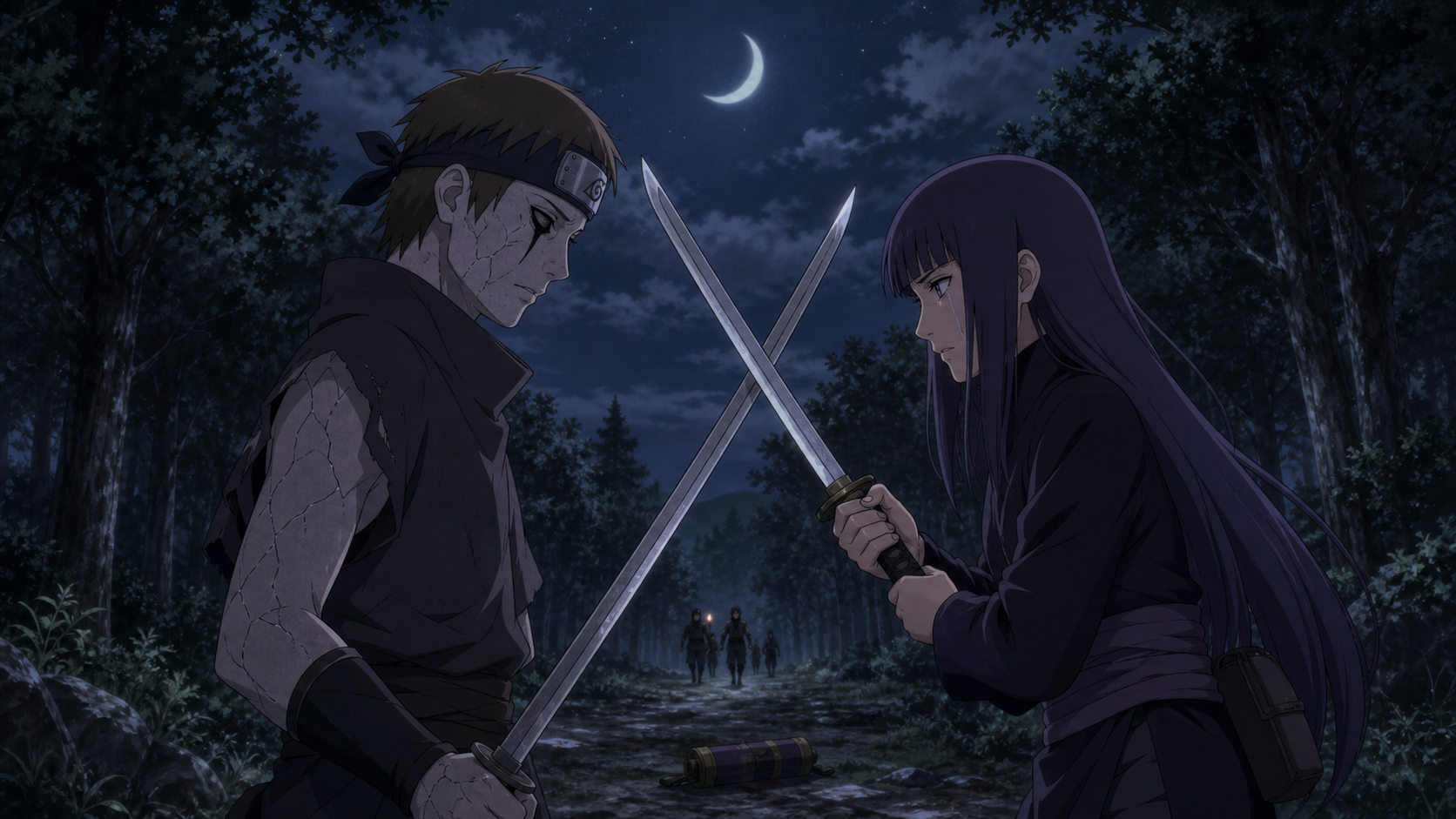
Crescent Moon Night
A moonlit pursuit becomes Yugao’s choice to reclaim her sword and release Hayate from Kabuto’s control.
Bottom line
“Crescent Moon Night” completes Yūgao Uzuki and Hayate Gekkō's two-episode war story with a reunion neither person chose. Yūgao joins the pursuit after Kabuto's reanimated team steals the Allied casualty scroll, freezes when Hayate attacks, and watches two comrades get hurt protecting her. Sakura challenges the shame beneath Yūgao's retreat without pretending grief can be switched off. Hayate finally resists Kabuto long enough to guide Yūgao's blade through his body, allowing the sealing team to put him to rest. The anime-original conclusion lands because both lovers recover a sliver of agency from Edo Tensei. The weak point is familiar: Yūgao receives attention mainly through a dead man, and the story treats renewed combat readiness as the clearest proof that she has healed.
The pursuit begins with an order
Sukui orders Yūgao to help track Hayate's team. Her knowledge of his swordsmanship makes tactical sense, but command reaches for intimate history as though expertise and consent were the same thing.
Yūgao moves with Sakura, Iō, Yokaze, and the pursuit unit while still visibly shaken. Compliance should not be mistaken for emotional readiness.
Yūgao remembers learning beside Hayate
As the team searches, Yūgao recalls sparring with Hayate. Sword practice was part of their relationship, not merely a professional skill shared by two shinobi.
That memory explains why drawing a blade feels impossible after his death. The weapon carries instruction, affection, competition, and the night she lost him all at once.
The crescent moon changes with the viewer
Hayate's lesson about the moon gives the title its emotional shape. A crescent can look incomplete, but the moon itself has not lost a piece. Human position changes what becomes visible.
The metaphor suits grief when handled carefully. Yūgao's life did not become false because Hayate disappeared from view. Loss changed her access to a future they expected to share.
The team catches the reanimated infiltrators
The pursuit unit reaches Hayate and the other two reanimated shinobi before the stolen casualty scroll can reach Kabuto. The confrontation shifts the episode from memory into immediate defense.
Stopping the team protects more than a document. The scroll could lead Kabuto to bodies, bloodlines, and biological samples he would treat as raw material.
The sealing corps handles the first two enemies
The Allied shinobi disable and seal Hayate's Suna and Kumo partners. Their quick response shows the value of specialists trained to restrain Edo Tensei bodies rather than destroy them repeatedly.
Sealing is also an ethical boundary. The reanimated dead are victims under control. Ending their forced service matters more than winning a conventional kill.
Hayate reaches Yūgao before she can act
Yūgao knows his stance and understands the danger, yet recognition interrupts her response. Trauma does not care how complete a briefing sounded.
Her freeze is a nervous-system reaction, not a moral choice. The episode should never frame that instant as proof that she values Hayate above her comrades.
Iō and Yokaze pay for the hesitation
Iō and Yokaze intervene and are wounded while shielding Yūgao from Hayate's strike. Their injuries create real consequences without making Yūgao responsible for Kabuto's violence.
She can regret what happened and still reject the claim that trauma equals negligence. Command placed her in the exact confrontation she said she could not manage.
Medical care interrupts the pursuit
Sakura and Yūgao stop to treat the wounded men. The pause reinforces that both women are medics, even while the narrative keeps pulling them toward sword combat.
Care is not dead time between action scenes. Stabilizing Iō and Yokaze prevents one failure from becoming two casualties and preserves the pursuit team's ability to recover.
Yūgao wants to leave the fight
After seeing others hurt, Yūgao prepares to step away. Shame makes retreat look like the only responsible decision because she assumes another freeze will endanger more people.
A safer response would assess her role rather than demand an all-or-nothing choice. She could advise, track, treat, or coordinate without becoming Hayate's sole opponent.
Sakura asks the question command skipped
Sakura asks why Yūgao cannot fight with a sword anymore. The conversation finally gives Yūgao room to explain the connection between the weapon and Hayate's death.
Sakura's directness works because she listens before acting. She does not tell Yūgao that grief is irrational or that duty should erase memory.
Sakura recognizes Kabuto as the violator
Sakura names Edo Tensei as the unforgivable act driving the crisis. That framing moves blame away from Yūgao and Hayate and back toward the person controlling the dead.
Kabuto arranged the raid, selected Hayate, exploited their relationship, and created the danger. Neither lover owes him a performance of perfect courage.
Sakura carries her own history with hesitation
Sakura understands what facing a loved person across a battlefield can do to judgment. Her history with Sasuke makes her challenge more credible than a generic speech about shinobi resolve.
The parallel has limits. Sasuke made choices while alive; Hayate is a captive inside his own body. Sakura's experience can create empathy without making the situations identical.
She pursues the scroll alone
Sakura heads after Hayate while Yūgao remains with the injured. The choice protects Yūgao's right to decide and keeps the stolen intelligence from reaching Kabuto uncontested.
Going alone is still a risk. Sakura should have backup against an opponent whose stealth techniques she has not studied, especially when a sealing team is required to finish the mission.
Yokaze returns the choice to Yūgao
Yokaze reminds Yūgao that Hayate asked to be stopped and offers her a sword. The gesture works best as an option, not an order.
Yūgao takes the weapon because she chooses what Hayate's request means now. The decision does not erase her earlier refusal or prove that pressure was justified.
Sakura meets Hayate as a former examiner
Hayate recognizes Sakura from the Chūnin Exams. That small connection ties his life before death to the capable medical ninja standing against him now.
Sakura is no longer the genin he watched compete. She can read the fight, protect the mission, and force Hayate to use more than straightforward swordplay.
Transparent Escape changes the duel
Hayate uses Transparent Escape to disappear from ordinary sight and attack from concealment. The technique fits a covert specialist and punishes Sakura for pursuing without sensory support.
Stealth does not make him invincible. Sakura uses a substitution to survive the apparent hit, buying time until Yūgao arrives.
Yūgao sends Sakura for the sealing team
Yūgao takes over the confrontation and tells Sakura to bring the sealing corps. The division of labor is sound: Yūgao can hold Hayate in place, while Sakura secures the only reliable method of release.
This is the first moment Yūgao controls the shape of the mission. She chooses her role, names Sakura's role, and faces Hayate without command speaking through either woman.
Their sword fight is also a conversation
Hayate recognizes Yūgao's improvement as their blades meet. Praise from a controlled opponent carries tenderness and horror together.
The duel shows that Yūgao did not lose every skill when she left ANBU. Her body remembers training even when grief made the sword inaccessible.
Kabuto tries to erase Hayate completely
When Hayate delays, Kabuto tightens control over his consciousness. The shift confirms that any gentleness or hesitation came from Hayate resisting his captor.
Edo Tensei becomes most monstrous at this boundary. Kabuto does not only animate a corpse. He suppresses the remaining will of the person inside.
Hayate appears to trap Yūgao
Under stronger control, Hayate pins Yūgao against a tree and raises the threat of a fatal strike. The staging makes Kabuto's intended ending clear: one lover's body will kill the other.
Yūgao cannot solve that cruelty through sentiment alone. She holds the blade and remains present even when the face in front of her asks every instinct to stop.
Hayate takes back one decisive moment
Hayate resists Kabuto long enough to redirect the outcome. He allows Yūgao's sword to pierce him rather than obey the order to kill her.
His choice does not turn death into romance. Hayate is already dead and imprisoned. He creates the opening that lets the sealing team end Kabuto's control.
Yūgao's strike is not revenge
Yūgao does not kill Hayate for abandoning her, nor does she punish him for the wounds caused during the raid. She helps stop the body being used against his values.
Calling the strike mercy can also oversimplify her cost. Consent under impossible conditions remains painful even when Hayate communicates what he wants.
The sealing team restores the proper objective
Once Hayate falls, the sealing corps binds him and ends the reanimation. The mission succeeds because pursuit, medical care, combat, and specialist containment all work together.
No single sword wins the operation. That matters on a page tempted to frame the entire outcome as a private lovers' duel.
The casualty scroll returns to the Alliance
Recovering the KIA scroll denies Kabuto a map to valuable remains. The Alliance protects its dead from another round of extraction and experimentation.
The camp still needs a security review. One successful recovery cannot excuse storing sensitive biological intelligence in a form a small infiltration team could steal.
Their goodbye offers closure without repair
Hayate and Yūgao receive a final exchange before sealing. They can acknowledge love and choice in a moment denied to them after his murder.
Closure should not imply that Yūgao's trauma disappears. A goodbye can clarify the past while grief, anger, and the consequences of forced combat continue afterward.
The episode confuses healing with a drawn sword
Yūgao's return to swordsmanship is presented as emotional movement. Reclaiming a skill can be powerful, especially when trauma made that skill feel owned by loss.
Healing does not require returning to ANBU or keeping the blade. Yūgao can remain a medic, set new boundaries, and still honor the person she became after Hayate died.
Sakura deserves credit without becoming a cure
Sakura creates space for Yūgao to speak, identifies Kabuto's wrongdoing, pursues the scroll, survives Hayate's stealth attack, and seeks the sealing team.
She supports Yūgao; she does not cure her. The final decision belongs to Yūgao, and the opening belongs to Hayate's resistance.
The anime-original ending earns its place
The manga does not stage this reunion. The anime uses the war's reanimation premise to revisit a supporting character death left largely outside the main emotional narrative.
The result fits Naruto's larger concern with bonds surviving systems built to exploit them. Viewers following only manga material can skip the pair, but character-focused viewers receive a complete, if imperfect, conclusion.
The romance remains too isolated from accountability
Baki killed Hayate during a conspiracy involving Kabuto and the Sand invasion, yet the resolution focuses on private love rather than institutional accountability.
Yūgao deserves answers about what Konoha and Suna did after his death. A moonlit goodbye cannot substitute for truth, apology, or care from the villages that continued around her.
Yūgao enters because somebody finally returns the choice
Command previously treated her history with Hayate as a tactical resource and her hesitation as a problem to overcome. Yokaze instead tells her what happened and lets her decide whether to continue.
That difference matters. Consent under war conditions is never perfect, but a person can still receive truth, time, backup, and a real option to step away.
Sakura asks about fitness before asking for sacrifice
She recognizes that Yūgao’s body has survived combat while her nervous system remains caught between memory, grief, and the man approaching with a sword. Medical readiness is not cowardice wearing clinical language.
Sakura cannot decide the choice for her. She can name risks, treat injuries, and refuse the idea that emotional pain becomes irrelevant once an officer issues an order.
Iō and Yokaze are injured by a plan built around one person’s grief
When Yūgao freezes, teammates absorb the attack. Their harm is real and should not become evidence that she owed everyone better emotional control.
The operational failure began earlier, when command deployed a grief-linked fighter without a paired interception plan. Accountability belongs to preparation as well as the instant when a traumatized person cannot move.
The casualty scroll carries people, not merely secrets
Recovering the document protects names, bodies, abilities, injuries, and families from Kabuto’s exploitation. The scroll should return to guarded custody with a complete record of who handled it.
Security also needs limits. The Alliance cannot hide deaths from families or erase casualties from public memory because the enemy proved medical records have strategic value.
Transparent Escape weaponizes uncertainty
Hayate’s technique removes the visible body while keeping the blade, movement, and threat present. Yūgao has to read sound, pressure, memory, and intention instead of waiting for a target she can see.
Her knowledge of his habits becomes useful without reducing the duel to romance. Skill built through shared training deserves as much attention as the moonlit symbolism.
Hayate’s resistance creates an opening, not absolution for the mission
He fights Kabuto’s control long enough to redirect the encounter and help Yūgao reach the ending he wants. That recovered moment belongs to him.
The Alliance still placed Yūgao in the position of striking somebody she loved. Hayate’s cooperation makes survival possible. Cooperation does not make the demand humane.
Yūgao’s blade is not a cure
The episode frames action as the route through paralysis, which can be emotionally satisfying and dangerously neat. Trauma does not disappear because a person completes the feared movement once.
She will still need sleep, medical review, grief care, and space away from combat. A successful strike proves she acted under pressure. The strike does not certify complete healing.
The sealing team gives the confrontation its ethical objective
Yūgao and Hayate can create the opening, but specialists end Kabuto’s control. Their arrival changes the goal from defeating a lover to releasing a captive body.
That language matters for everyone present. The seal should be documented as containment of Edo Tensei and release from forced action, not as Yūgao killing Hayate again.
Sakura should not have to pursue the scroll alone
She protects patients, evaluates Yūgao, identifies the medical-record risk, and then enters pursuit because the tactical gap remains open. Competence keeps attracting more work.
A second fighter and a records custodian should accompany her. Celebrating that she can carry every role only teaches command to leave every role understaffed.
Baki remains outside the goodbye he helped create
Hayate and Yūgao receive private closure, but the man who killed Hayate during the Sand conspiracy does not answer inside this episode. The alliance has moved forward politically without resolving that personal history.
Closure cannot mean removing every uncomfortable participant from the frame. Yūgao deserves a separate account of Baki’s responsibility and whatever justice remains possible.
The moonlight is memory, not permission to romanticize violence
The crescent moon ties training, love, death, and farewell together. The visual continuity is beautiful because Yūgao and Hayate recognize the life surrounding the violence.
The image should not soften Kabuto’s use of a corpse or the cost placed on Yūgao. Romance can hold the scene without making coercion look destined.
Hayate’s final agency should remain precisely described
He does not regain a normal life or escape reanimation through willpower alone. He creates one decisive opening inside a technique still controlling his body.
Precision protects the achievement. Saying love defeated Kabuto would erase the sealing team, Sakura, Yokaze, and the limits Hayate could not cross by himself.
Yūgao needs a next chapter that belongs to her
After the seal, the story should follow her recovery, work, anger, friendships, and decisions about service. Hayate’s farewell can matter without remaining the center of every future description.
A woman receiving closure is still a living person. The archive should remember what she did after the moonlight, not freeze her beside a dead man forever.
RaeRae’s verdict
“Crescent Moon Night” gives Yūgao and Hayate a painful conclusion built on stolen agency and one final act of resistance. Sakura is the episode's practical backbone, while the sealing team and recovered scroll keep the battle tied to the wider war.
The emotional finish lands, but Yūgao should not need a sword fight to prove she survived. Her medical work, refusal, grief, and eventual choice all belong to the same life.
RaeRae’s call
Hayate takes back one moment from Kabuto, Yūgao chooses to meet him, and the sealing team ends the coercion. The goodbye is earned. The sword is not therapy, love does not make this assignment fair, and Yūgao still deserves a life the story can describe without placing Hayate in every sentence.
The post-mission report should separate four records: the recovered casualty scroll, the injuries at the camp, Hayate’s moments of resistance, and Yūgao’s medical and operational needs. Combining them into one romantic incident would hide who made which decision and where the defense failed. Yūgao should review any personal section before wider circulation. Families named in the scroll need notice through a protected route, not battlefield gossip. Sakura needs credit for recognizing the ethical problem before command did. The sealing team needs the names of every controlled fighter released. Those records can honor Hayate while preventing his final appearance from becoming a story that asks Yūgao to carry the whole meaning alone after this final battle.
Episode details and viewing routes
- Official episode reference: Naruto Official episode guide
- Licensed episode route: Crunchyroll licensed episode page
What I am carrying forward
I am carrying forward the recovered casualty scroll, Hayate finally released from Kabuto's control, Sakura's refusal to blame the victims of Edo Tensei, and Yūgao choosing how to answer a request no one should have forced upon her.
I am also carrying forward the war's responsibility to its survivors. Sealing the dead ends one violation. Supporting the living after the battlefield requires more than calling a tragic goodbye closure.