
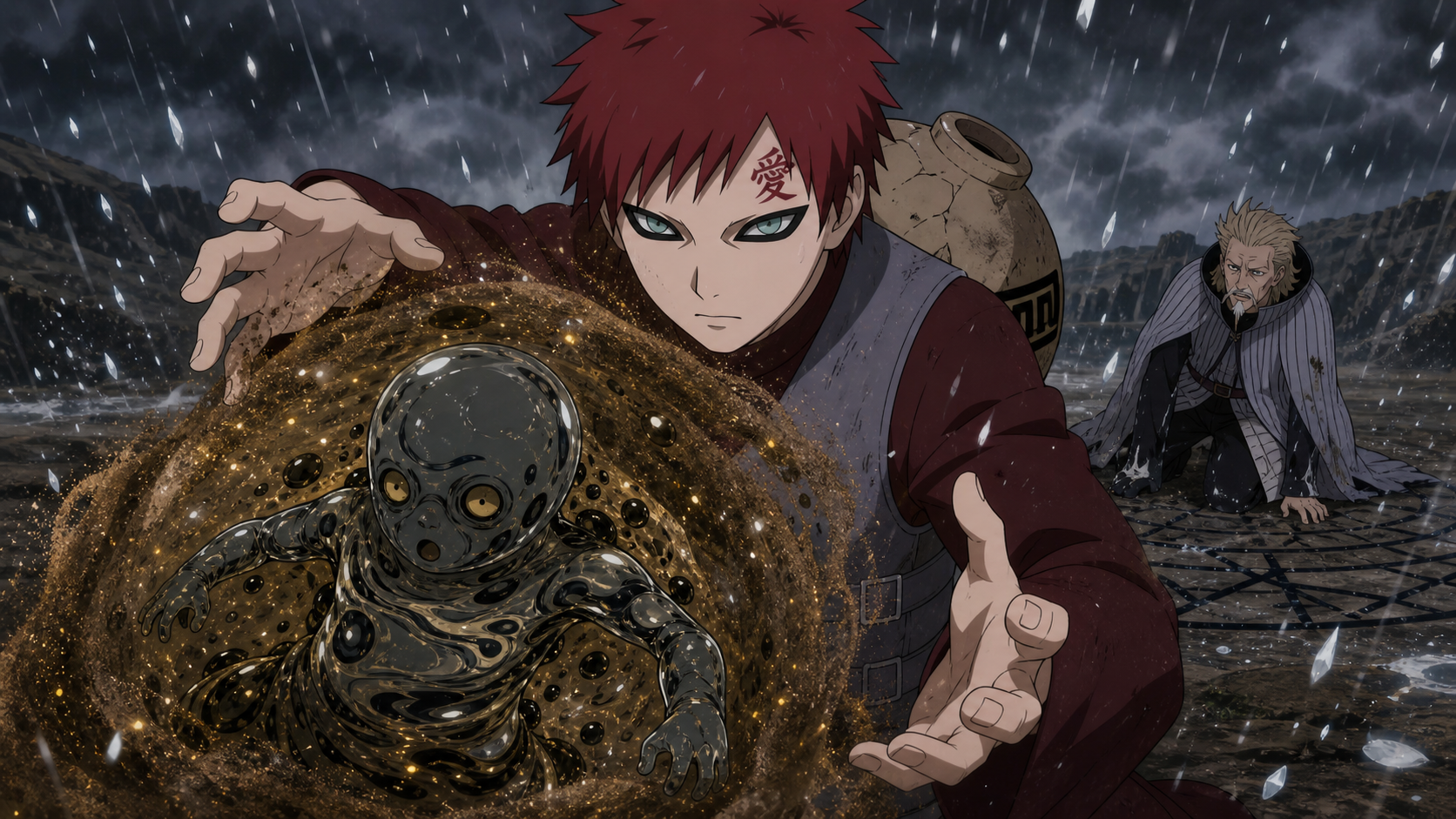
Terror! The Steam Imp
Gaara reads the Steam Imp’s repeating heat cycle, cools and weighs down the clone, and turns Rasa’s Gold Dust into protection while Mū’s hidden half survives.
Bottom line
“Terror! The Steam Imp” gives Gaara an enemy that turns movement into a repeating bomb. The Second Mizukage’s oil-coated water clone heats through speed, expands, explodes, cools as hail, and forms again. Gaara cannot win by catching the fastest phase or shielding one blast. He studies the cycle, protects the Fourth Division, locates the weakened real Mizukage, and mixes hail-soaked sand with Rasa’s Gold Dust to weigh and cool the clone before detonation. The victory transforms an inheritance once tied to parental control into a tool for collective protection. Meanwhile, Mū’s split body proves that even a completed-looking seal can hide an unfinished threat.
The apparent Ōnoki is Gaara’s sand clone
The Water Gun shot from Episode 300 strikes a substitute, not the injured Tsuchikage. Gaara used deception to protect a vulnerable ally.
That reveal matters because Gaara does not announce the rescue or wait for praise. He reads the danger, creates the sand double, and lets the enemy believe the shot landed. Younger Gaara once used sand as a wall between himself and everybody else. Current Gaara uses the same control to keep another Kage alive without turning protection into a performance. The change feels earned because the series spent years showing how badly Gaara understood human connection before Naruto reached him.
The official routes establish the final test
Naruto Official catalogs the episode as record `01_746`. Crunchyroll lists Shippuden Episode 302 under watch ID `GR2PW5J5R`, released February 28, 2013. The licensed summary describes the Second Mizukage testing Gaara after the mirage falls.
The test remains coercive because Kabuto forces the Mizukage’s body to continue.
The Second Mizukage still chooses what he says, and that limited choice creates the episode's strange mix of comedy, instruction, and horror. He wants the Alliance to defeat him. He also decides that Gaara needs to solve the final problem without another generous hint. Both positions can exist at once. His respect for Gaara does not erase the bodies standing inside the blast radius, and Kabuto's control means nobody on that field receives a clean contest.
The first sealing pyramid explodes
Gaara surrounds the real Mizukage and sealing tags approach, but a violent blast destroys the containment before completion.
Sealers need an external guard assigned to intercept remote techniques while tags are applied.
The failed pyramid also exposes how victory language can arrive too early. The Alliance has repeatedly treated immobilization as completion, even though reanimated bodies carry techniques, hidden divisions, and remote attacks that can outlive the first restraint. A sealing squad needs time, space, and protection. Gaara can provide the first two only while somebody else watches the entire field.
The face in the sky signals another technique
An ominous image appears above the blast, followed by hail. Fighters initially fear another illusion.
Ōnoki identifies a physical cycle rather than genjutsu. Correct classification changes every countermeasure.
The hail looks almost absurd after the fire and pressure, which is exactly why the clue works. A lesser battle episode would throw another power at Gaara and ask him to overpower the spectacle. This episode pauses long enough for Ōnoki to explain the mechanics and for Gaara to treat weather as evidence. The answer is already falling on everybody's heads.
The Steam Imp is an oil-and-water clone
The small clone has water inside and oil outside. Rapid movement increases heat until internal water becomes steam.
The design converts speed into pressure. Slowing and cooling are more useful than direct impact.
That mechanic gives the Steam Imp a nasty elegance. The clone punishes pursuit because greater movement helps the weapon reach its explosive phase. Fighters who rush to land a decisive strike may increase chaos, crowd the impact zone, and drain Gaara's defenses faster. The correct response requires discipline from an army trained to answer danger with immediate force.
Explosion creates the next cooling phase
After detonation, vapor rises and falls as hail, cooling the clone so the process can restart.
The battlefield itself becomes part of the weapon. Weather observations belong in the tactical map.
I like that the solution stays legible. Water heats, pressure grows, vapor rises, and hail cools the clone. Naruto techniques can become so large that the audience stops understanding what one move does to another. The Steam Imp remains frightening because every stage follows a rule, and Gaara wins by respecting that rule instead of producing a larger unexplained miracle.
Infinite repetition changes evacuation needs
One blast may be survivable behind Gaara’s sand. A recurring blast drains barriers, medics, and attention.
Units need wider spacing, rotating shields, marked impact zones, and a route away from the clone’s cycle.
Gaara cannot keep spending sand and chakra as though the Fourth Division has infinite protection. Every new detonation turns his compassion into a resource Kabuto can exhaust. The troops also need to stop clustering around the obvious target. A wide formation gives the clone fewer bodies per pass and gives Gaara a smaller rescue burden when the pressure starts climbing again.
The clone’s small form is still lethal
The chibi appearance encourages underestimation. The compact phase is fast enough to cut through formations before expanding.
Threat labels should describe function rather than size or appearance.
The little body is a cruel visual joke. Soldiers see something child-sized darting across the field, then watch the same shape swell into an explosion capable of tearing apart a sealing operation. The design also fits the Second Mizukage's personality. His most dangerous technique looks theatrical and almost silly until the mechanism begins doing exactly what he warned everyone about.
Gaara searches for the real Mizukage
Ōnoki explains that maintaining the Steam Imp weakens its creator. Gaara divides attention between the mobile bomb and the source.
One unit tracks the clone while Gaara’s sensory sand finds the real body.
Ōnoki supplies knowledge rather than taking over the solution. That division of labor respects both Kage. The veteran recognizes the weakness behind the technique, while Gaara converts the clue into a battlefield plan. Their exchange quietly answers the Mizukage's larger concern about whether the current generation can face Madara. Readiness does not mean one leader knows everything. Readiness means leaders can combine experience fast enough to keep people alive.
The real body remains a conscious prisoner
The Mizukage can speak and understands that his technique threatens the division. He no longer supplies every answer because he wants current leaders prepared for Madara.
His test may be sincere, but soldiers never consented to becoming examination material.
I understand why the Mizukage stops coaching Gaara. Madara will not explain a weakness, pause a technique, or congratulate a clever defense. The Alliance needs leaders who can work under incomplete information. I still refuse to romanticize the setup. The Mizukage's agency exists inside forced resurrection, and the division pays for a lesson Kabuto created through grave robbery and control.
Gaara attempts another seal
Sand captures the weakened Mizukage and forms a pyramid. The Steam Imp tears away tags before activation completes.
Containment needs redundant tags placed from protected angles rather than one exposed approach.
The clone does not need to defeat Gaara directly. Removing the sealing tags buys another cycle, and another cycle may be enough to break the formation. That detail makes the enemy feel intelligent without giving the construct a speech or a separate personality. The technique attacks the weakest stage of the procedure, not the strongest wall on the field.
Hydrification complicates restraint
The Mizukage can emerge through openings in the sand and avoid shuriken. Physical enclosure does not guarantee stable anatomy.
Sealers should combine absorbent material, chakra barriers, and temperature control.
Gengetsu Hōzuki's body and techniques keep reminding the Alliance that ordinary solid-target assumptions fail against the Hōzuki clan. Sand can surround a space and still leave a route for a liquefied body. Shuriken can enter the enclosure and accomplish nothing useful. The shinobi system has specialized bloodlines, yet battlefield planning often acts surprised when anatomy changes the rules of restraint.
Gaara shields the division again
As the clone expands, Gaara prioritizes a broad sand defense over immediate pursuit. Protecting troops costs chakra but preserves the team needed for sealing.
Command should track his depletion and assign relief barriers wherever possible.
Gaara's shield carries the emotional center of the episode because he never treats the soldiers as expendable pieces in his personal Kage examination. He could chase the impressive win and let the formation absorb losses. Instead, he spends power protecting people while continuing to calculate. That choice separates leadership from combat ranking more clearly than the Mizukage's later metaphor does.
Hail becomes a cooling resource
The clone’s own cycle provides cold material. Gaara incorporates hail into sand instead of treating every effect as enemy property.
Environmental adaptation turns the weapon’s reset mechanism into a constraint.
The move also gives the hail a second meaning. The same cold that prepares the Steam Imp for another round can help keep the clone from reaching the next detonation. Gaara does not erase the enemy's system. He steals one stage and forces that stage to work on his terms. That kind of answer suits a tactician far better than a surprise finishing beam.
Gold Dust adds weight
Gaara mixes Rasa’s Gold Dust into the sand around the clone. The denser material slows movement and disrupts heat buildup.
Inherited technique becomes usable without inheriting Rasa’s governing ethics.
Gold Dust enters Gaara's hands through one of the ugliest family histories in the franchise. Rasa measured his son as a weapon, authorized attempts on his life, and let fear shape the household around him. Episode 302 does not pretend that inheritance became wholesome. Gaara takes a material associated with his father's control and gives that material a different job: hold the threat down, cool the pressure, and protect strangers.
Cooling stops the pressure rise
Wet sand and hail keep the clone below the temperature needed for another explosion. Weight controls motion while cooling controls phase change.
The solution addresses cause rather than surviving another symptom.
Weight alone might reduce speed without solving the heat already trapped inside the clone. Cold alone might delay expansion while the clone continues cutting through the division. Gaara combines both controls because the technique has two linked requirements. The answer feels satisfying because viewers can trace the reasoning from hail and Gold Dust to the stalled explosion.
The division needs a temperature protocol
Sensors should monitor heat, expansion, speed, and hail formation. A rising threshold can trigger evacuation before detonation.
Medics also need burn, blast, inhalation, and cold-exposure stations.
The war arc often lets spectacular techniques dominate the frame while medical consequences disappear between scenes. Steam pressure, flying debris, sudden hail, and repeated shock waves create different injuries. A competent response cannot park every casualty in one tent and hope chakra solves triage. White Zetsu infiltration makes that medical chain even harder because every new patient and helper also becomes an identity risk.
The Mizukage acknowledges Gaara
Impressed by the solution, he recognizes Gaara’s judgment and the partnership forming around Naruto. His praise arrives before final sealing.
Recognition confirms performance but does not grant Gaara’s worth.
Gengetsu praises a leader who earned the judgment through visible choices. That distinction matters for Gaara, who grew up under a father who treated approval as a condition attached to usefulness. The compliment lands because Gaara has already protected his people, solved the mechanism, and created a clean sealing opportunity. He does not reshape himself to obtain the dead Kage's blessing.
The golden egg metaphor needs caution
Calling Gaara the valuable find among current Kage centers comparative ranking. Gaara’s leadership matters through protection, coalition, and accountability.
A generation does not need one chosen savior when several leaders can share responsibility.
Naruto and Gaara do make a powerful pair. Both were jinchūriki children punished for dangers adults placed inside them, and both chose bonds over the isolation their villages expected. The better promise is not that two exceptional boys will rescue every institution forever. Their partnership proves that damaged systems can produce leaders who recognize the same cruelty and refuse to repeat that cruelty.
Sealing finally completes
With the clone controlled, the team can secure the Mizukage without another interruption. Completion requires confirmation that both source and construct are inactive.
The record should preserve his voluntary warnings and forced attacks separately.
The seal closes a battle that Gengetsu spent several episodes trying to lose. His help does not make him weak, and his final resistance does not make him malicious. Edo Tensei turns those categories into administrative nonsense unless the Alliance records consent and control. Kabuto committed the violence. Gengetsu supplied the knowledge that finally stopped his own body.
Mū’s divided body survives
Elsewhere, half of Mū emerges after the Alliance believed him sealed. He split before capture, leaving power reduced but agency available to Kabuto.
The interrupted warning from Episode 300 becomes confirmed evidence.
Mū's survival is more than a cheap last-second reversal because Episode 300 showed him trying to communicate before the seal closed. The missing information now has a physical answer. He divided himself, and the Alliance sealed only one half. Reduced chakra makes the surviving body weaker, but weakness does not equal harmlessness when Kabuto needs a hidden pair of hands for another summon.
Post-seal surveillance was necessary
Sensors should have remained at Mū’s location after containment. A body count and chakra scan might have exposed the mismatch.
Every future seal needs a residual-chakra observation window.
The lesson sounds obvious after the reveal, which usually means a wartime system needed a checklist before the battle. Confirm the body, confirm the chakra signature, watch the sealed area, and compare the result against the enemy's known techniques. Celebrating before those steps finish gives Kabuto exactly the quiet interval he needs.
Kabuto gains time for a trump card
The surviving half cannot immediately free the sealed half, but Kabuto can redirect him and prepare another summon.
The Alliance should treat silence after a victory as a possible staging period.
Kabuto's language about a trump card changes the episode's ending from closure into preparation. The Second Mizukage is finally contained, yet the wider battlefield has not become safer. Madara remains the standard everyone fears, Mū remains available, and Kabuto still controls information that the Alliance cannot see.
The medical division remains frozen by infiltration
White Zetsu impostors continue destroying trust across logistical and medical spaces. Frontline victories do not restore internal identification.
Naruto’s sensor clones and independent verification teams remain essential.
That split focus keeps Gaara's victory from solving the war by itself. The front line proves that cooperation can beat an elaborate Kage technique. The rear proves that trust can collapse when nobody can verify a familiar face. The Alliance needs both kinds of intelligence: Gaara's patient reading of visible mechanics and Naruto's ability to identify the enemy hiding inside ordinary relationships.
The Steam Imp turns repetition into the real threat
One explosion is survivable when the division can shield, treat injuries, and regroup. A clone that cools, reforms, and detonates again turns every recovery interval into the beginning of another emergency.
Command needs cycle timing, temperature readings, evacuation rings, and replacement shield teams.
Gaara reads the weather as part of the battlefield
The hail is not decorative atmosphere. Cooling changes the oil-and-water balance inside the clone, giving Gaara a resource the Mizukage did not create and cannot fully control.
That choice shows why Gaara has become a leader rather than a larger weapon. He studies what surrounds the technique, combines local conditions with inherited Gold Dust, and builds an answer other people can survive.
The Mizukage’s praise should not become Gaara’s new permission slip
Recognition from a former Kage matters because the opponent understands the technique and the office. Gaara still does not need another powerful man to certify his worth.
He already protected the division, adapted after failure, and accepted help from battlefield evidence. The acknowledgment confirms what his actions showed. The acknowledgment does not create the leader standing there.
Mū’s divided body is the receipt against premature closure
The Mizukage is sealed, the visible front quiets, and victory language becomes tempting. Mū surviving in a divided form proves why post-seal sensing cannot be optional.
Every battlefield needs a verification sweep for chakra residue, secondary bodies, broken seals, discarded summoning tools, and missing remains. A celebrated finish is exactly when an enemy hidden by exhaustion gains time.
RaeRae’s verdict
“Terror! The Steam Imp” makes Gaara’s strongest move analytical. He identifies a repeating system and changes temperature, weight, and movement at once.
Gold Dust stops serving a father’s control and becomes part of a son’s shield.
The episode also refuses to let a clean seal become a clean ending. Gengetsu can rest, but Mū cannot. Gaara passes the test in front of him while Kabuto prepares the next one outside his sight. That tension works because the victory remains real and the danger remains specific.
RaeRae’s call
Gaara defeats the Steam Imp by refusing to treat another explosion as the only question. He reads the cycle, uses the hail, adds Gold Dust, and keeps his division alive long enough to finish the seal. Then Mū’s surviving half reminds everybody that victory still needs verification.
Episode details and viewing routes
- Official episode reference: Naruto Official episode guide
- Licensed episode route: Crunchyroll licensed episode page
What I am carrying forward
I am carrying forward Gaara’s hail-cooled Gold Dust, the completed Mizukage seal, Mū’s surviving half, and the need to verify residual chakra after every apparent containment.
I am also carrying forward the Steam Imp protocol: track the cycle, spread the formation, cool the source, slow movement, and never mistake a small body for a small threat.