
Ghosts from the Past
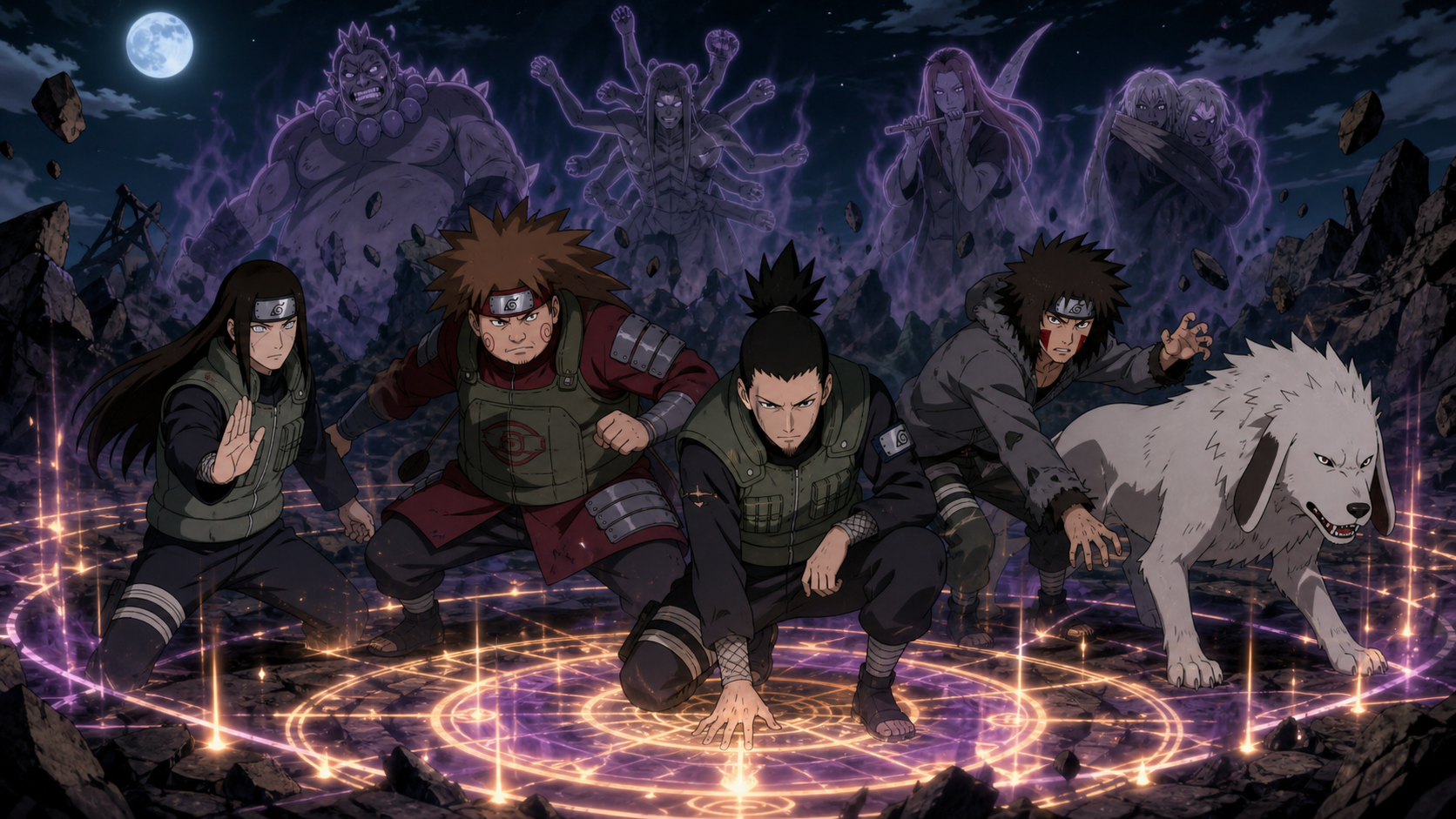
The grown Sasuke Retrieval team crushes a familiar rematch, then learns that Kabuto used the Sound Four’s defeat to place their souls inside a hidden seal.
Bottom line
“Ghosts from the Past” works best as a growth audit for the four Konoha shinobi who nearly died during the Sasuke Retrieval Mission. Shikamaru, Chōji, Neji, Kiba, and Akamaru face Jirōbō, Tayuya, Kidōmaru, Sakon, and Ukon again, except nobody needs a soldier pill, a suicide gamble, or a Sand rescue to survive the first exchange. The rematch is anime-original, and the episode does not hide that detour particularly well. Still, the comparison has value. Konoha's former genin now fight as experienced adults inside a war, while the Sound Four remain emotionally trapped in the day Orochimaru spent their lives buying Sasuke's escape. Their quick defeat is not the ending. A hidden seal activates around the victors, removes their souls from the battlefield, and reveals that Kabuto wanted revenge to become bait.
The war has already damaged trust
White Zetsu impersonations have made ordinary relief shifts feel dangerous. Darui nearly attacks a comrade because the battlefield no longer allows anyone to trust a familiar face without verification. Shikamaru names the mental exhaustion clearly. Shinobi can rest bruised muscles, but suspicion keeps working after the fighting stops.
The opening gives the Sound Four's return a useful context. Kabuto is not adding only four more bodies. He is throwing recognizable enemies into an army that already doubts every reunion. A face from the past may be a corpse, an impostor, or a real ally. The Alliance needs a verification process that does not depend on private memories alone because stolen appearances can carry stolen knowledge.
The official routes establish an anime-original rematch
Naruto Official catalogs the story as record `01_747`, titled “Ghost from the Past” on the English site. Crunchyroll lists Shippuden Episode 303 as “Ghosts from the Past,” watch ID `GRZXQ4VDY`, released March 7, 2013. Both summaries identify Shikamaru, Chōji, Neji, and Kiba confronting the reanimated Sound Four.
The episode does not adapt a manga chapter. That distinction matters because the rematch cannot rewrite the canon outcomes or pretend these enemies survived unseen. The story functions as anime-original character reflection inside the Fourth Shinobi World War. Fans following only manga-canon plot can skip the three-episode detour, while fans interested in the Konoha supporting cast receive a direct comparison between Part I trauma and Shippuden competence.
Kabuto buys time with familiar hatred
Mū's surviving half cannot immediately free the sealed half, so Kabuto needs another move while preparing his larger summon. The Sound Four become that delay. Their anger is predictable, personal, and easy to aim at the survivors of the Sasuke Retrieval Mission.
Kabuto treats resentment as reusable equipment. Edo Tensei gives him bodies that regenerate, but vengeance gives those bodies direction without constant instruction. The cruelty reaches beyond resurrection. He revives people inside the emotional limit that made them useful to Orochimaru, then sends them toward the same opponents who ended their lives.
The Sound Four mistake survival for theft
Jirōbō, Tayuya, Kidōmaru, Sakon, and Ukon talk as though the Konoha team stole victories that belonged to them. Their complaint ignores the actual mission. The Sound Four abducted Sasuke, attacked children trying to retrieve him, and used cursed seals supplied by a man who valued obedience over life.
Their rage still makes psychological sense. Each member died believing Orochimaru's cause gave that death meaning. Reanimation returns them to a world where Sasuke outgrew their role, killed Orochimaru, and built his own disasters. Accepting that history would require admitting that their loyalty purchased nothing lasting.
Shikamaru recognizes the old formation
The battlefield reunites most of the original retrieval squad without Naruto. Shikamaru immediately understands the danger and starts organizing information rather than charging the nearest corpse. Part I Shikamaru carried the guilt of his first command after every teammate came home broken.
Current Shikamaru has survived Asuma's death, hunted Hidan, supported Naruto through Pain's attack, and entered a multinational war. The old failure remains part of him, but the memory no longer freezes his judgment. He can look at the same enemy structure and ask what changed.
Chōji no longer needs to destroy himself
Jirōbō remembers the boy who swallowed the Three Coloured Pills and nearly died for enough power to win. That memory flatters Jirōbō because he can frame the first battle as a narrow loss caused by a desperate trick.
Chōji now carries butterfly power without paying the same lethal price. His body, chakra control, and confidence changed. More important, Chōji no longer needs an enemy's insult to define why he fights. The rematch lets him answer strength with controlled force instead of converting friendship into self-destruction.
Neji has already escaped the fatalism Kidōmaru remembers
Kidōmaru nearly killed Neji by finding the Byakugan's blind spot and firing through Neji's defenses. Their first fight pushed Neji to accept death while trusting Naruto to recover Sasuke. That boy believed fate could close around a life even after he started arguing against fate.
War-era Neji sees the same ranged tactics with years of field experience behind his eyes. The episode does not give enough time to make the rematch tactically rich, but the emotional comparison remains clear. Kidōmaru remembers a wounded prodigy. Neji arrives as a jōnin who understands both the flaw and the cost of leaving that flaw unguarded.
Kiba and Akamaru fight as a mature pair
Sakon and Ukon once turned Kiba's own body into the battlefield. Kiba had to stab himself to threaten an enemy fused with his flesh, then relied on Kankurō to finish the fight. The original encounter punished every close-range instinct Kiba and Akamaru used.
Their current teamwork moves faster and hits harder. Akamaru is no longer a puppy tucked inside Kiba's jacket. The pair can produce Super Fang Wolf Fang and control a larger attack path, although power alone does not erase the brothers' body-merging danger. Their growth comes from coordination, not from pretending the old matchup stopped being ugly.
Tayuya still knows how to attack Shikamaru's patience
Tayuya's insults and flute-based genjutsu once forced Shikamaru into a battle he could analyze but not finish alone. Temari supplied the overwhelming wind attack that killed Tayuya. That rescue became one of the retrieval mission's sharp reminders that a good plan can still need somebody else's power.
Shikamaru does not need to be ashamed of that history. Command means using the available team, not proving personal superiority in four isolated duels. Tayuya wants the rematch to become a private correction. Shikamaru keeps reading the group problem.
The cursed seals make the corpses stronger
Reanimation removes ordinary stamina and mortality limits, while the Sound Four can still push their cursed seals into advanced states. The visual callback tells viewers that Kabuto restored the versions remembered from Part I and added an undead safety net.
That combination should be terrifying. The episode instead makes the Konoha team's first victory look easy, which supports the growth comparison but weakens suspense. A short fight can prove competence. A rushed fight can also make opponents with regeneration and cursed-seal amplification feel like cardboard markers on a nostalgia route.
The team wins through accumulated adulthood
Nobody on the Konoha side suddenly reveals a miracle designed only for this episode. Their advantage comes from years of training, promotions, harder missions, grief, and better cooperation. The Sound Four return with greater durability but nearly the same worldview and combat identity.
That difference is the episode's strongest idea. Growth is not a louder version of the same child. Chōji controls power that once poisoned him. Neji protects a known weakness. Kiba and Akamaru operate as a developed combat unit. Shikamaru manages the field without collapsing under the memory of his first command.
A victory this fast should trigger suspicion
The Alliance celebrates when the reanimated enemies fall. Relief makes sense because exhausted soldiers just watched four notorious opponents go down. The timing still feels wrong. Edo Tensei bodies do not stay defeated through ordinary damage, and Kabuto rarely spends a recognizable asset without another purpose.
Shikamaru should be the first person to distrust an easy ending. The hidden seal proves that the physical battle was only the delivery mechanism. A war protocol should require sealing confirmation, chakra monitoring, and a perimeter check before anyone gathers around defeated reanimations.
The Underworld Transfer formula was waiting
A technique formula activates around the Sound Four and the Konoha team. The apparent losers become anchors for a trap that targets the victors. Bodies remain on the battlefield while the victims' souls move into a separate sealed space.
The move attacks the Alliance's definition of casualty. Medics can find pulses and bodies, yet ordinary treatment cannot reach a missing soul. Sensory teams may detect weak chakra without locating the person who needs to choose, fight, or return. Kabuto turns a completed-looking skirmish into a problem that crosses medicine, sealing, and spiritual technique.
Naruto feels the malice from a distance
Naruto senses the hostile surge and changes direction toward his friends. His arrival matters because the trapped group includes people tied to his earliest failures and promises. The Sasuke Retrieval Mission started with Shikamaru's team moving ahead while Naruto pursued Sasuke. Years later, Naruto is again racing toward the danger after the formation closes.
The parallel should not reduce everyone else to waiting for the protagonist. Shikamaru, Chōji, Neji, Kiba, and Akamaru already won the first battle. Naruto's role is to help solve the trap and protect the bodies outside, not erase their demonstrated growth.
The episode remembers supporting characters the war sidelined
The Fourth Shinobi World War has an enormous cast, and size often pushes the Konoha rookies into crowd shots. Episode 303 gives four of them a reason to speak from personal history. That attention is welcome even when the production exists outside manga canon.
The detour also exposes the cost of sidelining them for so long. A rematch must summarize years of growth quickly because Shippuden gave some of these characters far fewer major battles than their Part I introductions promised. Nostalgia can reopen the door, but one three-episode conflict cannot replace sustained development.
Neji's presence carries a heavier future shadow
Neji's first fight with Kidōmaru centered on a boy accepting possible death for a mission and for Naruto's promise. Watching him repeat that battlefield relationship during the war adds uncomfortable weight even before later events.
I am not treating future knowledge as something RaeRae possessed during an original 2013 watch. On a current franchise rewind, the episode reminds viewers how often Neji's loyalty becomes willingness to absorb lethal risk. The story praises devotion more consistently than the story asks what the Hyūga prodigy deserved beyond sacrifice.
The rematch cannot repair the Sasuke Retrieval Mission
Beating the Sound Four again does not change the original outcome. Sasuke reached Orochimaru, the retrieval team suffered catastrophic injuries, and Shikamaru carried command guilt. The new victory can measure growth without rewriting consequence.
That restraint helps the episode. The heroes do not discover that the first losses were fake, and the Sound Four do not reveal a secret moral innocence. Past pain remains real. Current competence shows that trauma influenced these shinobi without permanently owning their limits.
Orochimaru's hierarchy left the Sound Four disposable
The Sound Four called themselves elite guards, but Orochimaru built their mission around expendability. Their job was to carry Sasuke, delay pursuers, and die if necessary. Cursed seals offered power while increasing dependence on the person who marked them.
Kabuto repeats the structure with cleaner control. Edo Tensei bodies can be thrown away and restored, while old devotion supplies motivation. The Sound Four believe they are pursuing vengeance. Kabuto uses their belief to prepare a soul-transfer trap and buy time for a different plan.
White Zetsu and Edo Tensei attack identity differently
White Zetsu copies the living and poisons trust from inside the Alliance. Edo Tensei returns the dead and weaponizes unfinished relationships. One method asks whether a familiar person is genuine. The other asks whether a familiar enemy still owns the same emotional power.
The two threats make the war less about body counts and more about recognition. Shinobi need sensory verification for impostors, sealing knowledge for reanimations, and emotional discipline when old faces appear. A military that trains only for visible attacks will keep losing time to identity warfare.
The animation sells speed more than strategy
The rematch uses familiar cursed-seal designs, rapid exchanges, and upgraded combination attacks to make the generation gap visible. The episode's pace gives each Konoha fighter a recognizable moment without replaying every Part I duel shot for shot.
The compromise is tactical thinness. Several matchups carried entire episodes during the retrieval arc. Compressing four histories into one battle produces a highlight reel where technique mechanics arrive and disappear quickly. The emotional premise has more weight than the choreography receives.
The Japanese cast returns to old hostility
The Sound Four's performances need to sound recognizably contemptuous because resentment carries most of the episode's conflict. The Konoha cast answers with greater steadiness. I can verify the returning characters and Japanese-language presentation through the licensed route, but I am not turning memory of individual vocal beats into unsupported claims about breath, pitch, or timing.
The useful performance contrast comes from role and dialogue: the Sound Four speak from fixation, while their opponents speak from assessment. One group wants the past restored. The other group knows that survival changed them.
This filler label needs a fair explanation
“Filler” describes the adaptation relationship, not an automatic quality score. Episode 303 is anime-original and does not advance the manga's central war plot. Viewers who want only adapted canon can skip this side conflict without losing the main storyline.
Fans who care about Shikamaru, Chōji, Neji, Kiba, and Akamaru may still find the rematch worthwhile. The episode offers character comparison, a new sealing threat, and a bridge into Episodes 304 and 305. The honest label is anime-original side story with meaningful supporting-cast material, not mandatory canon and not worthless noise.
The trap restores stakes after the easy win
The first victory risks becoming pure fan service because the heroes dispatch strengthened reanimations too quickly. The soul-transfer seal changes the question from who became stronger to whether strength addressed the real plan.
Kabuto expected the Sound Four to lose. Their defeat places the targets in the correct position and lowers everyone's guard. That reversal makes the episode's earlier simplicity part of the trap, although the story could have planted more visible suspicion before the formula activated.
The Sound Four return with the wrong measurement of growth
They remember exhausted children who barely survived the Sasuke Retrieval Mission and assume adulthood means larger versions of the same techniques. Shikamaru’s team has changed through work, relationships, and the knowledge of what their earlier victory cost.
Maturity is using fear as information without letting humiliation write the plan.
The easy rematch is the first warning
Each Allied fighter defeats a former opponent faster than the Sound Four expect. The speed feels satisfying because viewers remember how brutal those battles were.
A battlefield full of reanimation and hidden seals should make easy success suspicious. Command needs a rule for checking bodies, terrain, chakra residue, and delayed techniques before anybody celebrates or separates.
The transfer seal weaponizes unfinished history
Kabuto does not need the Sound Four to win a fair fight. He needs Shikamaru, Chōji, Neji, and Kiba to enter the prepared formula while believing the past has been settled.
The trap uses memory as route planning. Familiar enemies pull familiar responders into predictable positions. Counter-intelligence should track emotional pairings as carefully as elemental matchups.
Supporting characters deserve more than nostalgia deployment
The episode gives four veterans a front of their own after the war has often treated Naruto’s clones as the answer everywhere. That attention matters when each person carries abilities and judgment the larger strategy needs.
The next episode has to keep their agency intact inside the trap. A reunion becomes worthwhile when the characters make new choices, not when familiar names merely decorate another rescue for Naruto.
The old mission remains a wound, not a scorecard
They survived the Sound Four, yet Sasuke still reached Orochimaru and every child involved carried consequences into adulthood. Winning this rematch cannot rewrite that outcome.
The healthier victory is recognizing how much they changed without pretending pain was useful preparation. Children should never have needed that mission to become competent adults.
RaeRae’s verdict
“Ghosts from the Past” gives neglected Konoha fighters a satisfying proof of growth, then refuses to let nostalgia count as strategy. The Sound Four remain stuck inside Orochimaru's disposable hierarchy. Shikamaru's team outgrew the children those enemies remember.
The episode loses energy when four major Part I matchups become a compressed victory reel. The Underworld Transfer trap saves the ending by revealing that Kabuto never needed the old enemies to win a fair rematch. He needed familiar hatred, predictable positions, and one careless celebration.
RaeRae’s call
The Sound Four expect the children they nearly killed and meet adults who learned how to fight without repeating the same sacrifices. Then the Underworld Transfer seal exposes the real plan: Kabuto used their history to place them exactly where he wanted them. Nostalgia is the bait, not the victory.
Episode details and viewing routes
- Official episode reference: Naruto Official episode guide
- Licensed episode route: Crunchyroll licensed episode page
What I am carrying forward
I am carrying forward five motionless bodies, five displaced souls, the Underworld Transfer formula, Naruto racing toward the hostile chakra, and Kabuto's use of the Sound Four as deliberate bait.
I am also carrying forward the episode's better character claim: surviving the past did not leave Shikamaru, Chōji, Neji, Kiba, and Akamaru unchanged. Their growth wins the visible battle. Their next test is recognizing the battle nobody could see.