
Paradox
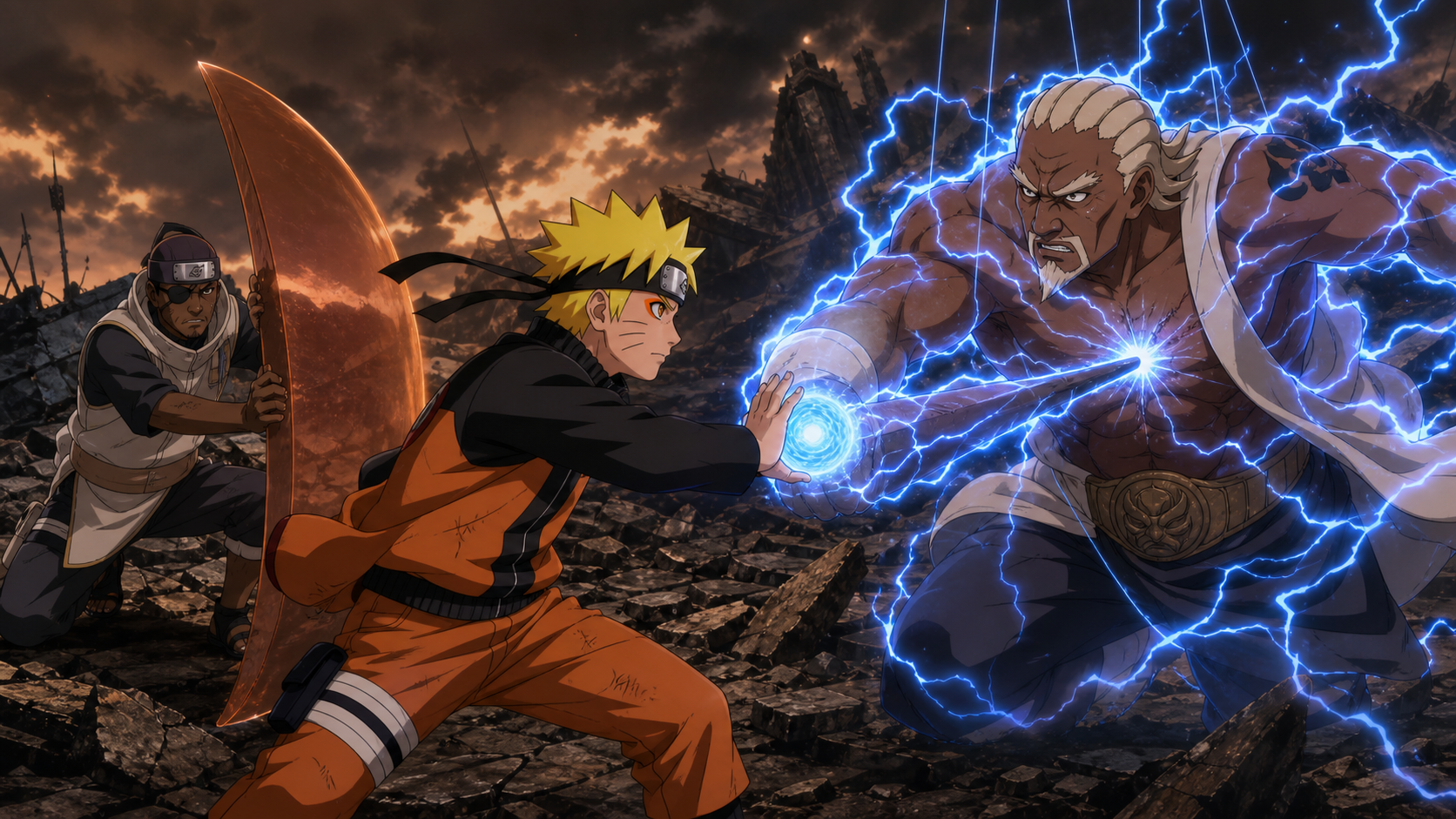
Naruto stops trying to overpower the Third Raikage and uses testimony, Sage Mode timing, and one precise redirection to solve the scar’s paradox.
Bottom line
“Paradox” defeats the Third Raikage by treating his scar as evidence. Temari’s Wind Release and Naruto’s Rasenshuriken cannot penetrate the lightning armor called the ultimate shield. Dodai explains the Raikage’s history, Gyūki remembers their exhausted collision, and Naruto realizes that the only attack strong enough to scar that body was the Raikage’s own One-Finger Hell Stab. Sage Mode gives Naruto the timing to redirect the ultimate spear into the ultimate shield. The answer comes from witnesses, memory, and restraint rather than a larger blast. On Gaara’s front, the Second Mizukage’s continuing resistance reminds everyone that one solved contradiction does not end the war.
Temari leads the Wind Release attack
The Fourth Division follows the Raikage’s own advice and strikes with the element expected to counter lightning. Their combined net appears to stop him.
The official routes establish the defense problem
Naruto Official catalogs “Paradox” as record `01_745`. Crunchyroll lists Shippuden Episode 301 under watch ID `G63VGWNVY`, released February 21, 2013. The official summary centers Temari’s strongest Wind Style failing against the Third Raikage’s invincible armor.
Elemental advantage supplies a starting hypothesis, not a guaranteed result.
The sealing team moves too early
When the Raikage falls, sealers approach before confirming that his lightning armor and movement have ended. He rises and throws them back.
Containment teams need a verification signal from sensors and restrainers before entering lethal range.
The first failure should trigger a short after-action review while barriers hold. Sealers need to know whether the Raikage remained conscious, whether lightning chakra damaged the binding material, and whether the body had stopped regenerating. A named safety officer can delay approach even when combat leaders feel pressure to capitalize. Five seconds of confirmation may prevent an entire specialist team from becoming casualties.
Dodai carries living institutional memory
The Raikage recognizes his former aide, and Dodai explains the leader’s techniques, endurance, and sacrifice. Personal knowledge becomes battlefield intelligence.
Command should record Dodai’s account while protecting him from pressure to remember every detail perfectly.
His dual role as former aide and current Allied fighter creates emotional strain. He must describe a respected leader’s vulnerabilities while watching that leader’s body attack colleagues. Interviewers should separate memory from inference and allow corrections after the battle. Dodai should retain access to his own statement so later summaries cannot remove the coercive conditions or turn private loyalty into propaganda.
The Third Raikage once held an army alone
He fought thousands for days so comrades could escape. That history explains both his endurance and the loyalty attached to his name.
Heroic sacrifice does not make his reanimated body less dangerous or his current actions voluntary.
The history also creates hesitation among soldiers from the Hidden Cloud. Command should acknowledge that conflict openly rather than accuse them of weakness. Units can rotate fighters who knew the Raikage personally, assign nonlethal support roles, and provide a clear explanation of why sealing honors his expressed wish. Emotional readiness is part of deployment safety.
Naruto promises a stronger wind attack
Naruto’s clone arrives with Rasenshuriken, believing superior Wind Release can break the defense. The confidence gives the division another option.
Local leaders should still define spacing, evacuation, and sealing positions before the throw.
Rasenshuriken carries a broad damage radius and microscopic chakra effects. Medics and sealing specialists must remain outside the impact zone until wind turbulence settles. Naruto should announce direction and timing through the division channel, not rely on everyone seeing his hand motion. Powerful reinforcement becomes useful only when the existing unit can integrate the attack safely.
Rasenshuriken barely changes the problem
The technique strikes, disrupts the battlefield, and still fails to create a stable sealing opening. Raw destructive scale reaches another limit.
Naruto responds by observing rather than immediately making a larger version. That pause begins the solution.
The division should preserve sensor readings from the impact. Even a failed attack reveals how the lightning armor distributes force, whether regeneration changes, and where debris patterns differ around the scar. Failure becomes evidence when someone records the result. Without that discipline, every new fighter would repeat the same spectacular mistake.
Kabuto suppresses the Raikage’s voice
The controlled body stops offering helpful instructions as Kabuto tightens command. The loss of speech closes a critical intelligence channel.
Allied reports must preserve everything the Raikage said before suppression.
Analysts should timestamp the moment his speech changed and compare chakra signatures before and after Kabuto tightened control. That boundary helps distinguish voluntary tactical advice from compelled threats. Similar patterns across reanimated fighters may reveal when controller attention shifts between fronts. Voice, posture, eye movement, and technique choice all belong in the record.
Earth walls become evacuation tools
Dodai orders Earth Release barriers while reinforcing them with rubber. The walls cannot defeat Hell Stab, but they slow movement and protect withdrawal.
A defensive technique succeeds when the objective is time, even if the attacker eventually breaks through.
The barriers also create predictable lanes. Dodai can use those lanes to move injured soldiers, keep the Raikage away from sealers, and position Naruto for observation. Earth and rubber users should stagger layers so one breach does not collapse the whole route. Defense should be evaluated by lives protected and seconds gained, not whether a wall remains standing.
Soldiers ignore the retreat warning
Some fighters remain after Dodai tells them to move. Courage becomes dangerous when people treat withdrawal as shame.
Command should repeat retreat routes, accountability counts, and regroup points before contact.
Leaders must also investigate why the warning failed. Noise, damaged radios, rank confusion, disbelief, and fear can all look like disobedience from a distance. Punishment before review discourages honest reporting. A better process identifies which soldiers heard the order, which route they understood, and which physical obstacles prevented movement.
Hell Stab reveals the ultimate spear
The Raikage reduces the number of fingers as the thrust becomes more concentrated. The One-Finger version is his most lethal attack.
Distance and angle matter more than armor against a technique built for penetration.
Naruto notices the chest scar
A mark on the supposedly invulnerable body contradicts the division’s assumption. Naruto asks how the scar happened instead of accepting the legend.
Visible injury becomes a case file. Scars can preserve tactical history that official stories omit.
Naruto’s question challenges the phrase invincible without mocking the person behind the legend. Medical archives should document wounds with consent during life and controlled access afterward. Commanders need relevant tactical information, while families and villages deserve protection from sensational display. The scar matters because evidence contradicts an unsafe absolute.
Dodai knows the Eight-Tails connection
The scar came from the Raikage’s long battle with Gyūki, but Dodai does not know the exact strike. He names the witness who may know.
Admitting the limit of one’s knowledge protects the investigation from confident invention.
Inoichi creates the communication bridge
The team contacts headquarters and reaches Killer B and Gyūki. A remote witness becomes usable because communication staff connect fronts.
Infrastructure deserves mission credit alongside the fighter who acts on the answer.
Inoichi’s network must authenticate both ends, maintain connection under attack, and translate urgency across distant command structures. A failed patch could expose B’s location or deliver false instructions. Communication staff should log participants, duration, and interruptions. Their work turns private memory inside Gyūki into a battlefield option within minutes.
Gyūki remembers exhaustion and collision
The Eight-Tails recalls trading force with the Raikage and both falling forward after extreme strain. He cannot initially name the scar’s cause.
Trauma and time can leave incomplete memory. The fragments still matter when combined with physical evidence.
Naruto avoids demanding certainty Gyūki cannot provide. He asks about the collision, compares the answer with the scar’s angle, and develops a test. This is responsible witness use: memory contributes to a hypothesis without carrying the whole burden of proof. Gyūki should later review the mission account and correct any claim that exceeds what he actually remembered.
Naruto reconstructs the accident
Naruto infers that the Raikage’s own hand struck his chest during the fall. The ultimate spear pierced the ultimate shield.
The conclusion remains a testable hypothesis until the battlefield reproduces the angle.
Before committing, Naruto creates a clone and uses Sage Mode to reduce risk to his original body. Dodai’s barriers and knowledge supply the approach route. Sealers wait for the predicted opening. Each part creates a stop condition if the scar hypothesis proves wrong. Tactical ingenuity includes planning for a failed idea, not only imagining success.
Sage Mode replaces chakra-cloak speed
Naruto’s Nine-Tails Chakra Mode has faded, so he uses Sage Mode for precise sensory timing. A different tool fits the new problem.
Adaptation prevents depleted power from becoming reckless overuse.
Sage Mode also changes what Naruto perceives. Natural-energy sensing helps him read the thrust without racing the Raikage through raw chakra speed. The choice respects current limits instead of treating exhaustion as a character flaw. Training records should teach how switching modes changes medical load, sensory range, and reaction timing.
Dodai creates the final opening
Rubber techniques redirect attention and protect nearby soldiers while Naruto positions a clone. The plan depends on support.
The final move should never be described as a solo victory.
Dodai supplied history and cover. Gyūki supplied memory. Inoichi carried the question. Temari’s failed attack established the defense threshold. Earth users created lanes. Sealers converted the opening into containment. Naruto connected those contributions through one precise action. Removing any link would change the outcome.
Naruto redirects rather than overpowers
At the last moment, Naruto uses Rasengan against the Raikage’s arm and turns the One-Finger Hell Stab inward. The Raikage wounds himself along the old path.
Precision converts the enemy’s forced attack into the mechanism that stops further harm.
The sealing team completes containment
The Raikage’s body destabilizes long enough for specialists to bind and seal him. This time the team confirms the opening.
The record should name sensors, barrier users, Dodai, communicators, Gyūki, Naruto, and sealers.
After containment, the division should confirm seal stability, collect damaged tags, record injuries, and preserve the Raikage’s final voluntary warnings. Cloud representatives deserve notice before remains or artifacts move. The battlefield can then release units to Gaara’s front without assuming the sealed subject can never escape.
Strongest spear and strongest shield separate
Dodai concludes that the Raikage held the strongest spear, while Naruto suggests Gaara possesses the strongest shield.
The comparison works as metaphor, not a universal ranking. Context decides what strength protects.
The Raikage’s agency remains visible
Before Kabuto silenced him, he tried to help the Alliance defeat his body. His cooperation belongs in the official account.
Forced violence should not overwrite voluntary warnings.
Gaara’s battlefield remains unresolved
The Second Mizukage continues resisting while teaching opponents about his techniques. Gaara faces oil, speed, and another escalating test.
Success against one Kage should not pull sealing resources away from the other front too early.
The scar should enter medical history
Future leaders need accurate injury records rather than myths of invulnerability. Concealing weakness creates danger for allies.
Medical privacy and tactical necessity require a clear access policy, not total secrecy or public spectacle.
Temari’s failed attack is useful evidence
Her strongest Wind Release does not penetrate the Third Raikage’s lightning armor. That result can feel like wasted effort only if the battlefield values success as immediate damage.
The attack establishes resistance, distance, timing, and the limits of elemental advantage against this specific body. Command should record those facts before asking another unit to repeat the same technique with more chakra and fewer precautions.
The sealing team moves before the target is contained
They approach because the Wind Release appears to create an opening, but the Raikage recovers before the lane is safe. Specialists become exposed precisely because everyone wants the fight finished.
Sealing should require a verified immobilization call from two observers and a protected withdrawal route. The people ending reanimation cannot be treated as disposable cleanup behind elite attacks.
Dodai knows the man underneath the assignment
He remembers the Third Raikage’s battles, techniques, decisions, and old injury. That knowledge gives the Allied force a route no generic intelligence file could provide.
Dodai is not merely exposition standing near Naruto. He is a witness confronting a former leader whose body has been stolen. Command should protect his testimony and recognize the emotional cost of using intimate memory as a targeting tool.
The Raikage’s silence does not mean consent
Kabuto suppresses his voice once his warnings become too useful. The body keeps attacking while the person loses the remaining channel through which he could resist.
Allied reports need to preserve what he said before the silence. A controlled fighter’s warning remains evidence even when the controller later makes cooperation impossible.
Earth walls become rescue infrastructure
The barriers cannot defeat the Raikage, but they redirect movement, slow the charge, and give soldiers time to leave the killing lane. Defensive jutsu earns value through seconds and cleared bodies.
After-action reports should count those outcomes. A wall that saves twenty people is not a lesser contribution because the final blow belongs to somebody else.
Retreat orders fail when courage is measured by proximity
Several soldiers remain inside the path after Dodai warns them. They may fear looking weak, abandoning teammates, or missing the one chance to help.
Training has to make disciplined withdrawal part of competence. A commander should name regroup points and covering roles so retreat becomes an organized action instead of a shameful scramble.
The scar carries a history the legend forgot
Everyone remembers the Third Raikage’s ultimate shield and spear. The chest scar proves that the supposedly invincible body once met a force capable of marking it.
Medical history, witness testimony, and battle records become tactical intelligence when people stop treating old injuries as private weakness. The scar does not diminish him. The scar makes the story accurate enough to solve.
Gyūki supplies memory without claiming certainty
The Eight-Tails remembers the exhausting battle and the moment when both fighters collapsed, but he did not see every movement clearly enough to explain the wound at first.
That limitation strengthens the testimony. Reliable witnesses can distinguish memory from inference. Naruto builds the answer by combining Gyūki’s account, Dodai’s knowledge, and the scar’s physical evidence.
Inoichi makes distant expertise operational
Naruto cannot leave the front to interview Gyūki in person, and B cannot stand beside every clone. Inoichi’s communication network turns a battlefield question into a rapid consultation.
The system works because somebody knows whom to ask and how to connect them. Communications staff deserve protection equal to the attacks their information makes possible.
Sage Mode wins through timing instead of volume
Naruto steps away from the faster chakra cloak and chooses perception precise enough to redirect the Hell Stab. The switch rejects the assumption that every harder enemy requires a larger blast.
He does not overpower the ultimate shield. He lets the Raikage’s own spear reach the one body strong enough to break it. Technique becomes judgment applied at the correct instant.
The paradox is institutional as well as physical
The strongest spear meeting the strongest shield solves the battle, but the larger contradiction belongs to reanimation. A village legend returns with all his power and none of his authority over that power.
The Alliance honors him by stopping the body Kabuto controls, listening to the warnings he managed to give, and refusing to describe coerced violence as his final choice.
Naruto needs other people’s knowledge to look brilliant
The redirection is his decision, yet Dodai, Inoichi, Gyūki, Temari, the earth-style users, and the sealing team create the conditions that make the decision possible.
Leaving those names out would turn collaboration into another lone-genius myth. Naruto’s strength includes asking the question and trusting answers that did not begin with him.
The sealing deserves the same narrative weight as the hit
Redirecting Hell Stab produces the memorable image. The battle only ends when specialists bind the Raikage and prevent Kabuto from restoring control.
Their work requires timing, proximity, and the willingness to approach a body that just defeated an entire attack line. Recognition should follow the full chain of success.
Victory should return the Raikage’s story to his people
The battle reveals how he received the scar and how he tried to help the people forced to fight him. Those details belong in the historical record.
His descendants and village deserve an account that includes strength without worship, injury without shame, and resistance without pretending he escaped control alone.
RaeRae’s verdict
“Paradox” delivers one of the war’s cleanest tactical answers. Naruto wins because he asks how an impossible scar exists and listens to people holding different pieces.
The episode rewards curiosity after power fails.
RaeRae’s call
Naruto wins after Temari establishes the limit, Dodai preserves living memory, Inoichi builds the communication bridge, Gyūki admits what he remembers, and the sealing team finishes the work. The paradox is not solved by bigger power. The answer appears when everybody stops worshipping invincibility long enough to read the scar.
That lesson should travel beyond this one front. Every unit facing a reanimated specialist needs a witness roster, injury history, communication route, tested retreat signal, and protected sealing lane. Old knowledge becomes lifesaving only when command treats memory, medicine, logistics, and ordinary soldiers as part of the attack plan from deployment.
Episode details and viewing routes
- Official episode reference: Naruto Official episode guide
- Licensed episode route: Crunchyroll licensed episode page
What I am carrying forward
I am carrying forward Dodai’s testimony, Gyūki’s incomplete memory, Sage Mode precision, the sealing team’s second and successful approach, and the duty to credit the network behind Naruto’s final redirection.
I am also carrying forward the scar as evidence. Legends call bodies invincible. Ethical command asks what happened, who remembers, and which contradiction can keep more people alive.