
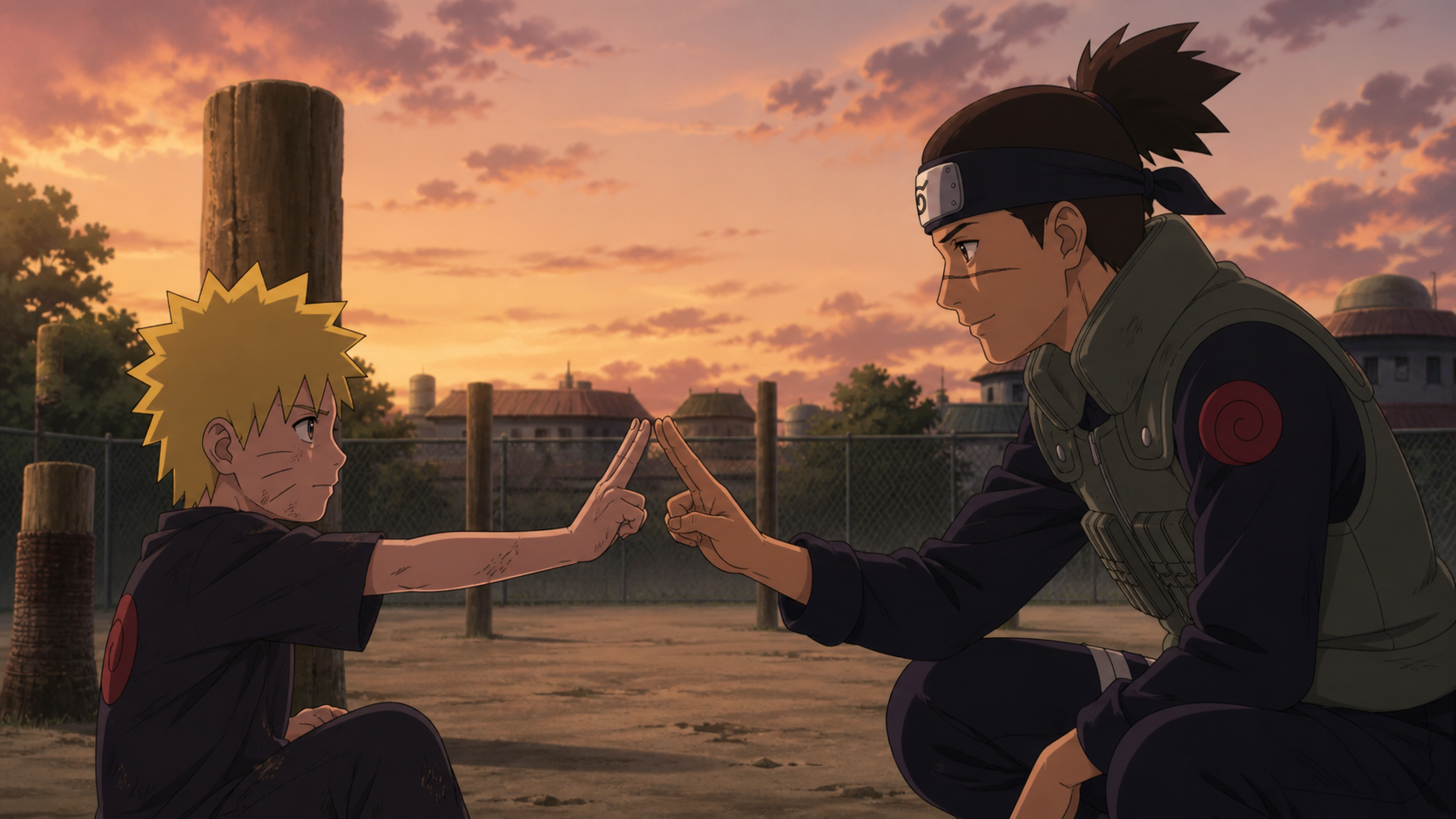
Unison Sign
Iruka’s memory reveals why a small academy gesture can carry enough trust to follow Naruto onto a battlefield where his teacher cannot go.
Bottom line
“Unison Sign” pauses Naruto’s rush toward the battlefield so Kurama can ask the question nobody else wants to slow down long enough to ask: what happens when Naruto meets hatred he cannot talk out of existence? Naruto answers with the same impossible confidence that has carried him for years, but the episode grounds that promise in Sasuke, Iruka, and the academy ritual meant to close a fight. Reconciliation is not magic. The sign matters because two opponents must choose to make the gesture after the blows stop.
Naruto and B are finally moving
After breaking through the island’s containment plan, Naruto and Killer B head toward the war. Movement changes the emotional pressure. Naruto no longer argues about whether he should leave. He must decide what he believes he can do once he reaches people carrying grief, fear, and orders that will not disappear when he arrives. B travels beside him as a partner who understands jinchūriki power and the danger of believing strength alone makes a person ready.
Two episodes share almost the same English title
Crunchyroll identifies this story as Shippuden Episode 277, “Unison Sign,” released August 30, 2012. The Naruto official site catalogs the same installment as overall animated episode 497 under record `01_721`. A much later Shippuden Episode 478 is titled “The Unison Sign” and concerns Naruto and Sasuke after their final battle. The distinction matters for links, images, and search results. Episode 277 is the war-road conversation with Kurama, not the 2016 finale chapter.
Kurama interrupts from inside the seal
Kurama speaks while Naruto travels, refusing to let momentum become certainty. The Nine-Tails has watched Naruto promise to confront hatred before, particularly after Pain’s attack. Kurama knows human violence repeats through loss, revenge, institutions, and fear. His skepticism is not a random villain speech. He has centuries of evidence that people use tailed beasts, fear what they used, and then blame the beast for the damage.
The question is larger than one battlefield
Naruto can defeat a reanimated soldier or destroy a White Zetsu body. Neither action automatically ends the hatred driving the war. Obito’s plan, Kabuto’s bargains, Sasuke’s revenge, and the villages’ history all come from different wounds. Kurama challenges the gap between Naruto’s stated goal and any practical method. Saying “I will handle hatred” sounds noble. The war needs choices about accountability, safety, punishment, power, and what happens when reconciliation is refused.
Naruto refuses Kurama’s definition of inevitability
Kurama treats hatred as a cycle people cannot escape. Naruto refuses to accept that conclusion even without a complete solution. That refusal is part stubbornness and part survival. If hatred is inevitable, Naruto’s childhood treatment becomes proof that exclusion was reasonable and any attempt to change the village becomes temporary. Naruto’s life already contradicts that fatalism. Iruka, Team 7, and the village changed their relationship with him through choices that were not guaranteed.
Optimism still needs a mechanism
Naruto’s confidence can become frustrating when the story lets determination replace policy. “Unison Sign” works best when his promise is read as a commitment to keep searching, not a claim that one speech will cure every conflict. Naruto’s actual record includes listening to enemies, exposing hidden pain, fighting when necessary, accepting help, and refusing revenge after personal loss. Those behaviors form an imperfect mechanism. Hope gains credibility through repeated conduct rather than volume.
Kurama speaks from exploited experience
Humans sealed Kurama into hosts, extracted his power, blamed him for attacks controlled by humans, and treated his containers as weapons. His hatred has causes. Naruto cannot answer that history by demanding a better attitude from the prisoner inside him. Any future partnership must recognize what was done to Kurama and how Naruto currently uses chakra taken through force. Kurama’s anger may endanger Naruto, but anger does not appear from nowhere.
Naruto includes Kurama in the promise
Naruto’s most important move is refusing to discuss world hatred while excluding the being speaking from inside his body. He tells Kurama that he intends to deal with the Nine-Tails’ hatred too. The promise is audacious and intrusive. Kurama did not ask Naruto to repair him. The better reading is that Naruto commits to changing their relationship rather than treating Kurama as a battery whose feelings become relevant only when control fails.
The seal is a relationship built without consent
Naruto did not choose to become a jinchūriki, and Kurama did not choose imprisonment inside Naruto. Both live inside a structure created by Minato’s wartime decision. Their conflict cannot be reduced to one good person and one bad beast. Naruto’s survival depends on the seal. Kurama’s confinement depends on the same seal. Partnership will require them to negotiate inside an injustice neither one designed, with consequences neither can simply walk away from.
Sasuke becomes the human version of the problem
Naruto’s promise about hatred always leads back to Sasuke. Sasuke has reasons for rage: clan massacre, manipulation by Itachi and Konoha, Danzō’s role, and the village’s political secrecy. His later choices still harm people. Naruto refuses both easy positions. He will not treat Sasuke’s pain as an excuse for everything, and he will not treat punishment or death as the only possible answer. That tension makes Sasuke the practical test Kurama knows Naruto has not finished.
The academy fight carries an unfinished sign
The unison sign comes from shinobi sparring etiquette. Opponents form the confrontation seal before a match and the reconciliation seal afterward, acknowledging that training conflict does not erase shared belonging. Naruto and Sasuke’s academy rivalry gives the gesture emotional weight. Their competition repeatedly continued past the point where a ritual could settle anything. The absent or incomplete sign becomes a picture of a relationship that never reached a safe conclusion.
Ritual cannot replace repair
Two fingers joined after a match look meaningful because the gesture represents mutual recognition. The sign would become empty if one fighter continued harming the other without accountability. Reconciliation needs changed behavior, truthful history, and boundaries. The ritual can mark that work; the ritual cannot perform the work alone. Naruto’s fixation on Sasuke risks confusing restored contact with restored trust. The episode’s symbolism is strongest when the sign remains a goal requiring substance.
Iruka taught conflict without permanent rejection
Academy instruction gave Naruto and Sasuke a controlled space to compete, fail, and remain classmates afterward. Iruka could discipline Naruto without declaring him permanently outside the community. That experience matters because Naruto grew up under a village gaze that often treated every mistake as evidence of the Nine-Tails. A teacher who allowed correction without total rejection gave him a model he later applies, sometimes recklessly, to enemies and friends.
Naruto remembers touch because isolation made touch rare
The unison sign is small physical contact. For a child avoided by adults and mocked by classmates, contact can mean acknowledgment. Naruto’s emotional memory attaches enormous value to gestures that other students might treat as routine. That history helps explain why he refuses to abandon bonds after betrayal. The strength can become a danger when he ignores another person’s boundaries, but the origin is understandable. Connection once proved that he existed inside somebody else’s world.
Killer B provides a quieter counterexample
B built cooperation with Gyūki before Naruto did the same with Kurama. Their partnership proves a tailed beast and host can become allies without erasing distinct personalities. B does not need to win Kurama’s argument for Naruto. His presence demonstrates that another relationship is possible. Examples matter because Naruto’s optimism often outruns available evidence. B and Gyūki provide living evidence close enough to challenge Kurama’s claim that hatred defines every host-beast bond forever.
Kurama watches Naruto instead of believing him
The Nine-Tails has no reason to accept a promise immediately. Humans have made promises around power for generations. Kurama can observe whether Naruto’s actions match his language. That waiting is not stubborn failure. Trust after exploitation should move slowly. The episode allows Naruto to speak with conviction while leaving Kurama unconvinced. Their relationship progresses because Naruto addresses him as a person, not because one conversation produces instant friendship.
The war will test selective compassion
Naruto finds compassion easier when he recognizes pain that resembles his own. The battlefield will place him beside strangers, rival villages, hostile reanimations, and people whose choices do not fit his story. A real answer to hatred cannot depend on liking every person. Naruto must protect people he does not know and confront people whose suffering does not excuse their conduct. Kurama’s challenge asks whether his empathy can survive beyond dramatic one-to-one recognition.
Reconciliation needs someone to survive
Iruka’s message asked Naruto to come back alive. The unison sign also assumes both opponents remain present after the conflict. That basic condition matters in a war where leaders turn bodies into tools and powerful techniques erase any chance for later repair. Naruto’s refusal to kill whenever possible is tied to preserving future choices. Mercy is not always safe or available, but death closes every route except memory, judgment, and consequences carried by survivors.
The episode slows momentum on purpose
After the Gedō Statue’s massive attack, a conversation-heavy episode may feel like another delay. The pause has a job. Naruto is about to enter a war built from the exact cycle he claims he can change. Giving him more power without testing the belief guiding that power would reduce his arrival to spectacle. Kurama forces the story to name the philosophical risk before Naruto’s clones begin changing battles across the map.
The title belongs to a future choice
Episode 277 does not complete Naruto and Sasuke’s reconciliation. The unison sign functions as a remembered rule and an unresolved destination. Naruto believes the relationship can still reach the gesture after years of violence, manipulation, and refusal. The belief may be unreasonable. The series asks viewers to measure whether later actions earn that ending. A title can name the work ahead without claiming the work is already finished.
Naruto’s promise creates obligations for Naruto
Refusing to give up on another person can sound generous while placing every burden on the person being pursued. Naruto must also examine his own conduct. He needs to listen when Sasuke names Konoha’s crimes, protect people from Sasuke’s attacks, reject revenge, and accept that reconciliation cannot mean restoring the old Team 7 arrangement without change. The same obligation applies to Kurama. Naruto cannot demand trust while continuing to treat stolen chakra as a permanent entitlement. His promise has value only if the promise changes what Naruto does, what harm he interrupts, and which uncomfortable truths he refuses to bury for a happy ending.
The sign begins after conflict instead of pretending conflict never happened
Shinobi students form the confrontation seal before sparring and the reconciliation seal afterward. The order matters. Connection is not offered as an alternative to naming opposition. The ritual acknowledges that two people fought and still choose a relationship beyond the fight.
That makes the gesture more demanding than generic peace. It cannot erase the blow, the motive, or the imbalance inside the match. It asks whether both people can return to recognition after those facts remain visible.
A classroom ritual gave Naruto a repeatable route back inside
Naruto grew up expecting one mistake to confirm every adult fear about the Nine-Tails. A spar with rules offered another pattern: conflict, correction, gesture, continued membership.
Iruka could be angry without making rejection permanent. That distinction taught Naruto something larger than academy etiquette. He began to experience belonging as a relationship capable of surviving trouble. The lesson later fuels his refusal to believe one fight, betrayal, or period of hatred must become a person’s final identity.
Iruka’s recognition carried weight because it happened before achievement
Later allies know Naruto as the hero who defeated Pain, mastered impossible techniques, or changed political outcomes. Iruka knew the boy who failed, disrupted class, and had no public victory available as proof of worth.
Naruto did not need to save the village first. Iruka’s imperfect early care told him personhood preceded performance, which is why a small gesture from this teacher can still reach farther than an order from headquarters.
Kurama hears promises from inside the history humans created
Naruto speaks about ending hatred while carrying a being humans captured, sealed, extracted, and blamed. Kurama has watched villages turn tailed beasts into military balance, then describe the resulting anger as proof the beasts are naturally monstrous.
His skepticism is evidence, not cynicism inserted to challenge the hero. Naruto cannot answer it by announcing better intentions. Partnership will require acknowledging the system that made both of them prisoners inside one body.
Naruto’s optimism earns trust only as repeated behavior
One speech cannot repair centuries of exploitation or guarantee what Sasuke will choose. Naruto’s confidence becomes credible through the pattern beneath it: listening after fighting, refusing revenge after personal loss, returning to people who reject him, and accepting help when pride would prefer isolation.
Those actions remain inconsistent and sometimes intrusive. The promise is not proof of completion. It is a standard Kurama can use while watching whether Naruto’s conduct changes when compassion becomes inconvenient.
Including Kurama does not give Naruto ownership of Kurama’s healing
Naruto says he will address the hatred inside the fox too. The declaration can sound generous and controlling at once. Kurama did not ask a teenage host to fix him.
The useful meaning is relational. Naruto commits to stop treating Kurama’s anger as noise surrounding useful chakra. He can change his own participation, make room for Kurama’s account, and refuse the human habits that created the hostility.
Sasuke tests whether recognition can survive accountability
Naruto understands the loneliness and manipulation shaping Sasuke. Those causes do not remove the people Sasuke attacks, abandons, or threatens. A reconciliation that names only pain would make victims finance the happy ending.
The unison sign therefore cannot mean returning to childhood without consequence. Naruto must hear the truth about Konoha, protect others from present harm, and let Sasuke become more than the teammate Naruto remembers. Recognition still needs boundaries or it becomes another form of possession.
Wanting the sign is not the same as earning the answer
Naruto often treats persistence as a moral guarantee. If he refuses to give up, the desired relationship should eventually return. That belief saved people and can ignore their right to refuse him.
A unison sign requires another hand. Naruto controls whether he offers honesty, safety, repair, and continuing contact. He does not control whether Sasuke accepts. The symbol works because mutuality remains visible in the physical shape.
Touch matters because Naruto’s childhood contained so little of it
Two fingers joined after sparring may look ceremonial to classmates accustomed to ordinary acknowledgment. For Naruto, contact confirms that conflict has not expelled him from another person’s world.
That scarcity explains why he invests gestures with enormous meaning. It does not excuse crossing boundaries later. Understanding the origin helps separate need from entitlement. Naruto can value contact deeply while learning that chosen connection must remain chosen on both sides.
Killer B makes possibility visible without arguing Kurama into trust
B and Gyūki disagree, tease, warn, and coordinate. Their relationship is not perfect harmony, which makes it stronger evidence. Distinct voices survive inside shared power.
Kurama does not need B to explain why he should trust Naruto. The partnership simply disproves inevitability. Host and beast can become something other than jailer and prisoner.
The war needs Naruto’s philosophy attached to practical limits
He will meet people who cannot be persuaded during an attack, controlled bodies requiring sealing, and commanders responsible for strangers rather than one intimate bond. Compassion does not remove triage.
Naruto’s answer to hatred must include stopping immediate harm, accepting incomplete rescue, and living with decisions that do not feel pure. Hope without those limits becomes a promise made using other people’s safety.
The pause earns itself by testing the power before deployment
After the Gedō Statue, viewers reasonably want movement. Another memory-heavy conversation risks draining urgency. The episode has one essential job: ask what will direct Naruto’s new strength when he reaches the map.
Without that question, clones and chakra become spectacle detached from the ethic the series claims matters. Kurama forces Naruto to name the burden before power multiplies his presence across every battlefield.
Reconciliation remains work after the hands meet
The academy sign closes a spar, not a political history. Adult conflicts carry murdered clans, institutional lies, coercion, and consequences no gesture can settle alone.
The symbol is valuable when it marks a beginning: truth told, harm interrupted, responsibility accepted, and relationship chosen again. Treating the touch as a finish would shrink reconciliation into sentiment. The future episodes must prove what Naruto believes the sign requires.
RaeRae’s verdict
“Unison Sign” repeats ideas Naruto has stated before, but Kurama’s perspective keeps the conversation from becoming empty inspiration. Hatred has history, exploitation, and institutional support. Naruto does not offer a policy manual. He offers a commitment to keep treating people, including Kurama and Sasuke, as capable of choices beyond the worst thing already done. The promise is incomplete. The incompleteness is honest, because reconciliation only becomes real when somebody else freely answers the sign.
RaeRae’s call
The unison sign matters because it needs two hands after the fight. Naruto can offer recognition and do the work that makes trust possible. He cannot complete reconciliation alone or call persistence consent.
Episode details and viewing routes
- Official episode reference: Naruto Official episode guide
- Licensed episode route: Crunchyroll licensed episode page
Next on the road
Episode 278, “Medic Ninja in Danger,” moves to the alliance’s medical compound, where White Zetsu infiltration turns trust into a security problem. Sakura must identify an enemy who copies familiar bodies and chakra while protecting wounded people who cannot defend themselves. The war attacks care work directly instead of meeting another combat division head-on.