
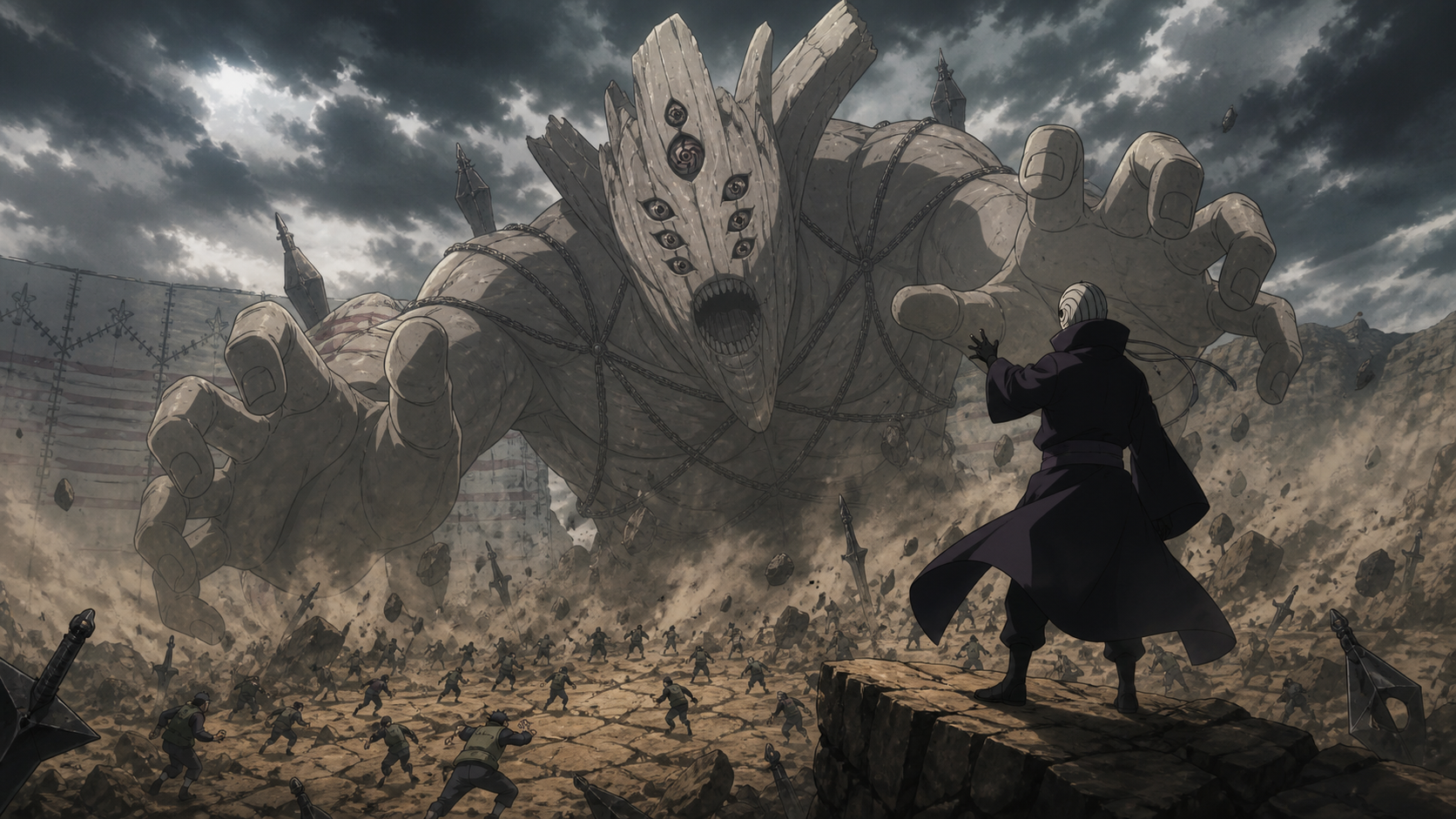
Attack of the Gedō Statue
Obito turns a colossal summon into a precise recovery mission, proving that a battlefield victory can still feed the enemy’s larger plan.
Bottom line
“Attack of the Gedō Statue” reminds the alliance that winning several human-scale battles does not mean the war is nearly over. Obito enters the field, summons a weapon large enough to turn formations into debris, and steals the sealed Nine-Tails chakra carried by Kinkaku and Ginkaku. The episode changes victory into inventory. Every captured enemy, recovered tool, wounded soldier, and unguarded route becomes part of the next calculation. The alliance did good work. Obito built a plan that can feed on the remains of that work.
The battlefield starts with dangerous optimism
Reanimated commanders have been sealed, Darui’s division survived the Gold and Silver Brothers, and Team 10 completed its painful fight with Asuma. Those victories create a sense that the alliance can control the pace. The feeling is understandable. Coordinated units solved problems that looked impossible at first contact. The mistake would be assuming Obito has to keep fighting through the same scale of problem. His arrival changes the kind of force on the board.
The records mark a new broadcast road
The Naruto official site catalogs the story as overall animated episode 496 and places the episode under the Seven Ninja Swordsmen road. Crunchyroll lists “Attack of the Gedo Statue” as Shippuden Episode 276 with an August 23, 2012 release. Both official descriptions state that the alliance appears close to victory before the masked enemy summons the massive statue. The shared summary makes escalation the episode’s central fact, not a surprise added after an unrelated battle.
Obito arrives for assets, not applause
The masked man does not enter because he needs to prove superiority to Darui’s division. He needs the tools holding Kinkaku and Ginkaku, whose bodies contain Nine-Tails chakra. That objective makes his violence colder. The soldiers are obstacles between him and material required for the Eye of the Moon Plan. Obito’s priorities expose how war leaders see a battlefield differently from the fighters trapped inside the battle. He looks past individual victories toward what can still be extracted, transported, and fed into a plan designed long before this division understood the brothers’ remaining value.
The treasured tools become containers
The Sage of Six Paths’ tools were introduced as legendary weapons with complicated verbal rules. After Darui used them to seal the brothers, the tools became prison cells holding both men and their chakra. Function changed without changing the objects. The alliance must therefore secure them as prisoners, weapons, and strategic resources at the same time. Leaving them near the front makes sense during active combat and creates an immediate recovery problem once Obito appears.
Kinkaku and Ginkaku still affect the war while sealed
Sealing stops their direct attacks but does not remove the chakra inside them. The brothers survived inside Kurama and consumed enough flesh to carry Nine-Tails power afterward. Obito does not need their cooperation. He needs what their bodies contain. That distinction shows why the alliance cannot treat a sealed opponent as a finished concern. Captivity changes access, not necessarily strategic value.
The Gedō Statue turns scale into policy
The statue is not merely a large summon. The demonic vessel connects directly to the tailed-beast plan and gives Obito a battlefield instrument built for overwhelming force. One movement can scatter squads, crush defensive lines, and force commanders to spend techniques on survival instead of pursuit. Scale becomes policy because the statue decides who gets to act. Soldiers cannot debate Obito’s objective while the ground beneath them stops functioning as safe ground.
Chōza confronts a body larger than clan pride
Chōza uses the Akimichi expansion techniques against the statue, bringing clan power to a scale that can physically contest the summon. The attempt matters even when brute force cannot solve the entire threat. He buys time and proves the alliance will not surrender the field simply because the enemy arrived with a larger body. Chōza’s role also echoes Chōji’s previous transformation. Akimichi strength belongs to coordinated defense, not spectacle alone.
Kitsuchi makes the earth part of the formation
Earth-style techniques reshape the battlefield to restrain or crush the statue. Kitsuchi’s contribution demonstrates why a multinational alliance can produce answers no single village formation could manage alone. The ground becomes a tool rather than passive scenery. Massive earth walls and layered pressure can delay a creature that ignores ordinary weapons. Delay remains valuable because sealing tools and injured soldiers need seconds more than they need a perfect victory.
Size does not erase coordination
The episode could have reduced the battle to giant hands hitting giant stone. Instead, alliance fighters combine physical expansion, earth release, ranged support, evacuation, and command signals. Their techniques attack different parts of the problem. One group redirects the statue. Another protects the sealing vessels. Another moves casualties. The division of labor keeps human decisions visible beneath the scale. Spectacle works because people still perform specific jobs inside the spectacle.
Darui’s earlier victory becomes a recovery burden
Darui solved the Gold and Silver Brothers’ verbal weapon system under extraordinary pressure. That victory created objects the alliance now must protect. Success often produces new responsibilities that stories ignore once the applause ends. Prisoners require guards. weapons require secure transport. intelligence requires distribution. Obito attacks during that vulnerable conversion from battlefield victory to controlled custody. His timing exploits the gap between defeating a threat and safely processing what remains.
The same gap affects exhausted people. Medics need routes to casualties, sealing teams need uninterrupted concentration, and commanders need accurate reports before moving dangerous objects. Obito attacks all three needs at once. The theft succeeds because a giant assault overloads the ordinary work that should follow a victory.
Obito understands logistics as well as ideology
The Eye of the Moon Plan may sound like grand philosophy, but Obito’s execution depends on routes, bodies, containers, timing, and incomplete substitutes. He knows where the Nine-Tails chakra sits and arrives with a tool capable of breaking the surrounding defense. Villains become more dangerous when ideology does not distract them from logistics. Obito can speak about peace through illusion while still tracking the exact package he needs to steal from a muddy battlefield.
The incomplete substitute changes the endgame
Obito wanted the complete Eight-Tails and Nine-Tails. The alliance has kept Killer B and Naruto away from him, so the original collection remains unfinished. Kinkaku and Ginkaku offer a smaller quantity of Kurama’s chakra. That substitute may not produce the ideal result, but the plan can move forward in altered form. The episode warns against assuming an enemy has only one valid route. Denying the best option matters without guaranteeing the enemy has no second option.
Protection plans need failure branches
The alliance’s jinchūriki isolation strategy focused on preventing capture of Naruto and B. That plan should also account for fragments, previous hosts, chakra residue, and people who consumed tailed-beast material. Obito’s theft exposes the danger of defining success too narrowly. Security cannot stop at “the primary target remains hidden.” Leaders need to ask what the enemy can build from partial access and which secondary materials become valuable after the main route closes.
The statue makes soldiers look disposable
Wide destruction can turn individual fighters into dots thrown through smoke. The visual effect is frightening because the alliance’s recent character-focused victories trained viewers to notice specific people. A giant summon threatens to erase those identities through scale. The episode resists complete erasure by showing commanders protecting units and named fighters anchoring techniques. Every distant body still represents a person whose survival depends on someone treating evacuation as part of victory.
Obito does not need to hold the field
His mission is theft, not occupation. Once the sealing tools are secured, remaining in prolonged combat would create unnecessary risk. That objective explains why the alliance can survive the attack without truly winning the encounter. Territorial control and mission success separate. The alliance may still stand on the same ground after Obito leaves, yet Obito departs with the resource he came to collect. Measuring only who retreats would misread the result.
The war punishes delayed information
Naruto has just discovered that commanders hid the war from him. At the same time, Obito escalates using a resource the alliance only recently understood. Both threads concern information moving too slowly through large systems. Naruto’s leaders kept knowledge away from a key fighter. Battlefield units may not know how the sealed brothers connect to Obito’s backup plan. Hierarchy can coordinate thousands of people, but hierarchy can also create dangerous lag when facts remain trapped in one command layer.
Madara’s name keeps confusing the public record
The official summary uses “Madara Uchiha” for the masked man because the character was still operating under that claimed identity at this point in the broadcast story. Later knowledge identifies him as Obito Uchiha. A careful React needs both boundaries. Calling him Obito helps current readers follow the complete series, while noting the Madara claim preserves what characters and contemporary viewers were meant to believe. Hindsight should clarify the record without pretending the reveal happened early.
The statue is a body built from stolen bodies
The Gedō Statue represents accumulation. Tailed beasts have been captured, extracted, and treated as pieces inside a vessel. The statue’s scale comes from a system that converts living beings into stored power. That history gives the destruction more meaning than a random giant monster attack. Every swing expresses the Akatsuki’s belief that personhood may be stripped away when a body contains something useful to the plan.
Alliance courage cannot substitute for preparation
The soldiers stand their ground, combine techniques, and protect one another. Courage prevents immediate collapse. Courage cannot restore stolen tools after Obito reaches them or answer every hidden function of the statue. The episode respects bravery without using bravery as a universal solution. Institutions owe brave people intelligence, contingency planning, secure transport, and realistic retreat routes. Otherwise leaders spend human courage to cover preventable gaps.
The attack reframes Naruto’s decision to leave
Commanders were right that the enemy could unleash catastrophic force near the jinchūriki. The statue proves their fear was not exaggerated. The same attack also shows why Naruto will reject permanent isolation. His allies face weapons built from tailed-beast power while his own power sits behind a lie. The ethical answer cannot be “send Naruto blindly” or “keep Naruto ignorant.” The alliance needs informed participation strong enough to meet a threat that already adapts around containment.
A battlefield win can hide a strategic loss
The alliance survives and prevents the statue from wiping out the division. That is a real achievement. Obito acquires the chakra-bearing brothers, which advances his larger objective. That is a strategic loss. Both judgments must remain visible. War stories become dishonest when every surviving hero pose is labeled victory. The episode closes with the balance altered in ways many soldiers cannot yet see.
Obito attacks the work that begins after victory
Darui’s division solved the brothers, but a solved battlefield threat becomes prisoners, dangerous artifacts, transport orders, exhausted guards, and information waiting to move. The unglamorous aftermath creates another vulnerable phase.
Obito understands that gap. He does not interrupt the clever sealing sequence; he arrives when relief loosens the formation and responsibility has multiplied. His timing turns success into exposure. Winning a fight is not the same as securing everything the fight leaves behind.
The statue’s size hides a small and precise objective
Buildings crack, soldiers scatter, and giant techniques answer giant limbs. The spectacle suggests indiscriminate destruction, but Obito wants specific containers holding specific chakra.
That precision makes the attack colder. Casualties are useful because they clear a route, not because rage needs an audience. The Gedō Statue becomes logistical force at monstrous scale. Every dramatic impact serves theft planned around the alliance’s assumption that sealed enemies were finished assets.
Sealed does not mean strategically dead
Kinkaku and Ginkaku cannot fight from inside the tools, yet the Nine-Tails chakra in their bodies remains available to somebody who knows how to use partial material. Capture changes agency and access, not value.
The distinction should reshape alliance procedure. A restrained enemy may require more protection than an active one if the enemy’s body contains what a larger plan needs. Custody becomes part of combat rather than paperwork after it.
The backup plan rewards Obito for accepting an imperfect result
Naruto and B remain beyond his reach, so the ideal Eight-Tails and Nine-Tails collection has failed. Obito does not confuse an incomplete route with no route. Fragments can move the plan forward.
That adaptability is more dangerous than stubborn confidence. The alliance protects primary targets and assumes the central strategy holds. Obito inventories substitutes, residue, previous hosts, and stolen chakra. Denying perfection matters, but victory requires understanding what the enemy can build from less.
Chōza contests scale without pretending scale is solved
Akimichi expansion lets a human body meet the statue where ordinary fighters would disappear beneath one movement. Chōza cannot defeat the entire system through size. He can redirect force and create seconds for others.
The attempt carries the same lesson Chōji learned. Physical power becomes valuable through purpose and timing, not because the largest silhouette owns the scene. Chōza places his body between devastation and smaller allies, making scale protective instead of merely impressive.
Kitsuchi’s earthwork turns terrain into collective armor
Massive Earth Release does more than strike. It changes footing, limits movement, and gives evacuation routes a chance to exist. The battlefield becomes an active participant shaped for survival.
Kitsuchi’s work depends on information about where allies remain and what Chōza can hold. A wall raised blindly becomes another hazard. Coalition power appears in the coordination beneath the size: sensors, commands, timing, and people trusting the ground to change exactly when promised.
Evacuation is part of the battle, not an admission of weakness
The statue makes some positions indefensible. Moving wounded soldiers and support units preserves the army’s capacity to fight later. Hero stories often frame retreat from the frame as failure because the camera stays with whoever attacks.
Here, survival demands people whose job is to leave correctly. Medics need routes, sealers need cover, and formations need room to reform. Holding every inch would turn courage into inventory for Obito’s next strike.
The alliance survives tactically and loses strategically
Obito does not annihilate the division. Chōza, Kitsuchi, Darui, and thousands of coordinated responses prevent that outcome. Their work deserves the word success.
He still departs with the chakra-bearing containers. That result advances the Eye of the Moon Plan. Both judgments must stand together. Counting survivors alone would hide what was stolen; counting the theft alone would erase the lives saved under impossible pressure.
Command cannot define victory by the last visible position
The alliance may remain on the coast after Obito leaves, which creates the comforting image that the defender held the field. Obito never came to occupy it.
Objective defines outcome. His withdrawal is mission completion, not defeat. Commanders need measures tied to resources, intelligence, custody, and the enemy’s next capability. Otherwise the map stays allied while the war moves somewhere else inside the objects carried away.
The Gedō Statue turns stolen personhood into architecture
The vessel exists through tailed beasts captured, extracted, and treated as stored components. Its enormous body represents a system that makes other living beings disappear into function.
That history keeps the summon from becoming generic monster spectacle. Every swing expresses Akatsuki’s central belief: power inside a person may be separated from the person’s claim to it. The statue is not only large. It is accumulation without consent given physical form.
Naruto’s isolation now looks both justified and impossible
The attack proves command was right about catastrophic escalation near jinchūriki targets. Obito can change the battlefield before ordinary protection reorganizes. Sending Naruto carelessly would be disastrous.
The theft also proves hiding him cannot freeze the war. Obito adapts around primary containment while Naruto’s allies pay for the delay. The necessary answer is informed coordination, not blind deployment or permanent deception. Naruto must enter the plan as a participant capable of changing it.
Courage cannot be the patch for every planning gap
Soldiers stand beneath a weapon they were not prepared to face and create a defense anyway. Their bravery keeps the loss from becoming massacre. That does not excuse missing custody plans for the tools or incomplete analysis of substitute chakra.
Institutions praise courage most dangerously when praise replaces learning. The alliance owes survivors updated transport, intelligence sharing, failure branches, and protection that does not rely on another person volunteering a body each time the enemy changes scale.
Obito wins the objective without winning every exchange. That distinction is the episode’s warning: surviving the weapon matters, but commanders must also track what the enemy came to take and why today.
RaeRae’s verdict
“Attack of the Gedō Statue” works because the giant spectacle has a precise logistical purpose. Obito does not summon destruction for decoration. He uses overwhelming force to retrieve sealed Nine-Tails chakra and build a substitute path around the alliance’s strongest protection plan. Chōza, Kitsuchi, Darui, and the surrounding units respond with real coordination, but bravery cannot stop every theft. The episode leaves the alliance alive, shaken, and strategically behind.
RaeRae’s call
The Gedō Statue is not spectacle wandering through the war. It is Obito’s precise theft machine. The alliance saves lives and loses the resource, proving a brave tactical stand can remain a strategic defeat.
Episode details and viewing routes
- Official episode reference: Naruto Official episode guide
- Licensed episode route: Crunchyroll licensed episode page
Next on the road
Episode 277, “Unison Sign,” returns to Naruto and Iruka through memory. The story traces their first classroom conflict, the gestures that changed their relationship, and the reason Iruka’s message can follow Naruto beyond the barrier even when Iruka cannot physically follow him into the war.