
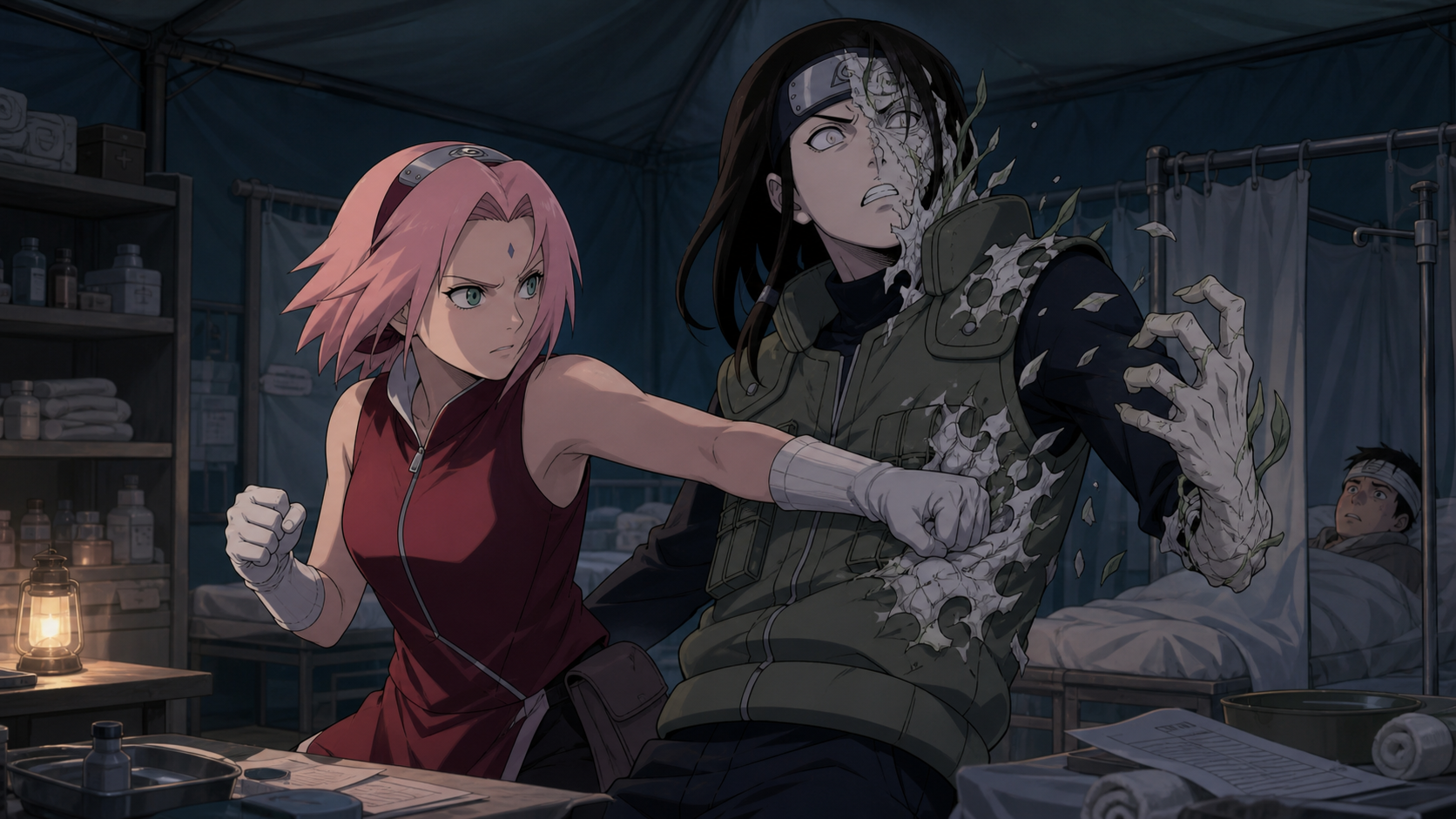
Medic Ninja in Danger
Sakura proves that a medic’s habits of observation, history-taking, and controlled response can expose an infiltrator that copied appearance and chakra.
Bottom line
“Medic Ninja in Danger” turns the alliance hospital into a horror story because White Zetsu attacks the rule every medical unit needs: the person wearing a familiar face must be safe enough to approach. Sakura survives by noticing that “Neji” knows the appearance of an ally without carrying the knowledge, priorities, or behavior of the real man. Her punch matters. Her diagnostic reasoning matters more. The episode makes care work part of the battlefield and shows how quickly an institution collapses when identity can no longer be trusted.
The medical unit is already at its limit
Sakura and the other medics work through casualties from the first day of war. Fatigue changes everything. Exhausted clinicians make slower decisions, wounded patients cannot protect themselves, and supplies must move through crowded spaces where privacy is limited. The camp looks safer than the front, but safety depends on perimeter control, accurate identity, and uninterrupted procedures. White Zetsu chooses a target where one infiltrator can damage people and the system caring for them.
The official routes establish the setting
The Naruto official site catalogs the story as overall animated episode 498 under record `01_722`. Crunchyroll lists “Medic Ninja in Danger” as Shippuden Episode 278, released September 6, 2012. Both descriptions place Sakura in the Medical Unit camp and identify Neji as a patient recovering from overusing the Byakugan. Those details build the disguise’s access. A respected scout entering a hospital for legitimate treatment would not automatically trigger alarm.
Neji’s exhaustion creates a believable cover
The real Neji has pushed his Byakugan hard enough to need medical attention. That fact gives White Zetsu a ready explanation for unusual behavior, fatigue, or gaps in performance. People expect an injured person to act differently. The disguise exploits compassion because medics are trained to interpret weakness as a reason for care, not suspicion. An infiltration system becomes especially dangerous when normal signs of trauma can hide the impersonator’s mistakes.
Three murdered medics change the genre
The discovery of dead medical workers transforms the camp from a treatment site into an active crime scene. Everyone knows the killer may have access to uniforms, routes, patients, and clinical spaces. Fear spreads faster because staff cannot simply abandon the wounded. A combat unit may reposition after an ambush. A hospital full of immobilized patients must protect people who cannot move while also investigating the threat. Duty becomes a trap the infiltrator expects them to honor.
White Zetsu weaponizes institutional trust
Medical systems depend on quick cooperation. A medic cannot demand a full biography before every bandage, and a wounded shinobi cannot authenticate every helper while bleeding. White Zetsu copies bodies and chakra well enough to pass ordinary recognition. The technique turns trust from a social strength into an attack surface. The alliance must add verification without making care so slow or hostile that patients suffer from the security response.
The audience watches the corners
The episode uses shadows, empty corridors, interrupted sight lines, and glimpses of movement to create slasher-film tension. Naruto rarely lets silence control this much of an episode. The change works because the medical camp contains narrow spaces and tired people performing routine tasks. A battlefield explosion announces danger. An infiltrator lets ordinary movement become suspicious. Every curtain, doorway, and supply trip can hide the next attack.
The shy love letter becomes a red herring
A nervous shinobi follows Sakura because he wants to give her a love letter. His secrecy resembles predatory movement from a distance, so the episode directs suspicion toward him. The misunderstanding is funny only until the murders make every concealed intention dangerous. He is not wrong for feeling shy. He creates risk by moving furtively through a locked-down medical camp without explaining his purpose. Private emotion collides with emergency security.
Sakura rejects the letter honestly
Sakura does not accept romantic attention merely because the sender is vulnerable or sincere. She has her own unresolved feelings and no obligation to reward a confession during a crisis. The moment matters because kindness does not require false consent. A gentle rejection respects both people more than temporary encouragement meant to avoid discomfort. The episode places that boundary beside a larger story about copied identities and reminds viewers that genuine connection still requires a truthful answer.
“Neji” has access no stranger could get
Neji’s reputation lets the impostor move through the camp without immediate force. He is a Leaf shinobi, a Hyūga, a Byakugan user, and a known alliance fighter. Those credentials become stolen keys. The attack exposes why reputation-based access fails when bodies can be copied. Security needs information the infiltrator cannot easily reproduce, such as recent shared experiences, assigned routes, rotating challenge phrases, or verification from multiple people.
Sakura tests knowledge instead of appearance
The impostor can reproduce Neji’s face and chakra, but copied form does not guarantee complete relational memory. Sakura uses conversation to probe what “Neji” should know about recent treatment and their shared context. Her suspicion grows from mismatched information rather than a magical instinct. That method makes her victory credible. She identifies a gap in the enemy’s copying system and creates a question whose answer carries more weight than familiar eyes.
Clinical reasoning becomes counterintelligence
Sakura’s medical training teaches her to compare symptoms, history, behavior, and expected recovery. The same habits apply to identity verification. Does the patient’s account match the injury? Does behavior match the person’s normal priorities? Does the story remain consistent under a specific question? The episode respects intelligence rooted in work. Sakura does not solve the mystery because the plot suddenly gives her genius. She uses the observation and questioning clinicians practice every day.
The false Neji attacks when the test closes
Once Sakura makes clear that the disguise has failed, White Zetsu abandons social access and moves to violence. The shift proves her question reached the correct target. An innocent injured Neji would respond with confusion or correction. The impostor tries to remove the witness who can expose the method. Sakura’s preparation matters because she asks the question while ready for the answer to become dangerous.
Sakura’s punch is the end of the diagnosis
Her physical strength delivers the memorable payoff, but the punch works because she controlled distance, suspicion, and timing first. Raw force against every uncertain ally would produce panic and friendly casualties. Sakura waits until evidence and hostile action identify the target. That sequence separates decisive protection from paranoia. She can hit hard without treating violence as the first diagnostic tool.
The real Neji is harmed without being present
White Zetsu uses Neji’s identity to kill allies and target Sakura. Even after the disguise is exposed, survivors may feel fear when the real Neji appears. Impersonation creates reputational injury and emotional contamination. The victim must live with actions performed through his face. A strong security response should record the incident clearly so blame remains attached to the infiltrator rather than drifting toward the copied person.
The murders expose a system-wide threat
One White Zetsu in one camp is not the whole problem. The copying technique means similar infiltrators may exist across divisions, command posts, supply routes, and treatment areas. Sakura’s discovery must become usable guidance quickly. A private victory protects one room. A distributed verification protocol protects the alliance. The episode ends its mystery by opening a larger administrative emergency.
Identification rules can create new harm
The alliance will be tempted to respond with aggressive suspicion. That response can protect people and also produce profiling, panic, delays, or attacks on confused wounded soldiers. Verification needs clear procedures rather than fear-driven improvisation. Challenge questions should rely on recent operational facts, not private trauma. Multiple checks should confirm suspicion before force whenever time allows. Emergency rules must protect the innocent people forced to live under them.
Shift changes also need signed handoffs so one exhausted medic does not become the only person responsible for confirming every patient, visitor, and supply runner.
Medics are strategic targets, not background helpers
Killing a medic harms current patients and future casualties. Destroying trust inside a medical unit multiplies that damage because staff hesitate, patients conceal information, and movement slows. White Zetsu’s attack recognizes care infrastructure as part of war capacity. The episode deserves credit for showing that battle outcomes depend on people cleaning wounds, tracking symptoms, preparing supplies, and staying awake after combat units leave the screen.
Sakura’s authority comes from competence
Sakura does not need Naruto or Sasuke to validate her conclusion. She observes, tests, defends herself, and communicates the infiltration problem. Her position in the medical unit gives her responsibility over vulnerable people and access to relevant evidence. The episode lets her carry a complete operational problem. That should not be rare for a character trained by Tsunade and trusted with frontline medicine.
Horror reveals the cost of familiar bodies
White Zetsu’s technique frightens people because humans depend on faces, voices, and chakra to decide who belongs. A copied stranger would remain a visible enemy. A copied friend walks through the defenses built around affection and shared service. The horror does not come only from surprise murder. The horror comes from learning that ordinary recognition can no longer guarantee safety.
The camp needs care after the threat is stopped
Killing or restraining the infiltrator does not return the medical unit to normal. Staff have lost coworkers. Patients know an attacker reached their beds. The real Neji’s face has become part of the traumatic event. Leaders need to explain what happened, update procedures, rotate exhausted workers, preserve evidence, and support survivors. Security repair without emotional repair leaves the institution functional on paper and frightened in practice.
Sakura protects evidence as well as patients
The dead medics, the impostor’s body, the sequence of access, and the failed answers all contain information other units need. Sakura’s responsibility does not end when immediate danger drops. She must help preserve a record accurate enough for intelligence teams to identify the copying limits and warn the wider alliance. That work competes with urgent treatment, which means command should assign investigators rather than expecting clinicians to perform every role. A medical camp cannot become a laboratory that delays care, but ignoring evidence would invite the same attack elsewhere. The episode points toward a response built from clinical notes, witness accounts, security routes, and shared operational facts.
The episode earns its genre experiment
“Medic Ninja in Danger” borrows slasher and body-snatcher language without becoming disconnected filler. White Zetsu’s established ability creates the mystery, and the medical camp gives the ability strategic consequence. The tonal shift teaches viewers why infiltration matters more effectively than another command-room explanation could. Genre becomes a way to understand the war, not a costume placed over an unrelated plot.
Sakura reads the person instead of worshiping the face
The smartest choice in the episode is also the least flashy. Sakura does not decide Neji must be genuine because his eyes, voice, and chakra look correct. She listens for the person behind those credentials.
That distinction matters far beyond this one attack. Shinobi culture trains children to respect bloodlines, uniforms, ranks, and clan techniques as proof of identity. White Zetsu turns those visible markers into camouflage. Sakura survives because she knows recognition is an active practice, not a glance.
The wrong question would have protected the impostor
A broad challenge such as asking Neji to name his clan or describe the Byakugan would be useless. An enemy assigned his body could prepare public facts. Sakura reaches for knowledge connected to a private exchange, where memorizing a dossier cannot replace actually being present.
The scene demonstrates why security questions fail when their answers are famous, inherited, or easily researched. Good verification is specific, current, and appropriate to the relationship.
Medical history becomes a form of intimacy
A clinician learns details patients do not announce in public. Symptoms, treatments, limitations, and recovery plans create a record of encounters that an impersonator may not possess. Sakura uses that knowledge defensively without turning Neji’s vulnerability into entertainment.
That balance deserves attention. Private information can protect identity, but spreading the information carelessly would injure the real patient. The alliance needs verification methods that share only what each checkpoint requires.
The episode refuses to make caregiving passive
Too many battle stories treat healers like furniture placed behind the important fighters. Somebody screams for a medic, the medic restores the hero, and the camera leaves before care acquires a point of view. Sakura’s unit has judgment, labor, exposure, and consequences of its own.
Her work is not lesser combat. She protects bodies when they are least able to defend themselves, interprets incomplete evidence, and decides when a familiar person has become an threat. The skills are different from charging a battlefield, not softer or narratively disposable.
White Zetsu attacks the emotional cost of teamwork
The Allied Shinobi Forces were built by asking former enemies to recognize one another as comrades. Then the infiltrators punish that achievement. Every new bond becomes another face the enemy can borrow, and every act of welcome creates access that suspicion might have denied.
That is crueler than espionage. The alliance cannot win by returning to total distrust because cooperation is the entire reason five villages can survive the war. Members have to protect trust without abandoning trust, which means procedures must carry some fear so individuals do not have to reinvent suspicion during every encounter.
Sakura’s restraint is part of the victory
Once viewers know a copy is present, nearly every pause feels like a reason to strike. Sakura cannot operate with audience certainty. If she punches the real Neji because one detail feels strange, she injures an exhausted ally and teaches the camp that seeking treatment is dangerous.
She waits, tests, positions herself, and responds when the evidence becomes actionable. Restraint here is not hesitation written to stretch suspense. It is professional discipline. The episode lets force arrive at the end of reasoning instead of presenting violence as proof that the reasoning was correct.
The love letter belongs to the same argument about consent
The confession subplot may appear separate from the infiltration plot, but both ask whether appearance and desire can replace another person’s truth. The young shinobi wants Sakura to return his feeling. His sincerity does not author her answer. White Zetsu wants a stolen body to produce automatic access. A familiar face does not author the camp’s answer either.
Sakura responds honestly in both situations. She can respect the vulnerable person offering affection and still say no. She can recognize Neji’s face and still require evidence.
The real Neji deserves protection from the copied crime
An impersonation story often celebrates the reveal and forgets what remains attached to the victim. Three people died around a body wearing Neji’s face. Survivors may understand the facts and still experience fear before thought catches up.
Command should name White Zetsu publicly, document the timeline, and prepare staff before the real Neji returns. Neji should not have to prove innocence room by room while recovering. Protecting him is part of repairing the medical unit, not a courtesy postponed until the war becomes less busy.
Protocols matter because heroism cannot cover every doorway
Sakura solves this encounter because she knows Neji and notices the gap. Thousands of alliance members cannot personally know everyone who crosses their tents. A system dependent on one brilliant observation will fail the moment that observer sleeps.
Rotating codes, paired confirmation, logged movement, scheduled check-ins, and limits on solitary access would turn her discovery into shared defense. None of those measures makes exciting animation.
RaeRae needs Sakura’s competence to change the story around her
I love watching Sakura flatten an enemy who assumed her medical role made her easy prey. I need the series to remember the analysis that made the punch possible. Competence should create authority, alter planning, and influence what other characters do next.
If headquarters merely praises Sakura and returns to business as usual, the scene becomes a temporary showcase. If her findings reshape identification across the army, her work becomes plot. That is the difference between giving a woman a cool moment and allowing her expertise to matter.
The horror works because certainty cannot be restored immediately
Exposing one infiltrator does not make the next familiar face safe. That lingering uncertainty is the episode’s strongest final wound. The camp has knowledge now, but knowledge expands the threat before procedures contain the threat.
The next episode must live inside that discomfort. Anyone can say trust is precious when trust costs nothing. The alliance has to decide whether comradeship can survive checkpoints, doubt, and the possibility of being wrong without turning every frightened soldier into another enemy.
RaeRae’s verdict
“Medic Ninja in Danger” gives Sakura one of the clearest demonstrations of why medical intelligence belongs in combat strategy. She notices the false history inside a familiar face, tests the inconsistency, prepares for violence, and protects a camp already exhausted by care work. The horror framing is fun, but the episode’s strongest idea is serious: trust keeps institutions moving, and defending trust requires procedures that are smarter than appearance without becoming crueler than the enemy.
RaeRae’s call
Sakura wins because she treats recognition as work. She respects the face, checks the relationship, waits for evidence, and acts hard when the evidence becomes danger. That is medical intelligence, not support-character luck.
Episode details and viewing routes
- Official episode reference: Naruto Official episode guide
- Licensed episode route: Crunchyroll licensed episode page
Next on the road
Episode 279, “White Zetsu’s Trap,” expands the infiltration crisis beyond Sakura’s room. The alliance must identify copied soldiers across the force while darkness, fatigue, and divided units make verification harder. One solved impersonation becomes proof that every familiar face may need a second check.