
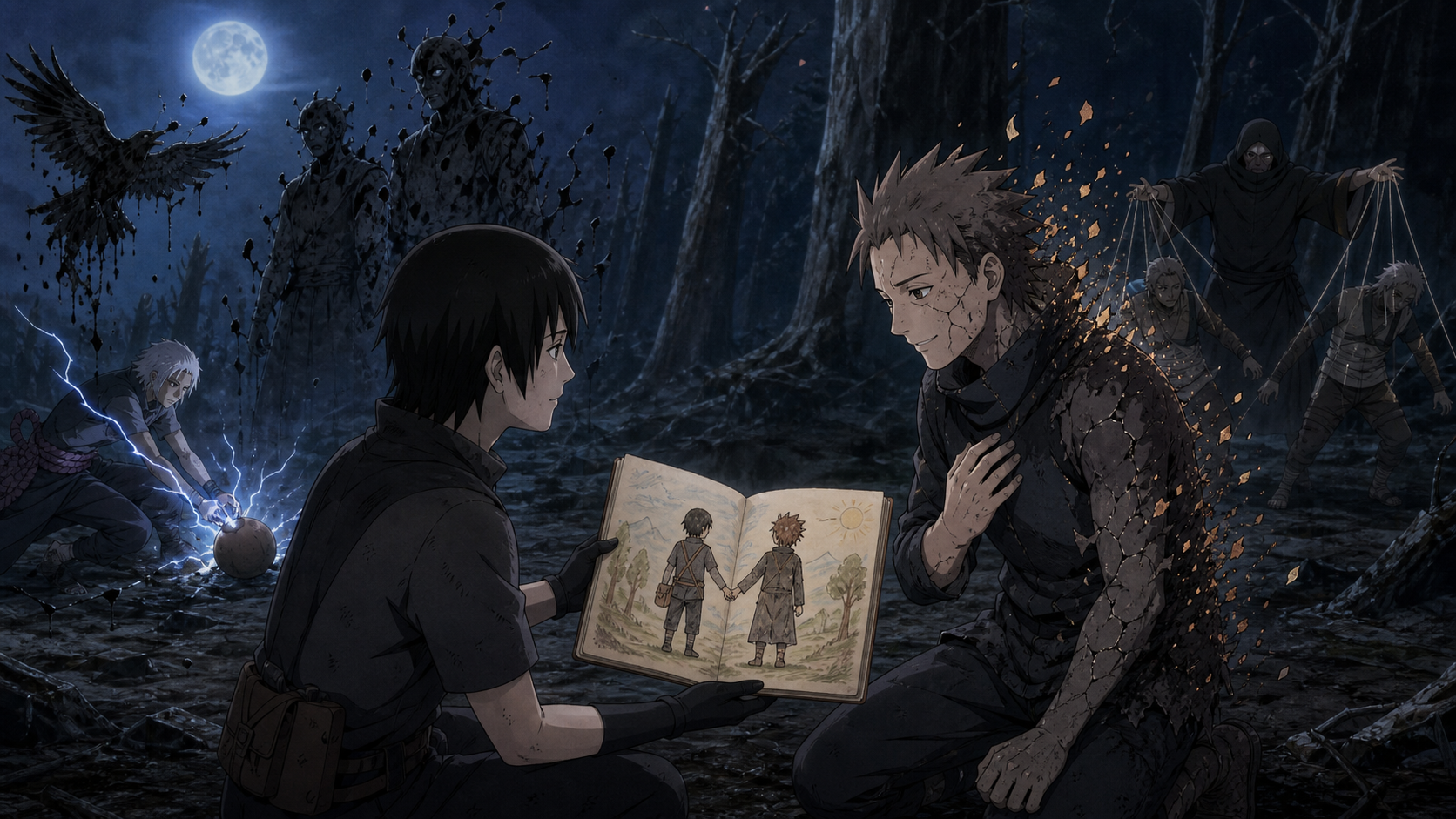
Sai and Shin
Sai confronts Root’s buried grief when Shin sees their completed picture book and finds enough peace to leave Kabuto’s reanimated army.
Bottom line
Naruto Shippuden Episode 263 gives Sai the reunion Root trained him never to need. Shin returns as a reanimated weapon with Deidara's explosive clay inside his body, and Sai has to fight the person he once called brother while protecting a picture book that contains the feelings Danzō's system ordered him to erase. The battle ends when Shin sees the completed final page and realizes Sai carried their bond into a life beyond Root.
That recognition breaks Kabuto's control long enough for Shin's soul to leave. No finishing attack gives him peace. Sai's honest drawing completes the promise that illness and institutional violence interrupted.
The episode makes a strong argument without pretending art is magic. Sai's book matters because he struggled for years to recover the emotions, memories, and relationships behind those pages. The drawing does not create his love for Shin. The drawing finally gives that love a visible form.
Shin returns inside somebody else's command
Sai spent years believing Shin died from illness before Root could force them through its final test. Reanimation removes death's boundary and returns Shin in a body controlled by Kabuto.
The reunion gives neither brother freedom. Shin cannot choose where he stands or whom he attacks. Sai cannot leave without abandoning his unit and allowing the enemy to advance.
Kabuto turns unfinished grief into battlefield leverage. He does not need to understand their bond to use its pain.
Root called brotherhood a weakness because attachment limited obedience
Root trained children to suppress emotion, identity, and personal loyalty. Danzō wanted operatives who would carry out orders without hesitation or competing relationships.
Sai and Shin formed a bond anyway. Calling one another brothers created an allegiance that Root did not authorize.
The institution treated their humanity as a defect because love can make a child refuse a cruel command. That refusal threatens any system built on total control.
The final test was institutional murder disguised as proof
Root paired trainees and expected the survivors to kill the people closest to them. The exercise did not measure ordinary skill. The test demanded that children demonstrate loyalty by destroying their strongest emotional connection.
Shin's illness prevented Sai from facing that exact order with him, but the intended violence shaped both boys before the test arrived.
Danzō could then describe the survivor's numbness as strength. The institution created the wound and promoted the symptom as discipline.
Sai's picture book preserved what training tried to remove
Sai drew a story in which he and Shin travelled from opposite sides of the book, defeated enemies, and moved toward the center. For years, he could not complete the final page.
The blank center reflected more than artistic uncertainty. Sai had lost access to the feeling that gave the journey its conclusion.
The book still survived. Every unfinished page became evidence that Root failed to delete the relationship completely.
Naruto and Sakura helped Sai recover the ending
Team 7 did not replace Shin. Naruto and Sakura gave Sai new experiences of argument, loyalty, embarrassment, trust, and chosen connection.
Those relationships helped him understand the image he wanted at the center of the book: two brothers holding hands after reaching one another.
Recovery came through imperfect contact. Sai learned emotion by making mistakes around people who did not disappear when his first attempts sounded strange.
Seeing the completed page tells Shin that Sai survived as himself
Shin does not need a speech explaining every year after his death. The finished drawing answers the most important question.
Sai remembered him. More importantly, Sai recovered enough of his own emotional life to finish their shared story.
The picture shows that Root failed to make their bond meaningless. Shin can leave knowing his brother did not become the empty weapon their handlers wanted.
Deidara fills Shin's body with explosive clay
Deidara turns Shin into another bomb after the opening attack with Muta. The tactic exploits Sai's instinct to approach his brother and makes Shin's body dangerous to everyone nearby.
Shin understands what has been done and warns Sai. His ability to speak does not give him control over the clay or Kabuto's commands.
The attack combines physical violation with emotional coercion. Deidara expects love to provide the delivery route.
Hoheto gives Omoi information that changes the fight
Hoheto's Byakugan detects explosive clay inside Shin. That sensory knowledge lets the unit move from confusion to a countermeasure.
Omoi uses Lightning Release because lightning can neutralize Deidara's earth-natured clay. His sword work turns technical information into immediate protection.
Their coordination matters as much as Sai's emotional confrontation. Shin cannot reach the book if the bomb kills everyone first.
Omoi acts through fear rather than waiting to lose fear
Omoi imagines catastrophic outcomes constantly, and this battlefield rewards some of his worst expectations. Reanimated attackers, hidden explosives, and controlled allies are all real.
He still enters the fight and applies the correct technique under pressure. Anxiety does not cancel competence.
The episode allows courage to look practical. Omoi recognizes danger, listens to the sensor, and moves before the danger becomes irreversible.
Sai's anger proves how far he has travelled
Sai reacts to Deidara's use of Shin with visible rage. The boy introduced with a rehearsed smile and little access to personal feeling no longer hides behind emotional neutrality.
His anger comes from love, violation, and the knowledge that another organization has turned Shin into a disposable tool.
The outburst carries risk in combat. The feeling also protects a moral boundary: Shin is a person, not clay storage.
Super Beast Scroll gives emotion physical force
Sai uses ink creatures and giants to strike from the air and overwhelm the reanimated artists. His drawing technique becomes an extension of the book that holds his private history.
The same hands create battlefield weapons and a tender record of brotherhood. Art does not belong to one moral category.
Sai's choices decide whether ink serves domination, protection, memory, or communication.
Kankurō turns Sasori's own body into a prison
Kankurō reveals the puppet created from Sasori's former body and uses Black Secret Technique to trap Sasori and Deidara.
The reversal attacks Sasori's claim to permanence. His abandoned body now serves a living puppeteer who values his team more than artistic immortality.
Kankurō inherits technique without inheriting philosophy. Craft can outlive its maker and gain a different purpose.
Sasori mistakes control for artistic survival
Sasori wanted permanent art and converted human bodies into puppets that preserved their abilities. He treated mastery over material as a way to defeat change.
Reanimation gives him a durable body while removing his autonomy. The condition exposes the weakness in his fantasy.
Physical continuation means little when another person owns every movement. Permanence without agency becomes captivity.
Deidara still wants the spectacle to define him
Deidara responds to restraint with contempt and insists on the superiority of explosive art. His identity depends on the instant that forces everyone to look.
Sai's completed book offers the opposite model. A quiet drawing gains power through relationship, memory, and the years required to understand the ending.
The battlefield places fleeting spectacle beside patient meaning. Shin chooses the image that tells him who his brother became.
Shin's release reveals a limit in Kabuto's technique
The Reanimation Jutsu can restore bodies, abilities, and memory while imposing command. Strong emotional resolution can loosen that control and allow a soul to depart.
Kabuto views the failure as a technical problem. For Sai, the release is a final exchange with the person he loved.
The same event carries different meaning depending on whether a person sees Shin as a brother or a unit in an army.
Emotional closure cannot be manufactured on command
The alliance now knows that resolution may release some reanimated shinobi. That knowledge cannot become a universal battlefield recipe.
Not every dead person has an unfinished promise available, and no soldier can force genuine peace through a convenient speech.
Shin leaves because the book answers his specific concern about Sai. The moment works through history, not a general weakness button.
Sai finally gets a goodbye Root denied him
Shin's original death left Sai with a book he could not finish and feelings he could not name. Root offered no healthy mourning process because grief contradicted its training.
The battlefield reunion is cruel, yet Shin's release gives both brothers a conscious farewell.
Sai can keep the relationship without remaining trapped at the unfinished center page.
The drawing holds joy without erasing abuse
The final image of the brothers holding hands is gentle. The page does not claim their childhood was safe.
They still met inside a system that trained them for violence and planned to make one kill the other. Their care grew under those conditions rather than proving the conditions harmless.
The book preserves what they made together, not a sanitized memory of Root.
Kankurō's unit wins through different kinds of knowledge
Hoheto sees the hidden clay. Omoi understands the lightning counter. Sai knows Shin. Kankurō reads Sasori's puppet technique. Ittan controls terrain.
No single expertise replaces the others. Emotional knowledge and technical knowledge cooperate instead of competing for importance.
That structure gives Gaara's alliance a working form. Different villages and histories become useful without demanding sameness.
Kabuto learns while other people pay
Kabuto senses Shin's release from a distance and updates his understanding of reanimation. The lost soldier becomes information for the next use of the technique.
He does not experience Sai's grief, Shin's relief, or the danger faced by Kankurō's unit. Remote command protects him from the human cost of experimentation.
That distance supports his confidence. Other bodies absorb every failed assumption.
The wider war continues after one private ending
Sai gets a form of closure, but the battle has not ended. Sasori and Deidara remain threats, Kabuto still commands a large reanimated force, and allied divisions are meeting enemies elsewhere.
War does not pause because one relationship reaches peace. Sai must carry the goodbye back into his duties.
The episode respects that tension. A personal ending can matter completely without ending the larger crisis.
Kakashi's division meets history of its own
Elsewhere, Kakashi and Sakura recognize Zabuza and Haku among the reanimated shinobi. Naruto carried their story beyond the Land of Waves, which gives the dead evidence that their lives changed someone.
The parallel expands Episode 263's central idea. Reanimation weaponizes unfinished relationships, but memory can also return dignity to the people Kabuto treats as equipment.
Sai and Shin are not an isolated exception. The war will keep forcing living shinobi to confront what they remember and what they never resolved.
Root feared the answer Sai finally drew
The center page gives brotherhood, not Root’s test, the final word.
Finishing the book required a life beyond Shin
Sai could not finish the page alone. Naruto, Sakura, and Team 7 gave him repeated chances to practice imperfect human connection.
That does not replace Shin or imply grief disappears when new friends arrive. The present gives Sai language for what the past already held. He learns that connection can survive mistakes, embarrassment, and anger. Only then can he draw brotherhood as reunion instead of another assignment he is failing to complete.
Shin’s peace is not forgiveness for the people who used him
Shin smiles because he sees that Sai remembered, grew, and found people. He does not bless Root, excuse Kabuto, or transform the violation of reanimation into a necessary gift. The goodbye is theirs despite the systems that forced it onto a battlefield.
That distinction protects the scene from sentimental laundering. Abuse sometimes produces a moment survivors reclaim. Reclamation does not make the abuse valuable. Sai and Shin create meaning from stolen circumstances, and the credit belongs to their bond, not to the men who tried to convert that bond into obedience or leverage.
Deidara cannot understand an artwork whose audience is one person
Deidara needs the blast, the instant, and the witness stunned into attention. Sai’s book has almost no public ambition. Its most important reader is the brother who inspired it, and its value comes from whether that one person recognizes the life preserved across the pages.
The contrast is larger than permanent art versus fleeting art. It is domination versus communication. Deidara makes an audience receive his conclusion through force. Sai offers Shin an image and waits for recognition. One artist treats bodies as material for spectacle. The other gives a person room to answer.
Anger returns Sai to himself instead of stealing control
Root associated emotion with operational failure. Sai’s rage at Shin being packed with explosive clay appears to confirm the warning: feeling can disrupt concentration. Yet the anger also tells him exactly what boundary has been crossed and why the fight matters beyond orders.
He does not become less disciplined by caring. He becomes specific. Shin is not an enemy unit to eliminate or a useful source of information. He is Sai’s brother being violated again. Technique gains direction from that truth. Emotional recovery does not make Sai gentle at all times. It makes his force belong to him.
The unit protects Sai’s private grief without stopping its public work
Hoheto detects the clay, Omoi applies lightning, Kankurō reads the puppetry, and the others keep the battlefield survivable long enough for Sai and Shin to face one another. Nobody can complete the brothers’ relationship for them. Everyone can create the conditions in which the meeting is not immediately consumed by an explosion.
This is what coalition care looks like under pressure. The team does not demand that Sai postpone being human until the mission ends. It also cannot suspend the mission around his pain. Different forms of knowledge hold the space together while one unfinished goodbye reaches its answer.
Reanimation turns memory into a security problem
Every restored face carries tactical ability and a network of living people who may hesitate, panic, or reach for the person they remember. Kabuto treats those responses as predictable weaknesses. He assumes love is valuable primarily because it changes how a target moves.
The assumption works often enough to be terrifying. It also misses why memory resists him. Shin can warn Sai because the bond preserves a self beneath commanded motion. The same history that makes Sai vulnerable gives Shin a reason to oppose the hand using his body. Memory opens the wound and interrupts the weapon.
Closure here is recognition, not forgetting
Shin does not leave because Sai has moved on so completely that the past no longer hurts. He leaves after seeing that the past remained important without trapping Sai inside Root’s intended emptiness. The finished book holds grief and growth on the same page.
Sai will remember his brother after the soul departs. He will also remember the battlefield, the bomb, and the institution that denied them an ordinary farewell. Closure does not seal those facts away. It changes who owns their meaning. Kabuto loses a soldier because the brothers recognize a story his technique cannot author.
The quietest object wins the loudest confrontation
Puppet bodies, explosive clay, ink giants, lightning blades, and reanimated artists fill the field. The decisive object is a small book whose central image once remained blank.
That choice does not reduce the importance of combat skill. Without the division’s counters, nobody survives long enough to open the pages. The episode simply refuses to let greater destructive force become the only definition of power. A drawing can release what an army cannot command because it reaches the person still present inside the weapon.
What landed
The picture book payoff earns its emotion because Sai's difficulty finishing the final page has followed him since his introduction. The episode lets a simple image carry years of suppressed grief.
Shin's smile and release show a meaningful weakness in reanimation without reducing the moment to a technique explanation. His concern remains personal: he needed to know Sai found connection.
The fight also keeps the whole division relevant. Sensory skill, lightning, ink, puppetry, and emotional recognition all contribute to survival.
What did not fully land
The battle gives Sai and Shin limited time together before the emotional resolution. Viewers who remember Sai's earlier arc supply much of the depth.
Shin's release can also make the Reanimation Jutsu appear easier to break than later battles will support. The episode needed a clearer reminder that this resolution depends on an unusually specific bond and unfinished promise.
Sasori and Deidara spend part of the confrontation commenting on art while captives and former comrades carry the real emotional stakes. Their argument fits them, but the repetition occasionally stalls the unit's urgency.
Final reaction
Naruto Shippuden Episode 263 gives Sai proof that Root failed. Danzō's training taught him to erase attachment, treat grief as weakness, and prepare to kill the person he loved most. Sai instead carried Shin through every unfinished page until new relationships helped him recover the drawing both brothers deserved.
Kabuto returns Shin as a controlled body. Deidara turns that body into a bomb. Neither man understands that the quiet picture book holds more authority over Shin than their techniques.
When Shin sees the completed page, he recognizes a brother who survived without becoming empty. His release does not undo Root's abuse or return the years they lost. The farewell gives Sai ownership of the bond that institutions kept trying to use against him. On a battlefield full of stolen bodies, that ownership counts as a victory.
RaeRae’s call
Sai does not defeat Root by forgetting it. He finishes the page Root made impossible. Shin sees that their love survived training, death, and reanimation, then leaves before another institution can decide the ending for them.
Episode details and viewing routes
- Official episode reference: Naruto Official episode guide
- Licensed episode route: Crunchyroll licensed episode page