
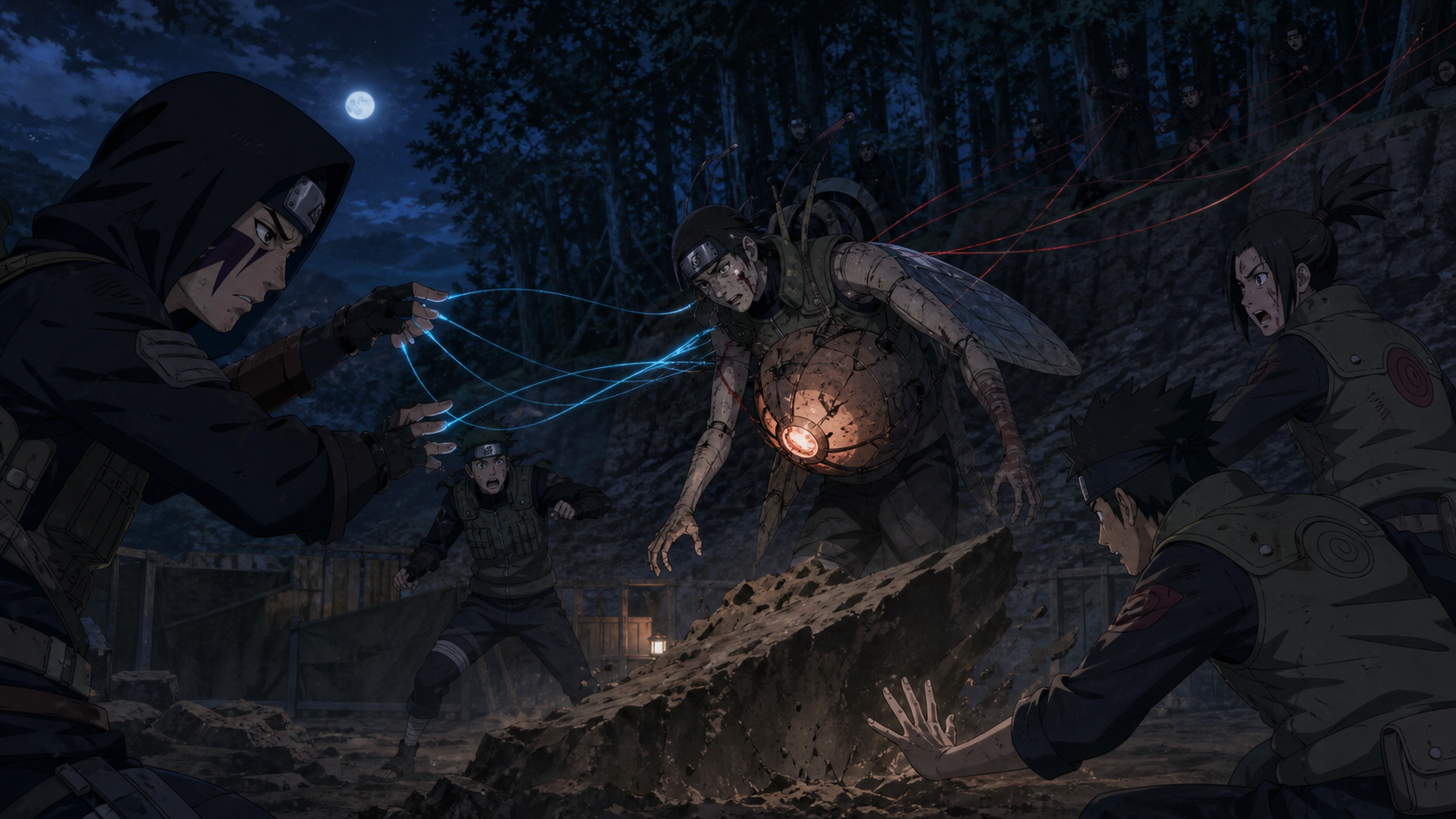
War Begins!
Kankurō’s forward unit survives the war’s first ambush by combining puppet strings, earthworks, sensory warning, and trust under impossible pressure.
Bottom line
Naruto Shippuden Episode 262 starts the Fourth Shinobi World War with a rescue that cannot save everyone. Kankurō's Surprise Attack Division finds Muta staggering toward its new outpost, and the team recognizes the trap seconds before Deidara's clay bomb explodes. Kankurō pulls Zaji away. Ittan raises the ground. Muta still dies because Sasori and Deidara turned a captured scout into delivery equipment.
That opening tells us what Kabuto's side plans to do with bodies. Living prisoners become puppets, dead shinobi become obedient weapons, and family bonds become pressure points. The allied army marched out after Gaara asked everyone to protect a friend. The enemy answers with warfare designed to make friendship, recognition, and rescue dangerous.
Kankurō's unit survives the first attack because its members combine puppet strings, earth techniques, sensory information, quick judgment, and trust. The victory is not clean. Three captured scouts are used against their allies, Muta dies, and the enemy includes people the living once knew. War begins through grief before either side can pretend the battlefield is abstract.
Kankurō's unit has a precise job before combat finds them
The Surprise Attack Division moves ahead of the main force to establish a forward base, gather intelligence, and create an operational advantage. Kankurō leads a mixed team that includes Sai, Omoi, sensory shinobi, and specialists from several villages.
Their assignment sounds controlled on a command map. In enemy territory, every trench and sightline can become a target before the team finishes setting up.
The division exists to surprise the enemy. Kabuto's reconnaissance and captured scouts reverse that advantage almost immediately.
Muta arrives as both comrade and weapon
Muta Aburame reaches the outpost injured and barely able to warn the unit. His condition activates the team's duty to rescue a fellow allied shinobi.
Sasori has attached chakra threads to his body. Deidara has planted explosive clay inside the trap. The enemy depends on the allies seeing a person rather than an object.
That cruelty does more than kill. The method teaches soldiers to distrust every wounded friend who approaches from enemy ground.
Rescue becomes a calculation measured in seconds
Zaji moves toward Muta because helping an injured ally is the expected response. Kankurō spots the danger and uses chakra threads to pull Zaji away.
Ittan changes the terrain with Earth Release, creating distance and protection before the explosion finishes the attack. Their techniques work together without a meeting or a speech.
The response saves part of the unit. Muta remains trapped inside an attack built around his body. Success arrives beside an immediate death.
Muta's death establishes the enemy's rules
Muta was a scout carrying information from Anko's infiltration team. Kabuto's forces convert both his knowledge and his physical return route into weapons.
The episode does not give Kankurō enough time to mourn him. Command requires the team to identify the next threat while smoke still hangs over the base.
Muta's death warns every allied division that capture may lead to forced participation against comrades. The psychological cost will outlast one blast.
Sasori's puppet technique violates the boundary of the body
Sasori always treated human bodies as raw material for art and control. Reanimation gives him another body while Kabuto controls his larger purpose.
He manipulates captives with chakra strings and turns their movements into extensions of his own strategy. A living person's face remains visible while choice disappears.
That image makes the first battle personal. The enemy is not only trying to defeat the alliance. Sasori attacks the idea that each body belongs to the person living inside that body.
Deidara turns recognition into a detonator
Deidara's explosive clay rewards curiosity, proximity, and rescue with death. He enjoys the spectacle because the blast proves his argument about fleeting art.
The human cost barely enters his performance. Muta's terror and the unit's grief become material for Deidara's preferred dramatic finish.
His partnership with Sasori remains darkly compatible. One artist preserves bodies as puppets. The other values the instant when a body disappears.
The reanimated Akatsuki members are also being used
Sasori and Deidara control prisoners while Kabuto controls their restored bodies. Their personalities and rivalries remain, but obedience sits beneath the conversation.
That layered coercion does not excuse their choices from life. Both men already built art from other people's suffering.
Reanimation makes their old beliefs useful to a new commander. Kabuto can exploit the techniques and emotional histories without respecting either man as a person.
Ranka and Tokuma force another impossible recognition
Ranka and Tokuma Hyūga emerge under Sasori's control after their capture. Their allies recognize them, which slows any simple decision to attack.
The captives can become lethal while remaining victims. Kankurō's unit must stop their bodies without confusing forced action with willing betrayal.
War regularly pressures people to flatten those categories. This fight demands more care because the visible enemy uniform belongs to a comrade.
Omoi's anxiety becomes useful preparation
Omoi often imagines disasters before anyone else has finished describing the task. That habit can irritate teammates, but the battlefield now contains traps worse than his anxious predictions.
He does not freeze when the attack begins. Omoi watches the chakra strings, creates an opening, and helps sever Sasori's control.
His fear and competence coexist. Courage here means acting with a full understanding that the situation can go badly.
Ittan makes terrain part of the team
Ittan uses Earth Release to raise and lower sections of ground, protect allies, and disrupt the enemy's position. His technique changes the available choices rather than merely adding another projectile.
The outpost becomes a moving defense system. Elevation, cover, distance, and footing matter as much as raw strength.
That practical use of ninjutsu suits the first battle. The alliance survives because specialists create space for one another.
Sai meets a face from the life Root tried to erase
Among the reanimated attackers stands Shin, Sai's adopted brother from Root. Their bond formed inside an institution that trained children to suppress emotion and eventually forced them toward a lethal final test.
Sai believed Shin died from illness before that test could be completed. Kabuto brings the unfinished grief onto the battlefield in a body forced to fight him.
The reunion is not sentimental relief. Sai receives proof that his buried attachment remains available for an enemy to exploit.
Shin warns Sai because control is not complete
Reanimated shinobi can speak, recognize people, and sometimes resist through information even while their bodies obey Kabuto's commands. Shin tells Sai to run and warns him about the technique.
That resistance preserves a piece of relationship inside coercion. Kabuto can direct movement without perfectly owning every thought.
Shin's warning also increases the cruelty. Both brothers understand the danger, yet knowledge alone cannot release the body carrying out the attack.
Kankurō faces the maker of his strongest puppet
Kankurō recognizes Sasori, the Suna prodigy whose puppet knowledge shaped the tradition Kankurō inherited. He now carries a puppet made from Sasori's former body.
The confrontation turns artistic legacy into a fight over meaning. Sasori treated human puppets as a path to permanence. Kankurō uses the inherited craft through teamwork, protection, and responsibility to living people.
Possessing Sasori's puppet does not make Kankurō a copy. His choices decide what the technique serves.
Sasori discovers that his strings can be taken
Kankurō connects his own chakra threads to the lines Sasori used and turns the control structure against him. Ittan raises the ground while Kankurō pulls Sasori into Deidara.
The move works because Kankurō reads the technique, coordinates with his team, and reacts faster than the attackers expect.
Sasori built his identity around mastery over bodies and strings. Losing control through those same strings makes the tactical reversal personal.
The episode gives support work real dramatic weight
No single hero solves the ambush. Sensory warnings, puppet control, sword work, earth movement, rapid rescue, and shared information keep the unit alive.
The sequence respects jobs that large battle stories often treat as background. Establishing a base and protecting scouts shape whether the main force walks into an informed battlefield.
Kankurō leads by using what each person can do. His command never requires pretending that every shinobi is interchangeable.
The first battle destroys the fantasy of a clean front line
The alliance expects enemy forces ahead. The attack arrives through wounded comrades, hidden strings, aerial explosives, and reanimated people tied to private histories.
There is no stable line separating safe support territory from combat. The forward base becomes a battlefield before the team can settle.
Kabuto's strategy spreads uncertainty through every route. A scout, corpse, familiar face, or patch of ground can carry the next attack.
Naruto remains absent while his generation enters the war
Naruto trains under protection while Sai, Omoi, Kankurō, and others face the first engagement. The alliance wants to keep its primary target away from capture.
That decision means his peers absorb danger connected directly to protecting him. Naruto did not ask them to die in ignorance of his own circumstances.
The imbalance will become harder to defend as casualty reports grow. Protection without honest participation can preserve a body while damaging trust.
Kankurō's command answers Gaara's speech with practice
Gaara asked the army to lend strength across old village lines. Kankurō's unit immediately demonstrates what that request requires.
Shinobi from different backgrounds do not pause to rank whose village deserves rescue. They combine techniques around the threat in front of them.
The cooperation does not erase their personalities or fear. Shared work gives the alliance substance that a speech alone could never supply.
Kabuto watches people as pieces on a board
Kabuto senses changes in his reanimated forces from a protected position. Distance lets him evaluate success without sharing the physical danger.
His technique turns extraordinary dead shinobi into a scalable command system. Individual pain becomes useful data about control, resistance, and battlefield effect.
That perspective reflects Orochimaru's influence and Kabuto's own hunger to prove he has surpassed the identity of an assistant.
Tobi can advance because Kabuto absorbs attention
The reanimated army and surprise attacks force the alliance to divide intelligence, defense, and emotional focus. Tobi gains room to move his larger plan toward the front.
Their partnership remains transactional. Kabuto supplies military power while holding knowledge Tobi cannot fully trust.
The alliance faces two commanders who cooperate without friendship. Shared interest can organize an army too, though betrayal remains built into their arrangement.
The first casualty turns compassion into a tactical vulnerability
Muta’s staggering return activates exactly the response an alliance should want from its soldiers. Zaji moves because wounded comrades are not disposable. Kankurō looks for a rescue because nobody should need to prove perfect safety before receiving help.
Sasori and Deidara build the bomb around that expectation. Their attack does not merely destroy a body. It tries to rewrite the unit’s future instincts so every injured person looks like bait. If the tactic succeeds psychologically, the enemy can keep harming the alliance after the explosion ends.
Kankurō saves Zaji without pretending he saved the situation
The chakra threads snap Zaji backward while Ittan throws earth between the unit and the blast. It is beautiful coordination performed too late for Muta. War stories often let one clever maneuver clean the emotional record. This episode leaves the failure standing beside the skill.
Kankurō has to continue commanding with that contradiction in his hands. The intervention mattered because one person lived. It remains insufficient because another person was turned into the mechanism of his own death. Leadership begins here with no option that deserves to feel triumphant.
A stolen body keeps the victim visible during the crime
Sasori’s strings preserve the face, uniform, and recognizable movements of the person whose choice has been removed. Allies cannot protect themselves by imagining an anonymous monster. They must look directly at someone they know and separate the danger of the controlled body from the innocence of the person trapped inside it.
That distinction is emotionally expensive and morally necessary. Killing the threat may become unavoidable. Calling the captive a traitor would make the decision easier by lying about what happened. Kankurō’s unit has to remain precise at the exact moment terror rewards simplification.
The episode makes support techniques the language of trust
Puppet strings pull an ally out of danger. Earth Release changes elevation and creates cover. Sensory information identifies threats before a stronger fighter could see them. Sword work severs control rather than chasing spectacle. None of these actions carries the battle alone.
The sequence understands that coalition warfare lives in handoffs. Each specialist must believe someone else will use the opening correctly. Gaara’s speech asked former enemies to lend one another strength. Kankurō’s division answers by making its techniques incomplete on purpose until another person supplies the next move.
Omoi’s fear is information, not a defect to cure
Omoi imagines catastrophe because he understands that consequences keep unfolding after the first mistake. Friends tease him when every possibility becomes a spiral. On this battlefield, the enemy has placed explosives inside a returning scout and attached strings to familiar bodies. His imagination is finally less extreme than reality.
Omoi turns fear into action.
Sai’s grief proves Root never successfully erased his bonds
Root treated attachment as contamination and trained children to flatten their own responses. Shin’s return exposes the lie in that education. Sai’s grief survived every lesson designed to eliminate it, waiting beneath the controlled voice and practiced smile.
Kabuto believes the bond gives him leverage. He is right, but not completely. Recognition hurts Sai and also helps Shin resist long enough to warn him. The relationship creates vulnerability and a route through coercion at once. What Root called weakness becomes evidence that neither brother was reduced to the tool adults wanted.
Sasori now experiences the ownership he imposed on others
Sasori speaks and strategizes through a body Kabuto has restored and bound to command. The irony is not justice. Being controlled does not repair any victim he converted into a puppet, and suffering the same violation does not create moral balance.
It does expose his philosophy from the inside. He believed permanence justified removing bodies from time and people from choice. Reanimation grants him the durability he worshiped while placing the final decision elsewhere. Immortality without self-direction is another form of display.
Kankurō inherits craft without inheriting Sasori’s contempt
Using Sasori’s former body as a puppet could look like simple escalation: the student carries the master’s strongest material. Kankurō changes the meaning through purpose. His strings rescue, coordinate, restrain, and protect a mixed-village unit rather than turning people into private objects.
Technique does not arrive morally pure. The hand directing it matters. Kankurō can honor Suna’s puppet tradition while rejecting the belief that mastery requires ownership of another person. Facing Sasori makes that difference visible enough to become the real contest beneath their tactics.
The enemy wants the alliance to survive by becoming less human
Every opening maneuver offers the same bargain. Distrust the wounded. Strike the familiar face before asking who controls it. Treat bodies as delivery systems. Suppress grief because command has already moved to the next threat.
Kankurō’s unit survives without accepting the whole bargain. The soldiers act quickly, but they keep distinguishing captives from collaborators and rescue from carelessness. That restraint may slow them. It is also the reason victory, if it comes, will preserve something worth returning to after the battlefield closes.
What landed
The first combat episode chooses a small unit and a brutal rescue instead of opening with an unreadable mass clash. That scale lets every technique and decision matter.
Muta's use as a bomb establishes the war's cruelty in one clear event. Sasori's prisoners and Shin's reanimation extend the same theme through different forms of stolen bodily control.
Kankurō earns his leadership through observation and coordination. The episode treats puppet techniques as rescue tools, battlefield control, inheritance, and a moral argument about who gets to direct a body.
What did not fully land
Muta dies so quickly that the episode has little room to establish him beyond the function of scout and victim. The shock works, while the person receives less attention than the trap built around him.
Several members of Kankurō's unit remain technique delivery systems rather than developed soldiers. A war this large will always strain character focus, but mixed-village cooperation would feel richer with more individual friction and connection.
The quick tactical reversals can also make Kabuto's first attack look less dangerous after the opening blast. The emotional threat posed by Shin, Sasori, and the captives promises a harder next stage.
Final reaction
Naruto Shippuden Episode 262 begins the war by showing why Gaara's call for unity was not decorative. Kankurō's team survives because its members trust unfamiliar techniques and act for people outside their original village structure. Their success still includes a dead scout whose body became the enemy's delivery system.
Kabuto's army attacks relationships as deliberately as positions. Sasori uses living comrades as puppets. Deidara makes rescue trigger an explosion. Shin's body turns Sai's buried grief into a weapon. Every tactic asks the alliance to become colder in order to survive.
Kankurō's unit refuses that bargain without becoming careless. The team recognizes victims, stops controlled bodies, changes the terrain, and turns Sasori's strings back against him. War begins with no clean victory, but the first response proves that care and competence can occupy the same battlefield.
RaeRae’s call
War begins by making care dangerous. Kankurō’s team refuses to answer that cruelty with indifference. Their first victory is not clean survival. It is keeping the difference between a controlled body and a willing enemy visible under pressure.
Episode details and viewing routes
- Official episode reference: Naruto Official episode guide
- Licensed episode route: Crunchyroll licensed episode page