
Secrets of the Reanimation Jutsu
Kabuto turns Fū and Torune into evidence for Tobi while Naruto learns that the strongest jinchūriki technique still depends on balance and cooperation.
Bottom line
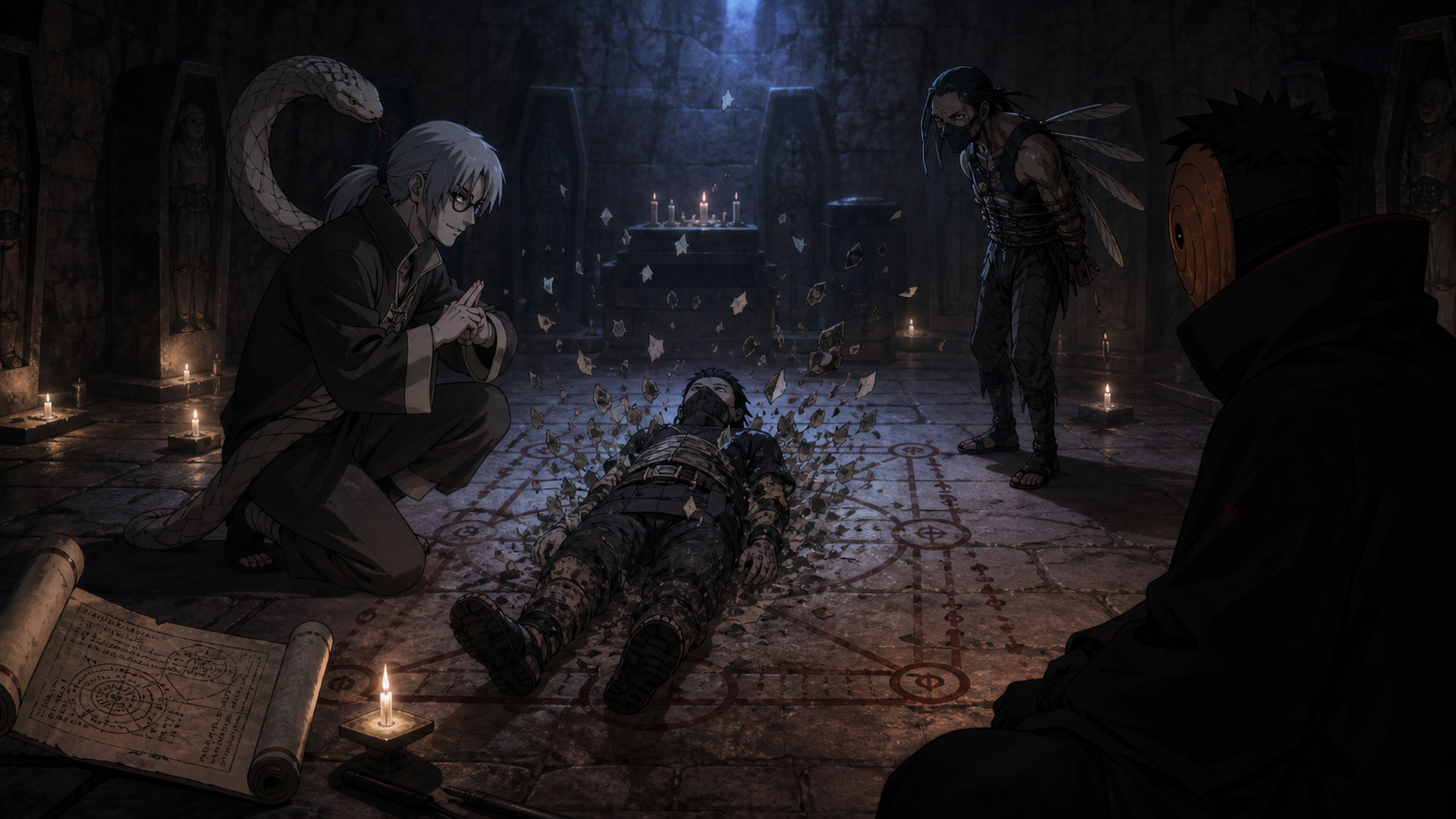
Naruto Shippuden Episode 264 explains Reanimation Jutsu by making Fū die for the demonstration. Tobi demands proof that Kabuto's army can be trusted, so Kabuto uses one captured Root operative as a living sacrifice and summons Torune into the stolen body. The mechanics are fascinating. The lesson is also murder presented as professional transparency.
Kabuto describes DNA, a living vessel, soul retrieval, regeneration, control tags, and known limits as though bodies were laboratory supplies. Tobi listens because knowledge gives him leverage over a partner he expects to betray. Neither man treats Fū or Torune as people with claims over their own lives and remains.
Elsewhere, Naruto struggles to form a Tailed Beast Bomb while the alliance drives thousands of White Zetsu out of the ground. The episode places three power systems beside one another. Naruto must learn synchronization with Kurama, allied shinobi combine labor across divisions, and Kabuto creates obedience by stealing bodies. Every route produces force. Only one route makes consent completely irrelevant.
Tobi asks for trust from a partnership built without trust
Tobi and Kabuto cooperate because each man needs what the other controls. Tobi has the White Zetsu army, the Eye of the Moon plan, and war infrastructure. Kabuto has reanimated shinobi, forbidden research, and a hidden demand connected to Sasuke.
Their alliance contains no friendship or shared moral commitment. Tobi expects deception because he would deceive Kabuto under similar conditions.
Requesting the secret behind Reanimation Jutsu is not curiosity. Tobi wants a way to measure, limit, and eventually counter Kabuto's leverage.
Kabuto answers suspicion with a human sacrifice
Kabuto could explain the technique in theory. He chooses a live demonstration using prisoners captured from Root.
Fū lies incapacitated while Kabuto prepares the ritual. Torune becomes the intended reanimated subject. One operative's body is consumed so another operative's soul can be forced back into combat.
The demonstration proves reliability by showing that Kabuto will kill a captive without hesitation. Cruelty becomes part of the sales pitch.
Fū disappears inside the word vessel
Kabuto calls for a living vessel because Reanimation Jutsu requires a body to receive the dead person's soul and appearance. Technical language makes the process sound neutral.
Fū had a name, training, loyalties, memories, and a history inside Root. Once the ritual begins, those facts become irrelevant to the people controlling the room.
Calling him a vessel hides the central action. Kabuto kills Fū and uses his body without consent.
Torune returns without gaining his life back
Torune's DNA allows Kabuto to retrieve his soul from the Pure Land and bind that soul to the transformed sacrifice. His memories and techniques return with him.
That restoration looks powerful because death no longer ends combat ability. Torune does not regain ordinary life, freedom, or a future.
He returns as evidence in an argument between two commanders. Continuation without agency is another form of captivity.
Reanimation copies a person and removes ownership
The summoned shinobi retains personality, knowledge, and signature techniques. Regenerating tissue makes the body difficult to destroy through normal attacks.
Kabuto can insert a control tag and suppress resistance when obedience matters more than personality. He decides how much of each person remains useful.
The technique preserves identity only where identity serves the operator. Everything else can be muted.
DNA gives the technique a physical boundary
Kabuto needs enough genetic material from the intended subject. Without DNA, he cannot summon a specific dead person.
That requirement turns graves, blood, tissue, and preserved remains into military resources. The dead no longer receive privacy from people willing to collect what remains.
DNA also limits Kabuto's reach. He cannot summon anyone from desire or rumor alone.
The soul must be available for retrieval
Reanimation Jutsu cannot call a soul sealed elsewhere. Kabuto explains that the first four Hokage are unavailable because the Reaper Death Seal holds their souls.
The limitation links old choices to the current war. Hiruzen's and Minato's use of the seal protects the battlefield from certain summons while imposing other costs on the people involved.
Even forbidden techniques operate inside a history of previous techniques, bodies, and sacrifices.
Knowing the release method does not make Kabuto safe
Kabuto explains that forcing the caster to perform the release hand seals can end the technique. That information gives Tobi a theoretical counter.
Reaching Kabuto, controlling his hands, and surviving his defenses remain separate problems. A weakness is not the same as an easy solution.
Tobi gains leverage while Kabuto gains proof that disclosure can increase confidence without surrendering actual control.
Kabuto believes the technique carries no risk to him
He presents Reanimation Jutsu as nearly perfect because the summoned bodies regenerate and battlefield losses do not injure the caster directly.
That distance encourages escalation. Kabuto can test dead shinobi against living opponents while hiding from the consequences.
The belief that he bears no risk is moral blindness before any technical mistake appears. Other people absorb every cost he excludes from the calculation.
Tobi and Kabuto turn knowledge into mutual threat
Tobi now understands more about the army. Kabuto knows Tobi needs that army enough to tolerate him.
Each man gives information strategically, watching for the moment cooperation stops being useful. Their conversation sounds controlled because open hostility would waste resources.
The war coalition on this side functions through blackmail, withheld facts, and overlapping ambition. Scale does not create unity.
Root created the prisoners Kabuto finds convenient
Fū and Torune served Danzō's organization, which treated operatives as tools and trained emotional suppression as loyalty. Kabuto extends that logic after their deaths and capture.
Root did not cause Kabuto's choice, but its structure made dehumanization familiar. Operatives whose identities were subordinated to missions become easy for another system to classify as material.
The episode never needs to pretend they were harmless agents to recognize the violation committed against them.
Naruto begins another stage of jinchūriki training
Killer B teaches Naruto about the Tailed Beast Bomb, a compressed sphere formed from balanced positive black chakra and negative white chakra.
The technique represents the destructive power expected from a fully functioning jinchūriki partnership. Naruto can access Kurama's chakra, but access alone does not create precision.
His training keeps returning to the difference between taking power and coordinating with the being who produces that power.
The Tailed Beast Bomb demands balance before scale
Naruto tries to reproduce the technique through familiar logic related to Rasengan. The resemblance helps him understand shape and compression.
The chakra ratio and stability remain different. More power cannot compensate for incorrect balance.
That requirement fits Naruto's larger problem. He has won chakra from Kurama in combat, but domination does not automatically supply cooperation or technical fluency.
Kurama's resistance places a limit on Naruto's control
Naruto can enter Nine-Tails Chakra Mode, yet Kurama still takes chakra from him and refuses a genuine partnership. Their struggle limits how long Naruto can sustain the form.
The relationship makes every training result conditional. Naruto's body carries power with its own will and resentment.
Kabuto solves resistance by suppressing the summoned person's personality. Naruto will need a better answer if he wants full access without repeating the same logic.
Gyūki and Killer B show what cooperation can look like
Killer B and Gyūki argue, joke, warn one another, and coordinate. Their bond is not peaceful every second, but both participants possess a voice.
Gyūki explains limits that B alone cannot observe from the outside. That knowledge protects Naruto from treating a dangerous form as unlimited.
Their partnership produces power through communication rather than a control tag.
Naruto's secrecy creates another training problem
The alliance keeps Naruto away from information about the war, so he trains without understanding the full reason for the urgency around him.
Leaders want concentration and safety. Withholding the truth also prevents Naruto from making informed decisions about risk, time, and responsibility.
Training becomes part of a protective lie. That arrangement cannot remain stable once he senses what the wider world is doing.
White Zetsu turns the ground into an enemy route
Ao detects the massive White Zetsu force moving underground. The army avoids ordinary roads and visible formations by using the earth itself as cover.
The tactic threatens supply lines, command posts, and divisions that assume danger will approach horizontally.
Sensory work becomes the difference between a hidden invasion and a target the alliance can answer.
Kitsuchi and Kurotsuchi force the hidden army into view
Kitsuchi and Kurotsuchi combine large-scale Earth Release to drive White Zetsu bodies upward. Their technique changes the battlefield across a vast area.
The response depends on accurate detection and specialized control. Raw strength without Ao's information would strike blind.
The alliance makes invisible movement visible through cooperation between villages and divisions.
The Zetsu army exposes another version of manufactured bodies
White Zetsu clones form a mass army created for infiltration, replacement, and attrition. Individual identity barely enters Tobi's planning.
Kabuto's reanimated shinobi preserve recognizable people while denying freedom. White Zetsu forces multiply bodies while minimizing individuality from the beginning.
Both armies reduce personhood in different ways. Tobi values numbers, access, and function.
Explanation does not equal accountability
Kabuto gives a detailed account of Reanimation Jutsu's inputs, controls, and weaknesses. The explanation is useful to viewers and Tobi.
He never answers the ethical question because neither man asks. Who gave permission to retrieve the soul? Who owns the sacrificed body? What does return do to the dead person's unfinished relationships?
Technical completeness can still leave the most important facts deliberately unnamed.
Orochimaru's research lives through Kabuto's choices
Kabuto built his knowledge from Orochimaru's experiments and Tobirama's original technique. He wants recognition as someone who improved what came before.
Inheritance does not remove responsibility. Kabuto chooses which research to continue, which boundaries to cross, and which bodies to spend.
Mastery becomes his answer to an unstable identity. The more completely he controls others, the less he has to face who he is without borrowed power.
The episode places consent beside control
Fū cannot consent to sacrifice. Torune cannot consent to return. Reanimated shinobi can resist only within limits selected by Kabuto.
Naruto and Kurama also lack a healthy agreement, but Kurama's resistance remains an active obstacle rather than a trait Naruto can simply erase.
Killer B and Gyūki provide the clearest alternative. Their strength grows from negotiated cooperation, history, and mutual warning.
The demonstration is a murder staged as customer service
Kabuto answers Tobi’s question by murdering a captive for proof.
Fū and Torune already survived one system that called them tools
Root trained both men to surrender selfhood, making Kabuto’s theft familiar without making it accepted, deserved, or inevitable.
Fū’s past as an operative cannot erase his claim to his living body. Torune’s service cannot become consent to posthumous deployment. The episode exposes how quickly military language treats earlier obedience as permanent ownership, especially when nobody powerful remains interested in asking the operative.
A rule can be precise and still describe an obscenity
DNA identifies the dead. A living sacrifice supplies the vessel. A soul must remain available. A tag can reduce resistance. The reanimated body regenerates until sealing or release interrupts it. Every rule helps viewers understand the battlefield and helps Tobi understand Kabuto.
Precision tempts us to admire the engineering before naming the act. The technique retrieves a person without permission, kills another person to house the return, and grants a third person control. Technical elegance does not create moral neutrality. It only makes exploitation repeatable.
Kabuto defines risk by where pain can reach him
He calls the technique nearly risk-free because destroyed soldiers rebuild and battlefield damage does not transfer to the caster. Fū’s death does not count. Torune’s captivity does not count. Families confronted by weaponized remains do not count. Risk disappears whenever Kabuto moves the cost outside his own body.
That accounting is not a blind spot beside the jutsu. It is what makes the army possible. Anyone who included consent, grief, or the sacrifice’s life in the calculation would not describe reanimation as efficient. Kabuto achieves confidence by choosing a definition narrow enough to protect himself from responsibility.
Tobi wants the release because partnership already means hostage negotiation
Learning that the caster can be forced through release seals gives Tobi a possible answer if Kabuto stops being useful. Kabuto provides the fact because access remains another matter. Knowing where a lock sits does not put the key in Tobi’s hand.
The exchange shows two men cooperating through contingency plans. Each resource offered is also leverage withheld. Unlike Gaara’s alliance, this coalition does not need trust, apology, or shared belonging. It needs overlapping appetite and enough uncertainty that betrayal remains temporarily more expensive than cooperation.
Naruto’s training asks whether borrowed power can become shared power
Naruto has taken Kurama’s chakra and shaped it around his own body, but the Tailed Beast Bomb demands a balance he cannot brute-force. The problem is technical and relational. Kurama still resists, steals chakra back, and refuses to become a silent supply inside Naruto’s heroic plan.
That resistance frustrates Naruto while protecting the episode’s central distinction. Another being’s power is not automatically his property because they occupy the same body. Full mastery will require recognition that Kurama has memory, anger, judgment, and a claim to participation no control tag can ethically erase.
Killer B and Gyūki make disagreement part of cooperation
Their partnership is not proof that consent looks like permanent harmony. They interrupt, correct, complain, and warn. Gyūki can tell B what the transformation costs because his voice remains available, and B can adjust because he treats that voice as information rather than sabotage.
The resulting power may look less efficient than Kabuto’s absolute command. It is also resilient in a way forced obedience cannot imitate. Knowledge moves in both directions. Neither participant needs the other to disappear before the technique counts as controlled.
The White Zetsu army removes individuality before the battle begins
Kabuto preserves recognizable personalities when their histories make them useful. Tobi multiplies bodies whose value lies in scale, infiltration, and replaceability. One army weaponizes identity. The other makes identity strategically irrelevant.
Both routes produce commanders insulated from ordinary loss. Thousands can be sent upward through the earth because no planner needs to imagine a household waiting for each copy. The allied divisions are slower and messier precisely because every casualty still belongs to relationships beyond the map.
Naruto is protected through another decision made without him
While he struggles to balance chakra, the alliance fights a war partly organized around keeping him from Tobi. Leaders conceal the conflict because they know Naruto will reject safe isolation when friends are paying for it.
Their fear is reasonable. Their method repeats the problem the episode keeps naming. Good intentions do not turn withheld information into consent. Naruto’s eventual anger will not mean protection was unnecessary. It will mean protection that requires deception has accumulated a debt the protected person never agreed to owe.
The episode’s three threads ask who gets to direct a body
Kabuto commands the dead and sacrifices the living. Tobi deploys manufactured bodies beneath the ground. Naruto tries to shape power shared with a being who does not trust him. Kitsuchi and Kurotsuchi coordinate willing soldiers to force an invisible army into view.
The common subject is not merely chakra. It is authority. Force becomes easy when personhood is excluded from the design. The harder strength belongs to people who must exchange information, tolerate refusal, and keep deciding that another body is not raw material simply because war makes ownership convenient.
What landed
The Reanimation Jutsu explanation gives concrete rules while keeping the demonstration disturbing. Fū's body makes every technical step carry a visible cost.
Kabuto and Tobi's conversation captures a partnership where disclosure increases both cooperation and threat. Their calm tone makes the mutual suspicion sharper.
Naruto's Tailed Beast Bomb training provides a useful contrast between balancing another being's power and deleting another person's will.
What did not fully land
Fū and Torune receive little interior attention during a scene built around their bodies. The episode condemns Kabuto through action, but the victims still function largely as examples.
The explanation revisits earlier Hokage battles and sealing rules at length, which slows the opening momentum of the war. The information matters, though some viewers already know much of the history.
Naruto's training and the White Zetsu eruption compete with the underground demonstration for focus. All three threads share a theme, but the episode sometimes feels like a briefing packet spread across several locations.
Final reaction
Naruto Shippuden Episode 264 makes Reanimation Jutsu frightening because the technique works exactly as Kabuto says. DNA identifies the dead. A living person pays for the vessel. The summoned body regenerates, remembers, fights, and obeys until somebody breaks the control or releases the soul.
Kabuto calls the method low-risk because he excludes everyone else's risk. Fū dies. Torune returns without freedom. Families face stolen versions of people they buried. Tobi receives an army capable of making grief attack the living.
Naruto's parallel training offers a harder route. The Tailed Beast Bomb requires balance with power that cannot be reduced to a silent tool. Killer B and Gyūki show that partnership can create force without erasing either participant. Kabuto has built a terrifying shortcut around consent, and the war will make thousands of people pay the price hidden inside his word vessel.
RaeRae’s call
Kabuto’s explanation is not morally neutral lore. Every elegant rule rests on Fū’s murder and Torune’s stolen return. Naruto’s harder lesson is learning that power shared with another being cannot become partnership by silencing the other voice.
Episode details and viewing routes
- Official episode reference: Naruto Official episode guide
- Licensed episode route: Crunchyroll licensed episode page