
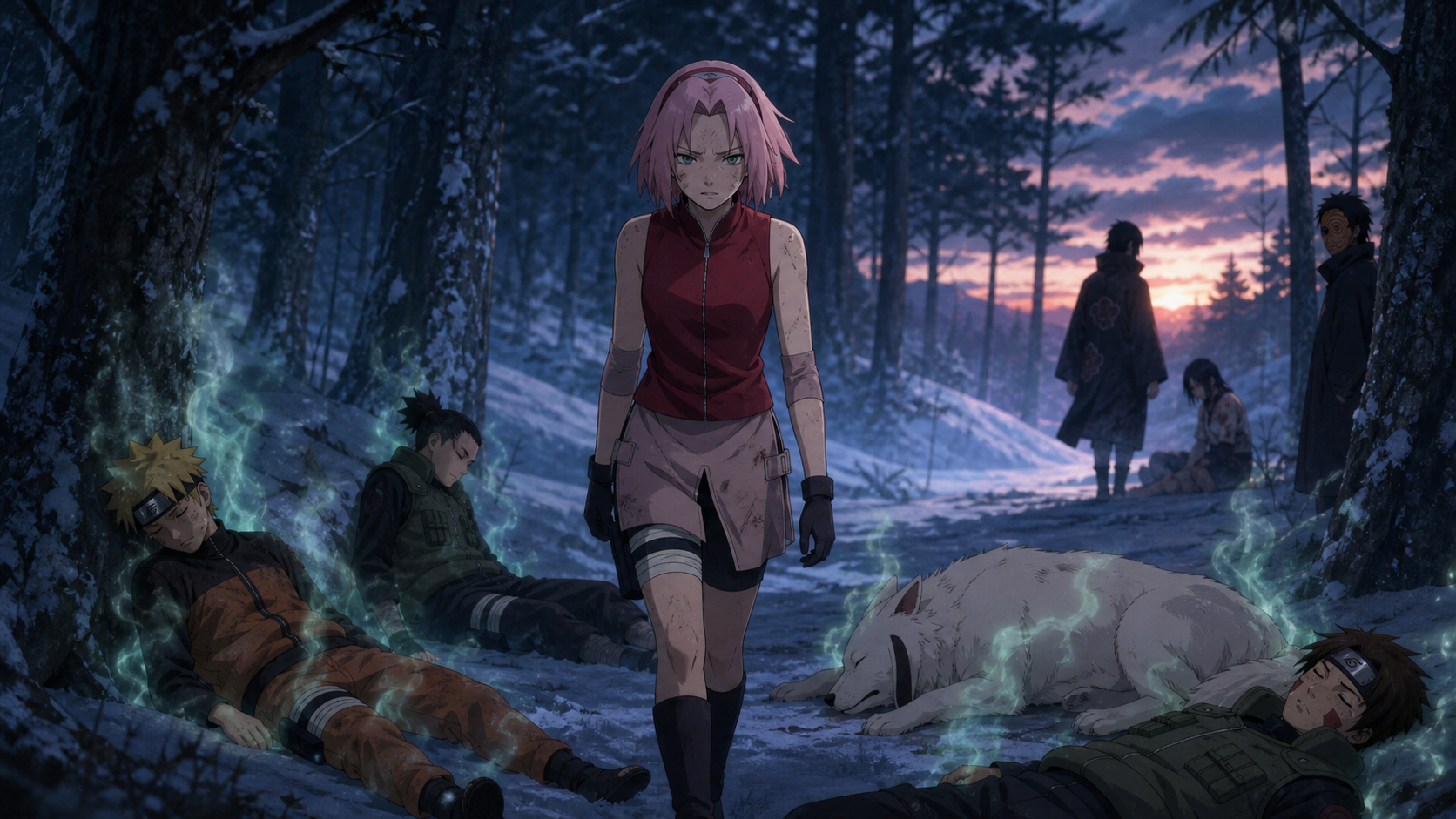
Sakura’s Resolve
Sakura incapacitates her own team and walks toward Sasuke alone, convinced that isolation is the only way to protect everyone else.
Quick reaction
Sakura has spent this entire stretch insisting that she can carry part of the weight Naruto keeps taking onto himself. “Sakura’s Resolve” finally tests that claim, and the result hurts because her courage and her mistake are the same decision. She refuses to let Naruto keep chasing Sasuke for her sake, yet she also refuses to trust Lee, Kiba, Sai, or Kakashi with the choice she has made. The result is not a clean heroic departure. Sakura walks into the snow after drugging the people who came to protect her.
That choice gives Episode 212 its sharpest image: Sakura moving forward while her team lies asleep behind her. The frame contains no victory. She is frightened, determined, guilty, and still convinced that doing the worst part alone will spare everyone else. Naruto and Sasuke have both made versions of that mistake. This time, Sakura mistakes isolation for responsibility.
Sakura sends everyone to sleep
Kiba’s tracking has brought the group close enough to Sasuke that the mission stops being theoretical. Sakura knows what the others expect: they will confront him together, and they will act as shinobi of the Leaf. She also knows that they have agreed Sasuke must be killed. That agreement was meant to release Naruto from the promise he made years ago, but saying the words and carrying them out are very different things.
Sai is already suspicious. He has watched Sakura’s false confession to Naruto collapse, and he understands how much of her plan rests on hiding the truth. Lee and Kiba are prepared to help, but Sakura does not want them stained by the act she has decided belongs to her. She releases sleeping gas, catches her companions before they can stop her, and leaves them in the forest with Akamaru.
The betrayal is brutal precisely because her motives are protective. Sakura is not abandoning them because she thinks they are weak. She is taking away their choice because she believes the burden belongs to her. The episode does not pretend that good intentions make that fair. Lee’s trust, Kiba’s effort, Sai’s warning, and Akamaru’s loyalty are all answered with silence as Sakura walks away.
Resolve built from old promises
The episode circles through Sakura’s memories because this is not a sudden decision. Sasuke’s departure, Naruto’s promise, and every failed attempt to bring Team 7 back together have accumulated inside her. The flashbacks can feel heavy, but their purpose is clear: Sakura is measuring the person she was against what she thinks she must do now.
When Naruto first promised to bring Sasuke home, Sakura accepted an impossible gift. Naruto turned her grief into his mission, then carried the promise for years. Sakura now sees the cost in his battered body and in the panic attack that followed the truth about Sasuke. Her answer is to remove herself from the equation. If she can kill Sasuke, Naruto no longer has to save him for her. If she dies trying, she imagines the burden ends with her.
That logic is emotionally honest and strategically terrible. Naruto’s bond with Sasuke stopped belonging to Sakura long ago. He is not pursuing Sasuke because a childhood promise forces the pursuit. He continues because he has chosen that bond again and again, even after learning the cost. Sakura cannot free Naruto by making the decision for him any more than she can protect her team by putting them to sleep.
Naruto refuses to stay behind
Naruto’s part of the episode mirrors Sakura’s. He wakes with the knowledge that Sasuke attacked the Five Kage Summit and that Sakura has gone after him. Yamato tries to keep him where he can recover, but Naruto cannot remain still while the people he loves move toward a collision.
The important point is not that Naruto has another clever escape. His body reaches the answer before anyone can talk him out of leaving. He understands that Kakashi and Sakura are heading toward Sasuke, and he knows what that confrontation could demand from them. Staying safe would mean allowing someone else to decide the ending of Team 7.
Naruto and Sakura are therefore running toward the same place for opposite reasons. Sakura wants to end the promise by acting alone. Naruto wants to protect the bond by refusing to be excluded. Neither has spoken honestly enough to the other, and Sasuke is waiting at the end of both paths.
Sasuke leaves Karin behind
The aftermath of Danzō’s death supplies the episode’s colder parallel. Karin helped Sasuke survive the summit, tracked enemies for him, healed him, and remained beside him as his decisions grew darker. He repays that loyalty by treating her as something already spent. After using her as part of his attack on Danzō, Sasuke is prepared to discard her without hesitation.
This is not the distant, wounded boy Team 7 remembers. Sasuke’s language and posture show someone cutting away every bond that might challenge his revenge. Karin is useful until she no longer serves his goal. Her injury is not a reason for him to stop; Sasuke reads the wound as evidence that she has become a liability.
Tobi’s presence makes the scene even more unsettling. He has encouraged Sasuke’s descent while presenting every manipulation as an opportunity. Sasuke believes he is choosing his own path, but the path keeps narrowing exactly as Tobi wants. The more Sasuke severs, the easier he is to direct.
Sakura reaches Sasuke
Sakura eventually finds him and opens with a lie: she says she wants to abandon the Leaf and join him. The claim is not convincing because the audience has just watched everything she sacrificed to reach this moment. She is not arriving as a convert. She is trying to get close enough to do what she believes no one else should have to do.
Sasuke does not offer the reunion she once imagined. His suspicion is immediate, and the distance between them feels larger than the snowy landscape. Sakura has rehearsed a final act against the Sasuke in her memories. The person in front of her has just abandoned Karin and declared war on the world that shaped him.
That is why the episode ends on tension rather than resolution. Sakura’s resolve got her here, but resolve alone cannot make her deception work. The next question is not whether she loves Sasuke or whether she wants to save Naruto. The question is whether she can act when those feelings, her duty, and her fear all collide at once.
The sleeping gas turns protection into control
Sakura knows exactly which teammates might stop her, so the gas is not an impulsive escape. She plans around Kiba’s tracking, Lee’s loyalty, Sai’s suspicion, and Akamaru’s senses. That competence makes the choice more troubling. The same tactical awareness that could support a team becomes the method for removing everyone else from the decision.
Lee and Kiba agreed to a lethal mission, which means Sakura cannot claim they were innocent bystanders who needed shelter from danger. She decides that her grief gives her a greater right to choose the cost. Sai recognizes the pattern because Root trained him inside a system where missions replaced consent, yet even his warning cannot break through Sakura’s certainty.
The scene belongs beside Sasuke’s habit of cutting bonds before those bonds can challenge him. Sakura’s motives are kinder, but her method shares the same assumption: attachment becomes manageable once other people lose the power to answer. CVM Sekai’s bottom line is uncomfortable here. Love without consent can still become control.
Medical knowledge carries an ethical shadow
Sakura’s training under Tsunade made her one of the group’s most capable protectors. She understands bodies, dosage, injury, and the narrow distance between incapacitation and harm. Episode 212 turns that knowledge sideways. Medicine becomes a tool for neutralizing allies so she can proceed toward an assassination alone.
The series does not suggest that Sakura has abandoned medical ethics forever, but the choice reveals how desperation can corrupt a protective skill. She calculates that temporary unconsciousness is safer than allowing her friends to follow. The calculation ignores what could happen if enemies find them, if the dosage affects someone unpredictably, or if Sakura never returns to explain where she went.
Later care for Karin will restore the healing role, but this episode needs the violation first. Sakura cannot become more honest without confronting how easily responsibility became permission in her own mind.
Karin and Sakura are not romantic duplicates
Both women care about Sasuke, but their positions in this episode are radically different. Karin has just been used as a living opening in Sasuke’s attack on Danzō. Sakura approaches with a concealed weapon and a rehearsed defection story. One has been discarded; the other is volunteering proximity while planning betrayal.
Reducing their encounter to jealousy would erase the real danger. Sasuke no longer treats affection as something requiring an answer. He treats devotion as access, leverage, or evidence of weakness. Karin’s wound shows Sakura what closeness currently means to him before Sakura speaks a single word.
Sakura’s lie also assumes that the memory of her old devotion will still matter enough to lower Sasuke’s guard. Sasuke instead uses her claim to create a test. The emotional history she hoped to weaponize has already become material he can weaponize back.
Chie Nakamura gives resolve a visible fracture
Chie Nakamura keeps Sakura’s voice controlled during the departure, but the control never sounds peaceful. Determination sits beside grief rather than replacing grief. That performance choice protects the character from a false transformation into a cold executioner. Sakura is trying to play someone who can sever every tie, and her voice keeps admitting she cannot.
Junko Takeuchi gives Naruto’s escape a different urgency. His refusal is immediate, almost physical, because waiting would repeat the exclusion that helped create the crisis. Noriaki Sugiyama makes Sasuke’s treatment of Karin frightening through restraint. The absence of emotional struggle communicates how far he has traveled from Taka’s original language of teamwork.
Direction reinforces those contrasts through bodies in space. Sakura leaves trusted companions behind in a quiet forest. Naruto leaves a clone behind in a guarded room. Sasuke leaves Karin injured on an exposed bridge. Three departures happen for different reasons, but every departure asks who gets denied a voice.
Resolve becomes dangerous when nobody may answer it
Sakura has reasons, training, and a mission she believes necessary. She also removes every person capable of challenging her interpretation before carrying it out.
The episode separates determination from moral clarity. Commitment can help someone endure a hard choice, but commitment cannot prove the choice belongs to one person alone.
Sakura protects her friends by creating a new emergency
Lee, Kiba, Sai, and Akamaru are unconscious in unfamiliar terrain while an international crisis develops nearby. Keeping them from Sasuke reduces one danger by exposing them to another.
Protection built without consent often moves risk rather than eliminating it. Sakura accepts the transferred risk because she controls the plan, not because the people behind her agreed the exchange was fair.
The sleeping bodies make trust physically visible
Her companions followed despite doubts because a shared mission requires believing teammates will not privately remove one another from action. The gas converts that trust into access.
Sakura catches them precisely because they allowed her close enough to do it. Their vulnerability is not incompetence; it is evidence of relationship used against itself.
Medical expertise cannot decide its own ethical purpose
Knowledge of dosage lets Sakura incapacitate without intending permanent harm. The technical control may reduce danger, but it cannot answer whether she had the right to override allied bodies.
A healer’s skill remains a tool whose ethics depend on context, consent, and necessity. Desperation makes the violation understandable while the sleeping forest makes its cost impossible to romanticize.
Sakura and Naruto keep inheriting each other’s worst strategy
She wants Naruto to stop carrying Sasuke alone, then creates a mission where only she will carry the killing. Naruto refuses exclusion and prepares to leave without Yamato’s agreement.
Both recognize the other’s self-sacrifice as damaging more easily than their own. Love becomes a mirror that reveals the pattern everywhere except inside the person currently acting.
Sasuke treats Karin as proof that usefulness has ended
Her sensory work helped identify Izanagi, and her healing helped him survive the summit. Once injured, she no longer advances the path toward Konoha.
Discarding her shows revenge reorganizing every bond into temporary function. Tobi benefits because a person willing to abandon support becomes more dependent on the manipulator who controls transportation and information.
Karin gives Sakura evidence stronger than memory
Sakura approaches with years of Team 7 history and a plan that assumes some old attachment may still create access. Karin’s wounded body shows how Sasuke treats present loyalty when loyalty obstructs revenge.
The evidence does not erase the boy Sakura knew. It warns that memory alone cannot predict the adult deciding whether she is useful, dangerous, or disposable.
Sakura’s defection story asks Sasuke to believe the wrong motive
She claims she will abandon Konoha for him, framing devotion as the bridge between past affection and present access. Sasuke has already rejected bonds as weakness, so romance offers little persuasive weight.
The lie also misunderstands how thoroughly he distrusts anyone connected to the village. Her history makes the performance less convincing because Sasuke knows what she would have to betray.
Sasuke answers the lie with a test instead of trust
He does not need to prove Sakura’s inner feelings. He can demand an action that either exposes deception or forces her to cross a boundary for admission.
The test turns her attempted manipulation back toward her. Both teammates meet through strategic performances because neither believes honest language can survive what the other has become.
Kakashi follows because adulthood means sharing the consequence
He cannot undo Sakura’s gas or guarantee Sasuke can be stopped without killing. He can refuse to let his student face that decision without the teacher whose earlier guidance failed to prevent this point.
Following is not rescue from agency. It is recognition that Team 7’s collapse belongs partly to the adults and institutions who left children carrying classified histories.
What this episode changes
“Sakura’s Resolve” moves the conflict away from the summit and into the intimate wreckage of Team 7. Danzō is dead, but his defeat has not relieved the pressure. Sasuke is more isolated, Karin is wounded, Kakashi is closing in, Naruto has refused to wait, and Sakura has removed every ally standing beside her.
The episode also challenges the idea that determination is automatically noble. Sakura is brave enough to face Sasuke, but bravery does not make her plan sound. Her attempt to protect everyone repeats the same pattern that has hurt Team 7 from the beginning: one person decides to suffer alone, hides the truth, and expects the others to accept the result.
That makes this a difficult Sakura episode in the best sense. The story lets her be active without making her infallible. She chooses, plans, deceives, and moves the conflict forward. She is also scared, emotionally compromised, and about to discover that the burden she claimed cannot be separated from the people who share the weight.
Naruto refuses safety purchased through exclusion
Remaining with Yamato would protect the alliance’s jinchūriki while Kakashi and Sakura approach Sasuke. Naruto understands that physical safety would make him absent from the decision defining his closest bonds.
His departure creates strategic risk, yet the adults cannot demand obedience after repeatedly withholding truth. Protection requires participation if the protected person is expected to trust its purpose.
Three departures reveal three relationships to other people
Sakura leaves unconscious friends because she wants to absorb their burden. Naruto leaves a clone because he refuses to let friends absorb his. Sasuke leaves Karin because her life no longer serves his burden at all.
The methods are not morally equal. Their parallel reveals how isolation can grow from care, fear, or indifference while still denying another person a voice.
Sakura’s agency matters most when the story lets her be wrong
She plans, uses specialized knowledge, deceives allies, tracks a target, and initiates the encounter. The episode does not reduce her to waiting for Naruto or mourning Sasuke from a distance.
Activity is not automatic empowerment if every decision must be celebrated. Sakura becomes more fully human because her courage can coexist with manipulation, tactical competence, fear, and a disastrous theory of responsibility.
Sakura believes pain becomes manageable when she chooses where everyone stands: friends asleep behind her, Naruto safely excluded, Karin treated as evidence, and Sasuke close enough to kill. The arrangement feels responsible because every risk has a place. What it lacks is permission from the people assigned those places. Team Seven cannot be repaired by one member privately distributing grief. Whatever happens next must survive the voices Sakura tried to silence, including her own frightened voice beneath all that resolve.
RaeRae’s final word on Sakura’s Resolve
Sakura looked at Naruto’s habit of carrying everybody alone and apparently decided the problem was that she had not tried the same strategy with sleeping gas.
I believe her care. I believe her fear. I also believe Lee, Kiba, Sai, and Akamaru deserved to remain conscious participants in the mission they agreed to risk.
Karin’s body is the warning Sakura reaches before Sasuke. Loyalty protected nobody once revenge decided usefulness had expired.
Resolve gets Sakura into the clearing. It cannot make her lie believable, make her team’s consent irrelevant, or make one lonely sacrifice capable of repairing Team 7.
RaeRae’s call
Sakura mistakes isolation for responsibility and uses trusted medical access to enforce the choice. Her courage is real, but courage cannot make a plan ethical after everyone else loses the right to answer.