
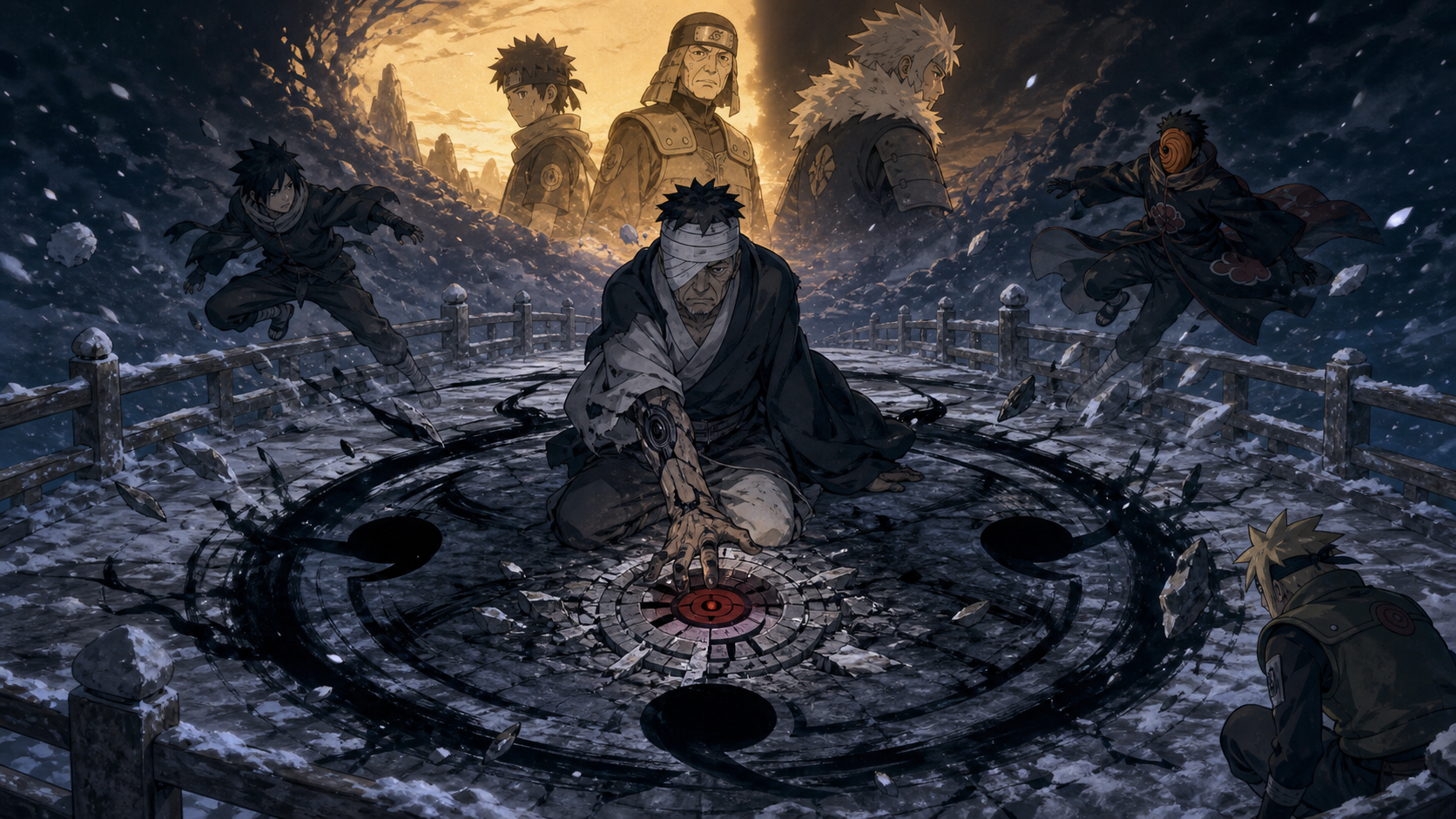
Danzō Shimura
Sasuke ends Izanagi with a subtle lie, and Danzō spends his final moments trying to become the sacrifice he once hesitated to make.
Bottom line
Naruto Shippuden Episode 211, “Danzō Shimura,” ends the battle on the Samurai Bridge and reveals the fear that shaped Danzō’s life.
Sasuke and Danzō pierce one another in a final exchange. Danzō believes one Sharingan remains available for Izanagi, but Sasuke placed him under a subtle genjutsu and made him misread the eye’s condition. With Izanagi exhausted, Danzō can no longer rewrite the wound.
His implanted First Hokage cells begin to overwhelm his weakened body. Danzō takes Karin hostage and tries to use Shisui’s eye against Tobi, but Sasuke attacks through Karin to reach him. Mortally wounded, Danzō remembers the mission when Tobirama chose Hiruzen as Third Hokage. He activates the Reverse Four Symbols Sealing technique in a final attempt to take Sasuke and Tobi with him, but both escape.
Sasuke wins by making Danzō trust the wrong eye
Danzō spent the fight depending on information only he seemed able to control. He counted the Sharingan, timed Izanagi, and treated every apparent death as a disposable outcome.
Sasuke uses a small genjutsu to alter that count. The deception is modest compared with Susanoo, but the lie attacks the exact certainty holding Danzō’s strategy together.
When Danzō commits to the final exchange, he believes reality can still be revised. The closed eye proves otherwise. A man who built power from hidden information loses because he trusts manipulated information of his own.
Izanagi’s limit restores consequence
For most of the battle, Danzō behaves as though death is a rehearsal. Each failure can be discarded while another stolen Sharingan remains.
Once the final eye closes, his choices regain permanence. The wound Sasuke delivers cannot be reclassified as illusion.
The shift changes Danzō’s posture immediately. Infinite confidence was always a finite stockpile. When the stockpile ends, he becomes an aging man on a bridge with nowhere left to place the cost.
Hashirama’s cells reject the body using them
Danzō’s implanted arm begins growing out of control as his chakra weakens. The First Hokage’s cells were never passive equipment; containing them required continuous effort.
His body becomes an argument against the idea that power can be collected without relationship or consequence. He fused Uchiha eyes and Senju tissue to command abilities neither lineage gave him.
At the moment his control fails, the stolen biology stops behaving like property and threatens to consume him.
Karin becomes expendable the moment she is inconvenient
Danzō seizes Karin as a shield because her life may force Sasuke to hesitate. She is reduced from observer and healer to leverage.
Sasuke’s response is worse than Danzō expects. He attacks through her to reach his target.
The moment confirms Karin’s earlier fear that Sasuke’s chakra had changed. Taka followed him because he once built a team around specific skills and shared movement. Revenge now matters more to him than the teammate who made this victory possible.
Sasuke’s attack through Karin crosses another boundary
Sasuke can argue that Danzō created the hostage situation and that hesitation would allow an enemy to escape. Those facts do not erase his willingness to injure Karin.
He does not seek another angle or acknowledge her risk. He sees the line to Danzō and attacks through her.
The choice shows what revenge has done to his definition of bonds. Anyone can become part of the target if their body stands in the way.
Shisui’s eye remains a final prize and threat
Danzō preserves the Sharingan in his face while spending the eyes in his arm. Shisui’s power can manipulate another person without the target recognizing the influence.
Tobi wants that eye, and Danzō knows what the dōjutsu could become in Tobi’s hands. Even at the end, the body of an Uchiha friend is still treated as strategic property contested by two older men.
Danzō’s determination to destroy the eye denies Tobi a weapon, but that final denial cannot undo the years Danzō used Shisui’s power for himself.
The memory of Hiruzen reveals Danzō’s oldest wound
As a young shinobi, Danzō served beside Hiruzen under Tobirama. When the team needed someone to act as a decoy and die, Danzō wanted to volunteer but fear delayed his voice.
Hiruzen spoke first. Tobirama chose Hiruzen as successor and took the fatal role himself.
Danzō spent the rest of his life measuring himself against that moment. He interpreted hesitation as the reason he remained in Hiruzen’s shadow and pursued authority as though becoming Hokage could retroactively answer the fear.
Understanding Danzō does not excuse him
The flashback gives Danzō emotional context. He was not born as a collection of schemes. He was a frightened young man who wanted to be brave and resented the friend who acted first.
That context matters because institutions are shaped by human wounds. Emotional context does not absolve the Uchiha massacre, Root’s abuse, Shisui’s stolen eye, summit manipulation, or years of sacrificing others.
Pain can explain a pattern without turning the people harmed by that pattern into acceptable collateral.
Danzō’s final sacrifice arrives too late to define his life
The Reverse Four Symbols Sealing technique turns Danzō’s body into a final trap. He tries to take Sasuke and Tobi with him and prevent Konoha’s secrets from falling into enemy hands.
The act resembles the courage he wished he had shown beside Hiruzen. This time he volunteers himself without hesitation.
Yet one brave death cannot erase a life spent deciding that other people should die first. The final sacrifice complicates Danzō without cleansing him.
Hiruzen and Danzō chose different relationships to fear
Both men knew fear and responsibility. Hiruzen’s answer was imperfect openness: bonds, teaching, and a village understood as people. Danzō’s answer was control from below the surface.
Hiruzen made severe mistakes, especially in allowing Danzō’s power to continue. Still, Danzō’s rivalry was built around the belief that hesitation could only be overcome by becoming harder than everyone else.
The bridge shows the endpoint of that belief: immense secret power, no trusted companion beside him, and a final audience made entirely of enemies.
Tobi escapes with the outcome he wanted
Tobi avoids the sealing field and watches Danzō die. Sasuke has spent more chakra, deepened his hatred, and removed a political obstacle.
The fight resolves Sasuke’s immediate target while serving Tobi’s larger plan. Danzō’s death destabilizes Konoha, and Sasuke becomes even easier to direct toward the village.
Tobi did not win the battle personally. He designed a situation where almost every possible result benefited him.
The title finally removes Danzō’s institutional disguise
Naming the episode “Danzō Shimura” matters because previous chapters let offices and organizations speak for him. He appeared as an elder, Root’s commander, an acting Hokage, and Konoha’s representative at the summit. Each title gave private ambition the language of public necessity.
The bridge strips those layers away. No council chamber remains, no masked subordinate waits for an order, and no diplomatic table allows him to call coercion policy. Danzō faces the last Uchiha survivor carrying stolen Uchiha eyes across his own body. The visual evidence makes his favorite abstraction, sacrifice for the village, brutally specific.
His younger self explains the wound beneath the offices. Danzō wanted recognition from Tobirama and equality with Hiruzen, then interpreted one delayed act of courage as a permanent verdict on his worth. Rather than learning that fear and courage can coexist, he built a life around never appearing vulnerable again.
Izanagi turns privilege into a literal mechanic
Danzō’s repeated survival is more than a supernatural trick. He can make consequences temporary because other people’s bodies have supplied him with extra chances. Every Sharingan embedded in his arm represents an Uchiha life converted into strategic insurance.
Sasuke cannot reset the same way. Every use of Susanoo damages him, every emotional escalation narrows his judgment, and every choice against Karin remains real. The uneven rules make the battle politically legible. Danzō has accumulated institutional power that allows him to survive failures ordinary shinobi would pay for immediately.
The final genjutsu defeats that privilege by corrupting the count. Sasuke does not overpower every stored life individually. He makes Danzō misjudge how many exceptions remain. Once the false certainty collapses, consequence arrives all at once.
The Hiruzen memory contains love Danzō cannot admit
Danzō’s rivalry with Hiruzen is not built from hatred alone. He wants Hiruzen’s position because he also wants the quality Tobirama recognized in him. The jealousy survives for decades precisely because Hiruzen’s judgment continues to matter.
That unspoken attachment makes Danzō’s final thoughts sadder. He imagines himself walking beside Hiruzen and asks what he was to his rival. The question arrives too late because Danzō spent his adult life translating relationship into competition. He could undermine Hiruzen, oppose him, and build a shadow government beneath his leadership, but honest recognition remained impossible.
Hiruzen also bears responsibility for allowing Root and Danzō to endure. Their different approaches were never as separate as Konoha’s public story suggests. Openness without accountability created room for secrecy to become permanent infrastructure.
Karin’s injury changes Sasuke before Team 7 arrives
Sasuke’s strike through Karin ensures the coming Team 7 confrontation cannot remain a debate about potential danger. He has already chosen revenge over a teammate’s body. Sakura and Kakashi will meet a Sasuke whose isolation is active violence, not merely a grim attitude.
Karin’s sensory perception makes the betrayal especially sharp. She has spent the summit reading Sasuke’s chakra and warning that the quality has become colder. Her body receives the final confirmation. The man she followed no longer treats the team he assembled as a relationship with obligations.
Tobi gains from this rupture too. A Sasuke without Karin’s warning, healing, or dissent becomes easier to direct. Manipulation thrives when every alternative voice has been injured or pushed away.
The Japanese cast refuses a clean villain’s exit
Hiroshi Ito gives the older Danzō a clipped authority that rarely invites intimacy. During the final memory, the performance allows fear and envy to surface without turning the character into a different man. The younger hesitation and older severity belong to the same person.
Noriaki Sugiyama keeps Sasuke focused through the genjutsu reveal, then makes the attack through Karin frighteningly direct. Victory carries no relief. The voice suggests that killing Danzō has not satisfied the wound driving him, which prepares the expansion of revenge toward Konoha.
Nobuo Tobita’s Tobi remains observant and almost conversational around the violence. That composure matters because Tobi is not emotionally trapped inside the duel. He is evaluating assets, eyes, and outcomes. The contrast leaves Danzō and Sasuke fighting over history while the architect of the next crisis waits outside their grief.
Sasuke defeats exemption by falsifying its inventory
Danzō survives because he believes he knows exactly how many discarded outcomes remain. Sasuke changes no grand memory and creates no elaborate dream. He alters the smallest piece of accounting.
The victory fits the opponent. A man who hid power inside classified systems loses when the private record he trusts becomes unreliable.
The final wound returns ownership of consequence
Until the last Sharingan closes, Danzō can make another stolen eye absorb the permanence of his mistake. The piercing exchange becomes different only when no substitute remains.
His body must finally carry the result produced by his judgment. Reality stops accepting payment from the dead and presents the bill to the person who chose the fight.
Hashirama’s cells expose control as continuous labor
Danzō treated implanted tissue like stable property, but the arm required constant chakra and restraint. Weakness allows growth to exceed the shape he imposed.
The failure reveals appropriation’s hidden maintenance. Stolen power never became naturally his; domination merely concealed the conflict until exhaustion made containment impossible.
Karin is betrayed after making victory possible
She identified Izanagi’s limit, monitored Sasuke’s condition, and remained within range of two men carrying lethal Uchiha techniques. Her intelligence created the opening Sasuke uses.
When Danzō takes her hostage, Sasuke sees only a line through her body. Revenge receives her labor as essential and her life as optional, revealing the moral collapse beneath his tactical improvement.
Danzō and Sasuke briefly agree about Karin’s value
Danzō assumes she matters enough to function as leverage. Sasuke answers that she matters less than the target. Both reduce her relationship to usefulness during the same exchange.
Their agreement is uglier than their hatred. Each man believes his objective authorizes deciding what Karin’s body may be required to absorb.
Shisui’s eye remains contested property at the edge of death
Danzō stole it to control political judgment. Tobi wants the same dōjutsu for purposes he keeps private. Shisui’s personhood disappears beneath arguments about who can use the technique best.
Destroying the eye denies Tobi without restoring what Danzō took. A final act can prevent future abuse while leaving the original violation fully unresolved.
The Tobirama mission becomes Danzō’s private creation myth
He hesitated before volunteering, Hiruzen spoke, and Tobirama recognized Hiruzen as successor. One human moment of fear became the explanation Danzō carried for decades of rivalry.
Instead of learning courage can follow hesitation, he interpreted vulnerability as permanent defeat. His political identity became an attempt to rewrite the boy who did not speak first.
Hiruzen’s friendship survives inside Danzō’s resentment
Danzō cannot stop measuring himself against Hiruzen because the bond still determines whose recognition matters. Competition becomes the only emotional language he permits himself to use.
His final question about what he meant to Hiruzen reveals a relationship he spent years refusing to inhabit honestly. Power never answered the intimacy he was too defended to request.
The last sacrifice cannot become retroactive innocence
Danzō finally uses his own body as the cost, activating a seal meant to take Sasuke and Tobi with him. The action contains courage and strategic purpose.
It cannot rewrite Root, the massacre, stolen eyes, or children sacrificed under orders. A meaningful final choice belongs inside the full life, never above it as a cleansing summary.
RaeRae’s reaction to Danzō Shimura
Danzō spent the whole fight editing reality, and Sasuke beat him with the smallest possible lie. One eye looked open after closing. That defeat is deliciously appropriate for a man whose entire career depended on believing he alone could see the truth.
The Karin moment is not something I can wave away because Danzō used her as a shield. Sasuke chose to go through her. She tracked the technique, healed him, followed him into the summit, and became disposable the second revenge demanded a straighter line.
The Hiruzen flashback makes Danzō sadder without making him innocent. I understand the boy who froze and spent years hating the person who spoke first. I do not accept the adult who turned that shame into a system that consumed children.
My sympathy stops where Danzō begins treating fear as a moral license. Plenty of frightened people in this story make damaging choices, but he built procedures that prevented victims from answering back. Root's silence was never proof of loyalty. Silence was the condition he imposed so his version of necessity would face no witness inside the room.
His final sealing attempt is brave. The tragedy comes from Danzō becoming willing to pay the full cost himself only after spending a lifetime charging everyone else. Tobi escapes, Sasuke survives, and the bridge is left with the consequences Danzō could not seal away.
Tobi escapes because he never entered the moral wager
Sasuke risks his body to kill Danzō. Danzō risks his body only when every other resource has failed. Tobi observes, transports, and withdraws before the seal can claim him.
The outcome proves how thoroughly he designed the encounter. Either rival could die, reveal techniques, or destabilize Konoha, and each possibility feeds the war he already declared.
Danzō dies beside the difference between secrecy and witness
His career depended on actions performed where victims could not speak and citizens could not judge. The bridge leaves Tobi, Sasuke, and Karin as witnesses who are compromised, injured, or hostile.
Truth emerges, but no accountable institution receives it. Danzō’s secrecy ensured even exposure would arrive through violence rather than a public record capable of repair.
Sasuke wins the target and loses another relationship
Danzō’s death completes the immediate revenge named after Itachi’s truth. The strike through Karin shows the victory has already expanded the damage rather than containing it.
Tobi needs Sasuke isolated, and Sasuke performs that isolation himself. Every bond discarded for the target makes the next manipulation easier to frame as independence.
Danzō spends his life believing courage means never allowing fear to be witnessed. That belief isolates him from Hiruzen, licenses Root’s silence, and turns every vulnerable person into proof that he is stronger. His final memory reveals the tragedy: Hiruzen’s judgment mattered because the relationship mattered. Danzō could acknowledge rivalry, resentment, and duty, but never the affection underneath them. When he asks what he meant to Hiruzen, nobody can answer.
RaeRae’s final word on Danzō Shimura
Sasuke defeats the man with a tiny false count after an entire fight full of giant skeletal rage. Danzō trusted his private inventory more than reality, which is exactly how he governed.
The flashback gives me the frightened boy beneath the machinery, and I can mourn that boy without forgiving the adult who made fear everyone else’s sentence.
Karin’s betrayal ruins any clean satisfaction. She solved the technique, stayed beside Sasuke, and became a surface he was willing to attack through once usefulness changed shape.
Danzō’s final seal is brave. It is also tragically late. He pays with his own body only after building a lifetime around sending somebody else first.
RaeRae’s call
Danzō finally accepts a permanent consequence after spending stolen eyes to avoid every earlier one. His last sacrifice complicates him, but Karin’s injury proves revenge is already teaching Sasuke the same expendability.