
The Forbidden Visual Jutsu
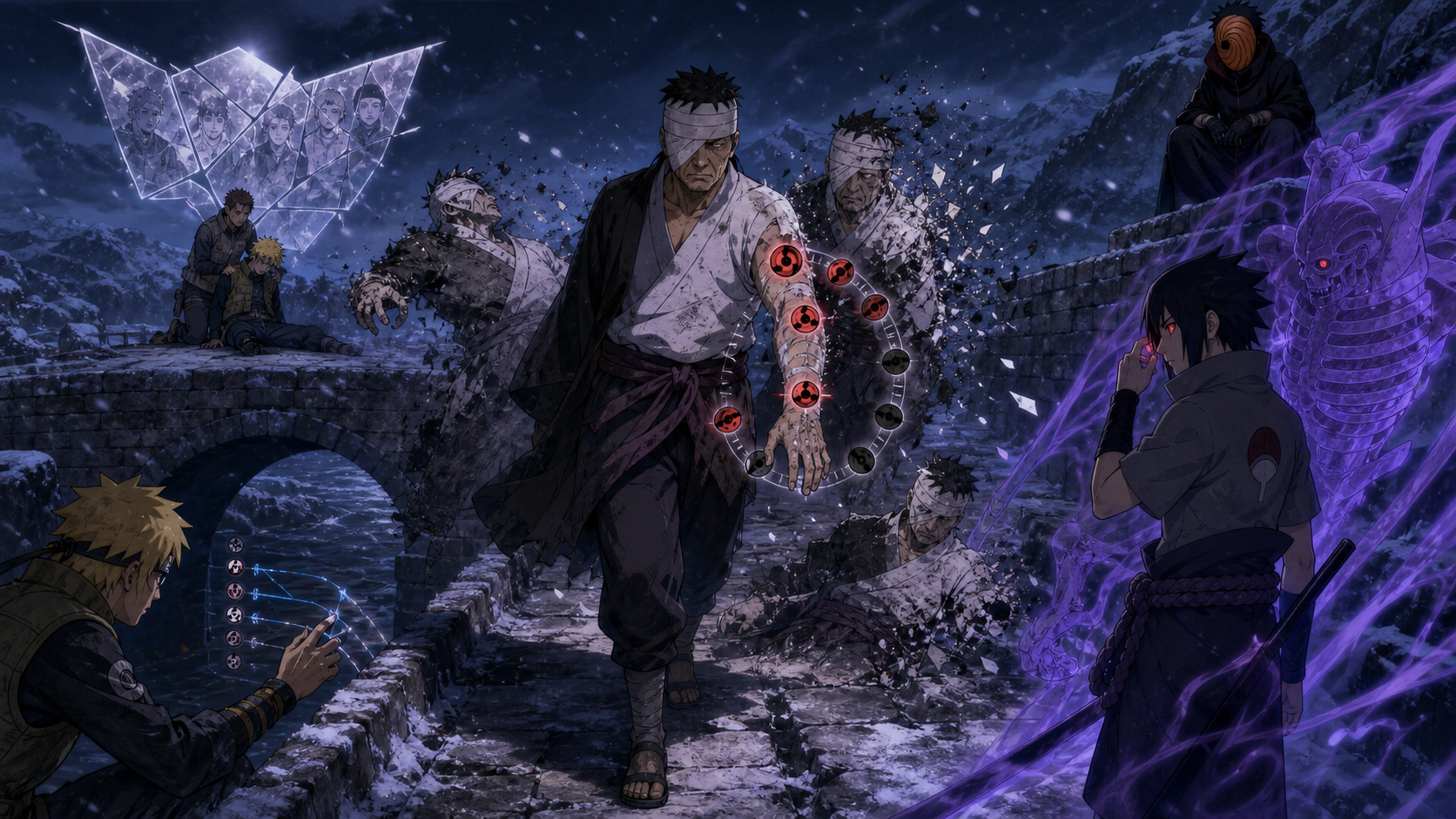
Izanagi lets Danzō discard fatal realities, but Karin discovers that every rewritten death consumes one stolen Sharingan.
Bottom line
Naruto Shippuden Episode 210, “The Forbidden Visual Jutsu,” reveals why Danzō can survive attacks that should kill him.
Sasuke repeatedly destroys Danzō with Susanoo, fire, and shuriken, yet Danzō returns as though each death never occurred. Karin watches the Sharingan embedded in his right arm and notices that one eye closes after each use. Tobi identifies the technique as Izanagi, a forbidden Uchiha visual jutsu that temporarily turns unfavorable reality into illusion.
Danzō can use Izanagi because Orochimaru implanted both Sharingan and the First Hokage’s cells into his body. The combination also gives him Wood Release and the potential to control a tailed beast. While Sasuke and Karin work to measure Izanagi’s limit, Naruto suffers a panic attack in the snow as the image of Team 7 fractures inside him.
Izanagi makes a successful attack insufficient evidence
Sasuke strikes Danzō decisively. The body falls, the damage is visible, and the fight should advance. Then Danzō stands somewhere else without the injury.
Izanagi does not merely block an attack. The technique edits the outcome after the attack succeeds, converting the user’s death or damage into illusion while preserving the reality he prefers.
That power attacks certainty. Sasuke cannot trust his eyes, his opponent’s body, or the apparent end of an exchange. Winning once means nothing if the victory can be removed from the record.
Every rewritten death closes a stolen eye
Izanagi has a price. Each Sharingan grants Danzō a limited interval of altered reality, then loses its light and closes permanently.
The cost is horrifying because Danzō does not pay with the eye he was born with. He spends eyes taken from dead Uchiha.
His apparent immortality is therefore a stack of other people’s finite sacrifices. Every time he refuses his own death, one more stolen inheritance is consumed beyond recovery.
Karin turns the impossible into a countable system
Karin cannot overpower Danzō, but she can observe what force alone misses. She notices the pattern of eyes closing and relates that pattern to the timing of his returns.
That transforms Izanagi from unlimited resurrection into a resource-management problem. Danzō has a number of uses, a duration, and a cost.
Karin’s work gives Sasuke a path forward: force Danzō to spend reality until he reaches the last version he can no longer discard.
Sasuke must fight the rule, not only the man
Sasuke’s first instinct is escalation. Susanoo can crush Danzō, and flames or blades can kill him again. Repetition alone favors the opponent whose technique erases consequences.
The fight becomes strategic when Sasuke recognizes that each false victory consumes part of Danzō’s arm. His attacks are no longer attempts to finish the battle immediately. They are pressure designed to drain a hidden clock.
This is an important shift. Rage brought Sasuke to the bridge, but analysis may let him survive the encounter.
Danzō fused Senju and Uchiha power inside one body
Tobi recognizes Wood Release and understands that Danzō carries the First Hokage’s cells alongside multiple Sharingan.
The combination echoes the founding conflict of Konoha while violating both lineages. Danzō did not reconcile Senju and Uchiha through shared purpose. He combined their bodies through experimentation to increase control.
The village built by those clans becomes, in Danzō’s arm, a private weapon assembled from what its politics destroyed.
Orochimaru’s influence survives inside Konoha’s acting leader
Danzō publicly presents himself as the hard guardian of the Leaf, yet his body contains the result of Orochimaru’s experimentation.
The partnership exposes how easily official power and forbidden research cooperate when both sides want results. Danzō could condemn rogue ninja while privately using their methods.
His secrecy is not separate from his authority. Secrecy preserves the appearance of institutional purity while allowing him to benefit from everything the institution claims to reject.
The power to control a tailed beast reveals another ambition
Tobi notes that the combined Senju cells and Sharingan could let Danzō control the Nine-Tails. That possibility changes the meaning of his interest in Naruto.
Naruto would not only be a person to protect or an asset to hide. He could become a source of power Danzō believed himself uniquely qualified to command.
The idea follows Root’s central logic: dangerous freedom should be replaced with useful obedience, and Danzō should decide what usefulness means.
Tobi explains Izanagi because knowledge serves his experiment
Tobi is not helping Sasuke out of generosity. He watches the fight, names the technique, and studies both Danzō’s limit and Sasuke’s response.
He already understands the history Danzō tried to hide. Sharing that knowledge keeps Sasuke moving toward the outcome Tobi wants while allowing Tobi to preserve his position outside the immediate risk.
The explanation is accurate and still manipulative. That combination has become Tobi’s signature.
Naruto’s panic attack is the emotional version of lost reality
Naruto’s understanding of Team 7 has held together through separation because he believed the bond remained real beneath every conflict.
Now Sakura plans to kill Sasuke, the rookies agree, Sasuke has attacked the Kage, and Tobi claims their opposition is inherited destiny. The picture Naruto relied on no longer matches the choices his teammates are making.
His breathing fails as that internal image shatters. Like Sasuke facing Izanagi, Naruto can no longer trust the reality he thought he understood.
Yamato responds to a crisis no restraint can solve
Yamato can suppress the Nine-Tails and physically keep Naruto from running into danger. A panic attack is not an enemy he can bind with Wood Release.
Naruto needs space to breathe and people willing to stop demanding an immediate answer. The moment reminds us that protecting a jinchūriki includes ordinary human care.
The alliance may see Naruto as one of two keys to preventing the Ten-Tails. Yamato sees a teenager overwhelmed by the possible loss of his family.
Forbidden techniques reveal what a person accepts as expendable
Izanagi is forbidden partly because the technique destroys the eye that performs the rewrite. Danzō bypasses the personal limit by collecting many eyes from others.
That choice captures his ethics. A cost does not deter him when he can transfer the payment to bodies he considers available.
Sasuke also spends himself through Mangekyō techniques, but his damage remains his own. Neither path is healthy; the distinction matters when judging who has been made to pay.
The arm is a political archive, not a power-up display
Danzō’s right arm is visually grotesque because the story needs the audience to see accumulation. Each embedded Sharingan belongs to a history the village tried to bury after the Uchiha massacre. The eyes have been removed from names, families, and funerals, then reorganized as an acting Hokage’s private reserve.
That image changes the usual language of inherited technique. Sasuke’s Sharingan connects him to family even when the inheritance hurts him. Danzō wears the same dōjutsu without kinship, permission, or mourning. He has converted ancestry into inventory.
The First Hokage’s cells add another layer of appropriation. Konoha publicly venerates Hashirama as a founder while powerful men privately divide his body into experimental material. Danzō’s arm joins two revered bloodlines through extraction rather than reconciliation, turning the village’s founding families into parts for a state weapon.
Karin performs the episode’s most important intellectual work
Karin’s contribution is easy to undervalue because Sasuke produces the spectacle. Susanoo fills the bridge, attacks land with enormous force, and Danzō repeatedly appears to die. None of that power provides a victory condition until Karin identifies the closing eyes and measures the interval.
Her sensory role also carries risk. Watching the pattern requires sustained attention while Danzō understands that she is feeding Sasuke information. Karin cannot hide behind the idea that support work happens outside combat. Her analysis actively changes the duel.
Sasuke uses her count, but the episode already hints at the unequal relationship beneath their teamwork. He receives the information without giving Karin meaningful control over the danger. Her intelligence makes his revenge possible, while his narrowing judgment will soon treat her body as expendable.
Naruto’s panic deserves more than a toughness lecture
Naruto has been asked to absorb incompatible truths in rapid succession. Sasuke attacked the summit. The allied villages want him dead. Sakura’s confession was false. Tobi connected Sasuke’s hatred to the Uchiha massacre and Konoha’s choices. Gaara asked Naruto to respond as someone who wants to become Hokage rather than only as Sasuke’s friend.
No amount of stubbornness can make those demands agree. Naruto’s panic attack is a bodily crisis produced by emotional overload, not a failure to care correctly. His usual solution is movement: train harder, run toward danger, create more clones, or make another promise. Snow, exhaustion, and Yamato’s restraint remove those exits.
The broken Team 7 image matters because Naruto has used that picture as proof that restoration remained possible. Seeing the figures fracture does not tell him the bond was fake. The image tells him the old arrangement cannot simply be recovered unchanged.
Izanagi and denial share a structure but not a moral scale
The episode links Danzō’s visual technique with Naruto’s emotional crisis through the problem of rejected reality. Danzō literally rewrites outcomes that threaten him. Naruto has tried to preserve a version of Team 7 that can survive every new offense. Both confront evidence that their preferred reality has reached a limit.
The comparison does not make Naruto morally equivalent to Danzō. Naruto’s denial grows from love and fear of loss; Danzō’s technique spends stolen bodies to preserve power. The shared structure instead clarifies why acceptance matters. Refusing reality cannot produce healing when another person pays the cost.
Naruto’s next growth must include Sasuke’s present choices as well as the child Naruto remembers. Sasuke’s victory requires recognizing how Danzō’s system works rather than merely killing the same body harder. Both storylines demand observation before action.
The Japanese performances keep exposition emotionally active
Nobuo Tobita carries much of the Izanagi explanation as Tobi, but the delivery never sounds like neutral instruction. His calm contains ownership. Tobi knows the history, understands both combatants, and releases information only when disclosure advances his experiment.
Noriaki Sugiyama gives Sasuke a clipped focus that contrasts with the scale of Susanoo. The performance does not celebrate each apparent kill because Sasuke recognizes that spectacle without finality is wasted effort. Kanako Tōjō gives Karin urgency without reducing her observations to shouted numbers; calculation and fear remain present together.
Junko Takeuchi’s Naruto scenes abandon the character’s familiar projection. Breath interrupts language, and the silence around him becomes part of the performance. The episode trusts physical distress to communicate a conflict Naruto cannot yet organize into a speech.
Izanagi turns privilege into a combat mechanic
Danzō experiences a fatal consequence, rejects the outcome, and spends property taken from someone else to continue. The jutsu literalizes a political habit already central to his career.
He has survived scandal, forbidden research, and the massacre’s secrecy because other people carried the cost. On the bridge, that exemption becomes visible every time another eye closes.
A forbidden cost means little when another body pays
The technique destroys sight, which should impose a severe personal limit. Danzō bypasses the intended boundary by filling one altered arm with eyes acquired through collective death.
Calling Izanagi forbidden cannot protect anyone if leaders possess the authority, secrecy, and bodies needed to transfer its price. Prohibition without accountability becomes ceremonial.
Karin restores sequence to a fight built from deleted outcomes
Danzō’s resets make cause and effect feel unreliable. Karin notices that the arm still records expenditure even when the battlefield no longer records death.
Each closed eye becomes an archive of what Izanagi tried to erase. Her count returns time, scarcity, and consequence to a system designed to make them disappear.
Sasuke learns patience through a technique powered by rage
Susanoo can destroy Danzō repeatedly, but each spectacular victory means nothing until the hidden clock expires. Sasuke must stop treating force as final proof and begin using force to test a rule.
The strategy is a rare interruption to revenge’s tunnel vision. He listens to Karin, measures the eyes, and accepts that understanding the enemy matters more than making anger look enormous.
Danzō combines Konoha’s founders without sharing their dream
Senju vitality and Uchiha perception coexist inside his arm, yet the union creates no reconciliation between clans. Their bodies have been assembled through experimentation and theft around one man’s desire for control.
The village founded through a fragile partnership appears here as anatomy without relationship. Danzō preserves useful bloodlines while discarding the people and consent that gave them meaning.
Wood Release carries the children who did not survive
Yamato’s existence already revealed how many experimental subjects died before Hashirama’s cells produced a usable result. Danzō wears another successful outcome without displaying the failed bodies behind it.
His technique cannot be separated from that history. The tree growing from his arm is also evidence of a research system where survival determined whether a child became an asset or disappeared.
Tobi narrates because explanation keeps him outside responsibility
He knows the technique, its lineage, Danzō’s alterations, and the likely limit. Supplying that knowledge helps Sasuke without requiring Tobi to risk his own body or disclose how he learned so much.
The narrator’s calm converts exploitation into fascinating mechanics. Sasuke receives useful truth while Tobi retains the power to frame what the truth should make him do.
Naruto cannot rewrite Team Seven without spending someone
Preserving the childhood image would require erasing Sasuke’s present harm, Sakura’s lethal decision, or the other villages’ right to defend themselves. Every comforting version now asks another person’s reality to disappear.
His panic arrives when love can no longer hold the old picture together. Acceptance must begin before he knows what new relationship, if any, can survive.
Yamato witnesses the limit of containment
Wood Release can restrain the Nine-Tails, block escape, and enforce an order to return. None of those functions can reorganize grief inside a person whose breathing has become a crisis.
Protecting Naruto requires presence rather than control. The distinction matters as an alliance prepares to hide him for strategic reasons that may ignore the human emergency already visible.
RaeRae’s reaction to The Forbidden Visual Jutsu
Izanagi is the ultimate “that did not count” technique, except Danzō purchased every retry with somebody else’s eye. He keeps rewriting his death while the evidence of an entire clan closes one by one on his arm.
Karin deserves credit because she turns a reality-breaking nightmare into math. Count the eyes. Watch the timing. Make him spend the thing he thinks is endless. Sasuke’s power looks spectacular, but her observation is what gives the fight a shape.
That distinction is why I refuse to call Karin background support. A battlefield does not become legible by accident. She identifies the rule, communicates the clock, and gives Sasuke a strategy beyond exhausting himself against repeated false endings. The episode belongs to her intelligence as surely as the explosions belong to his chakra.
Tobi calmly narrating all of this is infuriating in the most predictable way. He knows what Danzō did, knows what Sasuke needs to hear, and gives exactly enough information to keep the experiment moving.
Then Naruto’s Team 7 picture breaks, and the episode’s two stories click together. Sasuke is fighting a man who can discard realities he dislikes. Naruto is discovering that he cannot keep preserving the old version of his team simply because he needs the memory to remain true. Both of them have reached the point where the next answer has to survive reality.
The fight asks who owns reality after violence
Danzō declares unfavorable events unreal through a technique no victim consented to fund. Sasuke wants the massacre’s concealed reality acknowledged through killing the man who helped bury it.
Neither power alone can create a shared record. Justice requires truth that survives the preferences of both the state official and the avenger.
Closed eyes become the evidence Danzō cannot fully erase
Izanagi removes death from the immediate scene, but the arm keeps a physical account. Karin reads that account because stolen resources remain finite even when power pretends otherwise.
The image answers Danzō’s secrecy with involuntary disclosure. His own body reveals the cost his words would continue hiding.
Naruto and Sasuke face different versions of an ending that will not stay ended
Sasuke kills Danzō and watches him return. Naruto tries to preserve Team Seven and watches each new truth fracture the image again. Repetition exposes the rule neither can overpower through insistence.
They need a reality capable of holding history, harm, love, and consequence together. Anything simpler will demand another stolen eye or another excluded person.
Danzō believes reality belongs to whoever possesses enough power to revise it. Karin proves reality leaves evidence. A closed eye records the death he erased, the person he consumed, and the shrinking number of exits remaining. Her attention makes stolen history testify against its owner.
RaeRae’s final word on The Forbidden Visual Jutsu
Izanagi is Danzō’s entire political philosophy turned into a jutsu: if reality threatens his authority, spend somebody else’s body until the problem stops counting.
Karin is the reason the fight becomes solvable. She recognizes that the battlefield can lie while the arm keeps receipts, and suddenly immortality has a clock.
Sasuke finally listens long enough to fight the system instead of only striking the man. That growth is real, even while the teammate supplying his strategy remains dangerously invisible to him.
Naruto’s collapse completes the argument. He cannot rewrite Team Seven into the version he needs without erasing somebody else’s truth. His body demands reality before his heart has found an answer.
RaeRae’s call
Izanagi lets Danzō delete consequences by consuming stolen Sharingan. Karin defeats its illusion of infinity by finding the physical record his altered reality cannot conceal.