
Power of the Five Kage
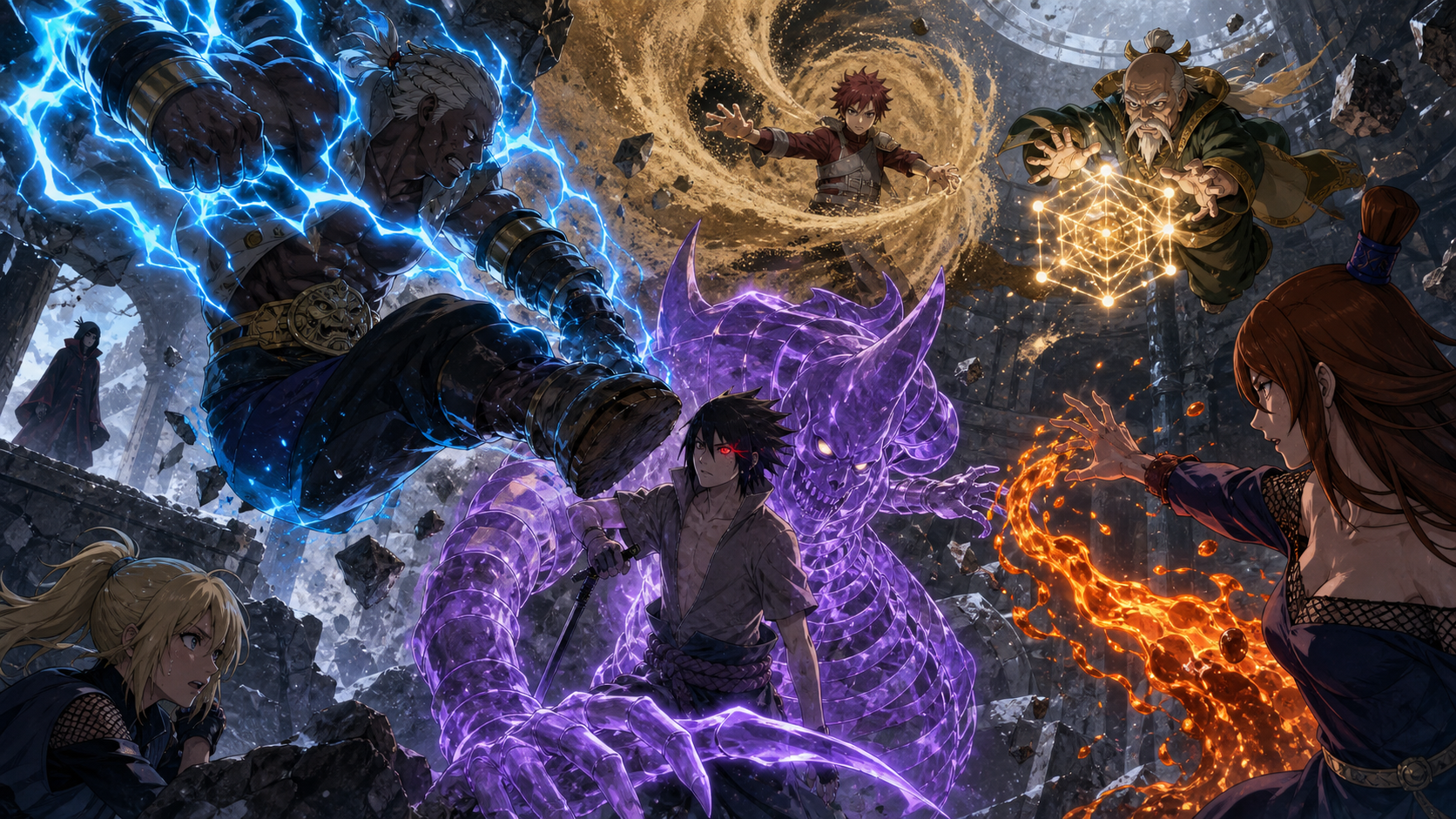
Sasuke’s summit invasion becomes a gauntlet as four Kage answer Susanoo with lightning, sand, lava and Particle Style.
Bottom line
Naruto Shippuden Episode 204, “Power of the Five Kage,” turns Sasuke’s summit invasion into a brutal tour of the leaders gathered to stop Akatsuki. The Fourth Raikage attacks first, driving through Sasuke’s defenses with speed and physical force. Sasuke answers with the Mangekyō Sharingan, black flames, and the skeletal protection of Susanoo.
Gaara interrupts the fight and tries to ask whether Sasuke can still turn away from revenge. Sasuke’s answer is silence and escalation. Darui, Temari, and Kankurō join Gaara’s attack, but Susanoo shields Sasuke long enough for him to pursue Danzō.
Inside the conference level, Mifune confronts Sasuke while Danzō escapes with Fū and Torune. Mei traps Sasuke with Lava Release and corrosive mist. Chōjūrō strikes him through a wall, and Ōnoki appears to erase him with Particle Style. Tobi then enters the chamber, revealing that Sasuke survived and seizing control of the summit’s attention.
The Raikage fights like grief has become momentum
The Fourth Raikage does not approach Sasuke as a puzzle. He believes this is the Akatsuki attacker responsible for Killer B’s capture, and he converts that belief into immediate force.
His speed is not only a combat advantage. Speed becomes characterization. Naruto asked him to stop and reconsider, but the Raikage has already decided that waiting rewards the person who caused the harm.
The episode lets that anger look frightening and understandable at once. Sasuke invaded neutral territory after attacking the Raikage’s brother. Mercy cannot be demanded as though the Raikage’s loss is less real than Sasuke’s.
Sasuke makes defense dangerous to touch
Sasuke’s black flames transform protection into a threat. He coats Susanoo with Amaterasu so that striking his defense can burn the attacker.
The defense is an effective response to an opponent whose entire style depends on closing distance. The burning armor is also a perfect image for Sasuke’s emotional condition. He has built pain around himself until anyone trying to reach him is punished for contact.
The Raikage still attacks. He is prepared to sacrifice his own body rather than allow Sasuke’s shield to dictate the outcome. Their clash is two forms of refusal meeting at full speed.
Gaara speaks because he recognizes the road
Gaara is the only Kage who pauses to address Sasuke as someone who might still choose differently. He knows how loneliness can become permission for violence. He also knows that another person’s stubborn belief can interrupt that path.
His appeal is not naïve. Gaara arrives ready to fight and protects others from the black flames. He offers Sasuke a choice without pretending that the summit can ignore the danger he presents.
When a tear slips from Gaara’s eye, the tear carries grief for the person Sasuke might become and for how close Gaara once came to becoming the same thing.
Sasuke cannot hear the warning he once embodied
There was a time when Sasuke understood comradeship well enough to put himself between Naruto and death. His revenge gradually taught him to treat that instinct as weakness.
Gaara is living evidence that a person shaped by hatred can build another life. Sasuke refuses to engage because accepting Gaara’s example would require admitting that revenge is a choice, not the only honest response to pain.
Tobi prefers the language of destiny. Sasuke prefers the language of resolve. Both descriptions protect the same straight line from interruption.
The Five Kage are powerful in different languages
The episode title is not asking us to rank five identical fighters. Each Kage expresses power through a different relationship to responsibility.
The Raikage is speed and direct protection. Gaara controls the battlefield and shields others. Mei turns the architecture itself into a sealed execution space. Ōnoki brings terrifying experience and a technique capable of removing matter. Danzō’s power, by contrast, is expressed through escape, secrecy, and guards who absorb danger for him.
The summit was politically fractured, but Sasuke’s invasion reveals why none of these leaders can be treated as ceremonial.
Danzō leaves other people to pay for his survival
Sasuke came for Danzō, yet the acting Hokage does not remain to answer him. Fū and Torune escort Danzō away while Mifune and the other villages confront the threat.
Retreat may be strategically defensible, especially after Danzō’s manipulation has been exposed. Still, the image is consistent with his leadership. He makes choices in secret, calls them necessary, and allows other bodies to carry the immediate cost.
Sasuke’s path through the summit harms samurai and Kage attendants who had no role in the Uchiha massacre while the man he wants keeps moving farther away.
Mei turns diplomacy’s room into a weapon
Mei’s techniques are especially effective because she controls space. Lava blocks routes, heat limits movement, and corrosive vapor punishes anyone trapped inside the chamber.
Sasuke’s Susanoo protected him from direct attacks, but maintaining the construct has already drained him. Mei attacks the limits of that defense rather than trying to overpower Susanoo in the Raikage’s style.
Her composure also changes the fight’s rhythm. After the Raikage’s explosive fury and Gaara’s emotional appeal, Mei treats Sasuke as an intruder to be contained and eliminated.
Chōjūrō and Ōnoki prove attendants are not decorations
Chōjūrō may be shy, but Hiramekarei sends Sasuke through a wall with enormous force. His hesitation in conversation does not predict weakness in combat.
Ōnoki arrives with even less ceremony. Particle Style reduces the space around Sasuke to a geometric boundary of destruction. For a moment, everyone believes the fight is over.
These attacks make the summit feel like the worst possible place for a depleted intruder. Every corridor leads to another specialist, and every leader brought people capable of protecting them.
Karin’s value is being consumed by Sasuke’s choices
Karin tracks Danzō, monitors Sasuke’s condition, and keeps trying to guide him through a building filled with enemies. Her sensory skill is the reason his pursuit has direction.
Yet Sasuke’s escalating attacks leave little room for the team to operate as a team. He spends chakra at a dangerous rate and expects Karin to keep pace inside battles she cannot control.
Her concern is practical and personal. The person she chose to follow is becoming harder to recognize, while her usefulness increasingly depends on helping him reach the next act of revenge.
Tobi rescues the piece he still intends to use
Ōnoki’s attack appears to erase Sasuke, but Tobi reveals that he removed him in time. The rescue clarifies the power relationship between them.
Tobi encouraged Sasuke’s summit attack, exposed his location through Zetsu, and allowed him to test himself against the Kage. When the experiment reaches a fatal endpoint, Tobi preserves the asset.
Sasuke experiences his campaign as personal choice. Tobi keeps deciding when he enters the board, who finds him, and when he is removed from danger.
The summit becomes a map of competing leadership styles
Combat exposes the political differences that conversation introduced. The Raikage places his own body at the front and accepts physical loss as the price of protection. Gaara controls range while shielding allies. Mei uses containment and environmental pressure. Ōnoki relies on experience and decisive destructive power.
Danzō’s absence is therefore part of the comparison. His guards carry the immediate danger while he preserves himself for a claim to authority already damaged by manipulation. The other leaders may be flawed, but they remain inside the crisis their positions helped create.
The title’s “power” includes more than techniques. A Kage’s strength is also the relationship between office, risk, and the people expected to pay.
The Raikage’s sacrifice is courageous and strategically alarming
The Raikage attacks through Amaterasu even after recognizing the cost. His willingness to lose an arm communicates devotion to Killer B and refusal to let Sasuke escape consequence. The same willingness can also narrow leadership into vengeance.
A village cannot easily replace the person coordinating its military power. Every injury affects people beyond the fighter. Naruto’s earlier plea failed partly because the Raikage heard a request for mercy without sufficient acknowledgment of the Cloud’s loss, but grief does not erase his responsibility to survive for others.
The episode lets both truths remain. His attack is brave. His refusal to disengage nearly gives Sasuke’s defensive strategy exactly the sacrifice Sasuke designed the flames to demand.
Gaara’s tear is recognition rather than absolution
Gaara does not cry because Sasuke is secretly innocent. He has watched Sasuke attack neutral samurai, injure summit personnel, and refuse every opening to stop. The tear recognizes a person choosing the road Gaara once believed was unavoidable.
That history gives Gaara authority without granting control. Naruto interrupted Gaara’s isolation, but Gaara still had to choose what came after defeat. He offers Sasuke the same possibility and cannot make him accept.
The grief belongs partly to the limit of rescue. Caring can create an opening, protect a life, or tell the truth. Caring cannot choose transformation on another person’s behalf.
Mei’s chamber reverses Sasuke’s control of distance
Sasuke survived the Raikage by making close contact dangerous and endured Gaara’s range through Susanoo. Mei changes the problem by controlling exits, air, heat, and the surfaces around him. The room becomes part of her technique.
Her approach is clinical rather than emotionally detached. Sasuke invaded a diplomatic summit and arrives already depleted. Containment protects everyone outside the chamber while pressure attacks the endurance his visual techniques have consumed.
The sequence also prevents the Kage from feeling interchangeable. Mei does not imitate the Raikage’s speed or Gaara’s appeal. She reads the remaining weakness and makes the architecture enforce her answer.
Karin sees the team disappearing around the target
Karin’s sensory guidance keeps Sasuke oriented toward Danzō while enemy chakra fills the building. Her value is constant, yet Sasuke increasingly treats that guidance as a function rather than a relationship.
Suigetsu and Jūgo have already been separated from the pursuit. Taka entered the summit as a team, but revenge reorganizes every member into equipment: tracking, healing, distraction, or force. Once a function cannot serve the target, the bond becomes easier for Sasuke to discard.
Karin recognizes the change before she can fully name the consequence. Concern for his chakra is also concern for the person she believed she followed.
The Japanese cast gives each Kage a distinct temperature
Unshō Ishizuka drives the Raikage’s lines with grief compressed into command. Akira Ishida gives Gaara a measured appeal whose restraint makes the tear sharper. Yurika Hino lets Mei sound composed without softening the lethal containment she creates.
Tomomichi Nishimura gives Ōnoki the confidence of someone whose age has reduced his patience for spectacle. Noriaki Sugiyama keeps Sasuke increasingly narrow, answering different forms of authority with the same fixation on Danzō.
Nobuo Tobita’s arrival changes the room because Tobi sounds less exhausted than everyone else. He has treated the entire invasion as preparation. The vocal contrast makes his control audible before his larger plan is explained.
Sasuke enters the summit as a grievance and becomes a crisis
His target is Danzō, but the route immediately expands beyond the man connected to Itachi’s orders. Samurai, attendants, and Kage become bodies he is willing to cross because revenge has declared every interruption morally irrelevant.
The episode refuses to let a righteous grievance guarantee righteous conduct. Sasuke’s reason for arriving can remain understandable while his behavior makes the entire summit responsible for stopping him.
Amaterasu turns Sasuke’s boundary into collective punishment
Coating Susanoo in black flame means anybody who reaches him must burn. The defense communicates exactly how Sasuke now manages intimacy: approach becomes injury, and concern becomes another opening he can weaponize.
The technique is tactically brilliant against the Raikage. Emotionally, it reveals a person who would rather make contact impossible than risk another voice changing his direction.
Ay’s missing arm makes revenge visible on both sides
The Raikage is willing to sacrifice flesh for B because grief has shortened the distance between protection and retaliation. Sasuke is willing to sacrifice strangers for Itachi because grief has done the same thing to him.
Their motives are not identical, but the collision shows what happens when pain decides delay is betrayal. Bodies become proof of devotion before either man has considered who must live with the aftermath.
Gaara offers recognition without requesting exemption
He does not tell the Kage to release Sasuke or pretend the invasion is a misunderstanding. Gaara shields allies, contains the flames, and remains ready to fight while asking whether another future is still imaginable.
That balance makes his appeal stronger than forgiveness without conditions. He recognizes Sasuke’s wound and refuses to let the wound erase everyone standing in danger.
Danzō’s escape exposes the architecture of unaccountable power
The person most directly connected to Sasuke’s target leaves through a guarded route while leaders from other villages absorb the attack. Danzō survives by making secrecy, hierarchy, and loyal subordinates carry consequences away from him.
Sasuke responds by treating every substitute body as acceptable. Both men reproduce the same logic from opposite directions: the objective matters, and whoever stands between can be spent.
Mei’s containment respects the scale of the threat
She does not assume one spectacular attack has settled Sasuke. Mei closes exits, changes the air, and forces an exhausted opponent to keep paying for defenses he cannot sustain forever.
Her battlefield intelligence is a form of leadership. Protecting the larger summit means restricting the crisis to a room, even when the person inside carries a history the audience understands.
Ōnoki answers spectacle with terrifying efficiency
After lightning armor, black flames, sand, lava, and a living skeletal shield, Particle Style appears almost quiet. Its clean geometry threatens to remove the entire argument from physical existence.
The apparent ending reminds us that legendary power does not make Sasuke untouchable. Tobi’s intervention, not Sasuke’s control, is what keeps the revenge campaign alive.
Tobi treats the Kage as instructors in Sasuke’s development
He exposes Sasuke through Zetsu, watches each new pressure force greater Mangekyō use, and rescues him only when the lesson would become fatal. The summit is a classroom built from other people’s risk.
Sasuke thinks escalating proves independence. Tobi measures the escalation as progress toward a weapon that will be more isolated, exhausted, and dependent on the next piece of information he supplies.
RaeRae’s reaction to Power of the Five Kage
This episode is twenty minutes of Sasuke opening another door and finding a fresh reason he should have stayed home. The Raikage arrives like a thunderstorm with shoulders. Gaara brings emotional clarity and an entire desert indoors. Mei turns the room into a pressure cooker. Then Ōnoki floats in and basically says, “Have we tried deleting him?”
Gaara is the part that hurts. He is not begging Sasuke from a place of innocence. He knows exactly how rage feels when rage becomes an identity. That tear is for the life Sasuke is refusing to imagine.
And Danzō running while everyone else deals with the consequences? Of course he does. Sasuke is destroying unrelated people to reach a man who has built his whole career around making other people stand between him and accountability.
The Kage are impressive, but the real pattern is Tobi’s control. He points Sasuke at the summit, lets hatred burn through every warning, then pulls him out before death can end the plan. Sasuke thinks nobody can steer him. That may be the most dangerous illusion in the room.
Power means deciding whose body stands in front
Ay puts his own body there. Gaara places sand between danger and others. Mei turns her technique into containment. Danzō places guards and foreign leaders between himself and the accountability chasing him.
The title therefore judges leadership as much as combat. A devastating jutsu proves capacity. Where a leader locates personal risk reveals what that capacity protects.
Taka is dissolving while Sasuke insists he acts alone
Karin remains useful because she can find Danzō and measure Sasuke’s collapse. Suigetsu and Jūgo are separated somewhere behind him, consequences of an operation that no longer values the team’s survival equally.
Revenge promised Sasuke freedom from manipulated bonds. Instead, he converts new bonds into tools and becomes more dependent on the masked man who keeps rescuing the mission.
The summit cannot return to ordinary diplomacy after this
Every village has now seen Akatsuki violence reach the table where cooperation was being debated. Political suspicion remains, but distance from the organization is no longer a believable defense.
Sasuke’s invasion gives Tobi exactly the shared emergency he needs. The Kage are being pushed toward unity while he prepares to define the enemy, the terms, and the price.
The episode never lets spectacular power answer the moral argument. Every technique stops a body, protects a leader, or opens an escape, while the cycle producing this violence remains available to Tobi.
RaeRae’s final word on Power of the Five Kage
Sasuke walked into one building and collected a lightning demigod, weaponized sand, lava, acid mist, a giant sword, and a floating elder who can delete matter. That is not a battle plan. That is a consequences sampler.
Gaara’s tear still lands hardest because he knows rescue has a limit. Somebody believed in him, but Gaara eventually had to choose what that belief meant. He cannot make that choice for Sasuke.
Danzō escaping while everybody else fights feels perfectly on brand. He built policy in shadows and keeps expecting public bodies to settle the bill.
Then Tobi saves Sasuke at the final second, because this was never freedom. Sasuke is being sharpened through people who did not consent to become his training ground.
RaeRae’s call
The Five Kage reveal power through force, protection, containment, experience, and escape. Sasuke survives their combined answer because Tobi still controls when his chosen weapon may leave the board.