
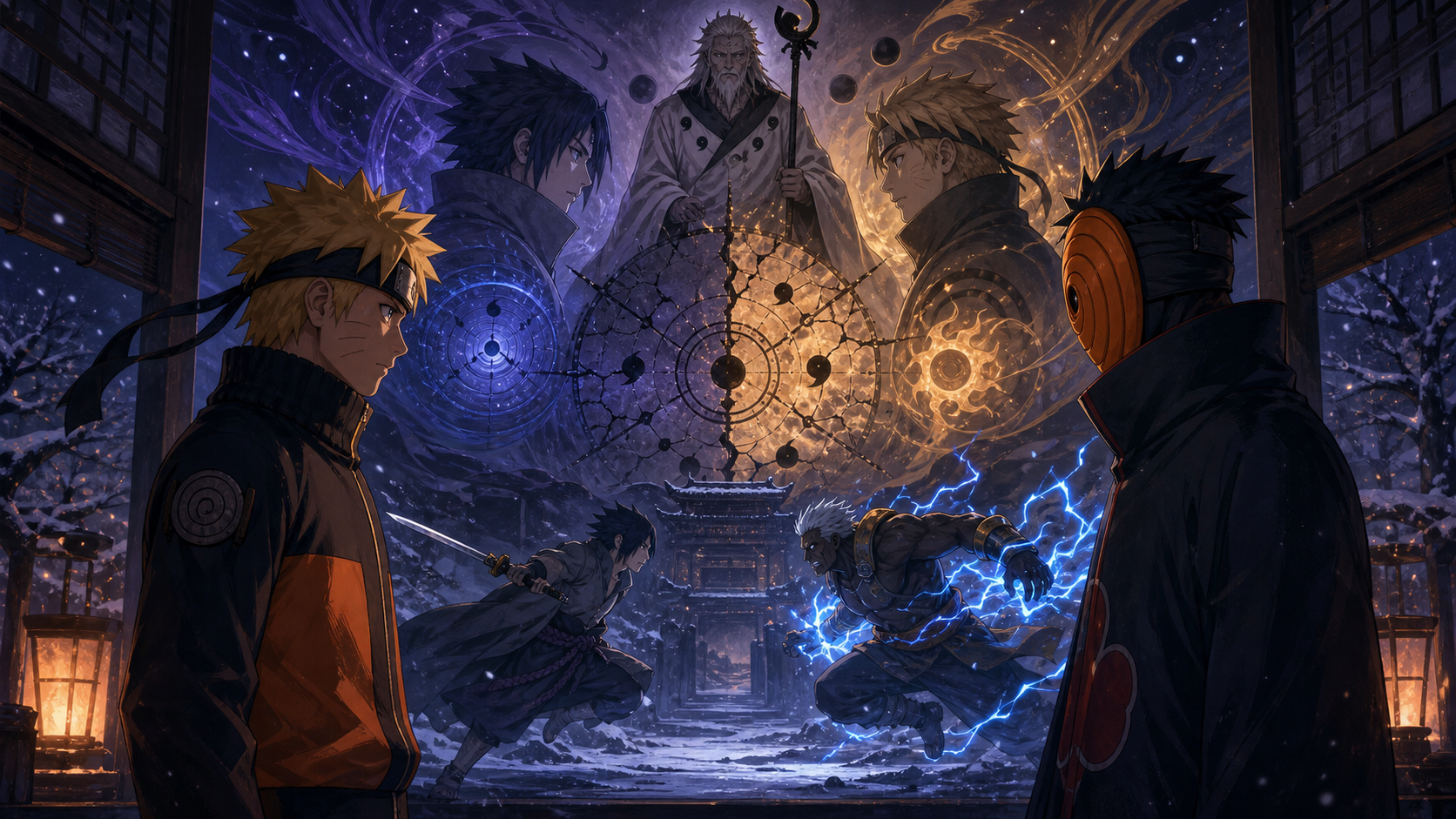
Sasuke’s Ninja Way
Tobi turns ancient history into a prophecy for Naruto and Sasuke, but Naruto refuses to let inheritance write their ending.
Bottom line
Naruto Shippuden Episode 203, “Sasuke’s Ninja Way,” turns Tobi’s account of Itachi into a much larger claim about the shinobi world. Naruto, Kakashi, and Yamato learn that Itachi accepted disgrace and death to protect both Konoha and Sasuke. Tobi then traces the Uchiha conflict back to the Sage of Six Paths and the opposing ideals inherited by his two sons.
According to Tobi, the elder son trusted power while the younger believed cooperation created peace. The Sage chose the younger as his successor, and their rivalry continued through their descendants. Tobi frames Naruto and Sasuke as the latest people trapped inside that ancient opposition.
Naruto rejects the idea that Sasuke must be killed or abandoned. Elsewhere in the Land of Iron, Sasuke advances toward Danzō while the Fourth Raikage closes in, making the philosophical argument feel dangerously immediate.
The truth about Itachi changes the question, not the damage
Naruto’s shock is understandable. Itachi was presented to the world as a murderer who destroyed his clan for ambition. Learning that Konoha used him to stop a coup, then allowed him to carry the blame alone, explains why Sasuke’s target changed from his brother to the village.
Explanation is not absolution. Sasuke has still joined Akatsuki, attacked Killer B, invaded the summit, and harmed people who had nothing to do with the massacre. The truth makes his rage legible without making every action righteous.
That distinction is the emotional work Naruto must do. If he cannot see the wound, he cannot reach Sasuke. If he sees only the wound, he risks erasing everyone Sasuke hurts.
Tobi tells history like a man arranging pieces
Tobi presents the Sage’s family as the origin of a conflict that has survived for generations. His voice makes the story sound inevitable: one brother chose strength, the other cooperation, and their descendants kept repeating the argument.
The history matters, but so does the storyteller. Tobi benefits when Naruto believes that he and Sasuke occupy fixed positions in an ancient design. Fate can become a convenient excuse for the person who keeps engineering their collision.
He offers real information while quietly narrowing the available conclusions. That is his favorite kind of manipulation. A lie can be rejected. A carefully framed truth is much harder to escape.
The Sage’s choice created an inheritance of resentment
The Sage chose his younger son because peace required connection rather than individual dominance. The elder son interpreted that choice as rejection, and the brothers’ disagreement became conflict.
Their descendants inherited more than techniques or bloodlines. They inherited a story about who deserved to lead and what power meant. Each generation could point backward and treat old injury as proof that the next confrontation was necessary.
That pattern resembles the hidden villages themselves. Children are handed missions, grudges, and secrets created before they were born, then judged by how well they carry them. History becomes an assignment instead of a lesson.
Naruto refuses to make ancestry a verdict
Tobi wants Naruto to accept that Sasuke’s hatred is the natural result of the Uchiha inheritance. Naruto refuses the conclusion even before he has a complete alternative.
That refusal is central to his ninja way. Naruto has been assigned identities since childhood: jinchūriki, danger, failure, orphan. Other people treated those labels as predictions of who he would become. He survived by choosing relationships that contradicted them.
If Naruto accepts that Sasuke is only the latest vessel for an ancient curse, he also accepts that choice has no meaning. Everything Naruto has learned from Iruka, Team 7, Jiraiya, and Pain argues otherwise.
Kakashi listens as a teacher implicated in the outcome
Kakashi stands between Tobi’s history and Naruto’s determination with his own failures close at hand. He taught Sasuke Chidori, tried to warn him against revenge, and could not stop him from leaving Konoha.
He also understands how grief can narrow a person’s world. Kakashi lost his father, teammates, and teacher, yet eventually allowed new bonds to interrupt his isolation. Sasuke has repeatedly chosen the opposite direction.
The episode does not give Kakashi a speech that solves the contradiction. His presence reminds us that teachers can offer tools and guidance, but they cannot choose a student’s path for him.
Yamato protects Naruto while hearing a history Root buried
Yamato’s role may look purely defensive, but the conversation touches the system that shaped him. Danzō’s Root treated children as resources, suppressed identity, and justified cruelty through the language of stability.
Itachi’s mission came from the same willingness to sacrifice an individual so the village could preserve its public order. Yamato is listening to the cost of a logic he survived.
His Wood Release can hold the room, but the technique cannot restrain the political history Tobi has released. Protecting Naruto now means allowing him to know what Konoha would rather keep hidden.
Sasuke’s ninja way has become a straight line toward Danzō
The title belongs to Sasuke, but Sasuke is barely interested in explaining himself. His choices do the speaking. Danzō is ahead, and anyone between them becomes an obstacle.
This is a ninja way stripped of the promise usually attached to that phrase. Naruto’s path is built around recognition and refusing to abandon bonds. Sasuke’s current path is built around ensuring that no bond can redirect his revenge.
Tobi calls that trajectory destiny. Sasuke experiences the pursuit as freedom after a lifetime of deception. The tragedy is that the more fiercely he asserts his own will, the more closely he follows the route Tobi prepared.
The Raikage turns the debate into a deadline
While Naruto argues that Sasuke can still be reached, the Fourth Raikage is racing toward the person who attacked his brother. He has no access to Naruto’s private revelation and no reason to pause for a theory about inherited hatred.
For the Raikage, Sasuke is an Akatsuki criminal inside a diplomatic fortress. Protecting the summit and answering Killer B’s apparent abduction are immediate duties.
That collision prevents Naruto’s hope from remaining abstract. If he believes there is another answer, he must eventually produce one in a world where other people are entitled to defend themselves now.
Naruto and Sasuke are parallels without being copies
Both boys grew up lonely. Both carried power that made others afraid. Both wanted acknowledgment, and both formed their identities through loss.
Their similarities make Naruto’s loyalty convincing, but their choices remain different. Naruto learned to use pain as a reason to recognize other people. Sasuke increasingly uses pain as permission to shut them out.
Tobi’s ancient framework emphasizes repetition. The episode’s deeper tension comes from the differences repetition cannot erase. Naruto is not the younger son, and Sasuke is not the elder son. They are people who can still make choices their predecessors did not.
Tobi’s history lesson hides the editor behind the facts
Tobi gains credibility by revealing information Konoha concealed. Itachi’s assignment, the coup, and the village’s benefit from his silence all explain evidence Naruto already knows. Accurate details make the larger claim about destiny easier to accept.
The manipulation enters through arrangement. Tobi selects where the history begins, which motives receive emphasis, and what conclusion should follow. He moves from ancient brothers to Naruto and Sasuke as though centuries of institutions, families, teachers, and choices were only a straight inheritance line.
Naruto does not need to prove every historical detail false. He needs to reject the edited conclusion. A pattern can influence people without becoming a command they must obey.
Itachi’s sacrifice exposes Konoha’s preferred kind of hero
Konoha benefited from Itachi performing violence in secret, accepting public hatred, and dying before the institution had to acknowledge what the mission cost. His loyalty was praised privately precisely because public truth would threaten the village’s moral story.
That model of heroism asks one person to absorb collective wrongdoing so everyone else can remain innocent. Naruto has repeatedly been encouraged toward similar self-erasure: carry the Nine-Tails, protect the village, forgive its treatment, and keep smiling as proof that the system worked.
Understanding Itachi gives Naruto another reason to distrust solutions built on solitary sacrifice. Saving Sasuke cannot mean finding a new child willing to carry the same silence.
The inherited-will story can challenge power or protect power
The younger son’s faith in cooperation sounds closer to Naruto’s values, but inherited righteousness can become another cage. Naruto would still lose agency if the story declared him good by bloodline and Sasuke dangerous by bloodline.
The series often celebrates wills passed between generations. Episode 203 reveals the danger when inheritance becomes verdict. A useful legacy offers language and examples; a destructive legacy claims the descendant owes repetition.
Naruto’s refusal protects both boys from that verdict. He refuses to call Sasuke innocent, but he also refuses to treat ancestry as a sentence that makes present choice meaningless.
Kakashi must hear that teaching was never the whole system
Kakashi carries personal guilt because he trained Sasuke, taught him Chidori, and failed to stop his departure. Tobi’s account places that failure inside a much larger structure: massacre policy, classified truth, Danzō’s interference, and a child forced to choose between clan and village.
Structural context does not erase Kakashi’s responsibility. The context prevents him from pretending one better lecture about revenge could have repaired everything surrounding Sasuke. Team 7 entered a history the adults had hidden from them.
Kakashi’s next responsibility is therefore broader than defeating a former student. He must confront what Konoha demanded, what teachers were never told, and what accountability could mean after secrecy helped shape the threat.
The Raikage represents consequences outside Naruto’s relationship
Naruto can interpret Sasuke through childhood loneliness, Team 7, and the truth about Itachi. The Raikage knows Sasuke through an attack on Killer B and an armed invasion of neutral territory. Both perspectives contain real moral claims.
That difference keeps empathy from becoming ownership. Naruto’s closeness does not give him the right to ask every victim to wait indefinitely. The Raikage’s anger does not give him access to the history that produced Sasuke.
Any answer worthy of Naruto’s ninja way must hold both sets of truth. Reaching Sasuke matters, and protecting people from Sasuke matters at the same time.
The Japanese performances make destiny sound persuasive
Nobuo Tobita gives Tobi’s account a calm, almost instructional rhythm. The absence of visible strain makes the conclusion sound settled before Naruto has responded. That composure is part of the trap.
Junko Takeuchi gives Naruto’s refusal force without returning to childish denial. His voice carries shock, anger, and a stubborn need to preserve choice. Kazuhiko Inoue keeps Kakashi quieter, allowing the teacher’s guilt and political recognition to collect underneath the conversation.
Noriaki Sugiyama’s shorter Sasuke scenes answer the room indirectly. His forward focus gives Tobi’s destiny story visual evidence while also showing how much external planning surrounds the path Sasuke calls his own.
Tobi makes inevitability sound like scholarship
He gives Naruto a family tree, a founding conflict, and centuries of repetition, then quietly presents his preferred ending as the only conclusion an intelligent listener could reach. The performance is neat enough to hide the pressure inside it.
History can explain the shape of a conflict without commanding its next victim. Tobi erases that distinction because people who believe they are trapped are easier to steer.
The elder brother’s wound becomes a political inheritance
The Sage chooses cooperation, but the rejected son does not experience the decision as a philosophical debate. He experiences it as proof that strength, birth order, and expectation could still leave him displaced.
That private resentment survives because descendants build identities around it. A family wound becomes doctrine, and doctrine gives each new generation honorable language for reopening the same injury.
The younger brother’s ideal is not automatically innocent
Cooperation sounds morally safer than domination, yet villages also use unity to demand silence from the people they sacrifice. Konoha called Itachi loyal while requiring him to carry its crime alone.
Naruto cannot break the cycle by repeating the village’s version of togetherness. Connection must include truth, dissent, and responsibility or it becomes another polished command to endure.
Naruto refuses the role Tobi wrote for him
Tobi expects Naruto to become one more cooperative heir opposing one more power driven Uchiha. Naruto hears the parallel and rejects its authority over the ending.
His refusal matters because it is not a denial of danger. Sasuke has chosen violence. Naruto simply will not let an ancestor, a village, or a masked storyteller make that choice permanent on his behalf.
Sasuke calls the road his own while Tobi controls the map
Revenge feels like freedom after years of lies. Danzō is a real target, and the village truly did benefit from Itachi’s silence. Those truths make Sasuke’s certainty emotionally credible.
They do not change who arranged his information, supplied his access, and turned the summit into a proving ground. A manipulated choice remains a choice, but independence requires noticing who keeps preparing the available routes.
The Raikage carries a claim history cannot postpone
Ay does not know Sasuke as Itachi’s grieving brother or Naruto’s lost teammate. He knows the Akatsuki attacker connected to Killer B’s disappearance and the intruder cutting through summit security.
Naruto’s empathy cannot require Ay to treat immediate harm as a footnote. Any answer to inherited hatred must protect the living people caught in its newest repetition.
Team Seven’s bond is not a private moral universe
Naruto and Kakashi possess memories that make Sasuke more than a criminal file. Their knowledge is valuable, but it does not give them ownership over everyone else’s response.
Sakura, B, the samurai, and the Kage live inside consequences they did not create. Saving Sasuke must mean returning him to accountability, not asking the world to disappear until Team Seven finishes grieving.
Choice remains real even when every option is inherited
Naruto did not choose the Nine-Tails, loneliness, or Konoha’s suspicion. Sasuke did not choose the massacre, Itachi’s deception, or Danzō’s policy. Both still decide what their pain permits them to do next.
That is harsher than Tobi’s destiny and more hopeful. It denies them the comfort of innocence while protecting their ability to become something history did not predict.
RaeRae’s reaction to Sasuke’s Ninja Way
Tobi really brought a full generational trauma presentation into Naruto’s room and acted like the final slide said, “Therefore, your friend is doomed.” I do not trust this man with a grocery list, much less the history of the world, but the facts about Itachi hurt because they fit too well.
Naruto’s refusal matters to me because the choice is not ignorance anymore. He knows Sasuke is dangerous. He knows other villages have legitimate reasons to come after him. He still will not accept that ancestry gets to write the ending.
At the same time, the Raikage is already moving, and honestly, what is he supposed to do, schedule a feelings summit while Sasuke is cutting through the building? Naruto’s hope has moral weight, but everyone endangered by Sasuke has moral weight too.
That is why this episode works. The story lets Tobi make destiny sound enormous, then places the answer in the smallest and hardest place: individual choice. Sasuke has chosen revenge. Naruto chooses not to surrender him to hatred. Neither choice stays private, and the lightning coming down that corridor is about to collect the cost.
A ninja way is tested by who must pay for it
Naruto’s promise asks him to endure rejection, keep seeking another answer, and accept responsibility for reaching Sasuke. Sasuke’s present vow asks guards, allies, and strangers to become acceptable costs on the road to Danzō.
Conviction alone does not make a path noble. The moral difference lives in whether the person carrying it treats other lives as relationships or scenery.
Tobi edits responsibility out of his history lesson
His account moves from ancient brothers to modern rivals so smoothly that institutions almost vanish. The Uchiha police assignment, village surveillance, coup planning, Root, and the massacre become scenery behind bloodline destiny.
That edit protects every adult system that converted resentment into policy. Naruto must resist both fatalism and the comforting lie that personal friendship alone can repair organized harm.
Inheritance is context, not consent
The episode’s truth is inheritance names a pressure without becoming permission. Naruto understands why Sasuke’s anger exists, but understanding cannot authorize every choice anger makes. Ay understands the damage, but punishment alone cannot expose the system that helped create it. Tobi wants every partial truth locked into one inevitable collision. Naruto’s harder task is keeping all of those truths visible long enough to choose an ending that history did not prepare.
RaeRae’s final word on Sasuke’s Ninja Way
Tobi arrived with the shinobi world’s longest family slideshow and somehow every arrow pointed exactly where he wanted Naruto to stand. Convenient history is still history, but I am checking who chose the captions.
Naruto refusing the script is not childish optimism. He knows Sasuke is dangerous now. He also knows what happens when adults call a child’s suffering inevitable and use that label to excuse their own choices.
Meanwhile Sasuke is proving why hope cannot be the only plan. The Raikage is not interrupting a private Team Seven tragedy. He is answering harm that has already crossed borders and bodies.
This episode makes the conflict hurt because everybody has part of the truth. Naruto sees the person inside the threat. Ay sees the threat arriving before anybody has contained it. Tobi sees exactly how to make those truths collide.
RaeRae’s call
History explains why Naruto and Sasuke recognize themselves in an ancient rivalry. It does not own their next decision. Breaking the cycle requires choice, accountability, and room for every person already paying its cost.