
Declaration of War
Tobi offers a world without conflict by erasing free will, and the Kage answer his demand with the first shape of an alliance.
Bottom line
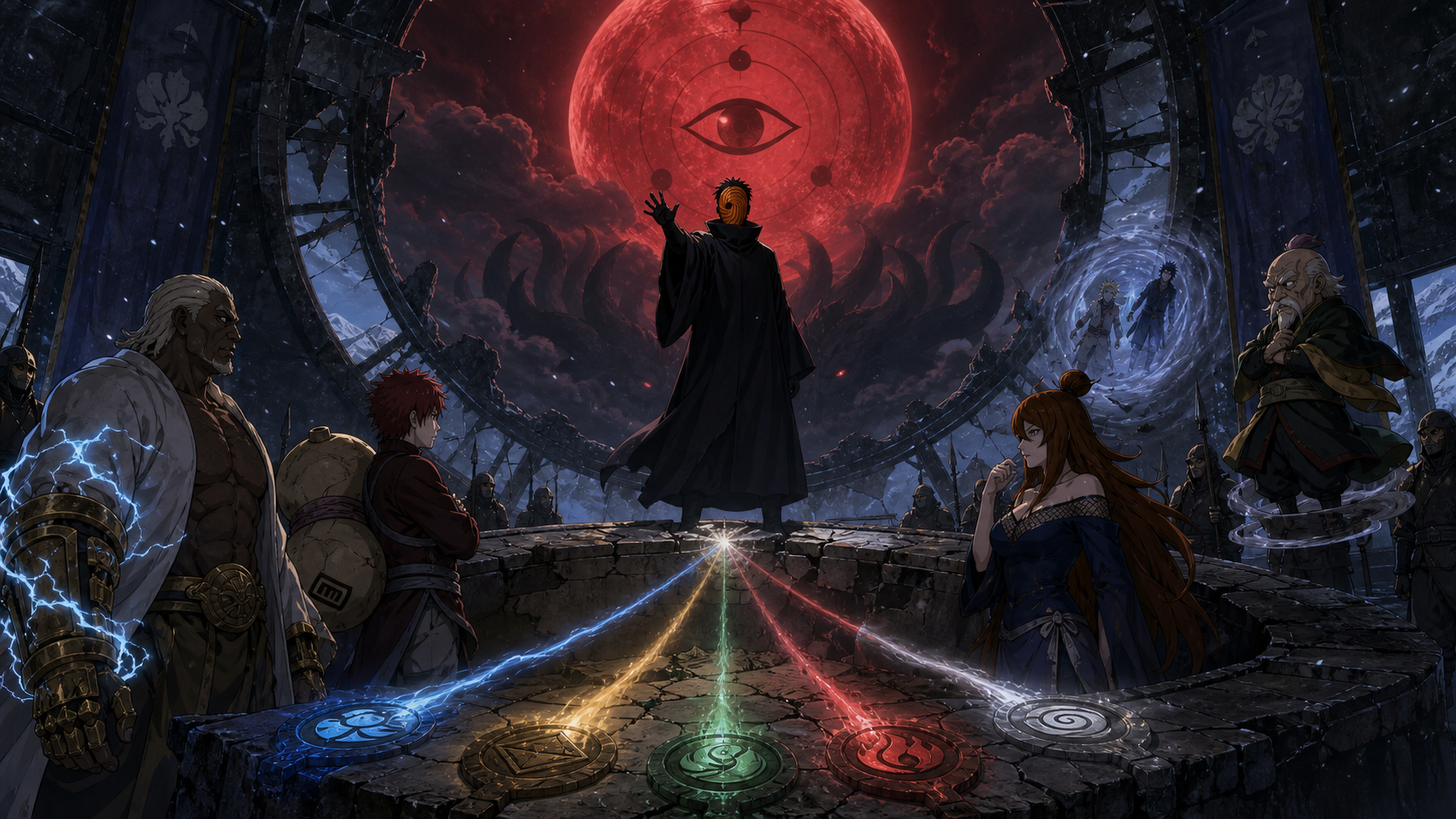
Naruto Shippuden Episode 205, “Declaration of War,” replaces the summit’s battle with an even larger threat. Tobi sends the exhausted Sasuke and Karin away, then stands before the four remaining Kage to explain Project Tsuki no Me.
He tells them that the Sage of Six Paths once sealed the Ten-Tails within himself. Before dying, the Sage divided its chakra into the nine tailed beasts and sealed its empty body away as the moon. Tobi intends to reunite those beasts, become the Ten-Tails’ jinchūriki, and project an Infinite Tsukuyomi from the moon over the entire world.
His promised peace would remove conflict by removing everyone’s freedom. Tobi demands the remaining jinchūriki, Naruto and Killer B. The Kage refuse. He responds by declaring the Fourth Great Ninja War, and the villages begin forming the alliance they could not fully agree on before his arrival.
Tobi offers peace with every person removed
Project Tsuki no Me is presented as an end to war, hatred, and uncertainty. Inside the Infinite Tsukuyomi, everyone would experience a world shaped by illusion.
The plan solves disagreement by making agreement irrelevant. Nobody would choose peace, repair harm, forgive an enemy, or build trust. They would be trapped inside a dream selected by the person controlling the technique.
Tobi calls that unity because every mind would be connected to the same power. The result is closer to solitary confinement on a global scale. Each person receives an unreal world while losing contact with every other real person.
The Ten-Tails changes the scale of Akatsuki’s hunt
The villages understood that Akatsuki was collecting jinchūriki and weaponizing tailed-beast power. They did not know the beasts were pieces of an older creature.
Tobi’s explanation turns nine separate captures into one reconstruction project. Gaara’s extraction, Killer B’s attack, and the repeated pursuit of Naruto are not isolated missions. Each is a step toward rebuilding the Ten-Tails.
That revelation also makes every captured jinchūriki part of the coming war, even when their villages treated them as expendable while they were alive. The enemy understood their combined value before the great powers understood their shared responsibility.
Tobi uses ancient history as a demand for present surrender
The Sage of Six Paths and the Ten-Tails sound like myth to several people in the room. Tobi does not require them to believe every detail immediately. His demand creates its own evidence.
He already commands a network that defeated jinchūriki across national borders. He can appear inside the summit, rescue Sasuke from Ōnoki’s attack, and leave at will. Even if the Kage doubt the oldest parts of the story, they cannot dismiss the capability standing in front of them.
Tobi turns history into leverage: accept my account, hand over two people, or face war.
Naruto and Killer B are discussed as people and strategic assets
The remaining jinchūriki are the targets Tobi needs, but they are also people with their own villages, relationships, and choices.
The Kage’s first responsibility is to keep them out of Akatsuki’s hands. That necessity can easily slide into the same old habit of treating hosts as containers whose location must be managed by leaders.
Gaara is important here because he knows both sides. He was a weaponized child and a captured jinchūriki. His insistence on protecting Naruto carries personal recognition that a military asset can also be the person who saved your life.
The Raikage learns Killer B made him grieve on false information
Tobi reveals that Killer B escaped Sasuke’s capture. The news means the Raikage’s brother is alive, but relief arrives tangled with fury.
B used the attack as an opportunity to leave the village and pursue his own interests. His deception allowed the Raikage to believe he had been taken or killed, shaped the Cloud’s accusations against Sasuke, and fueled the violence at the summit.
The moment is funny because the Raikage’s reaction is so immediate, but the underlying problem is serious. B wanted freedom from surveillance; he obtained that freedom by exploiting his brother’s fear.
The Kage finally receive an enemy large enough to force cooperation
Before Tobi’s arrival, the summit was collapsing under old grievances and Danzō’s manipulation. Every village had reasons to distrust the others.
The declaration of war does not erase those reasons. War makes isolation more dangerous than cooperation. No village can defend both remaining jinchūriki, counter Akatsuki’s transportation and intelligence network, and prepare for the Ten-Tails alone.
The Allied Shinobi Forces begin not because the villages suddenly like one another but because they recognize a shared boundary: peace cannot mean surrendering every mind in the world.
Gaara emerges as the alliance’s moral center
Gaara speaks with unusual clarity throughout the summit. He understands Akatsuki’s methods, the experience of a jinchūriki, and the change Naruto can create in someone who had given up on connection.
He does not minimize the danger or pretend trust is already present. Instead, he asks the leaders to act as though cooperation can become real through what they do next.
That is the opposite of Tobi’s plan. Tobi wants unity first and will manufacture obedience through control. Gaara accepts that genuine unity begins incomplete and must be chosen repeatedly.
Danzō’s absence becomes a political crisis
The acting Hokage fled after Ao exposed his manipulation. Konoha therefore lacks a trusted representative at the exact moment the other villages create a wartime alliance.
The Kage cannot build joint command around someone who tried to control the summit’s moderator. They decide that the Leaf must resolve its leadership problem and that Kakashi is a more credible partner.
Danzō wanted authority over the alliance so badly that he used Shisui’s eye to seize control. That act ensures the alliance must form without him.
Tobi declares war because the Kage preserve choice
The Kage refuse to hand over Naruto and Killer B. Strategically, protecting them prevents the Ten-Tails’ return. Morally, the refusal rejects the idea that two lives can be surrendered to purchase an illusion of safety.
Tobi’s response exposes the contradiction in his promised peace. A man genuinely committed to ending conflict might reconsider when every leader refuses his terms. Tobi immediately escalates to world war.
His peace is not a goal reached through persuasion. The promised peace is obedience imposed after everyone else’s resistance has been broken.
Sasuke is absent while his handler reshapes the world
Sasuke entered the summit focused on killing Danzō. Tobi used him to destabilize the meeting, expose the Kage’s abilities, and create urgency, then removed him before he could die.
Now Tobi announces a war that will pull every village into his plan. Sasuke does not participate in that decision, despite being one of the most visible causes of the summit’s collapse.
The pattern makes his supposed independence look increasingly fragile. He may choose his target, but Tobi keeps choosing the battlefield around him.
Infinite Tsukuyomi mistakes anesthesia for peace
Tobi’s plan recognizes a real problem: people inherit grief, institutions preserve rivalry, and peace agreements repeatedly fail. His solution does not repair any of those structures. He removes every person’s capacity to encounter them.
A dream can provide comfort without producing justice. Victims receive private fantasies instead of acknowledgment. Perpetrators face no accountability. Communities never negotiate a shared future because nobody remains awake inside a shared world.
The scheme resembles anesthesia applied to history. Pain disappears from conscious experience, but the disappearance comes through permanent captivity. Tobi calls the absence of resistance harmony because his definition never requires another person’s consent.
The moon becomes infrastructure for surveillance and control
The moon is usually distant, common, and outside any village’s ownership. Project Tsuki no Me turns that shared object into the delivery system for one person’s authority. Nobody can leave the range, negotiate the terms, or maintain a private mind beyond the projection.
That scale explains why surrendering Naruto and Killer B cannot buy safety. Their capture would complete a mechanism capable of reaching every nation at once. The Kage are not choosing between two lives and no war. They are choosing whether to help build the weapon that makes all later refusal impossible.
Tobi’s red-moon image gives the plan visual grandeur, but the political design is brutally plain: centralized control without exit, appeal, or witness.
The tailed beasts become a history of divided responsibility
The Sage divided the Ten-Tails’ chakra into nine living beings, yet the villages later treated those beings as separate national resources. Each power focused on possession, deterrence, and the host assigned to carry the cost.
Akatsuki exploited that fragmentation. A village could lose a jinchūriki while rivals calculated advantage rather than recognizing one step in a shared capture sequence. By the time the Kage understand the reconstruction plan, most hosts are already dead.
The alliance begins with the uncomfortable discovery that isolated policy helped create global vulnerability. Protecting the last two jinchūriki now requires responsibility for a history every village previously preferred to treat as somebody else’s problem.
Gaara offers chosen unity as the counterargument
Gaara does not deny the summit’s mistrust. He has challenged the older Kage, named their failures, and watched Danzō manipulate the moderator. His support for alliance comes after seeing exactly how incomplete cooperation remains.
That is why his position answers Tobi more effectively than a speech about universal friendship. Gaara believes people can choose shared action while disagreement survives. Unity does not require identical memory or perfect trust on the first day.
Tobi cannot tolerate that unfinished process because chosen cooperation leaves room for refusal. Infinite Tsukuyomi guarantees the outcome by erasing the chooser. Gaara accepts uncertainty because relationship without uncertainty would only be control.
Killer B’s survival complicates the Raikage’s authority
The Raikage’s relief is genuine, and so is his anger. B used Sasuke’s attack to escape constant supervision, leaving his brother to interpret the missing body as capture or death. The deception exploited a family bond inside an international crisis.
B’s choice also reveals why protection cannot mean ownership. He is a decorated fighter and a complete jinchūriki, yet village security still limits his movement as though his body belongs first to the Cloud. His escape is irresponsible and understandable at once.
The alliance will reproduce the same conflict on a larger scale unless B and Naruto remain participants in decisions about their safety. Gaara’s language creates that possibility; military necessity will keep threatening to close the door.
The Japanese performances separate myth from salesmanship
Nobuo Tobita gives Tobi’s history lesson measured confidence. The delivery makes ancient claims sound organized and inevitable, which is part of the manipulation. He is not merely explaining Project Tsuki no Me. He is selling surrender as the mature response to facts only he can frame.
Akira Ishida gives Gaara a quieter authority. His refusal does not need Tobi’s theatrical scale because Gaara’s argument rests on lived experience as a former host and present Kage. Unshō Ishizuka lets the Raikage’s reaction to B break the room’s apocalyptic tension without making the family pain disappear.
The ensemble turns the summit from exposition into competing definitions of responsibility. Tobi speaks as though history has already chosen. The Kage answer by making a choice history did not guarantee.
Tobi defines peace as the absence of another person’s answer
Real peace requires people who can disagree, remember harm differently, negotiate responsibility, and still decide against violence. Infinite Tsukuyomi removes every difficult participant from that process while leaving their dreaming bodies available to one controller.
His proposal does not fail because illusion feels unpleasant. It fails because nobody inside it can consent, revise the terms, or wake another person when the dream becomes a prison.
The captured jinchūriki reveal a coalition formed too late
Akatsuki collected hosts one village at a time while national rivalries encouraged everyone else to treat each disappearance as somebody else’s weakness. Only two remaining targets make the shared pattern impossible to ignore.
The alliance begins beside an indictment. Cooperation now may protect Naruto and B, but it cannot return the dead hosts whose isolation made the enemy’s sequence easier.
Naruto and B cannot become alliance property
Protecting them is strategically essential because their capture completes the Ten-Tails. That necessity tempts leaders to discuss locations, confinement, and deployment without the people whose bodies carry the danger.
A coalition opposing forced control must be careful not to reproduce a smaller version of it. Safety planned entirely around a jinchūriki rather than with him preserves the old weapon system under kinder language.
Gaara’s authority comes from surviving both sides of the policy
He knows what it means to be feared as a weapon and hunted as a container. He also knows Naruto as a person whose refusal to abandon connection made another future possible.
When Gaara supports protection, he is not sentimental about the military risk. He is insisting that strategic value and human value occupy the same body and neither can ethically erase the other.
B’s escape turns freedom into a family injury
The Raikage’s relief arrives beside the knowledge that B used Sasuke’s attack as cover. B wanted life beyond surveillance, but he purchased temporary freedom with his brother’s terror and a diplomatic crisis shaped by false grief.
Freedom needs responsibility.
Danzō proves control cannot build trustworthy unity
He tried to manipulate Mifune into granting him authority over the coalition, treating agreement as an outcome worth manufacturing. Exposure leaves Konoha without a credible representative when cooperation becomes urgent.
His method and Tobi’s plan differ in scale, not principle. Both men define successful leadership as other minds producing the answer they selected in advance.
The Kage choose an alliance before trust is complete
No reconciliation montage erases stolen techniques, proxy wars, jinchūriki policy, or recent manipulation. They cooperate because shared action can begin while accountability and suspicion remain unfinished.
That imperfection is the coalition’s moral advantage over Infinite Tsukuyomi. Every member retains the ability to object, leave, argue, and demand better terms. Fragility is evidence that people are still choosing.
War is Tobi’s answer to freely chosen refusal
He offers surrender as peace, receives a unanimous no, and immediately threatens violence on a global scale. The escalation exposes coercion that the moon imagery tried to make transcendent.
Tobi does not want the Kage to understand his vision. He wants compliance. Their refusal becomes intolerable precisely because independent judgment is the human capacity his finished world would eliminate.
RaeRae’s reaction to Declaration of War
Tobi walked into a room he helped wreck, put a red moon in the group presentation, and said, “Good news, I can end conflict by taking away every thought you have.” That is not peace. That is one man turning the entire planet into his locked diary.
The terrifying part is how neatly the plan connects everything Akatsuki has done. Every jinchūriki they treated as an individual tragedy was also one piece of the same machine. The villages kept thinking locally while Tobi planned globally.
Gaara is the person I trust most in this room because he understands that protecting Naruto is not only strategy. Naruto is a human being whose choices changed Gaara’s life. You do not answer forced unity by sacrificing the person who taught you what a real bond feels like.
And Killer B being alive? Wonderful. The Raikage discovering his brother used an international incident for vacation time? Less wonderful for B’s immediate future.
The alliance is born from a threat, but that origin does not make the coalition false. These leaders choose difficult cooperation over a perfect dream controlled by somebody else. Tobi declares war because their imperfect freedom is the one thing his plan cannot tolerate.
The moon plan converts private longing into public infrastructure
A personal dream can comfort, reveal desire, or offer temporary escape. Tobi turns dreaming into a compulsory system delivered through an object no nation can avoid.
Once the projection begins, there is no outside witness and no shared reality in which captives can compare what was taken. Control becomes complete because even loneliness is disguised as fulfillment.
Sasuke helped create the emergency without choosing the war
His attack scattered the summit, tested the Kage, and gave Tobi a dramatic entrance. Then Tobi removed him before the declaration that converts those consequences into a global campaign.
Sasuke calls himself free while another man selects the stage, preserves his life, and spends the political damage. Revenge has not escaped manipulation. It has become useful to a larger manipulator.
Chosen cooperation is the episode’s real counterattack
The Kage cannot defeat Infinite Tsukuyomi merely by producing a stronger technique. They answer its premise by attempting the very thing Tobi says human beings cannot sustain: voluntary alliance across genuine difference.
Their coalition will be messy, compromised, and vulnerable to old habits. That difficult reality remains more human than a flawless peace nobody was allowed to choose.
RaeRae’s final word on Declaration of War
Tobi put a red moon above the planet and tried to sell permanent mind control as conflict resolution. Sir, peace does not count when you removed everybody capable of saying no.
The tailed-beast history hurts because Akatsuki understood the hosts as one connected project while villages kept abandoning them as separate problems. The alliance is necessary, and it is painfully late.
Gaara keeps the room grounded. Protecting Naruto is strategy, gratitude, friendship, and recognition from somebody who knows what becoming an asset costs.
The Kage do not trust each other perfectly. Good. Their agreement means something because refusal remains possible. Tobi declares war against the freedom inside that imperfect yes.
RaeRae’s call
Infinite Tsukuyomi promises a painless world by abolishing consent. The Kage answer with a fragile alliance whose disagreements prove that every person inside it remains awake, present, and free to choose.