
Drive Towards Darkness
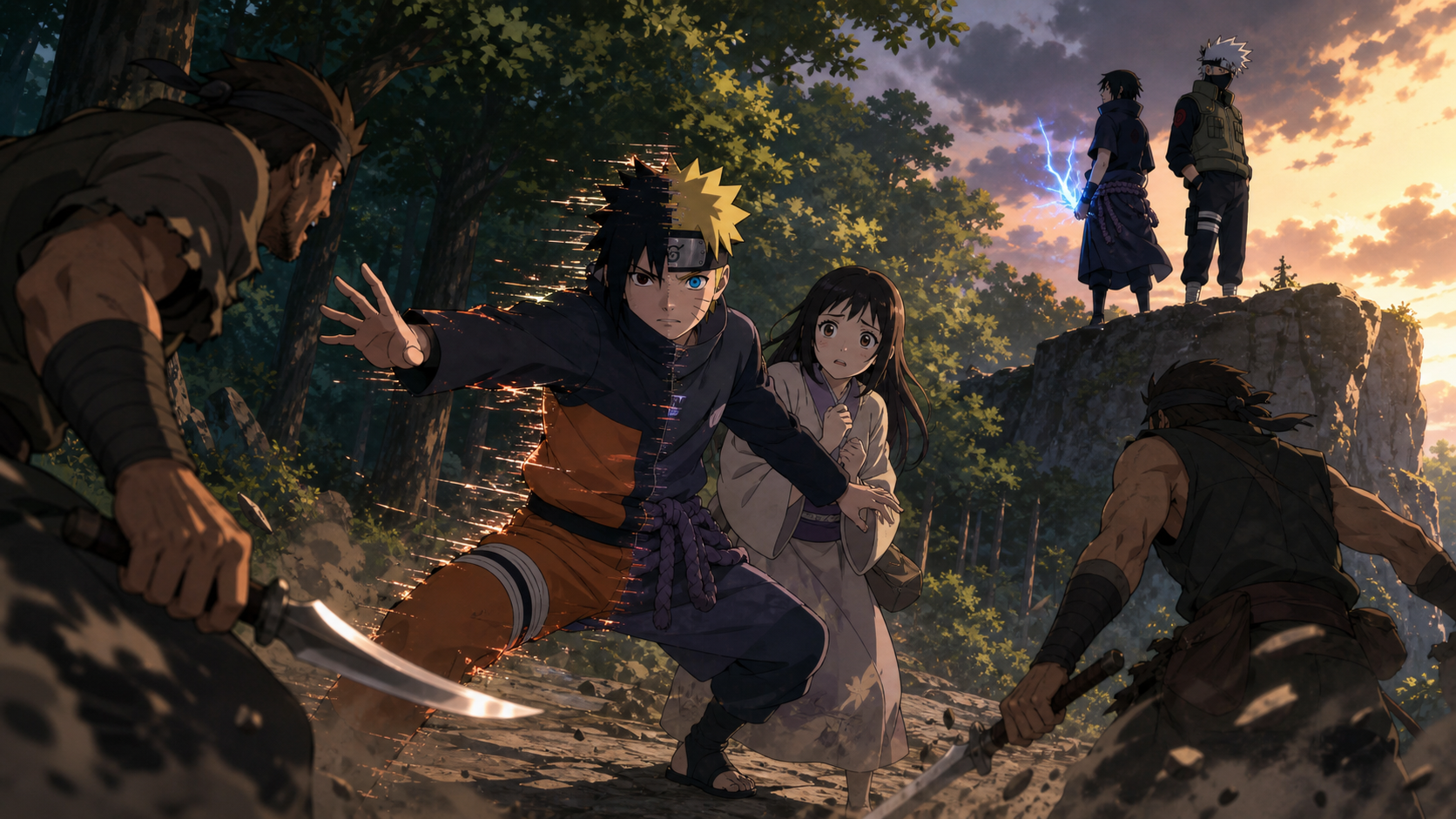
Naruto borrows Sasuke’s face to protect Naho while the real Sasuke turns a successful mission into a frightening measure of everything he fears he lacks.
Bottom line
Naruto Shippuden Episode 196, “Drive Towards Darkness,” returns to the period after Naruto defeats Gaara. Sasuke cannot ignore how quickly Naruto has grown. The boy he once dismissed has summoned Gamabunta and helped save the village, turning rivalry into a measure Sasuke fears he is losing.
Sasuke vents that frustration during training and saves Naho, a young relative of the Fire Daimyō, from falling. His blunt treatment fascinates her because he does not flatter her status. When Naho later needs an escort to Shizume Village, she insists that Sasuke protect her.
Tsunade has another problem. Wanted bandits have crossed into the Land of Fire, and the friction between Naruto and Sasuke has become impossible to miss. She separates them: Kakashi and Sasuke investigate the intruders while Naruto and Sakura guard Naho. To satisfy their client, Naruto transforms into Sasuke.
The assignments converge when Kakashi discovers the bandits intend to abduct Naho. Naruto’s disguise survives only until the fight exposes his techniques. After Naruto and Sakura are overwhelmed, the real Sasuke arrives and defeats Sadai with a violence that frightens the girl he once rescued. In the present, Sasuke remembers the incident while Naruto continues carrying his promise to bring him home.
Naruto wearing Sasuke’s face is more than a gag
The disguise begins as comedy. Naho wants one particular guard, the mission needs to move, and Naruto believes a transformation can solve the argument. His performance falls apart the moment he starts inventing “Sasuke” attacks that are obviously his own.
But the joke places Naruto inside the image Sasuke is desperate to protect. Naho sees the cool, capable Uchiha she imagined while the courage beneath that face belongs to Naruto. The episode quietly separates reputation from action.
Naruto does not become Sasuke by looking like him. He remains himself because protection, improvisation, and stubborn recovery are the choices he makes when the disguise stops being convincing.
Naho falls for the person who refuses to perform
Sasuke saves Naho before knowing her family connection. He does not bow, charm her, or adjust his manner for political importance. To someone surrounded by careful deference, that indifference feels honest and exciting.
Her infatuation is childish, but the crush gives the mission a revealing complication. She asks for an image of Sasuke built from one rescue. Naruto can reproduce the appearance, yet he cannot reproduce the cold distance that made the encounter memorable.
By the end, Naho sees the real Sasuke without the fantasy. His power is undeniable, but so is the rage driving him. The episode lets admiration collapse into fear without blaming her for having misunderstood a stranger.
Tsunade recognizes that rivalry has stopped being useful
Competition once pushed Naruto and Sasuke to work harder. After the fight with Gaara, rivalry begins cutting in another direction. Sasuke does not merely want to improve; he experiences Naruto’s progress as evidence that his own purpose is slipping away.
Tsunade responds practically. She does not stage a lecture about friendship or force the boys to reconcile on command. She assigns separate missions, giving each of them space to work without turning every decision into a contest.
The choice is sensible, but separation cannot remove the comparison already living in Sasuke’s mind. Even on another road, he measures himself against Naruto. Distance cools the immediate argument while exposing how deep the wound has become.
Two missions reveal two definitions of strength
Naruto’s assignment asks him to absorb inconvenience. He has to tolerate Naho’s demands, maintain a disguise, protect a client who would rather have someone else, and keep moving after the deception is exposed.
Sasuke’s mission seems closer to the work he wants: track dangerous intruders, read their purpose, and defeat them. Yet when the routes meet, his strength becomes frightening because victory is no longer enough. He keeps attacking after Sadai is beaten.
The contrast is not that Naruto is gentle and Sasuke is powerful. Naruto fights hard, and Sasuke begins by doing legitimate protective work. The difference is what each boy needs the fight to prove. Naruto wants Naho safe. Sasuke wants the enemy to carry the weight of his humiliation.
Sadai discovers the name that opens Sasuke’s deepest wound
Sadai’s mistake is not merely challenging Sasuke. His language echoes the contempt Sasuke associates with Itachi, turning a border mission into something intensely personal.
Once that connection is made, the bandit in front of Sasuke becomes a substitute for an older terror. Sasuke’s attacks stop serving only the mission. He is striking at weakness, comparison, and the memory of being judged incapable by the brother he intends to kill.
Kakashi’s arrival matters because Sasuke is not regulating himself. The enemy has already lost, but Sasuke cannot yet separate punishment from proof. That inability points toward the choices he will soon make outside the village.
Kakashi sees danger that a successful report could hide
On paper, the operation ends well. The abductors are stopped, Naho survives, and the Leaf identifies why wanted ninja crossed the border. A mission report could reduce everything to completed objectives.
Kakashi sees the part that does not fit a success box. Sasuke’s technique, judgment, and speed are improving while his emotional control is narrowing. Greater competence has not made him safer.
That is one of the episode’s saddest observations. A teacher can recognize the direction of a student’s fall and still lack the one sentence that would turn him around. Kakashi can interrupt the beating, but he cannot erase the comparison consuming Sasuke.
Sakura is trapped between the joke and the warning
Sakura helps maintain Naruto’s disguise because the escort must continue, but she also understands how badly the performance could land. She knows Naho wants Sasuke and knows Naruto enjoys proving he can fill the role.
When the real Sasuke appears, Sakura witnesses the gap between the boy Naho imagined and the teammate she has been trying not to lose. The scene gives her no easy position. Correcting Naho’s fantasy does not fix Sasuke, and defending Sasuke’s hidden goodness cannot make his violence disappear.
Her silence carries the discomfort of someone who can see the fracture but has not yet learned how to name the danger.
The Past Arc ends by returning to the present promise
The flashback is framed by Taka’s movement toward Konoha. Sasuke is no longer the frustrated genin beside Kakashi; he has chosen a road built around severed bonds and revenge. The old mission now reads like an early warning.
Naruto’s present-day reflection answers that warning without pretending the past was simpler. He remembers the promise to bring Sasuke back after the village has already suffered enormous loss. The task is not nostalgic recovery of a perfect friendship. Naruto refuses to treat Sasuke’s darkest direction as the only possible ending.
That makes “Drive Towards Darkness” an appropriate closing note for the arc. The village memories explain what people are rebuilding, while Sasuke’s memory shows the bond Naruto still cannot leave among the ruins.
Naruto’s disguise separates a reputation from a moral choice
Naho wants Sasuke because one rescue allowed her to build an entire person from appearance, skill, and emotional distance. Naruto can copy the face, posture, and voice well enough to satisfy the mission for a while.
Danger reveals the limit. His improvised techniques, protective instincts, and inability to maintain Sasuke’s cool performance identify Naruto before the transformation fails. Character appears through repeated choices rather than a recognizable silhouette.
The joke therefore carries the episode’s central argument. Sasuke’s reputation can attract admiration, but the name does not guarantee what his power will do once anger controls the stopping point.
Naho learns that rescue and safety are not identical
The real Sasuke arrives in time to defeat Sadai, fulfilling the fantasy Naho attached to him. He is strong, decisive, and capable of ending the threat Naruto and Sakura could not overcome.
Then he continues. The extra violence changes the emotional meaning of the rescue because Naho can no longer trust where protection ends and punishment begins.
Her fear is not ingratitude. A person can save someone from one danger while becoming frightening through the method. The episode allows a young girl to revise her judgment after receiving new evidence.
Sasuke turns comparison into an emergency
Naruto’s victory over Gaara does not take power away from Sasuke. Sasuke experiences that growth as a threat because revenge has made progress feel scarce. If Naruto advances faster, Sasuke believes his own path toward Itachi is failing.
That belief converts a teammate’s success into humiliation. Training no longer serves mastery alone; every result must prove that Sasuke remains ahead of the person he once dismissed.
The bandit fight becomes dangerous when Sadai’s taunts connect to that private fear. Sasuke is no longer answering the enemy before him. He is trying to erase the comparison Sadai accidentally reopened.
Tsunade’s separation solves logistics without healing rivalry
Sending the boys on different missions is a sensible command response. Their friction threatens teamwork, and both assignments need capable shinobi. Space prevents an immediate contest from consuming either objective.
Separation cannot alter the meaning Sasuke assigns to Naruto’s progress. He carries the comparison onto Kakashi’s route and into the eventual fight. The absence of Naruto does not remove Naruto from his mind.
The decision shows the boundary of administrative solutions. A leader can redistribute personnel and reduce risk. A leader cannot order insecurity to disappear.
Kakashi catches the part the mission report would miss
Completed objectives reward outcomes: kidnappers stopped, client recovered, border threat contained. Sasuke’s final strikes could disappear inside that success if nobody evaluates the judgment behind them.
Kakashi sees that greater skill is arriving beside weaker restraint. The combination is more dangerous than poor technique because Sasuke can now act on impulses with devastating efficiency.
Stopping his hand matters, but the intervention arrives after the emotional mechanism has already surfaced. Kakashi can identify the warning without possessing a guaranteed way to redirect the student.
Sakura watches two boys occupy the same image differently
Sakura helps Naruto maintain the disguise and knows the performance is absurd. She also sees him protect Naho while wearing the face of the teammate both girls admire.
When Sasuke arrives, Sakura receives the inverse image: the right face and frightening behavior. Appearance, affection, and moral action no longer align cleanly.
Her silence reflects more than romantic discomfort. She is learning that defending Sasuke’s memory cannot answer what he does in front of witnesses.
The Japanese performances let comedy curdle into warning
Junko Takeuchi makes Naruto’s Sasuke imitation exaggerated enough to expose the joke while keeping the protective turn sincere. Noriaki Sugiyama gives the real Sasuke a restraint that breaks under Sadai’s provocation.
Kazuhiko Inoue shifts Kakashi from mission focus to teacher alarm without a long explanation. Chie Nakamura keeps Sakura caught between managing the client, reading Naruto, and watching Sasuke cross a line.
The tonal change works because the cast does not treat comedy and danger as separate episodes. The same mistaken image that produces laughter becomes the standard against which real violence is judged.
Naruto’s victory over Gaara becomes Sasuke’s private accusation
Naruto did not take skill, status, or opportunity from Sasuke. Sasuke experiences the achievement as proof that his own road toward Itachi is failing.
Comparison makes another person’s growth feel like personal loss. Rivalry stops providing motivation and begins demanding evidence that Naruto must remain beneath him.
Naho admires refusal because status usually controls every interaction
Sasuke saves her without knowing whom she is related to and refuses the flattering behavior political importance normally buys. His bluntness feels more honest than rehearsed deference.
The crush grows from limited but understandable evidence. Naho mistakes one unperformed rescue for a complete understanding of the person who performed it.
Naruto can copy Sasuke’s appearance but not his emotional temperature
The transformation satisfies the assignment until personality starts leaking through. Naruto invents techniques, overplays coolness, and protects Naho with instincts no borrowed face can contain.
The joke separates identity from silhouette. Character becomes the pattern of choices that survives after visual resemblance fails.
Tsunade treats distance as risk management
She recognizes that friction between the boys is consuming attention and sends them toward separate objectives. The choice reduces immediate competition without pretending a personnel assignment can heal insecurity.
Sasuke carries Naruto onto Kakashi’s road inside his own thoughts. Physical absence cannot remove the comparison organizing his anger.
The converging missions place image beside conduct
Naho travels with Naruto wearing the face she idealized. Then the real Sasuke arrives and demonstrates the power she expected, followed by violence she did not imagine.
The two versions force reputation apart. The false face behaves protectively. The authentic face makes rescue frightening by refusing to stop.
Naho is allowed to revise admiration after receiving evidence
Fear does not make her ungrateful. Sasuke saves her from Sadai and simultaneously reveals that his judgment is becoming unsafe.
A person can perform one protective act without becoming a safe person in every moment. Naho’s changed response respects what she witnesses rather than trapping her inside the earlier crush.
Sadai becomes a substitute for arguments he never entered
His taunts touch Itachi’s contempt and Naruto’s growth, allowing Sasuke to pour older humiliation into the available body. The bandit is defeated before Sasuke’s need has finished.
Extra strikes cannot answer whether Sasuke is strong enough. They only reveal how desperately he wants pain to produce certainty.
Kakashi sees successful violence becoming a hidden failure
The client survives and the abductors lose. A conventional report can call the operation complete while ignoring that Sasuke’s stopping point disappeared.
Kakashi recognizes the danger because improved technique now gives emotional instability greater reach. Competence and safety are moving in opposite directions.
Sakura watches affection lose its explanatory power
She knows Sasuke can care and has memories supporting that belief. Naho’s fear shows that hidden goodness cannot answer visible conduct forever.
Sakura is left between the teammate she remembers and the boy acting in front of her. Silence marks a fracture she has not learned how to name.
RaeRae’s reaction to Drive Towards Darkness
The transformation comedy should not work as well as the scene does, but I love what the disguise reveals. Naruto can wear Sasuke’s face, borrow his attitude badly, and invent the least convincing special moves imaginable. When danger arrives, the part that matters is unmistakably Naruto: he plants himself between Naho and the threat.
Then the real Sasuke arrives and delivers exactly the power Naho thought she wanted. The episode lets that fantasy turn cold. He saves her, but the extra violence makes rescue feel unsafe. Strength without a stopping point is not reassurance.
Kakashi watching Sasuke is the detail that stays with me. He knows this is more than a temper flare. Sasuke is trying to beat an answer out of someone who cannot give him one, because the real argument is with Naruto’s growth, Itachi’s judgment, and his own fear of falling behind.
Ending the Past Arc here is sharp. These memories are not random side stories anymore. They form a trail toward the split Naruto is still trying to cross, and this episode shows the moment rivalry started asking Sasuke for more than friendship could survive.
The Past Arc ends where memory becomes warning
These village stories preserve ordinary bonds during reconstruction. Sasuke’s flashback shows that memory also contains the early direction of rupture.
Naruto’s present promise does not depend on pretending Team 7 was ever simple. He remembers tenderness, rivalry, fear, and danger together, then refuses to let the darkest trajectory claim inevitability.
Rescue without restraint cannot feel entirely safe
Sasuke’s arrival changes the fight and prevents Naho’s abduction. His continued punishment changes the meaning of that protection. Power needs judgment capable of recognizing when the objective has already been achieved.
The episode does not deny his usefulness. It exposes the cost when a protector needs the enemy to carry pain belonging to somebody else.
Sasuke’s tragedy is not that he lacks people noticing the change. Kakashi notices. Sakura notices. Tsunade notices enough to separate the boys. Naho recognizes danger the moment admiration collides with his refusal to stop. The problem is that recognition does not automatically create access to the wound driving him. Every observer can describe the direction while Sasuke keeps treating concern as interference with revenge. The episode lets that helplessness remain. Seeing someone move toward darkness is morally important, but sight alone does not provide the language, timing, or trust required to turn them around.
That gap is the tragedy Kakashi witnesses most clearly.
RaeRae’s final word on Drive Towards Darkness
Naruto wearing Sasuke’s face should be disposable comedy, but it becomes the episode’s sharpest test. The disguise looks right and behaves unmistakably like Naruto once danger arrives.
Then the real Sasuke delivers the power Naho requested and turns the fantasy cold. Saving her does not erase how frightening he becomes after victory is already secured.
I appreciate that Naho gets to change her mind. A young girl does not owe permanent admiration because somebody once caught her before she fell.
Kakashi’s alarm stays with me because the mission report could hide everything important. The target is safe, the bandits are beaten, and Sasuke is still moving toward danger.
Ending the Past Arc here makes every lighter memory ache. Team 7 had ridiculous missions and genuine care. The fracture was real too, growing each time Sasuke treated Naruto’s progress as proof of his own failure.
RaeRae’s call
Naruto can wear Sasuke’s face without becoming him, while Sasuke can rescue Naho without making her feel safe. Identity lives in choices, especially the choice to stop once protection is complete.