
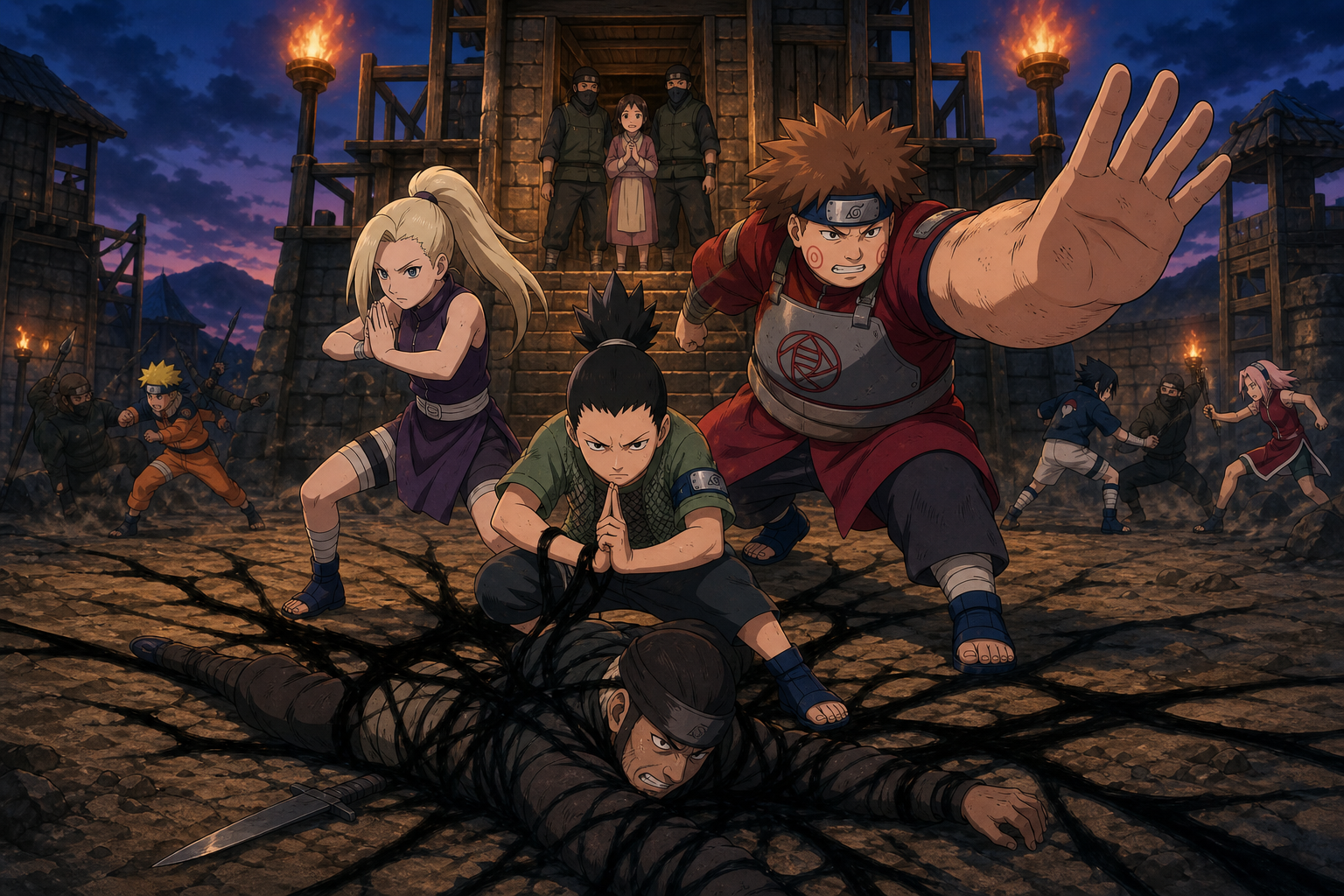
Team 10’s Teamwork
A compromised guide separates the formation, but Ino, Shikamaru, and Chōji prove their teamwork survives without constant instructions or adult rescue.
Bottom line
Naruto Shippuden Episode 195, "Team 10's Teamwork," begins during Konoha's reconstruction as Ino, Shikamaru, and Chōji coordinate the capture of hogs for the village food supply. Their rhythm reminds Shikamaru of a joint mission with Team 7.
The episode uses that memory to make a precise point: Team 10's formation is more than a famous set of clan techniques. Their real advantage is shared judgment. Shikamaru can risk becoming a hostage because Ino and Chōji understand the rescue without needing him to narrate every step. A modest flashback becomes a satisfying study of how trust turns three specialists into one dependable unit.
A village headman's granddaughter has been kidnapped by Baji's bandits. Teams 7 and 10 accept the rescue mission under Kakashi and Asuma. Tōfū, who claims to be a former member of the gang, guides them toward a fortress protected by layered traps.
Shikamaru sends the two jōnin to examine another approach, leaving six genin to continue. Tōfū reveals himself as Baji's double agent and is “captured” to lead the team into a controlled exchange. Shikamaru offers himself as a hostage so Ino and Chōji can discover where the girl is held.
Ino and Chōji locate the tower, free the granddaughter, and return to support Shikamaru. Team 10 combines shadow control, Mind Transfer tactics, and Chōji's strength to defeat Baji, while Team 7 handles the remaining bandits. The rescue succeeds because the three teammates keep acting on a plan even after their usual formation is split.
Herding hogs is still teamwork
The present-day framing is deliberately unglamorous. Team 10 is not defeating an Akatsuki member or protecting a Kage. They are gathering food for people whose homes were destroyed.
Their coordination makes the work efficient because years of missions taught them how to read one another without lengthy instruction. Shikamaru notices routes, Ino redirects movement, and Chōji provides the physical presence that closes the gap.
That ordinary competence matters during reconstruction. A village is not rebuilt only by the people who won the headline battle. Recovery needs meals, deliveries, repairs, and teams willing to use elite skills on tasks that look small.
The contrast also keeps the flashback from feeling detached from the present. The old rescue explains the ease visible in the hog field. Every clean handoff has a history behind the motion. Years earlier, the trio learned to continue when their formation was disrupted; now those lessons make public service look almost effortless.
Shikamaru starts leading before anyone gives him the title
Even with Kakashi and Asuma present, Shikamaru reads the fortress problem and assigns useful work. Sending the jōnin toward another route is not disrespect. The choice creates multiple lines of access and prevents the whole force from walking into Tōfū's prepared path.
Once the adults are separated, the mission becomes a test of whether Shikamaru can lead peers who do not automatically share Team 10's habits. He has to account for Naruto's impatience, Sasuke's independence, and Sakura's judgment while tracking a guide he never fully trusts.
Leadership here means distributing uncertainty, not pretending he knows everything.
That distinction suits Shikamaru better than a sudden display of command. He does not become louder or more theatrical to prove that he can lead. He notices the weakness in a single-file plan, separates responsibilities, and leaves room for other people to make decisions. The episode shows the beginnings of the officer he will become without pretending the younger Shikamaru has already finished growing.
Tōfū weaponizes the team's need for local knowledge
The fortress is unfamiliar, layered with traps, and controlled by people who know the terrain. A former bandit offering guidance seems indispensable. That is exactly why Tōfū's betrayal works.
He does not need to overpower eight Leaf ninja. He shapes the route, controls what they expect, and waits for their formation to split. The episode treats information as a battlefield advantage instead of background exposition.
Shikamaru cannot eliminate the risk of following him. He can prepare for the possibility that the guide is choosing what the team sees.
The hostage exchange is Shikamaru's information play
Offering himself for Tōfū looks like surrender, but the exchange moves Shikamaru inside the enemy's decision loop. Baji assumes the strategist is valuable because removing him will make the remaining genin easier to control.
Shikamaru uses that assumption to create freedom elsewhere. Ino and Chōji no longer need to protect his position; they can search for the granddaughter while the bandits focus on their prize.
The plan requires trust. Shikamaru cannot monitor every corridor from captivity. He has to believe his teammates understand the objective and will adapt without waiting for another instruction.
Baji reads the hostage exchange as proof that Team 10 has lost its brain. That reading is the bandit's decisive mistake. Shikamaru is important, but the plan was never stored inside one person. Ino and Chōji carry enough shared context to recognize the opening and enough confidence to use the opening. Capturing the strategist therefore does not capture the strategy.
Ino and Chōji prove Team 10 is not one genius plus assistants
Team 10 is often reduced to Shikamaru's plans executed by two supporting pieces. Episode 195 pushes against that reading. Once Shikamaru becomes the hostage, Ino and Chōji carry the rescue forward.
They locate the tower, assess the guards, protect the kidnapped girl, and return at the moment their teammate needs them. Their work is not a mechanical replay of instructions. The rescue requires initiative under pressure.
Shikamaru's intelligence is useful because his planning creates room for capable people. A plan that collapses when the planner loses contact is not good enough for this team.
Ino and Chōji also refuse the false choice between saving the hostage and saving Shikamaru. They finish the hidden assignment, then return with the rescued girl and the tactical balance changed. Their entrance matters because they arrive with results, not merely concern. Loyalty becomes action that advances the mission.
Ino–Shika–Chō works as a chain of different strengths
The formation is powerful because each technique changes the conditions for the next. Shikamaru restricts movement. Ino disrupts control and information. Chōji supplies force and protection once the opponent cannot evade cleanly.
None of the three needs to become a weaker copy of another. Their friendship is expressed through specialization. They know when to create an opening and when to trust someone else to use that opening.
Baji's group relies on hierarchy and betrayal. Team 10 relies on people remaining themselves while coordinating purpose. That difference decides the fight.
The sequence works because no technique becomes a convenient answer to every problem. Shadow control can halt movement but cannot search the fortress at the same time. Mind Transfer can seize a crucial advantage but demands protection. Chōji's power can finish an opening but works best when the target has already lost room to respond. Their limitations create cooperation instead of weakening the trio.
Team 7 provides contrast rather than competition
Naruto, Sasuke, and Sakura bring ability, but their early teamwork is volatile. They can combine effectively in bursts, then lose time arguing about who should lead or receive credit.
Watching Team 10 operate shows them a partnership built before the crisis. Ino, Shikamaru, and Chōji have disagreements, yet their default response under pressure is to preserve the formation.
The joint mission does not need to declare one team superior. Team 7 handles the wider fight while Team 10 solves the hostage problem. Success belongs to roles fitting together across both groups.
That division gives the crossover purpose. Team 7 is not present only to increase the number of familiar faces, and Team 10 is not reduced to a demonstration for Naruto. The two squads cover different parts of one rescue. The result feels like a village assigning complementary teams rather than an artificial contest between casts.
Asuma's teaching remains visible when he is absent
Asuma spends part of the mission away from his students, but the way they work reflects his training. He taught a formation without making himself its permanent center.
That is the difference between command and dependence. A teacher who solves every crisis may look impressive while producing students who freeze alone. Asuma's team can lose direct supervision and still recognize one another's cues.
The present-day hog scene carries extra emotion because Asuma is gone. The formation continues in ordinary work, proving his instruction became part of how they move through the world.
Asuma's influence is clearest in the team's balance between discipline and independence. His students know the formation, but they are not waiting for a teacher to authorize every adjustment. That maturity gives the flashback a quiet ache. Viewers know the man is absent from the reconstruction scene, while his method remains visible in every coordinated move.
Rescue comes before punishing betrayal
Tōfū's double-cross and Baji's arrogance invite revenge, but Shikamaru keeps the kidnapped granddaughter as the central objective. Ino and Chōji go to the tower rather than chasing the traitor who embarrassed them.
That priority is what separates a rescue team from a group looking for a satisfying fight. The bandits can be captured after the hostage is safe. Reversing that order would let anger dictate the mission.
Team 10 wins because its members keep asking what the next person needs, not what would make each individual look strongest.
The rescued granddaughter is never treated as a trophy at the end of a tactical exercise. Her safety defines whether the mission succeeds. Shikamaru's cleverest move matters only because the move creates a route toward her. That moral clarity keeps the strategy grounded in service rather than allowing cleverness to become the whole point.
Why this flashback belongs during reconstruction
Placing the memory after Pain's assault changes the emotional weight of a straightforward rescue. Konoha is rebuilding, Asuma is gone, and Team 10 has endured losses that the younger versions cannot imagine. The episode does not need to announce every change. The present-day frame lets viewers measure the distance.
The younger trio learns that a formation must survive separation. The older trio applies the same principle to village recovery. They have become shinobi who can carry Asuma's teaching into work that will never earn a monument. That connection makes the episode feel less like a pause and more like a reminder of what Konoha is trying to preserve.
Baji and Tōfū misunderstand what makes a team
The bandits cooperate through leverage. Tōfū supplies access because betrayal benefits him, while Baji assumes fear and rank will keep everyone aligned. Their arrangement lasts only while each person expects a reward or fears a consequence.
Team 10 operates through a completely different bond. Shikamaru cannot force Ino and Chōji to interpret an unfinished plan correctly. They respond because years of practice taught each person how the others think. Baji sees three young ninja and tries to isolate the most visibly strategic member. He never recognizes that their accumulated trust is the real command structure.
That contrast gives the final reversal more meaning than a simple power gap. The bandits lose because their model of cooperation cannot account for teammates who remain effective when separated and who value the shared objective above personal safety.
The hog field proves teamwork is not a performance
Team 10 does not reserve coordination for enemies worthy of dramatic music. Food recovery after Pain receives the same attention, timing, and mutual awareness.
That ordinary use makes the bond credible. Skill has become a public resource instead of a switch activated only when personal glory is available.
Shared judgment is the formation’s invisible technique
Shadow possession, Mind Transfer, and expansion are recognizable clan abilities. The harder advantage is knowing what another teammate will infer when contact breaks.
Shikamaru can become a hostage because the plan does not live only inside his head. Years of practice distributed enough context for Ino and Chōji to continue.
Shikamaru’s leadership creates room instead of obedience
He sends the jōnin to investigate another route and leaves peers with meaningful decisions. The plan accepts uncertainty rather than pretending one strategist can control every corridor.
Leadership becomes the design of useful independence. A teammate who must wait for constant orders is another vulnerability Baji could exploit.
Tōfū controls the map before he controls the trap
The false guide does not defeat anyone through superior force. He determines which terrain the Leaf sees, where the formation divides, and what danger appears urgent.
Local knowledge is power because teams must act before certainty. Shikamaru’s answer is not refusing all help. It is preserving alternatives while using compromised information carefully.
The hostage play tests whether trust travels
Shikamaru removes himself from immediate command and wagers that Ino and Chōji will identify the opening. Baji thinks he captured the brain.
He fails to understand that Team 10 stores strategy inside relationship. The planner matters, but the team is not a body waiting for one mind to return.
Ino and Chōji finish the hidden mission themselves
They find the tower, assess resistance, free the granddaughter, and decide when to return. None of that is automatic execution of a complete script.
Their initiative validates Shikamaru’s trust. They arrive with the hostage safe and the tactical situation changed, not merely with concern for their captured friend.
The formation works because every technique has limits
Shadow control restricts movement but cannot search the fortress. Mind Transfer creates access but leaves Ino vulnerable. Chōji supplies force that becomes most effective after escape routes close.
Limitations generate cooperation. Nobody needs to become a universal solution when teammates understand where responsibility should pass next.
Asuma remains present through decisions he no longer supervises
His students can separate, adapt, and reunite without waiting for him to authorize each move. Teaching succeeded because it became judgment inside them.
In the reconstruction frame, that continuity aches. Asuma is absent, yet his work remains visible every time the trio trusts the formation during an ordinary task.
RaeRae's reaction to Team 10's Teamwork
I am always happy when an Ino–Shika–Chō story remembers that the formation is not “Shikamaru thinks and everyone else obeys.” His hostage plan works because Ino and Chōji can operate without him, find the girl, and return on their own judgment.
The hog-herding frame is perfect. Their teamwork does not switch on only for dramatic enemies. Their coordination has become muscle memory they can use to feed neighbors after a disaster.
Tōfū's betrayal is effective because the team genuinely needs a guide. “Never trust anyone” would not solve the fortress. Shikamaru's answer is better: use the information, assume the source may be shaping the route, and keep enough flexibility that one compromised source cannot end the mission.
The episode feels like a small tribute to Asuma without turning into a memorial speech. His students move together, protect a child, and finish the work while separated from their teacher. That is the proof his lessons stayed.
My favorite choice is the refusal to make Shikamaru's intelligence a magic trick. His plan leaves him vulnerable and depends on two friends being exactly as competent as he believes. Ino and Chōji reward that faith by completing the rescue before returning to the fight. The victory belongs to all three, which is exactly what an Ino–Shika–Chō episode should understand.
The rescue stays ahead of revenge
Tōfū’s betrayal invites personal retaliation, but Ino and Chōji locate the kidnapped girl first. Shikamaru’s cleverness remains accountable to the person the mission exists to protect.
That priority separates strategy from vanity. The best plan is not the one that humiliates Baji most elegantly. It is the one that gets a child home.
Team 7 shows another stage of learning
Naruto, Sakura, and Sasuke can combine brilliantly, but their early rhythm still breaks around credit, authority, and impatience. Team 10 offers a partnership built through longer shared practice.
The comparison does not declare a winner. Both groups cover different parts of the rescue, letting contrast teach without turning friendship into competition.
Baji mistakes visible command for the whole team
Capturing Shikamaru appears decisive because he is the person most visibly arranging the board. Baji assumes everyone else becomes directionless once the strategist is removed.
That assumption reveals how hierarchy shapes the bandits. Their cooperation depends on a leader controlling information and subordinates waiting for orders. Team 10 has practiced a different structure. Each member understands the shared objective well enough to recognize what changed and what must happen next.
Ino and Chōji do not prove Shikamaru unnecessary. They prove his leadership succeeded by making their independent judgment possible. When they return, the formation reunites stronger because every person carried responsibility during separation rather than preserving empty positions until the captain came back.
That is what durable teamwork looks like inside a dangerous rescue mission.
RaeRae’s final word on Team 10’s Teamwork
I am happiest when an Ino-Shika-Chō story remembers the formation is not Shikamaru thinking while two assistants wait to be deployed.
His hostage plan works because Ino and Chōji are capable without him. They interpret the gap, find the girl, complete the extraction, and return on their own judgment.
Tōfū is dangerous because the team genuinely needs local knowledge. “Trust nobody” would be useless. Shikamaru uses the guide while keeping enough flexibility to survive the betrayal.
The hog-herding frame may be my favorite choice. Their coordination feeds neighbors after disaster, proving teamwork belongs to service before spectacle.
Asuma does not need a memorial speech. His students moving together while he is gone says more. He taught a formation capable of surviving his absence, and that may be the most loving evidence a teacher can leave.
RaeRae’s call
Team 10’s greatest technique is shared judgment. Shikamaru can disappear from command because Ino and Chōji carry the mission, make decisions, and return with the person everyone came to save.