
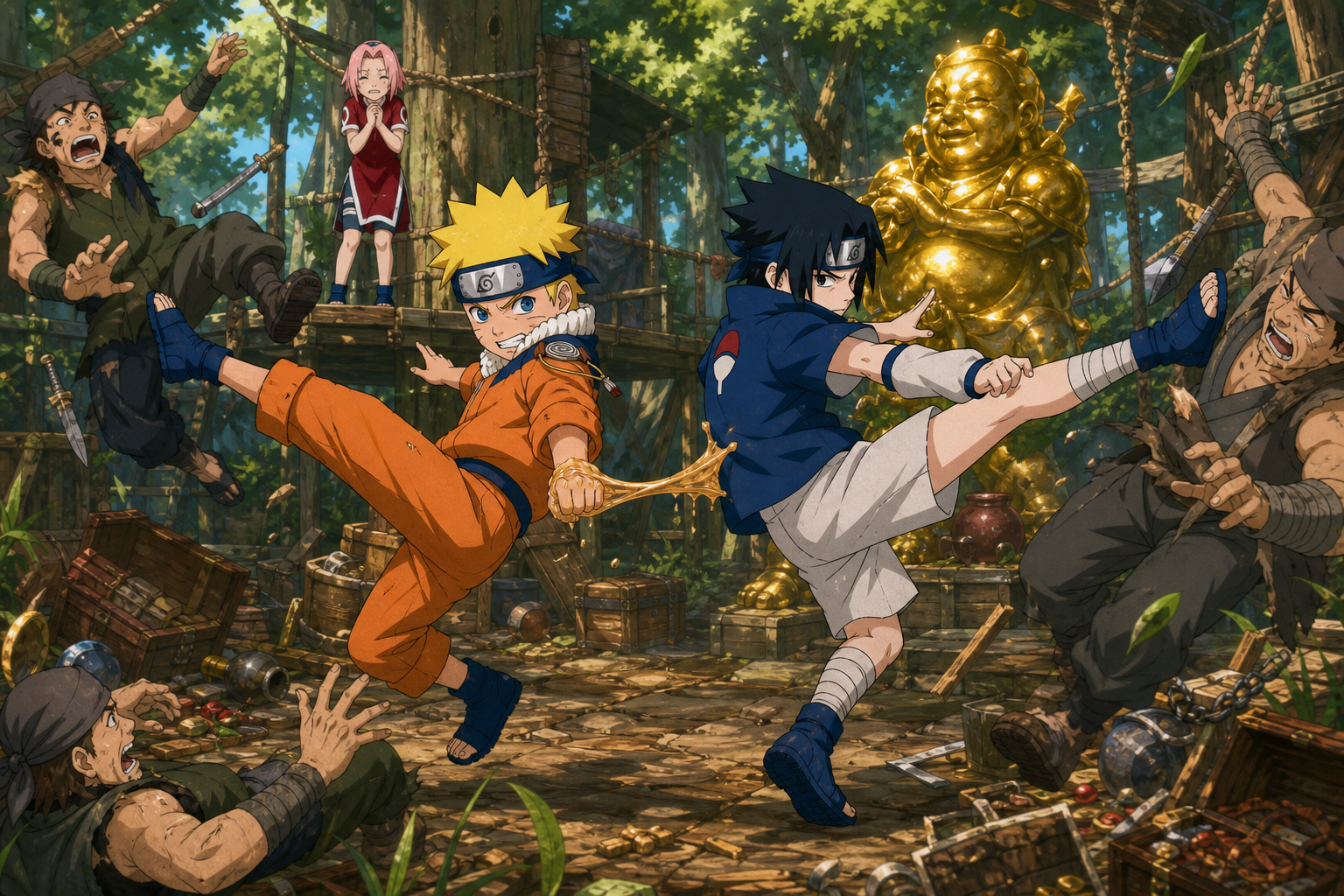
The Worst Three-Legged Race
Chakra glue gives Naruto and Sasuke the partnership they keep denying, one synchronized kick and furious argument at a time.
Bottom line
Naruto Shippuden Episode 194, "The Worst Three-Legged Race," begins during Konoha's reconstruction when Sakura jokes that Naruto and Sasuke were once literally inseparable. Naruto remembers an early Team 7 mission to recover a golden statue stolen from a feudal lord's sister.
Kakashi divides the team to intercept the thieves by land and water. Naruto and Sasuke rush ahead, recover the statue, and fall into a river while Sakura is captured. A chakra adhesive from bandit leader Jako bonds one of Naruto's hands to one of Sasuke's.
The boys try force, water, and increasingly desperate ideas to separate. Nothing works. Sasuke initially argues that protecting the statue is the mission, but Naruto repeats Kakashi's lesson that abandoning a comrade is worse than breaking the rules. They turn back for Sakura.
Fighting while physically attached forces Naruto and Sasuke to coordinate every step, kick, and feint. Once they stop resisting each other's movement, they overwhelm Jako's group, free Sakura, and recover the damaged statue. Kakashi suggests melting and recasting the gold. Sakura cheerfully tells the horrified boys that the adhesive may take several days to crumble.
The comedy works because the adhesive makes Team 7's central contradiction impossible to hide. Naruto and Sasuke insist that they want independence, yet both already know the other's movements well enough to become a remarkable fighting pair. Episode 194 turns rivalry, loyalty, and reluctant intimacy into a physical problem. The result is silly on the surface and unexpectedly honest underneath.
The title turns rivalry into a movement problem
Naruto and Sasuke can barely share a plan when both have full freedom. Bonding their hands makes every private decision physically impossible. If one lunges, the other moves. If one refuses, both stop.
The “three-legged race” idea is funny because the boys do not lack athletic ability. They lack willingness to accept a shared rhythm. Their first attempts fail not because the adhesive is too strong, but because each treats the other as dead weight.
The episode turns an emotional problem into choreography. Cooperation stops being a slogan from Kakashi and becomes the only way to walk without falling over.
Their joined hands also remove the usual escape route of pretending that one person can win alone. Every successful movement has two authors. Naruto cannot claim a kick without Sasuke providing balance, and Sasuke cannot redirect momentum without Naruto following the turn. The gag forces both boys to experience teamwork before either can rename the result as individual brilliance.
Rushing ahead creates the mess they blame on each other
Naruto and Sasuke recover the statue quickly, which seems to justify ignoring the rest of the formation. Then the river, Sakura's capture, and the adhesive expose how fragile that success was.
Neither boy wants to admit that competing for credit made the team easier to divide. Naruto blames Sasuke's attitude. Sasuke blames Naruto's carelessness. Both descriptions contain truth, which is why the argument goes nowhere.
The golden statue is in their hands, but the mission is not successful while Sakura is a hostage. Their mistake is treating the objective as an object rather than the condition of the whole team.
That distinction exposes the danger in chasing the most visible prize. A recovered statue offers immediate proof of success, while protecting the formation requires patience and attention. The thieves exploit that impatience by separating Team 7's fastest rivals from the teammate covering another route. Naruto and Sasuke do not merely fall into a trap. Their competition helps build the trap around them.
Sakura's capture gives the mission a moral test
Sakura spends much of the episode waiting for rescue, which limits her role, but her capture forces the boys to define what “complete the mission” means. Sasuke wants to secure the statue and report. Naruto refuses to leave her.
Naruto wins the argument by returning Kakashi's first lesson to Sasuke: people who abandon comrades are worse than those who break rules. The words carry particular weight because Sasuke accepted that principle during the bell test.
This is one of the moments that explains why Naruto later refuses to treat Sasuke's departure as a clean choice that ends their responsibility. He believes bonds create obligations that survive inconvenience and orders.
Sasuke does not change because Naruto shouts louder
Sasuke's decision to help rescue Sakura is not sentimental surrender. Naruto reminds him of a standard he already chose. Sasuke can dismiss Naruto's feelings, but dismissing Kakashi's rule would mean denying Team 7's founding lesson.
That distinction matters. Naruto does not invent Sasuke's loyalty. He points to evidence of loyalty beneath the performance of detachment.
Sasuke remains annoyed, competitive, and determined to control the plan. He also turns back. The episode lets his care appear through action without demanding a speech that would not fit him.
The choice feels consistent with the younger Sasuke because loyalty often emerges through what he does rather than what he admits. Returning for Sakura costs him time, control, and the clean completion he prefers. Those costs make the decision meaningful. Naruto supplies the argument, but Sasuke still has to accept the consequence.
The adhesive reveals how well they already read each other
Once Naruto and Sasuke stop fighting the bond, their coordination improves almost immediately. They know each other's speed, habits, preferred angles, and likely reactions because rivalry has made them obsessive observers.
Competition taught them information that teamwork can use. Naruto can anticipate when Sasuke will pivot. Sasuke understands how Naruto turns a stumble into an attack. Their bodies begin solving the shared movement faster than their mouths can agree.
The fight is satisfying because the adhesive does not create compatibility from nothing. The restriction exposes a partnership that has been developing underneath constant argument.
That buried familiarity is one reason their rivalry matters so much across the series. Each boy pays close attention because surpassing the other has become personal. Episode 194 temporarily redirects all that observation toward a shared opponent. The same knowledge that fuels jealousy can also produce trust when both choose the same goal.
Losing one hand forces better taijutsu
The adhesive prevents comfortable hand signs and reduces the value of their signature techniques. They cannot solve the hideout with one dramatic jutsu. Kicks, balance, timing, and positioning become the tools available.
That limitation produces some of their most inventive teamwork. One boy anchors while the other rotates. A missed strike becomes momentum for the attached partner. The bond that initially made them vulnerable becomes a flexible center line the bandits cannot read.
There is a lovely irony in Naruto and Sasuke becoming more dangerous after losing individual freedom. The enemy assumes restriction means weakness because he does not account for coordination.
The action therefore earns the episode's absurd premise. Joined hands affect footwork, distance, and recovery rather than disappearing whenever the fight needs convenience. Naruto and Sasuke have to turn a fixed point between them into an axis. Their improvement becomes visible in the choreography: early movement pulls against the bond, while later movement travels through the bond.
The golden statue survives as material, not shape
By the end, the supposedly precious statue is battered. Kakashi's answer is practical: the gold can be melted and cast again. The value lies in the material, not the perfect preservation of its original form.
That joke quietly mirrors Team 7. The mission does not proceed in the shape Kakashi designed. Plans break, relationships get messy, and the result returns dented. The important parts can still be recovered and remade.
The comparison is not a promise that every broken bond repairs easily. The damaged statue instead offers a reminder that damage does not automatically erase value.
“Inseparable” becomes painful in the present
Sakura tells the story as a joke while Sasuke is absent from Konoha. The word “inseparable” carries more weight now than the word carried when chakra glue held two annoyed genin together.
Naruto and Sasuke once fought so hard to regain physical independence, yet they never managed emotional indifference. Even after separation, each continues defining choices around the other.
The flashback is funny because the younger boys cannot imagine wanting closeness. The memory is sad because the older Naruto would accept far worse than adhesive if such a bargain meant bringing that teammate home.
Sakura remembers more than the punch line
The framing belongs to Sakura as much as the embarrassing mission belongs to the boys. Her teasing gives Naruto a reason to remember, but the joke comes from someone who witnessed both their ridiculous resistance and their eventual coordination. She knows that “inseparable” was once literally true.
Sakura also occupies a painful position in the present. One teammate is gone, and the other has built much of his life around refusing that loss. Her playful language does not erase the fracture. The humor makes the memory bearable enough to revisit while allowing the missing person to remain present in the conversation.
The flashback therefore carries affection without pretending early Team 7 was peaceful. Naruto and Sasuke were exhausting, competitive, and frequently careless with Sakura's patience. They were also capable of turning back for her and learning one another's rhythm. Both truths belong in the memory.
Kakashi's first lesson keeps returning
The bell test established a principle that Team 7 would spend years trying to understand: a mission cannot be separated cleanly from the people carrying the mission. Episode 194 brings that principle down to a simple choice between securing an object and rescuing a teammate.
Naruto remembers the lesson as a moral boundary. Sasuke initially treats the statue as the stated objective, but Kakashi's words expose the weakness in that reading. A successful report cannot make abandoning Sakura acceptable. The rule matters most when following the rulebook would be easier.
Kakashi's eventual solution for the damaged gold completes the argument. Material can be recast. A teammate cannot be treated as replaceable inventory. His practical answer removes the excuse that protecting Sakura necessarily destroyed the mission.
The episode understands reluctant closeness
Naruto and Sasuke do not become sweeter once they coordinate. They remain irritated, proud, and desperate to separate. That refusal to sand down their personalities is exactly why the teamwork feels recognizable. Cooperation does not require them to stop being rivals.
Instead, the fight shows closeness as knowledge plus responsibility. Each boy knows how the other moves, and each finally accepts responsibility for keeping the shared body upright. Their mouths continue arguing while their timing becomes generous. One adjusts so the other can land safely; one creates momentum so the other can strike.
The episode's final joke preserves that tension. Physical separation is all they want after the mission, but the audience has already seen how naturally they can function as a pair. The adhesive will crumble. Their awareness of one another will not.
The glue makes every selfish decision physically public
Naruto and Sasuke usually hide individual choices behind speed. Once attached, intention travels directly into the other person’s balance. A lunge, pause, or refusal has immediate shared consequence.
The adhesive does not create their conflict. It removes the distance that once let each boy pretend his choices belonged only to him.
Rivalry taught them the information cooperation needs
They know each other’s timing because both have watched obsessively for weakness, improvement, and any chance to surpass the other. Competition becomes an accidental archive of movement.
When the goal finally aligns, that stored attention converts into coordination. Jealousy gathered the data that trust can use.
Sakura’s capture exposes the limits of object-first success
The statue is recovered, which allows Sasuke to describe the mission as nearly complete. Sakura’s absence makes that definition morally empty.
An object can satisfy the written objective while the team carrying it has already failed. Naruto understands Kakashi’s lesson well enough to reject the clean report.
Sasuke turns back through a value he already accepted
Naruto does not invent loyalty inside him. He recalls the bell test and forces Sasuke to decide whether Kakashi’s rule mattered only when it was easy.
Sasuke returns without becoming verbally tender. The cost of abandoning efficiency lets action say what his pride refuses to announce.
Restriction produces a new shared body
One boy anchors, the other rotates, and momentum moves across the bonded hands. The fixed point becomes an axis rather than a chain.
The choreography matters because cooperation remains visible in every strike. Neither can erase the other from the authorship of success.
The bandits mistake reduced freedom for reduced power
Jako expects attachment to disable two opponents who already resent each other. That assumption is reasonable until irritation gives way to rhythm.
Once Naruto and Sasuke stop pulling apart, the enemy has created a fighting structure neither boy could produce alone. Constraint reveals capability.
The damaged statue separates value from perfect form
Kakashi understands that gold can be melted and cast again. Its material value survives dents that horrify the young team.
Sakura cannot be treated the same way. The episode places repairable property beside an irreplaceable person and makes the priority obvious.
Sakura’s teasing carries grief into the present
Calling Naruto and Sasuke inseparable is funny because chakra glue once made it literal. It hurts because the present has proven physical distance cannot produce emotional indifference.
Humor lets her revisit an ordinary day without pretending the missing teammate no longer shapes both survivors.
Team 7 intimacy never needed softness to be real
The boys complain, compete, blame, and threaten each other through the entire lesson. Their bodies still begin making generous adjustments so the other can land, turn, and strike.
Closeness appears as knowledge plus responsibility. Affection does not need to look polite before it becomes consequential.
RaeRae's reaction to The Worst Three-Legged Race
The best part is how quickly Naruto and Sasuke become terrifying once they stop spending all their strength resenting the glue. The bandits think they disabled two ninja. What the bandits actually created is one furious six-limbed argument with excellent timing.
Naruto quoting Kakashi back at Sasuke lands for me. He is not asking Sasuke to become soft. He is reminding him that Team 7 already decided comrades matter more than a clean rulebook.
I wish Sakura had more to do after being captured, but I like that the episode treats rescuing her as non-negotiable. The statue is valuable. Sakura is a person. If those priorities conflict, someone can recast the gold.
The final threat that Naruto and Sasuke may stay attached for days is exactly the right punishment for two boys who treat cooperation like humiliation. They prove they can move beautifully together, then immediately want the universe to forget the entire performance.
I also love Kakashi refusing to panic over the battered statue. Naruto and Sasuke spend the mission acting as though a dented object will define their failure, while their teacher calmly recognizes a solvable material problem. Saving Sakura was the irreversible choice. The gold was always repairable.
Kakashi’s first lesson survives because it keeps becoming practical
“Never abandon a comrade” could remain a noble phrase from the bell test. This mission places the rule against a secured objective, damaged property, and tactical inconvenience.
The lesson becomes real when following it costs something. Kakashi’s recasting solution confirms that rules should protect people before they protect the appearance of flawless completion.
The memory explains Naruto’s later refusal to release Sasuke
Naruto once watched Sasuke turn back for Sakura while insisting he did not need anyone. He has lived inside the contradiction between Sasuke’s language and conduct.
That evidence helps explain why departure never becomes proof of indifference. Naruto remembers the teammate whose body learned cooperation faster than his pride could admit it.
The physical gag reveals an emotional habit
Naruto and Sasuke spend the first half trying to solve attachment by destroying the thing between them. Force and blame all assume separation is the only acceptable outcome.
The rescue asks a different question: what can they do while connection remains? Once they stop treating the bond itself as failure, they discover balance, shared momentum, and an answer to Jako that neither had alone.
That does not mean every attachment is healthy or permanent. The glue should crumble. The lesson is that resisting connection can consume more energy than learning what responsibility it creates.
Years later, Sasuke is physically gone and still shapes Naruto’s movement. Episode 194 makes that future visible in miniature. Separation may change distance, but it cannot erase knowledge accumulated through rivalry, rescue, and the ordinary missions where each boy learned the other’s rhythm before either understood why it mattered.
RaeRae’s final word on The Worst Three-Legged Race
The bandits think they disabled two ninja. What they actually created is one furious six-limbed argument with excellent timing and absolutely no emotional regulation.
I love how quickly Naruto and Sasuke become dangerous after they stop wasting strength on separation. Rivalry made them study every movement. Teamwork gives all that attention a better job.
Naruto quoting Kakashi is the moral hinge. The statue can be held, reported, and recast. Sakura is their teammate. Any definition of success that leaves her behind deserves to fail.
I wish Sakura had more agency inside the rescue, but her place in the present matters. She remembers the day with affection and pain because she knows how naturally those two boys once moved together.
The final warning that the glue may last for days is perfect. Naruto and Sasuke prove they can coordinate beautifully, then react as if the evidence itself is the worst injury anybody suffered.
RaeRae’s call
The chakra glue only makes Team 7’s truth impossible to hide. Naruto and Sasuke already know each other well enough to fight as one; their pride is simply the last part to receive the information.