
The Man Who Died Twice
A loose talisman brings Naruto an amnesic soul, a buried intelligence case, and one final chance to let Kisuke’s warning reach the village.
Bottom line
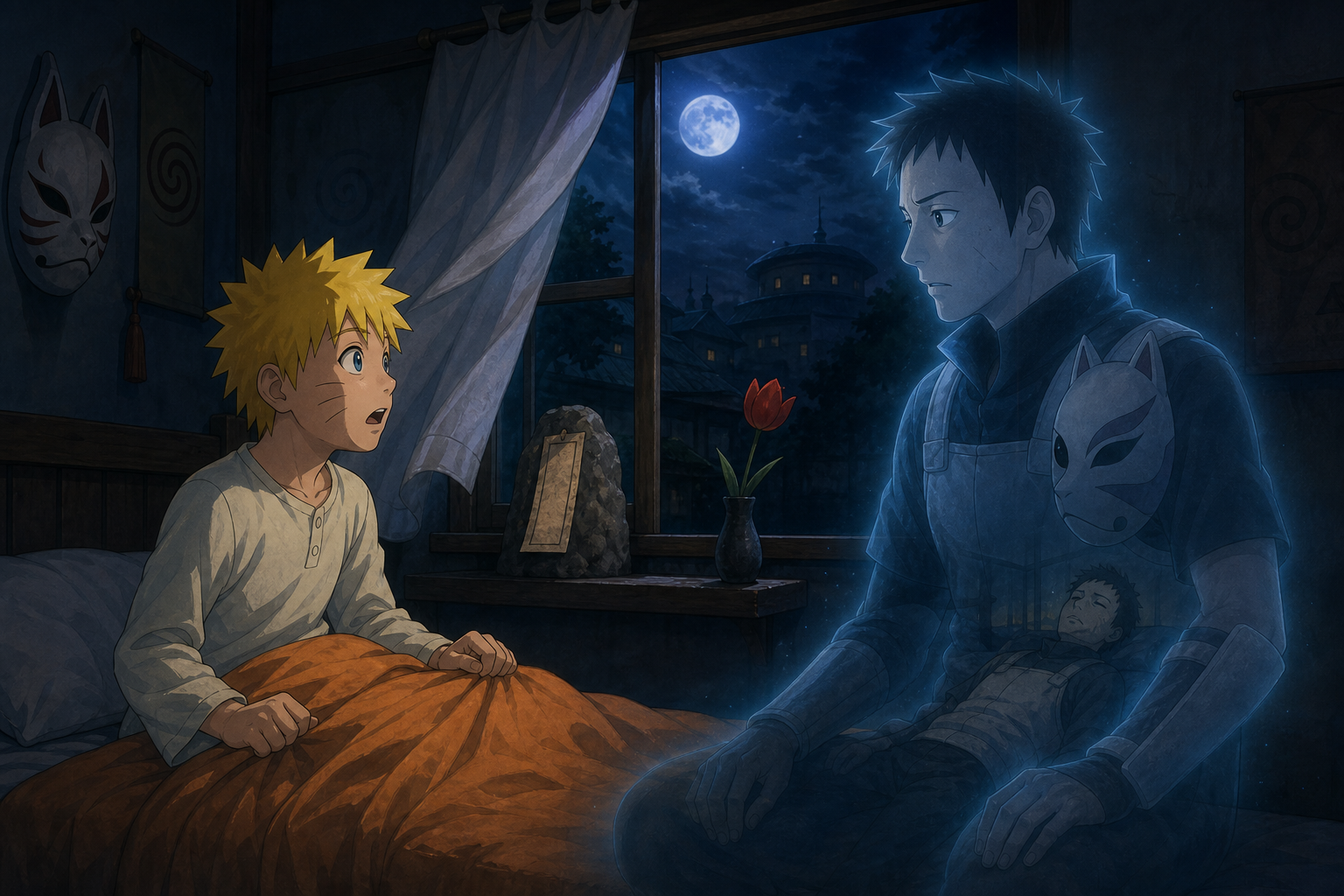
Naruto Shippuden Episode 193, "The Man Who Died Twice," begins when Naruto tears a talisman from a stone on his way home. That night, an unfamiliar man appears beside his bed. Naruto assumes he is a ghost; the man cannot remember his name or how he got there.
A red tulip restores pieces of the stranger's memory. He is Kisuke Maboroshi, a Leaf intelligence operative who investigated a security official named Sabiru. Kisuke discovered that Sabiru was an infiltrator, but Sabiru used a soul-separation seal against him. Kisuke's spirit became trapped while his living body remained comatose.
Naruto finds the body and helps Kisuke return home, where he learns that Sabiru killed Kisuke's wife and intends to control Konoha's new security system. Naruto disguises himself as Kisuke and confronts Sabiru during a planning meeting, provoking the spy into revealing himself.
Kakashi and the Leaf move to arrest Sabiru. Before he can expose the organization behind him, Kabuto kills him from concealment. Sabiru also destroys Kisuke's body, making the separated soul truly dead. Kisuke accepts his end and asks Naruto to place flowers at his grave whenever he remembers him.
Episode 193 wraps a conspiracy story inside a ghost tale, then refuses the easy comfort of pretending exposure guarantees rescue. Naruto helps Kisuke recover his name, finish his warning, and reclaim the meaning of his final actions. He cannot restore the life Sabiru stole. The victory is truth reaching the people who need to hear the truth before another enemy can bury the evidence.
Naruto releases the mystery before he understands the danger
The entire episode begins because Naruto removes a seal without reading the situation. The choice is classic Naruto behavior: curiosity first, consequences after midnight. The decision is careless, but the same decision also frees Kisuke's spirit from isolation.
That balance keeps the supernatural opening from becoming a simple warning about touching cursed objects. Naruto causes the problem and becomes the only person positioned to hear the stranded man's request. His impulsiveness creates responsibility, and he accepts the responsibility once the frightened screaming stops.
The talisman is not only a spooky prop. The seal represents a secret someone wanted immobilized. Naruto's habit of disturbing what looks settled gives the truth a chance to move again.
That opening also establishes Naruto as the right partner for Kisuke. A more cautious shinobi might have left the seal untouched and reported the strange stone. Naruto makes the wrong procedural choice, recognizes the human consequence, and stays. His compassion does not erase his carelessness. Compassion determines what he does next.
Kisuke is not dead yet, which makes the title crueler
Naruto calls Kisuke a ghost because the spirit has no body nearby. The hospital reveals something stranger: Kisuke's body is alive while his soul wanders separately. He has been denied both life and death.
That condition reflects what happened to his investigation. He discovered a threat but could not deliver the warning. His knowledge remains present without the institutional body needed to make anyone act on the warning.
The first “death” is therefore suspension. Sabiru removes Kisuke from the world without creating the evidence and questions a normal murder would produce. The second death arrives only after Kisuke regains his identity and completes the work he was prevented from finishing.
The title becomes cruel because Kisuke has to experience disappearance twice. First, Sabiru separates him from his body, family, name, and professional authority. Later, the destruction of the body closes the remaining route home. Between those losses, Kisuke earns a narrow interval in which someone finally listens.
The tulip restores a life through an ordinary memory
Kisuke does not remember himself through a weapon, code phrase, or ANBU mask. A flower opens the path. The tulip connects him to his wife and home, the personal life that existed beside his intelligence work.
That choice is important because Sabiru tried to reduce Kisuke to an obstacle. The flower returns the parts of him that cannot be described by the case file: affection, grief, and the reason his disappearance hurt someone beyond the security office.
Naruto follows the memory rather than dismissing the memory as irrelevant. He understands that solving who Kisuke is requires more than identifying his rank.
The tulip also gives the mystery a human scale. Codes and security plans explain what Kisuke was investigating, but the flower explains whom the investigation cost. His wife is not incidental background to an operative's case. Her absence is part of Sabiru's violence, and remembering her helps Kisuke become a person again before he becomes a witness.
Sabiru turns security into the perfect hiding place
Sabiru proposes a system designed to protect Konoha while secretly serving the people infiltrating the village. The position gives him access, credibility, and influence over where the village will look for danger.
That access makes him more threatening than an obvious attacker at the wall. He can define suspicion, build blind spots into procedure, and make resistance look like opposition to safety itself.
Kisuke saw the contradiction early and paid for the discovery. Naruto cannot defeat Sabiru by shouting that the man feels untrustworthy. He needs Sabiru to expose knowledge and aggression in front of witnesses who can act.
Security language gives Sabiru moral camouflage. Anyone questioning his proposal can be framed as careless about Konoha's safety, especially during a vulnerable period. Kisuke's investigation threatens more than one spy. His findings threaten the authority Sabiru has built by claiming to protect the village from people like himself.
Naruto uses transformation as testimony
Disguising himself as Kisuke is emotionally brutal and strategically effective. Sabiru believes the man he silenced has returned. His reaction supplies evidence Naruto cannot present through an invisible witness.
Naruto often uses Transformation Jutsu for comedy or direct infiltration. Here the technique becomes a way to let a victim confront the person who erased him. Naruto gives Kisuke's face a body and a public voice long enough to destabilize the lie.
The technique does not make Naruto an investigator overnight. The confrontation works because he has listened closely enough to know which truth Sabiru fears.
Naruto is not impersonating Kisuke to steal authority from him. He lends physical visibility to a witness who cannot enter the room. That difference matters. The transformation serves Kisuke's testimony, and Sabiru's own panic supplies the confirmation.
Kakashi arrives when accusation becomes proof
Naruto's provocation creates an opening, but adult authority still matters. Kakashi and the Leaf witnesses can turn Sabiru's reaction into an arrest rather than another private fight.
This is one of the better uses of Naruto's recklessness. He acts outside normal procedure because the procedure is compromised, then drives the situation toward people capable of securing the threat.
The plan is risky, especially with a hidden organization still watching. The plan succeeds at exposing Sabiru but cannot protect every witness or guarantee a clean interrogation.
Kabuto closes the trail before the investigation reaches him
Sabiru's death prevents the village from learning the full network behind the infiltration. Kabuto treats his own operative as disposable the moment capture becomes likely. The killing confirms Kisuke's warning while preserving the larger secret.
That interruption keeps the story from offering a tidy detective ending. Naruto and Kisuke identify the immediate traitor, but the system producing traitors remains outside the room.
Kabuto's presence also changes how we read Sabiru's confidence. Sabiru believes infiltration grants power, yet he is only useful while silent and effective. The organization he serves will not rescue him from failure.
The murder is an ugly reminder that revealing one layer of a conspiracy can activate another. Naruto and Kakashi create the conditions for an arrest, but Kabuto has already decided that a captured asset is a liability. Sabiru spends the episode treating Kisuke as disposable and discovers too late that his own masters apply the same logic to him.
Kisuke's second death completes his unfinished duty
Sabiru destroys Kisuke's comatose body, removing the possibility that his soul might return. The act is a cruel victory even after the spy's exposure. Naruto cannot save Kisuke by winning the confrontation.
Kisuke still reaches peace because his warning lands. His family receives truth. The village knows Sabiru was compromised. The duty holding his spirit in place is no longer unfinished.
That outcome is not the same as saying sacrifice was fair or necessary. Kisuke instead recovers authorship over the meaning of his final act. Sabiru separated him to bury the investigation; Kisuke uses that impossible state to finish the work.
Naruto's limitation is central to the ending. He can fight the immediate enemy, expose a lie, and keep a promise. He cannot reverse every consequence once violence has occurred. The episode lets compassion remain valuable even when compassion cannot produce a miraculous rescue.
Flowers become a promise against disappearance
Kisuke asks Naruto to bring flowers when he remembers him. The request is modest because memory is the only memorial he can guarantee. Intelligence work often requires anonymity, and Kisuke's most important success may never become a public legend.
Naruto is a good person to receive the promise. He knows what being unseen feels like, and he treats remembrance as an active responsibility. A flower at a grave says that secret service did not make the person disposable.
The tulip that restored Kisuke's identity becomes the gesture that keeps that identity from vanishing again.
The case distinguishes exposure from justice
Sabiru is exposed, but the conclusion leaves several wounds open. Kisuke and his wife remain dead. Kabuto prevents an interrogation. The organization behind the infiltration survives beyond the episode's immediate conflict. Naming the traitor is necessary, yet naming alone cannot repair every consequence.
That incompleteness strengthens Kisuke's request. He does not ask Naruto to pretend the case ended cleanly or to turn him into a celebrated hero. He asks for remembrance. Flowers cannot replace justice, but they resist the final erasure Sabiru attempted.
The village also receives a warning about systems that inherit the motives of their designers. A security structure can look protective while creating precisely the blind spots an infiltrator needs. Kisuke's victory is giving Konoha enough truth to question the proposal before trust becomes infrastructure.
Naruto becomes a witness before becoming a fighter
Naruto's most important work begins with listening. Kisuke has no rank he can prove, no body he can control, and incomplete memories. Naruto still treats the stranger's confusion as a problem worth following. That patience makes every later tactic possible.
The transformation at the meeting is effective because Naruto has gathered a person's story, not merely a suspect's name. He understands Sabiru's fear, Kisuke's purpose, and the urgency surrounding the security plan. Fighting enters only after testimony forces the conflict into public view.
That order suits Naruto's larger growth. His instinct is often to act first, but his deepest victories come when he recognizes another person's pain accurately enough to act for the right reason. Episode 193 gives that ability a small mystery-story form.
Naruto’s mistake frees testimony somebody buried
Removing the talisman is irresponsible because he has no idea what it contains. It also interrupts a successful silencing. Procedure would have left Kisuke trapped and Sabiru’s security plan moving forward.
The episode does not turn impulsiveness into automatic virtue. It asks whether Naruto will accept responsibility for the person his curiosity released. He does.
Kisuke’s first death is administrative disappearance
His body remains alive, but he cannot speak through it, prove rank, return home, or deliver the warning. Sabiru removes function and credibility without producing the questions a corpse might trigger.
That suspension is tailored to intelligence work. A secret can remain technically alive and still become useless when separated from every channel capable of receiving it.
The tulip returns the husband before the operative
Kisuke remembers through affection, color, and home rather than a code or weapon. Personal memory restores the person Sabiru reduced to an obstacle.
Only after that connection returns can the case regain shape. The episode insists that learning what he protected is incomplete without learning whom he loved.
Security offers Sabiru the ideal moral disguise
He does not infiltrate by arguing Konoha should become weaker. He offers protection, access control, and institutional confidence during a vulnerable period.
Anyone challenging the design can appear reckless about safety. That camouflage lets an infiltrator decide where the village looks for threats while placing himself beyond suspicion.
Transformation gives an invisible witness public weight
Naruto cannot carry Kisuke’s soul into the meeting as admissible proof. He can carry the face Sabiru believes permanently removed and watch guilt reorganize the room.
The disguise serves testimony rather than stealing identity. Naruto listened closely enough to make the victim visible until the culprit supplies his own confirmation.
Kakashi converts provocation into institutional action
Naruto can expose panic, but arrest requires witnesses and authority capable of securing the immediate threat. Kakashi arrives where accusation becomes evidence.
The partnership matters because recklessness alone might produce another private fight. Naruto disrupts compromised procedure, then reconnects the truth to people who can act on it.
Kabuto reveals the conspiracy’s disposable hierarchy
Sabiru treats Kisuke as removable when investigation threatens him. Kabuto applies the same rule when Sabiru’s capture threatens the larger organization.
The spy mistakes usefulness for belonging. His death confirms the warning and proves the people he served never considered him valuable beyond silence and success.
The second death denies a miracle without denying meaning
Destroying Kisuke’s body closes the route home after Naruto has finally restored name, memory, and purpose. Exposure cannot reverse every injury already inflicted.
Kisuke still completes the act Sabiru tried to suspend. Truth reaches Konoha, giving his final interval authorship even though it cannot give him survival.
Flowers resist the anonymity intelligence demanded
Kisuke does not ask for a monument or public legend. He asks Naruto to remember and place something living near the grave.
The promise protects his personhood from disappearing behind classified service. A tulip restored his identity once; future flowers keep that identity attached to a human life.
RaeRae's reaction to The Man Who Died Twice
Naruto screaming at the man beside his bed is the correct response. He fights monsters for a living, but one quiet spirit sitting politely in his room nearly ends him. I appreciate how the episode lets the supernatural opening be funny before the story becomes sad.
Kisuke's condition is genuinely unsettling because he is not a normal ghost. His body is alive somewhere while the part that remembers and chooses is stranded elsewhere. Sabiru did not only try to kill him; he tried to suspend the truth indefinitely.
The Naruto-as-Kisuke confrontation is clever. Naruto cannot bring an invisible witness to a security meeting, so he brings the face Sabiru thought he erased and waits for guilt to speak first.
The ending refuses to make exposure equal rescue. Kisuke dies, Kabuto protects the larger conspiracy, and Naruto is left with flowers instead of a triumphant new friend. That small promise works for me. Not every person who protects Konoha gets a monument. Sometimes survival belongs to the person who agrees not to forget.
I especially like that Kisuke's identity returns through a tulip instead of an intelligence trick. The case matters, but the man existed beyond the case. By the time Naruto understands the danger to Konoha, he also understands whose home was emptied and why a flower deserves a place beside the final warning.
The case ends with evidence and unfinished justice
Sabiru is exposed, but Kisuke and his wife remain dead, Kabuto escapes scrutiny, and the organization behind the infiltration survives. Truth prevents one dangerous system from being installed. It does not refund everything taken.
That incompleteness makes remembrance necessary rather than sentimental. Flowers acknowledge a victory whose cost cannot be repaired by the arrest Naruto helped create.
Naruto’s first useful skill is believing a confused stranger
Kisuke begins without credentials, complete memory, or a body he can command. Naruto stays long enough for fragments to become a person and a warning.
The later transformation works because listening came first. Naruto can provoke Sabiru accurately only after caring about the life surrounding the intelligence.
Kisuke’s request also gives Naruto a duty without an enemy to defeat. Visiting a grave demands no spectacular technique and earns no public praise. It requires returning after urgency fades. That kind of promise tests whether compassion survives beyond the adventure that first created it. Remembering Kisuke becomes quiet maintenance, the same way intelligence work protected people through acts they might never see or know enough to celebrate.
RaeRae’s final word on The Man Who Died Twice
Naruto screaming at the polite man beside his bed is correct. He can face giant summons, but one quiet ghost-shaped stranger nearly sends him through the wall.
Then the joke turns cruel. Kisuke is not properly dead. His body and soul have been separated so the truth can remain alive without reaching anybody.
The tulip gets me because it restores the husband before the operative. Sabiru tried to erase an investigator. Naruto discovers a home, a murdered wife, and a person whose work mattered because people mattered.
Using Kisuke’s face at the meeting is smart precisely because Naruto cannot present the real witness. He lends visibility until Sabiru’s reaction speaks.
The ending refuses easy comfort. Kisuke dies, Kabuto closes the trail, and Naruto inherits flowers instead of a rescued friend. Remembrance cannot become justice, but it can prevent secrecy from finishing the erasure.
RaeRae’s call
Naruto cannot return Kisuke’s stolen life. He can listen, carry the warning into public view, and keep bringing flowers so a hidden act of service never becomes a vanished person.