
Neji Chronicles
Naruto never enters Neji’s rescue story, yet the belief he challenged becomes the reason Neji chooses family over the role destiny assigned him.
Bottom line
Naruto Shippuden Episode 192, "Neji Chronicles," begins with Konohamaru, Moegi, and Udon asking Neji for a story about Naruto's heroism. Neji answers with a mission in which Naruto never physically appeared.
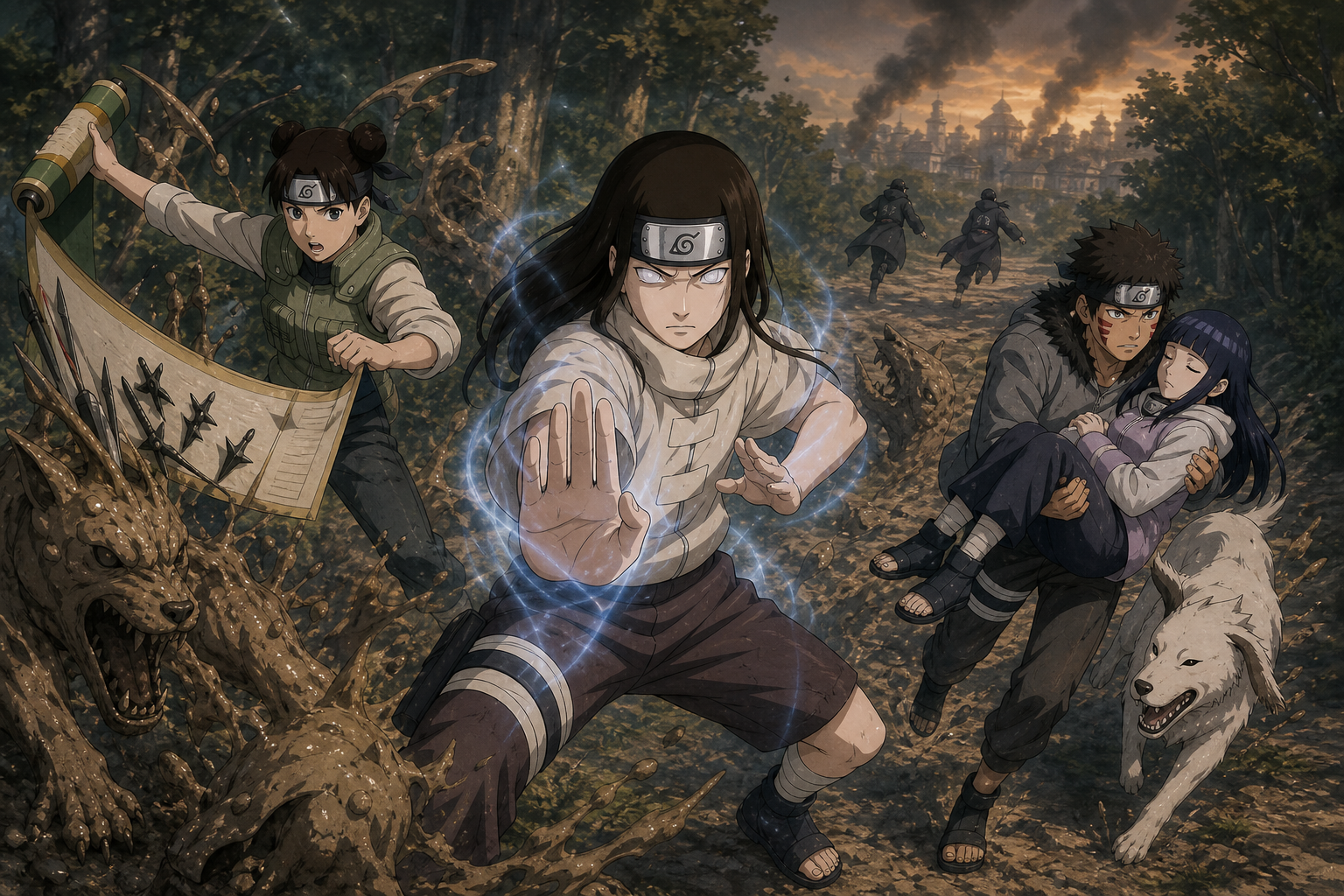
During the Konoha Crush, Neji is recovering from his Chūnin Exam defeat when Tenten arrives. The invasion erupts around them, and a wounded Hyūga elder reports that two Cloud spectators used the chaos to abduct Hinata for her Byakugan. Neji receives an A-rank recovery order.
Tenten joins him. Kiba and Akamaru insist on coming because Hinata is their teammate and Kiba does not trust Neji's feelings toward her. The Cloud ninja leave mud-wolf traps behind; Tenten stays to hold them while Neji, Kiba, and Akamaru continue.
Kiba disrupts the kidnappers long enough to carry Hinata away, but the escape becomes a fight. Hiashi arrives and defeats the remaining threat. He tells Neji that his late brother Hizashi loved him and that Neji is not merely a branch-family tool. Neji realizes Naruto's challenge to his belief in fixed destiny had already changed the choice he made to rescue Hinata.
The Academy reporters complain that Naruto was absent from the story. Neji explains that Naruto was its most important person.
That answer gives Episode 192 its purpose. Naruto's heroism is not measured by screen time or by who lands the final blow. His earlier challenge changes how Neji understands destiny, family, and personal choice. When Hinata needs help, Neji makes a decision that the version of himself from the Chūnin Exam preliminaries might never have made.
Naruto matters through the decision he changed
The framing cleverly asks what influence looks like after the influential person leaves the room. Naruto does not rescue Hinata, defeat the kidnappers, or speak during the mission. His contribution happened earlier in the arena when he challenged Neji's certainty that people cannot escape assigned roles.
Neji could have dismissed that speech as a winner's noise. Instead, the idea keeps working inside him. When the Hyūga elder orders recovery of the Byakugan, Neji has to decide whether Hinata is primarily clan property or a person he wants to save.
Naruto's heroism here is not ownership of the outcome. His influence is the change that makes someone else choose differently.
The distinction keeps Neji from becoming a supporting prop in Naruto's legend. Naruto supplies a challenge, not a replacement identity. Neji still has to examine the order, face his resentment, pursue Hinata, and decide what kind of cousin he wants to be. Influence matters precisely because another person retains agency.
Neji begins from a painful contradiction
Neji recently attacked Hinata without mercy during the preliminaries. Now the clan orders him to retrieve her from people who value her eyes more than her life. Kiba is right to question whether Neji can separate duty from resentment.
The mission forces Neji to confront the similarity between the kidnappers and the Hyūga system he hates. Both reduce a person to the power in her eyes. If he pursues Hinata only to recover the Byakugan, he is obeying the same logic under a different uniform.
Protecting her as family requires a choice beyond the command. Neji does not announce that distinction immediately, but his actions begin making the difference visible.
Kiba's presence prevents Neji from hiding inside official language. The order concerns an inherited dōjutsu, while Kiba keeps naming the kidnapped person as his teammate. Those two descriptions pull the rescue in different moral directions. Neji's growth appears when his actions move toward Kiba's human priority rather than stopping at the clan's property claim.
Kiba refuses to leave Hinata to clan politics
Kiba joins because Hinata is his teammate. That answer is refreshingly direct. He does not care whether the Hyūga considers the mission an internal matter or whether Neji is the clan's prodigy. Someone took a member of Team 8, so he and Akamaru are going.
His distrust of Neji adds necessary friction. The audience knows Neji is changing, but Kiba remembers what happened in the exam. He does not offer trust as a reward for one defeat and one speech.
When Kiba reaches Hinata, he removes her from the fight rather than chasing personal glory. His priority stays exactly where he said the priority would remain: teammate first.
Kiba also functions as a witness to Neji's choice. A private change can be claimed easily after the danger passes. Kiba watches Neji accept the pursuit, continue through the traps, and treat Hinata's safety as more than a clan assignment. Trust begins to rebuild through evidence rather than forced forgiveness.
Tenten holds the route open
Tenten's assignment against the mud wolves can look like the supporting character being removed from the central fight. Her work is more useful than that. The trap exists to slow the pursuers and let the kidnappers widen the gap. If everyone races forward, the pack attacks from behind and collapses the rescue.
Tenten recognizes where her weapons expertise fits and takes responsibility for the problem. She does not need Neji to validate the decision or Kiba to remain beside her. Her stand converts a dangerous route into time for the faster trackers.
This is the kind of team contribution image-card summaries often erase. The person who does not touch the hostage may still make the rescue possible.
Byakugan is treated as inheritance and target
The Cloud spectators exploit a village-wide invasion to continue an older appetite for Hyūga power. Hinata's kidnapping echoes the incident that led to Hizashi's death, when the Cloud demanded a life after an earlier attempt to seize her.
Neji therefore chases more than two opportunists. He is running into the history that shaped his hatred. The Byakugan gave his family status, but the same inheritance also made bodies negotiable between clans and nations.
The Konoha Crush creates perfect cover because every defender is focused on the obvious attack. The kidnapping shows how a public emergency opens space for older ambitions. Hinata is targeted not for anything she chose, but for a bloodline other people believe they can own, bargain over, or weaponize.
Saving Hinata cannot undo Hizashi's sacrifice. The rescue can prevent Neji from letting the same system write the next version of the story.
Hiashi arrives with truth Neji should have received earlier
Hiashi's intervention ends the immediate threat, but his words matter more than his power. He tells Neji that Hizashi chose to protect his brother and that Neji remains a beloved connection to him, not a disposable branch-family instrument.
That truth does not magically excuse the Hyūga structure. Neji grew up under a seal and with an explanation of his father's death that produced justified anger. Adults withheld context until hatred hardened into identity.
Still, hearing that Hizashi acted from love gives Neji another way to understand sacrifice. His father was constrained by the clan, yet he retained agency within that terrible situation. Neji can honor him without treating himself as permanently authored by the same cage.
Hiashi's confession lands because Neji has already begun acting against the story he inherited. The information does not manufacture compassion at the final moment. Rather, the truth meets a young man who has chosen to pursue Hinata and is finally prepared to hear that his father's last decision contained love as well as coercion.
Destiny loses power when Neji acts against his script
Before fighting Naruto, Neji believed the main and branch families fixed every role in advance. Hinata would remain weak. He would remain bound. Effort might refine technique, but effort could not alter the essential pattern.
The rescue contradicts that worldview through action. Neji protects the main-family heir he once resented. Kiba challenges a clan prodigy. Tenten takes an A-rank threat without waiting for rank to certify her. Hiashi speaks to Neji as family rather than equipment.
None of them becomes free of institutional consequences in one mission. They create evidence that assigned roles do not dictate every choice.
The episode gives Neji ownership of his change
Naruto opens the door, but Neji walks through the opening. That distinction protects both characters from a shallow version of inspiration. Neji does not become good because Naruto delivered a magical speech. He takes Naruto's challenge, measures the challenge against new information, and chooses how to live differently.
Years later, he understands the relationship clearly enough to tell Konohamaru's team that Naruto was central without pretending Naruto performed the rescue. Gratitude does not require surrendering authorship.
Neji owns the mission and names the person who helped make that version of him possible.
The framing challenges a narrow idea of heroism
Konohamaru, Moegi, and Udon expect a Naruto story to include a dramatic entrance. Their disappointment is understandable because Naruto's most visible victories are loud. Neji offers a more demanding definition: a hero can matter by changing what another person believes is possible.
That definition expands Naruto's influence without stealing the rescue from Neji, Kiba, Tenten, Akamaru, or Hiashi. Each participant contributes something concrete. Naruto's role occurred earlier, when he refused Neji's claim that assigned fate was unchangeable and then proved his argument in the arena.
Neji remembers that challenge because the challenge kept producing consequences. A heroic act does not end when the crowd stops watching. Sometimes the strongest evidence appears later in a choice the original hero never sees.
Hinata is a person before she is a bloodline
Both the kidnappers and the official order emphasize Hinata's eyes. The Cloud ninja want the Byakugan, while the wounded elder frames recovery around protecting the clan's inherited power. Kiba supplies the missing language immediately: Hinata is his teammate.
Neji has personal reasons to resent the main family and every institution surrounding those eyes. Choosing to protect Hinata does not require him to forgive the system. The choice requires him to distinguish the girl from the position assigned to her.
That separation is a meaningful stage in his healing. Hinata did not design the branch-family seal or choose the circumstances surrounding Hizashi's death. Neji can oppose the structure without treating another child trapped inside the structure as the enemy.
The rescue distributes courage across the team
No single character completes every part of the mission. Tenten holds the trap line. Kiba and Akamaru track and extract Hinata. Neji confronts the history attached to the pursuit. Hiashi ends the immediate danger and finally shares the truth about Hizashi.
That distribution supports the episode's argument about influence. Just as Naruto can matter without appearing, Tenten can matter without reaching the hostage, and Kiba can matter without defeating the strongest opponent. The rescue is an accumulation of choices that preserve the route for someone else.
Neji's story therefore avoids replacing one destiny myth with a lone-genius myth. He changes because people challenge, distrust, accompany, inform, and depend on him. His decision remains his own, but growth happens inside a network of relationships.
Neji refuses the reporters’ definition of presence
Konohamaru’s team expects Naruto to appear because heroic stories usually follow visible action. Neji asks them to trace consequence instead.
Naruto’s challenge remained inside him after the arena emptied. When Hinata disappeared, that earlier argument changed which version of Neji answered the order.
The rescue begins inside a morally compromised command
The Hyūga elder emphasizes recovering the Byakugan, language that reduces Hinata to inherited property. Cloud kidnappers use the same logic from the opposing side.
Neji can obey the mission while rejecting its premise. Saving his cousin as a person transforms what identical movement through the forest means.
Kiba keeps Hinata’s name ahead of her eyes
He does not join because clan assets require protection. His teammate was taken. That direct loyalty prevents institutional language from swallowing the child at the center.
Kiba’s distrust of Neji is also care. After the preliminaries, allowing him unquestioned control would ignore what Hinata endured.
Trust returns through witnessed behavior
Neji cannot request that Kiba believe in private change. Kiba watches him pursue, endure, and place Hinata’s safety beyond old resentment.
Conduct supplies evidence an apology alone could not. The mission does not erase the exam. It creates the first reason to imagine Neji will choose differently next time too.
Tenten’s rear position is not secondary work
The mud wolves exist to consume the pursuit from behind. Tenten staying at the trap line protects every person moving closer to Hinata.
Rescue stories often reward proximity to the hostage. This one shows that holding open a route can be the action that makes extraction possible.
The Cloud attempt repeats history during public chaos
Konoha’s invasion draws defenders toward the obvious attack, leaving an old appetite for Hyūga power room to move. Hinata’s body becomes the site where national ambition and clan hierarchy meet again.
Neji is forced to confront the machinery surrounding Hizashi’s death while deciding whether repetition is destiny or warning.
Hiashi’s truth arrives after Neji has already chosen
Hizashi’s love changes the meaning Neji attached to the sacrifice, but it does not create his decision to rescue Hinata. Neji was already moving toward her.
That order matters. New information meets growth in progress instead of magically producing compassion at the final moment.
Naruto influences without owning Neji’s redemption
He cracked certainty and offered evidence that assigned roles can be challenged. Neji performed every difficult step afterward.
Gratitude does not require surrendering authorship. Neji can name Naruto as essential while keeping the rescue, reflection, and changed relationship genuinely his own.
RaeRae's reaction to Neji Chronicles
I love the answer Neji gives the Academy kids. They want a story where Naruto bursts through a wall and saves everyone. Neji gives them something more useful: Naruto changed a belief, and that changed who showed up for Hinata when Naruto was somewhere else.
Kiba's suspicion is important. Neji does not deserve instant trust after what he did to Hinata in the exam. The rescue becomes proof, not a request that everyone accept his private growth on faith.
Tenten holding the mud wolves deserves respect too. The mission only looks like a straight pursuit if you ignore the teammate preventing the trap from consuming everyone behind the leaders.
Hiashi's explanation about Hizashi is emotional, but I cannot separate the explanation from the fact that Neji should not have had to build a childhood around incomplete truth. His healing does not make the system acceptable. The new knowledge gives him a way to stop that system from being the only voice narrating his father's love.
Naruto never enters the flashback, yet the episode understands his best power. He makes people question the sentence they thought had already been written for them. Neji's rescue of Hinata is his own act, and the rescue exists partly because Naruto taught him that “destiny” can be argued with.
I also appreciate that Kiba does not become unreasonable for remembering the preliminaries. Neji harmed Hinata, and one inspiring speech does not obligate her teammate to feel safe around him. The mission gives Kiba something stronger than reassurance: conduct he can judge for himself.
Heroism becomes what continues after the hero leaves
Naruto never knows his words will affect this mission. The influence is not performed for gratitude or public recognition. It works because Neji kept wrestling with the idea after defeat.
That is a demanding measure of impact. The strongest act may be the one that equips another person to choose well when nobody who inspired them is watching.
The episode does not use healing to excuse the Hyūga system
Hizashi possessed agency inside terrible circumstances, and Hiashi loved his brother. Neither truth makes the branch seal humane or justifies withholding the story from a grieving child.
Neji’s growth means the structure loses exclusive authority over his identity. It does not mean the structure was secretly acceptable all along.
Hinata’s absence from the conversation is another warning
Much of the mission is narrated through what other people believe her eyes, status, and safety mean. The kidnappers want the Byakugan. The clan wants its inheritance recovered. Kiba wants his teammate back. Neji is confronting family history through her abduction.
Kiba’s language is the most human because it begins with relationship rather than symbolism. Even protective people can make someone the center of a lesson without giving her a voice inside it. Remembering that limit keeps the rescue from becoming a complete account of Hinata’s experience.
Neji’s change matters because it can alter what happens when she speaks later. Saving her is one decision. Learning to recognize her choices beyond weakness, heirship, and inherited conflict is the longer work Naruto’s challenge has only begun.
That distinction deserves to remain visible here.
RaeRae’s final word on Neji Chronicles
The Academy kids want Naruto bursting through a wall. Neji gives them the better story: Naruto changed a belief, and that belief changed who arrived for Hinata while Naruto was somewhere else.
Kiba’s suspicion keeps the episode honest. Neji hurt Hinata. Nobody owes instant trust because he lost a fight and heard an inspiring speech.
Tenten holding the mud wolves matters just as much as reaching the final clearing. Somebody has to protect the path while everyone else follows the target.
Hiashi’s truth gives Neji another way to understand Hizashi, but it arrived painfully late. Love inside a sacrifice does not absolve the system that forced a child to build his identity around incomplete information.
Naruto’s role is catalytic, not possessive. He argues with destiny, then Neji authors the next decision. That is influence worthy of being called heroic because it leaves another person more capable of choosing for himself.
RaeRae’s call
Naruto never enters Neji’s rescue story, yet his challenge is everywhere inside it. Heroism becomes the belief another person carries forward and turns into a choice of their own.