
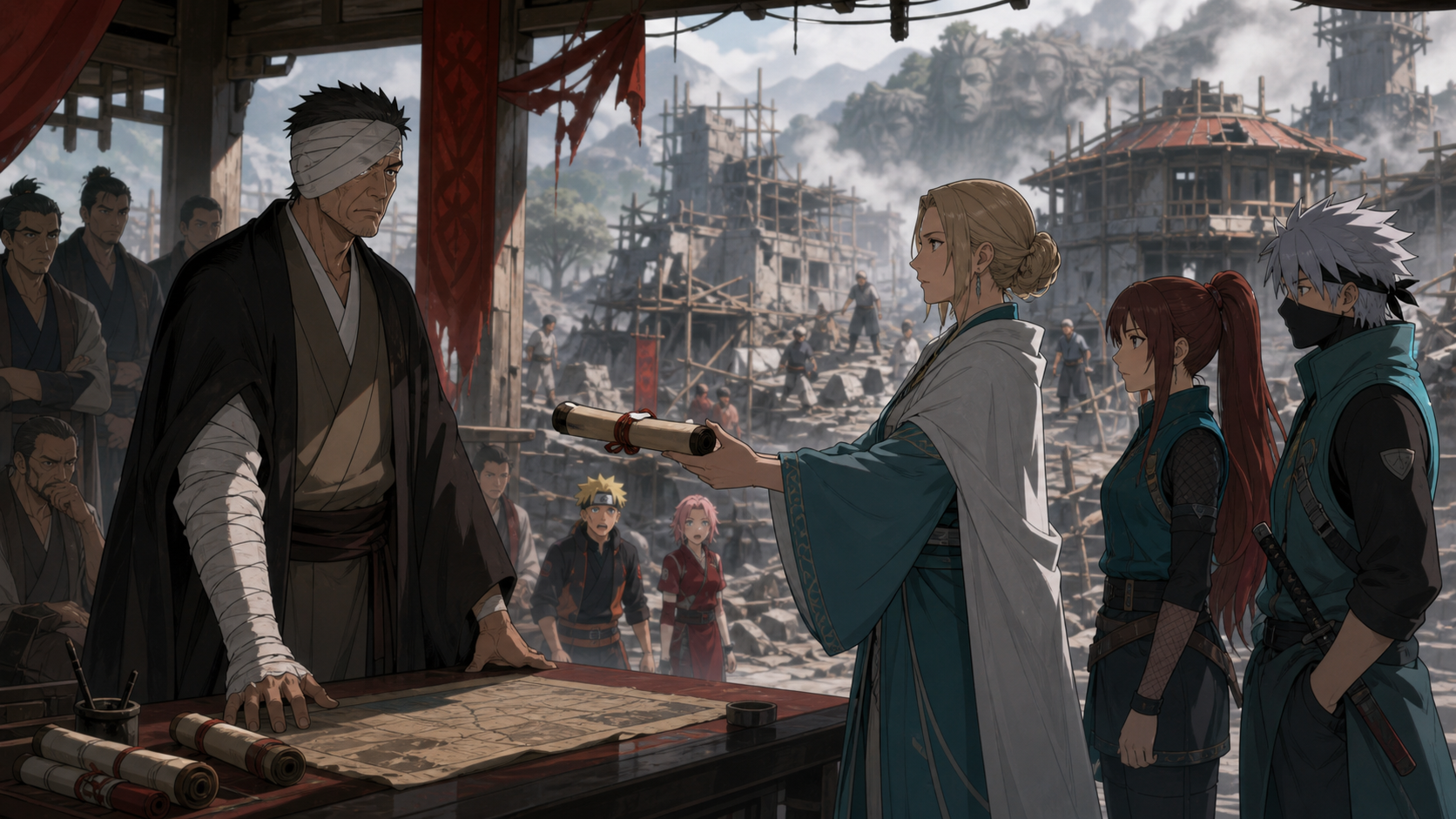
The Sixth Hokage Danzō
The Cloud delegation arrives with a legitimate grievance, and Danzō turns Konoha’s weakest moment into authority over Sasuke’s fate.
Bottom line
Naruto Shippuden Episode 197, “The Sixth Hokage Danzō,” returns to the present after the Past Arc. Konoha is still rubble after Pain’s assault, Tsunade remains unconscious, and the political world has already started moving faster than the village can recover.
Near one of Orochimaru’s former hideouts, Sai uses ink mice to locate Kabuto. Before Anko’s reconnaissance team can act, Tokuma Hyūga arrives with orders recalling Sai and news that the Leaf was destroyed. The emergency is larger than a single target: Danzō has been appointed Hokage while Tsunade lies in a coma.
Team Samui reaches Konoha carrying an official letter from the Fourth Raikage. Samui, Karui, and Omoi expect to deliver the message to Tsunade, but instead enter a village of tents, broken buildings, and exhausted survivors. Danzō appears as the acting leader and announces himself as the Sixth Hokage.
The Raikage’s message concerns Sasuke’s attack on Killer B. Danzō readily authorizes Sasuke’s elimination as a rogue ninja. Naruto and Sakura learn that their former teammate is now an international target, while the Cloud delegation begins looking for information about him.
Konoha’s ruins become a political opening
Pain’s assault destroyed homes, institutions, and the physical symbols of authority. The village has barely begun clearing debris when the question of leadership becomes urgent. Someone must receive foreign envoys, issue orders, and represent the Leaf beyond its broken walls.
Danzō understands that urgency better than anyone. He does not need the village to love him before he takes the seat. He needs the elders and Fire Daimyō to believe delay is dangerous.
The episode makes his rise feel inseparable from the disaster. Where other people see neighbors to rescue and homes to rebuild, Danzō also sees a moment when fear can make his preferred kind of rule look necessary.
Tsunade’s absence changes every conversation
Tsunade is alive, but she cannot speak for the village. That distinction creates a painful vacuum. The people who trust her cannot ask for guidance, and foreign governments cannot wait indefinitely for her recovery.
Her coma also lets Danzō frame recent events without her challenge. He can describe Pain’s attack as proof that her leadership was too soft, while ignoring the choices that saved lives and allowed Naruto to end the assault.
Leadership is being reassigned before the village has processed what Tsunade sacrificed. The speed feels administrative on paper and deeply personal in practice.
Team Samui arrives expecting protocol and finds trauma
Samui, Karui, and Omoi are not tourists surveying damage. They carry a formal demand tied to an attack on their own village and the apparent capture of Killer B. Their mission deserves urgency.
Even so, the sight of Konoha unsettles them. The Leaf is supposed to be one of the great hidden villages, yet its streets have become an emergency camp. The visual shock reminds us that international business does not pause while civilians are grieving.
Samui keeps the delegation focused. She asks for the Hokage, presents the Raikage’s position, and refuses to let confusion derail the purpose of the visit. Her composure is not coldness; that composure is the discipline required to represent people who believe their teacher has been taken.
The Raikage’s letter brings Sasuke’s choices home
For Naruto and Sakura, Sasuke has remained a private promise wrapped in Team 7 history. They want to retrieve a friend, repair a bond, and believe there is still a road back.
The Cloud delegation turns that private story into an international incident. Sasuke has attacked Killer B while wearing the Uchiha crest and working with Akatsuki. Other villages are not obligated to understand the memories that make Naruto hesitate.
That collision is the episode’s real pressure point. Sasuke is simultaneously the boy Team 7 remembers and the rogue ninja named in a Kage’s official demand. Affection cannot erase the harm attached to his name.
Danzō says yes because the order serves more than justice
Authorizing Sasuke’s elimination can be defended as a conventional response to a rogue shinobi attacking another village’s jinchūriki. Danzō does not need to invent the charge.
What makes the decision disturbing is how neatly the order serves his existing agenda. Sasuke is an Uchiha survivor, a former Leaf ninja outside Danzō’s control, and a living connection to secrets Danzō would rather keep buried.
The Raikage’s demand gives Danzō an international reason to remove a domestic threat. He can present severity as diplomacy while benefiting personally from the outcome.
Sai is recalled because Root’s leash is tightening
Sai’s ink mice locate Kabuto, suggesting the reconnaissance mission is close to producing valuable intelligence. Then the village emergency pulls him away.
The recall is more than logistical. Danzō’s promotion changes the person with direct authority over Sai. The Root operative who entered Team 7 under hidden orders now has his former master sitting at the top of the village.
Sai has begun forming genuine bonds with Naruto and Sakura, but institutional power can reactivate old obligations. His return places that growth under immediate pressure.
Anko’s mission connects unfinished threats to the new crisis
Kabuto remains loose, carrying Orochimaru’s legacy into a world already destabilized by Akatsuki. Anko’s team is trying to contain that danger when news from Konoha forces priorities to shift.
The scene prevents the new arc from feeling like a clean reset. Pain is defeated, but Kabuto remains hidden. Sasuke is moving with Taka. The Cloud wants accountability. Tsunade cannot lead. Every unresolved thread now enters the same political weather.
Anko understands the cost of leaving a trail half-followed. The village, however, cannot preserve every operation when its command structure has changed overnight.
Naruto’s victory does not give him political power
Konoha celebrates Naruto as the person who saved the village, but he does not control what happens next. He cannot appoint the Hokage, answer another Kage’s letter, or erase Sasuke’s classification.
That gap matters. Recognition fulfills one of Naruto’s oldest wishes, yet popularity is not authority. The people may trust his heart more than Danzō’s, but the system can still make decisions that reshape his life without his consent.
The Five Kage Summit arc begins by forcing Naruto to confront institutions rather than a single enemy. He must decide how to defend his bond with Sasuke in a world where other people have legitimate losses of their own.
Danzō’s title is technically provisional and emotionally absolute
Danzō has not yet received every layer of formal confirmation associated with the office, but he introduces himself without hesitation. He understands that titles gain force when others start acting as though they are settled.
The announcement to Team Samui is therefore a political act. A foreign delegation hears “Sixth Hokage,” carries that status forward, and helps turn a contested appointment into external fact.
His confidence contrasts with the temporary pavilion around him. The building is improvised, the village is damaged, and Tsunade may awaken. Danzō behaves as if none of those uncertainties weaken his claim.
Disaster creates urgency and lowers the price of consent
Konoha needs decisions immediately. Foreign messages arrive, reconstruction requires coordination, missions cannot remain suspended, and Tsunade cannot respond. That urgency makes a rapid appointment defensible.
Danzō benefits because frightened institutions often accept control they would debate under ordinary conditions. He does not need broad affection or a public reckoning with Root. He needs decision-makers to fear delay more than they fear his methods.
The episode does not claim every emergency appointment is illegitimate. The danger comes from allowing urgency to erase scrutiny precisely when expanded authority can do the most harm.
Tsunade’s coma lets other people rewrite her leadership
Tsunade spent her chakra protecting villagers during Pain’s assault, and that sacrifice helped leave her unconscious. Her absence now becomes evidence opponents can use against her, even though the absence resulted from protecting the population.
Danzō can describe destroyed streets as failure without placing Katsuyu’s protection or Naruto’s return inside the same account. A leader unable to speak cannot challenge the edit.
The political transition therefore depends partly on narrative control. Whoever explains the disaster first can define whether Tsunade looks reckless, heroic, weak, or indispensable.
Team Samui forces Konoha to face harm beyond its ruins
The Cloud delegation enters a village visibly devastated by Pain, yet their own mission cannot wait for Konoha’s grief to finish. Killer B’s apparent capture created fear and anger in Kumogakure before the Leaf’s destruction occurred.
That timing prevents victimhood from becoming moral exemption. Konoha has suffered enormously and still owes another village an answer about a former Leaf shinobi acting with Akatsuki.
Samui’s discipline holds both realities. She observes the emergency without abandoning the people who sent her.
Danzō converts an international grievance into domestic cleanup
The Raikage’s demand gives Danzō a lawful-looking route to eliminate Sasuke. The charge is real: Sasuke attacked Killer B and aligned with Akatsuki. Authorizing pursuit is not fabricated from nothing.
Danzō also gains protection from what Sasuke knows and represents. The surviving Uchiha threatens secrets surrounding the massacre, Shisui’s eye, and Root’s role in village policy.
The decision becomes dangerous because public justice and private benefit point toward the same death. Nobody hearing the order can easily separate legitimate response from self-protective motive.
Naruto’s new popularity cannot veto the state
Naruto has finally received the recognition he wanted since childhood. Villagers celebrate him, children imitate him, and adults who once avoided him now understand his protection. None of that recognition grants formal power.
Danzō can confine him, classify Sasuke, and respond to another Kage without Naruto’s consent. The gap teaches Naruto that changing hearts and changing institutions are related but different tasks.
Heroism can create moral authority. Policy still moves through offices, councils, documents, and command systems capable of ignoring the hero standing outside the room.
Sai’s recall places chosen bonds under Root authority
Sai has developed loyalty to Naruto, Sakura, and Team 7 while operating beyond the emotional limits Danzō intended. The promotion of his former commander changes the risk around that growth.
Root no longer sits only beneath the Hokage. Root’s architect now speaks as Hokage. Orders that once competed with village leadership can claim to represent village leadership.
Recalling Sai from Kabuto’s trail therefore carries symbolic force. Institutional authority reaches toward the person he has become and tests whether old conditioning can still define his choices.
The Japanese performances make administration feel threatening
Hiroshi Ito gives Danzō quiet certainty rather than triumph. The announcement sounds settled because he understands that acting like authority can help produce authority. Rina Satō gives Samui precision suited to a diplomat refusing distraction.
Junko Takeuchi and Chie Nakamura let Naruto and Sakura receive Sasuke’s classification as a personal blow inside formal language. The contrast keeps the order from becoming abstract policy.
The episode’s tension comes from calm voices issuing consequences while rubble remains visible. No villain speech is required when procedure can move faster than grief.
Danzō reads rubble as opportunity before the dust settles
Konoha needs leadership, reconstruction, diplomacy, and functioning command. That urgency is real. Danzō understands how quickly a necessary appointment can become permission for the government he always wanted.
He does not wait for affection because emergency power rarely requires it. Fear makes decisiveness look like legitimacy before scrutiny catches up.
Tsunade’s sacrifice becomes evidence against her while she cannot answer
She spent her chakra protecting civilians, and the cost left her unconscious. Opponents can point to destroyed streets while excluding every life Katsuyu helped preserve.
Leadership is being judged through an edit controlled by the person seeking the vacant seat. Silence lets protection be reframed as failure.
Team Samui carries grief into somebody else’s disaster
They arrive among tents and debris, but Killer B’s apparent capture does not become less urgent because the Leaf has suffered too. Their mission represents another community’s fear.
Samui’s discipline holds both realities. She sees Konoha’s trauma without abandoning the people who sent her for an answer.
Sasuke’s name stops belonging only to Team 7
Naruto and Sakura carry childhood, promises, guilt, and hope whenever they hear it. Kumogakure hears an Akatsuki operative who attacked their jinchūriki.
The international demand forces private love into contact with public harm. Other villages are not obligated to treat Team 7’s memories as exemption from consequence.
Danzō’s authorization can be justified and self-serving together
Sasuke is a rogue ninja accused of a serious cross-border attack. Pursuit does not need fabricated charges. The same death would protect Danzō from a surviving Uchiha tied to secrets he wants buried.
Public justice and private benefit align so neatly that motive becomes difficult to challenge through procedure alone.
The title becomes real through repetition
Danzō announces himself to foreign envoys before every layer of confirmation feels emotionally settled. He knows other people acting on the title will strengthen the claim.
Authority is partly performance backed by systems. A temporary pavilion can produce durable consequences once orders, letters, and diplomats accept the speaker.
Naruto’s recognition cannot veto government
He saved Konoha and finally received the love he wanted. Popular gratitude does not let him appoint leaders, answer the Raikage, or change Sasuke’s classification.
The gap between moral authority and formal power becomes his next education. Changing hearts and changing institutions demand different kinds of leverage.
Sai’s recall tests whether Root can reclaim his identity
Sai has developed chosen bonds while working beyond Danzō’s emotional design. Now his former master speaks from the highest office rather than from a hidden faction.
Old conditioning can present itself as ordinary village duty. The promotion makes separating loyalty to Konoha from obedience to Danzō immediately harder.
Anko’s interrupted pursuit keeps unfinished danger visible
Kabuto remains active with Orochimaru’s legacy while the village emergency pulls resources away. The story refuses a clean transition between threats.
Pain is defeated, yet political instability, Sasuke’s actions, Kabuto’s movement, and Root’s ascent all converge. Recovery does not pause the world outside the crater.
RaeRae’s reaction to The Sixth Hokage Danzō
This episode makes me angry in exactly the intended way. Konoha has not finished counting broken roofs, and Danzō walks into the opening like disaster was an invitation carrying his name.
The Cloud team’s arrival keeps the anger complicated. They are not wrong to demand an answer about Killer B. Karui and Omoi believe someone they love was taken, and Team 7’s history does not cancel that fear. Sasuke’s choices have crossed a boundary Naruto cannot talk away with a promise.
What bothers me is how quickly Danzō turns that real grievance into something useful for himself. He can authorize Sasuke’s death, satisfy the Raikage, weaken Naruto’s influence, and remove an Uchiha threat with one decision that looks perfectly official.
The ruined village is the strongest image in the episode. Naruto has finally earned Konoha’s love, but while people rebuild around him, the machinery of power chooses a leader who represents almost everything he rejects. Winning the battle did not end the fight over what the Leaf will become.
Emergency lowers the price institutions demand for consent
Foreign letters need answers, missions need authorization, and rebuilding needs command. Delay carries cost. That pressure can also make expanded control feel too urgent to examine.
The danger is not that Konoha appoints someone quickly. The danger is allowing speed to erase questions about Root, Uchiha history, and the methods Danzō intends to normalize.
Sasuke’s elimination order changes Naruto’s promise
Bringing a friend home was already difficult. Now Naruto must face people whose losses give them legitimate reasons to want Sasuke stopped permanently.
Protecting the bond can no longer mean speaking only about the boy he remembers. Any honest answer must include the harm Sasuke is choosing in the present.
Reconstruction becomes a contest over narrative
The person who explains Pain’s assault can define what failed, what deserves preservation, and which powers appear necessary next. Danzō speaks while Tsunade cannot, giving his interpretation institutional force before survivors finish processing their own experience.
Naruto’s victory offers another account of Konoha. Protection came through trust, recognition, information shared across generations, and a boy the village once feared. Danzō reads the same destruction as proof that control must become harder and dissent easier to classify as danger.
The struggle therefore concerns more than who occupies the office. Each leader carries a theory of what saved Konoha and what should govern the rebuilt version. Rubble is not politically neutral. It can become evidence for compassion, militarization, accountability, or secrecy depending on who gains authority to tell the story first.
That is why the quiet announcement feels as consequential as a battle. Danzō does not need to defeat Naruto in the street. He needs documents, envoys, elders, and frightened officials to begin moving through the world he names.
Power fills the silence.
RaeRae’s final word on The Sixth Hokage Danzō
Konoha has not finished counting broken roofs, and Danzō walks into the opening like disaster sent him a formal invitation.
The Cloud delegation keeps my anger complicated. They believe Killer B was taken. Team 7’s pain does not cancel theirs, and Sasuke’s choices have crossed a border Naruto cannot wish away.
What makes Danzō frightening is how efficiently that real grievance serves him. One official order can satisfy the Raikage, threaten Naruto’s bond, remove an Uchiha, and protect secrets attached to Root.
Naruto has finally earned the village’s love and discovers love is not governmental power. The same system can celebrate him in the street while choosing a leader who represents nearly everything he rejects.
Winning against Pain saved Konoha’s people. Episode 197 begins the harder argument over what kind of village those people are rebuilding.
RaeRae’s call
Danzō turns disaster, diplomacy, and Sasuke’s real wrongdoing into one clean route toward control. The order looks official because the private benefits are buried inside legitimate urgency.