
Origin of Pain
Nagato’s testimony follows a peaceful movement from Jiraiya’s training through Hanzo and Danzo’s betrayal, where Yahiko’s hope is preserved in a form that reverses its meaning.
What happens in Naruto Shippuden Episode 173?
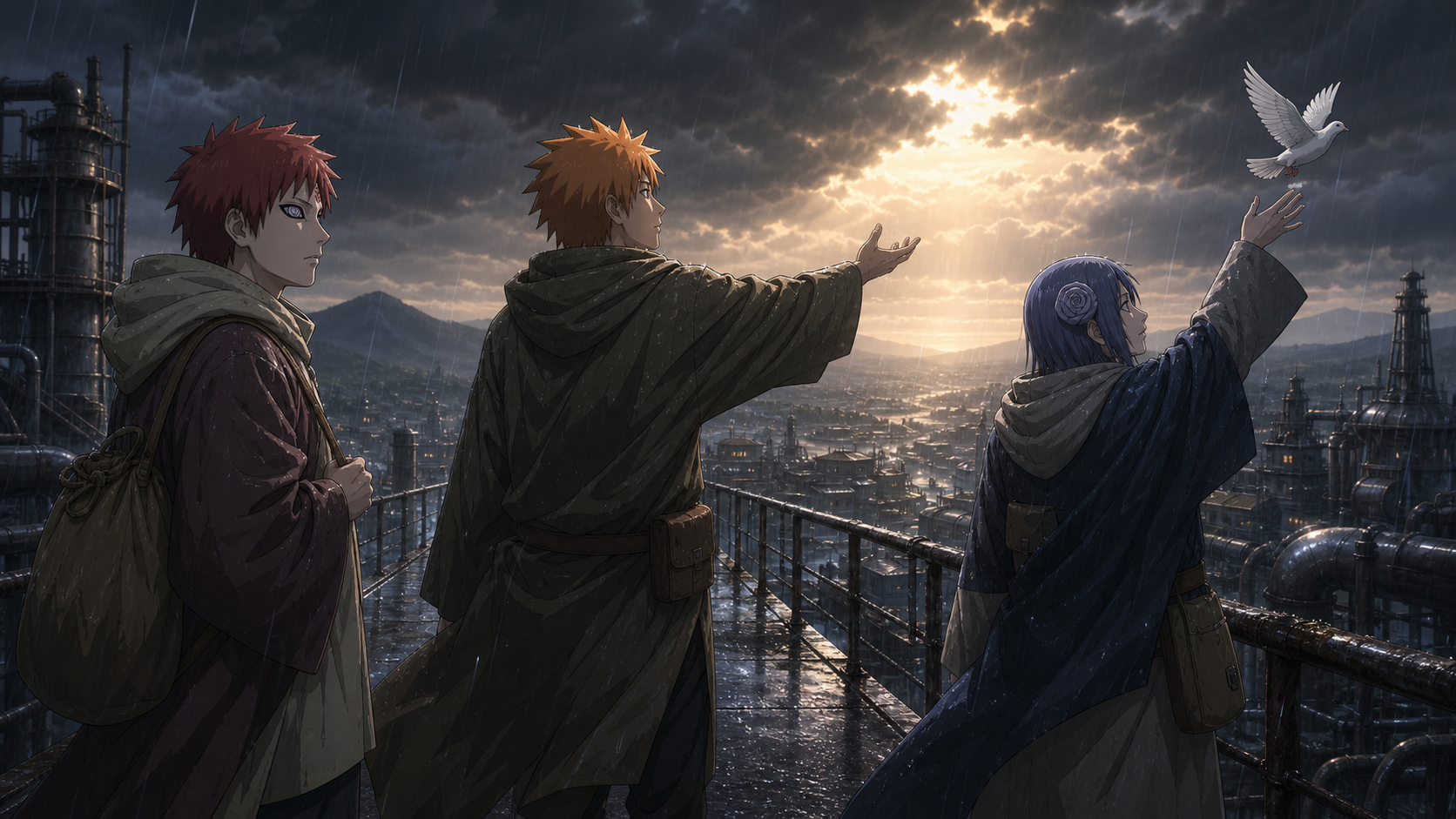
Naruto Shippuden Episode 173, "Origin of Pain," continues Nagato's testimony from the hungry children in the rain to the movement that would become the Akatsuki. Nagato, Yahiko, and Konan seek out Jiraiya, learn ninjutsu, and begin imagining a Hidden Rain that does not have to remain a battlefield for larger nations.
After Jiraiya leaves, Yahiko leads an organization committed to peace without conquest. Its support grows because people recognize the same exhaustion in one another. That growth frightens Hanzo, who joins with Danzo to destroy the group before it can challenge his authority.
Konan is taken hostage. Yahiko chooses to die rather than force Nagato to choose between them. Nagato's grief erupts through the Demonic Statue, and the boy who once wanted only to protect his friends begins building a philosophy around making the entire world understand pain.
Jiraiya gives the orphans tools and a future tense
Jiraiya does not rescue the Rain children by taking them away from their country. He stays, trains them, and gives them enough skill to decide what they want to build. That distinction respects their attachment to home.
For Nagato, training turns the Rinnegan from a frightening response to trauma into something he might use deliberately. For Yahiko, it creates the practical foundation for leadership. For Konan, it expands the quiet precision already visible in her paper work.
The three are not yet defined by the roles they will occupy later. They are students eating together, arguing, improving, and testing whether strength can protect the small home they made.
Yahiko's Akatsuki begins as a peace movement
The original Akatsuki matters because it contradicts the idea that Nagato was always moving toward Pain. Yahiko's organization seeks negotiation, independence, and an end to the way powerful nations use the Rain as disposable ground.
Its members are not chasing tailed beasts. They are gathering people who believe their country deserves a future not dictated by outsiders. The name that will later terrify the world begins as a dawn people can choose together.
That beginning makes the corruption more tragic. The violent Akatsuki does not replace a void. It inherits the symbols of a movement built against exactly that kind of domination.
Support makes the movement dangerous to power
Hanzo does not move against Yahiko because the young organization has failed. He moves because it is succeeding. People trust it. Its message travels. The possibility of peace outside Hanzo's control threatens the authority he claims to protect.
This is one of the episode's clearest political points. A leader can praise peace as long as peace preserves his position. Once ordinary people organize without him, their hope becomes an enemy.
Yahiko believes an invitation to negotiate might represent recognition. Hanzo treats negotiation as the setting for an ambush. The betrayal weaponizes the very method the Akatsuki wanted to normalize.
Danzo extends the cycle beyond the Hidden Rain
Danzo's involvement prevents the tragedy from being framed as a private Rain conflict. The Leaf has an interest in controlling which forces rise beyond its borders, and Danzo is willing to support brutality if it serves that calculation.
Naruto is listening to this history as someone who loves the Leaf. He has to hear that people acting in his village's name helped create the conditions behind Pain's attack. Loyalty cannot require him to deny that fact.
Danzo believes security comes from manipulating fear before it reaches him. The result is the very enemy he claims his methods prevent.
Konan is turned into leverage
The ambush reduces Konan from a founder and strategist to a hostage meant to control two men. Hanzo understands the trio's bond well enough to use it against them.
Konan's capture is not evidence that attachment makes the movement weak. It is evidence that the attackers cannot defeat its loyalty honestly. They manufacture an impossible choice because direct political competition would expose Hanzo's loss of legitimacy.
Her horror in the scene comes from knowing what Yahiko and Nagato will sacrifice for her. She is forced to witness love being translated into a weapon by someone who believes bonds are pressure points.
Yahiko's final choice breaks the shape of the group
Yahiko moves into Nagato's blade before Nagato can obey Hanzo's demand. The act saves Konan from an immediate execution, but it also leaves Nagato holding the physical evidence of a choice he never wanted to make.
Yahiko asks Nagato to continue the mission. That request becomes unbearable because grief changes what continuation means. Nagato preserves Yahiko's face as the central Pain body, but the body carries a philosophy Yahiko did not lead.
The friend who believed people could organize for peace becomes the image through which Nagato enforces peace by terror. Memory is preserved while meaning is reversed.
The Demonic Statue answers grief with scale
Nagato summons the Demonic Statue after Yahiko falls. The technique overwhelms the attackers, but its cost is visible in Nagato's body. Rods pierce him, chakra drains him, and the power that appears to restore control binds him to another system of pain.
This is the moment extraordinary power stops being a possibility and becomes infrastructure. Nagato can punish the people responsible, yet punishment does not return Yahiko or restore the original movement.
The statue gives his grief reach. It cannot give it direction. That direction comes from the conclusion Nagato chooses afterward.
Pain is a philosophy built around prevention through trauma
Nagato decides that people cannot understand one another until suffering forces them to. If every nation experiences catastrophic pain, the memory of that pain may create temporary peace.
The theory takes one true observation and turns it into a weapon. People do ignore distant suffering. The great nations did treat the Rain's losses as acceptable. Nagato concludes that empathy must be manufactured through terror.
That answer guarantees repetition. Each generation inherits both fear and a reason for revenge. Pain may interrupt war for a time, but it cannot create the trust Yahiko's movement was building.
Naruto is hearing what his village helped make
Naruto cannot answer Nagato by listing the Leaf's virtues. The story has connected his village to the death of Nagato's parents and to the ambush that destroyed Yahiko's organization.
This does not make every Leaf shinobi equally responsible. It makes innocence at the level of institutions impossible. A village can protect its own children while creating orphans elsewhere.
Naruto's challenge is to love home without requiring another home to absorb its costs. That is a harder form of loyalty than denial.
Jiraiya stays because survival needs more than one meal
Orochimaru sees three war orphans and offers the cold efficiency of killing them before hardship does. Jiraiya refuses. He understands that food for one night cannot prepare children for the soldiers, hunger, and instability waiting after the team leaves.
Training becomes practical care. He gives them tools to defend the home they refuse to abandon rather than deciding their future for them.
The orphans build family before they build policy
Yahiko, Konan, and Nagato share chores, meals, danger, and the awkward process of learning together. Their later political commitment grows from this household experience of mutual survival.
Peace begins as the expectation that another person will come back. The organization only makes sense because the small family worked first.
Nagato’s Rinnegan frightens him before it empowers him
Extraordinary eyes do not arrive with instructions or emotional safety. Nagato associates their awakening with bodies, missing memory, and a level of force he cannot explain. Power makes him more uncertain about himself.
Jiraiya helps separate capacity from identity. Nagato can possess frightening ability without being destined to become frightening.
Jiraiya sees the possibility of prophecy and a child
The Rinnegan evokes legends about a person who could transform the world. That symbolic weight risks turning Nagato into another vessel for adult expectation.
Jiraiya teaches him as a student who needs food, practice, and moral guidance. The ordinary relationship keeps prophecy from consuming the person too soon.
Yahiko turns shame about weakness into a public dream
He hates begging powerful outsiders to protect them and wants strength enough to decide Amegakure’s future. His pride can be reckless, but it grows from watching his country treated as disposable.
The dream is not domination. Yahiko wants Rain citizens to speak with authority about what happens on Rain ground.
Konan’s paper becomes communication and defense
The flowers she made from scraps develop into precise ninjutsu. Beauty and utility do not replace each other. Konan carries both into the movement she helps found.
Her skill reflects the trio’s original politics: transform what war discarded into something capable of connecting and protecting people.
Jiraiya leaves because the students can stand
Departure is an act of faith and another source of vulnerability. The orphans have learned to fight, cooperate, and imagine a future. They still live inside a country targeted by forces much larger than their group.
A teacher can prepare students and remain unable to guarantee what the political world will do to them afterward.
The original Akatsuki grows through credibility
People join because Yahiko’s group names the exhaustion ordinary Rain citizens share. They seek negotiation and independence rather than replacing one ruler’s violence with another.
The organization becomes dangerous to Hanzo when hope stops being private. Collective belief can challenge authority more effectively than an isolated attack.
Hanzo fears peace he cannot own
He presents himself as the protector of Amegakure while treating any independent movement as a threat to his position. Yahiko’s success exposes the gap between national leadership and personal control.
Hanzo offers negotiation only when he has arranged force around the meeting. Peace becomes bait for preserving power.
Danzo exports Konoha’s shadow politics
His participation destroys any comfortable claim that the Rain tragedy belongs only to Rain leaders. Danzo sees a rising organization outside the Leaf and chooses manipulation before its potential can complicate his plans.
The security method creates the enemy it claims to prevent. Konoha will later suffer from consequences one of its officials helped manufacture.
The alliance between Hanzo and Danzo is built from mutual fear
Neither man trusts grassroots legitimacy. Hanzo fears losing control at home. Danzo fears an unpredictable force near the Leaf. Together, they label suppression protection.
Their cooperation shows how powerful institutions can coordinate easily when ordinary people begin building power outside approved channels.
Konan’s kidnapping attacks the movement through relationship
Hanzo cannot defeat Akatsuki’s ideas through honest negotiation, so he turns a founder into leverage. The hostage arrangement weaponizes the bond that made the organization possible.
Connection is not the weakness. The moral failure belongs to people who see love and immediately calculate how to exploit it.
Yahiko refuses to make Nagato the executioner
Hanzo orders Nagato to kill Yahiko if he wants Konan to live. Yahiko moves onto the blade himself, taking the choice before Nagato can obey or refuse.
The act saves Konan in the immediate second and leaves Nagato holding a guilt no decision of his own created.
Yahiko’s request becomes vulnerable to grief
He asks Nagato to continue their mission. The words do not specify terror, corpses, or forcing nations into peace through catastrophic pain. Nagato will interpret continuation through the trauma of this moment.
A dying person’s hope becomes dangerous when the survivor treats one broken interpretation as sacred instruction.
The Deva Path preserves Yahiko’s face and reverses his politics
Nagato places Yahiko’s body at the center of the Six Paths. The friend remains visible while the movement he led is transformed into coercion.
This is grief refusing burial and refusing correction. Memory survives as an image emptied of the consent the living Yahiko could have offered.
The Demonic Statue makes retaliation feel like regained control
Nagato summons overwhelming force after Yahiko dies. Attackers fall, and the impossible hostage scene no longer dictates his movement. The power feels like agency returning.
Its rods pierce his body and establish another captivity. Revenge removes enemies while binding Nagato more tightly to the machinery of pain.
Obito finds a movement after betrayal weakened its meaning
The masked man did not invent the orphans’ suffering or Hanzo’s cruelty. He understands how to approach devastation and redirect what remains. The original Akatsuki’s network, name, and grief become materials for another plan.
Manipulation succeeds because real injustice has already done the breaking.
RaeRae's reaction
The original Akatsuki is what hurt me most. These were not people who began by believing terror was noble. They built a movement because negotiations between powerful leaders had never protected ordinary Rain citizens.
Hanzo's betrayal is cruel because he uses the language of peace to punish them for making peace credible. Danzo's presence makes it worse. The Leaf did not merely fail to help. One of its officials actively strengthened the trap.
Yahiko's death is the point where every bond in the trio is preserved in a distorted form. Konan stays beside Nagato. Nagato carries Yahiko's body. The name Akatsuki survives. Everything remains, except the future those things were meant to serve.
Naruto is right not to forgive quickly. He is also right to keep listening. Nagato's story does not excuse the crater outside. It explains why answering that crater with another killing would fit perfectly inside the lesson Nagato learned from Hanzo: trust is a trap, bonds are leverage, and peace belongs to whoever can make the other side suffer first.
Explanation does not turn Pain into fate
Every step in Nagato’s history makes his conclusion understandable. None proves terror was the only possible answer. Yahiko, Konan, Chibi, Jiraiya, and the original movement all represent moments when connection produced something else.
Nagato chooses which evidence becomes the foundation of Pain.
RaeRae’s final word on Origin of Pain
The original Akatsuki makes me angry because it worked. People believed in a movement that treated Rain lives as politically important, and Hanzo destroyed it because peace outside his control threatened him.
Danzo belongs in the indictment. The Leaf cannot call Pain an incomprehensible foreign evil while ignoring the official who helped place Konan on that platform and Yahiko against Nagato’s blade.
Yahiko’s body becoming the Deva Path is one of the cruelest forms of remembrance in the series. Nagato preserves the face and violates the meaning. Love without the surviving person’s ability to question it becomes a monument grief can use for anything.
Naruto needs to hear all of this. He also needs to refuse Nagato’s claim that the road was inevitable. Pain has an origin, not an excuse, and understanding the difference is where accountability can finally begin.
The tragedy is political before it becomes mythic
It would be easy to blame everything on legendary eyes, a demonic statue, or a masked mastermind operating beyond ordinary accountability. The episode keeps returning to recognizable decisions. A ruler fears losing influence. An intelligence official treats an independent movement as a security problem. Negotiation is offered dishonestly. A woman is kidnapped because men know her friends will risk themselves to save her.
Those choices matter because they prevent Pain from becoming a supernatural accident. Institutions manufacture the conditions, then Nagato gives those conditions an ideology and extraordinary reach. The Rinnegan magnifies the result. It does not invent the betrayal.
Yahiko’s organization threatened Hanzo through legitimacy rather than conquest. People trusted Akatsuki because its founders shared their losses and asked Rain citizens to imagine political life beyond permanent proxy war. That is why Hanzo could not simply outperform them. He had to make trust itself look fatal.
The ambush teaches Nagato the lesson Hanzo wants everyone to learn: negotiation exposes you, love can be leveraged, and organized hope gets people killed. Nagato later universalizes that lesson instead of recognizing it as the survival logic of a threatened ruler. Pain becomes Hanzo’s worldview with larger weapons, even while claiming to avenge what Hanzo destroyed.
Konan lives inside that contradiction. She preserves the original paper, name, friendship, and loyalty, but her continued support also helps Nagato turn Yahiko into an instrument. Her love is not fake. Love can be sincere and still protect choices the beloved should be challenged to stop.
Naruto is hearing a warning about inherited missions. Jiraiya gave both students hope without a completed method. Yahiko asked Nagato to continue. Minato trusted Naruto to change the future. None of those requests authorizes the survivor to freeze one interpretation and call it the dead person’s will.
Honoring somebody requires allowing their values to question what grief wants to do in their name. The living Yahiko built consent, negotiation, and collective power. The Deva Path imposes outcomes through a corpse that cannot object. That difference is the whole tragedy.
Nagato’s history deserves compassion because every wound is real. His victims deserve accountability because his response was chosen. Naruto’s task is not selecting one truth. It is refusing the system that always protects one community’s grief by making another community pay for it.
The name Akatsuki means dawn, and that origin should haunt every use of it. Yahiko imagined light reaching a country kept beneath storms. Nagato kept the name after deciding darkness could teach the world to fear sunrise. Naruto cannot restore the first movement by defeating one body or forgiving one survivor. He can remember that Akatsuki once proved another politics was possible. That memory challenges Pain more deeply than revenge because it shows Nagato’s own life contains evidence against his certainty. The path to terror was built through choices, and a path built through choices can be refused by the next person asked to carry it.
RaeRae’s call
Akatsuki began as Yahiko’s credible peace movement. Hanzo and Danzo broke it through hostage violence, and Nagato preserved his friend’s face while reversing everything that face once asked the world to become.